World Heritage Identification Number: 495
World Heritage since: 1988
Category: Cultural Heritage
WHE Type: Historic Cities & Urban Areas
Transboundary Heritage: No
Endangered Heritage: No
Country: 🇫🇷 France
Continent: Europe
UNESCO World Region: Europe and North America
Map
Strasbourg, Grande-Île, and Neustadt: A Unique Urban Landscape in Eastern France
Strasbourg, Grande-Île, and Neustadt form a unique urban landscape in eastern France, with the historic center of Grande-Île inscribed on the UNESCO World Heritage List in 1988. The Neustadt district, developed during the German administration (1871–1918), was added to the inscription in 2017.
Situated in the historical region of Alsace, Strasbourg serves as the prefecture of the Grand Est region and the official seat of the European Parliament. The city’s architectural and cultural heritage, shaped by its complex history, makes it a remarkable example of European integration, where French and German influences coexist.
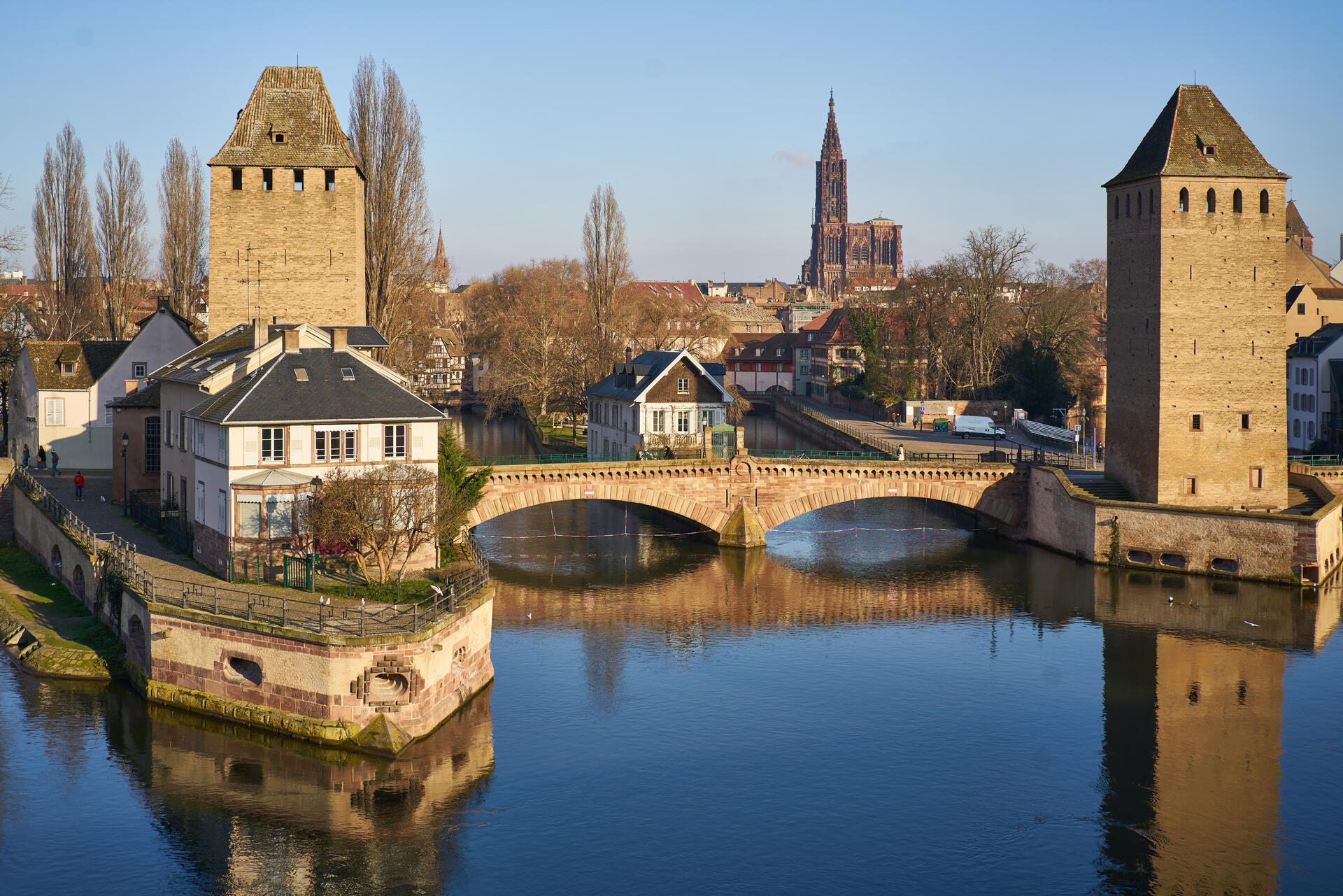
The initial property encompasses the Grande-Île, the historic center of Strasbourg, which is structured around the cathedral. The Grande-Île exhibits a rich architectural heritage, featuring a blend of Romanesque, Gothic, Renaissance, and Baroque styles. The most prominent structure within this area is the Strasbourg Cathedral, a masterpiece of German Gothic or Alsatian Gothic architecture, boasting the sixth-tallest spire in the world. The cathedral's construction began in 1015 and took over four centuries to complete, showcasing the evolution of architectural styles throughout the Middle Ages.
The Grande-Île is characterized by narrow, winding streets, half-timbered houses, and various religious buildings, such as the Church of Saint Thomas and the Church of Our Lady. These structures contribute to the picturesque charm of the historic center, which has been preserved through careful restoration efforts.
In contrast, the Neustadt, or New Town, was developed during the German administration (1871-1918) and extends the urban fabric of Strasbourg. The Neustadt draws inspiration from the Haussmannian model, a style of urban planning that aimed to improve living conditions in cities by widening streets, creating public spaces, and demolishing old buildings. However, the Neustadt also incorporates an architectural idiom of Germanic inspiration, resulting in a distinct urban space that combines French and German influences.
The Neustadt features wide avenues, grand public squares, and imposing administrative buildings, such as the Palais du Rhin and the Post Office. The urban design of the Neustadt emphasizes symmetry, order, and functionality, reflecting the principles of modern urban planning at the time. Despite these differences, the perspectives created around the cathedral in the Grande-Île open up to a harmonious landscape around the rivers and canals in the Neustadt.
Together, the Grande-Île and Neustadt create a unique urban landscape in Strasbourg, where the rich history and architectural heritage of the medieval center seamlessly blend with the modernity and efficiency of the new town. This dual influence has resulted in a city that offers visitors a fascinating journey through time, showcasing the best of French and German cultures.
UNESCO Description of the World Heritage Site
The initial property, inscribed in 1988 on the World Heritage List, was formed by the Grande-Île, the historic centre of Strasbourg, structured around the cathedral. The extension concerns the Neustadt, new town, designed and built under the German administration (1871-1918). The Neustadt draws the inspiration for its urban layout partially from the Haussmannian model, while adopting an architectural idiom of Germanic inspiration. This dual influence has enabled the creation of an urban space that is specific to Strasbourg, where the perspectives created around the cathedral open to a unified landscape around the rivers and canals.
UNESCO Justification of the World Heritage Site
Criterion (ii): French and Germanic influences have shaped the Grande-Île and Neustadt. They have enabled the emergence of a unique expression coming from the two cultures, which is especially conveyed in the fields of architecture and urbanism. The cathedral, influenced by the Romanesque art of the East and the Gothic art of the kingdom of France, is also inspired by Prague, particularly for the construction of the spire. It is a model that acted as a vector of Gothic art to the east. The Neustadt, a modern city forged by Haussmannian influences, and a model of urbanism, also embodies the theories of Camillo Sitte.
Criterion (iv): The Grande-Île and the Neustadt in Strasbourg constitute a characteristic example of a European Rhineland city. Integrated into a Medieval urban fabric in a way which respects the ancient original fabric, the Renaissance-style private residences built between the 15th century and the late 17th century form a unique ensemble of domestic Rhineland architecture, which is indissociable from the outstanding Gothic cathedral. In the 18th century, French classical architecture became dominant, as exemplified by the Palais Rohan, built by the king’s architect, Robert de Cotte. From 1871 onwards, the face of the town was profoundly modified by the construction of an ambitious urbanistic project, leading to the emergence of a modern, functional city, emblematic of the technical advances and hygienistic policies that were emerging at the turn of the 19th and 20th centuries. The private and public buildings of the urban ensemble bear witness to political, social and cultural change, with the town’s status changing from a free city of the Holy Roman Empire to a free city of the Kingdom of France, before it became a regional capital.
Encyclopedia Record: Strasbourg
Strasbourg is a prefecture and commune, and the largest city of the Grand Est region of northeastern France, in the historic region of Alsace. It is the prefecture of the Bas-Rhin department and the official seat of the European Parliament.Additional Site Details
Area: 183 hectares
Number of Components: 1
(iv) — Outstanding example of a type of building or landscape
Coordinates: 48.5844444444 , 7.7488888889