World Heritage Identification Number: 373
World Heritage since: 1986
Category: Cultural Heritage
WHE Type: Archaeological Sites
Transboundary Heritage: No
Endangered Heritage: No
Country: 🇬🇧 United Kingdom of Great Britain and Northern Ireland
Continent: Europe
UNESCO World Region: Europe and North America
Map
Exploring the Prehistoric Legacy: Stonehenge, Avebury, and Associated Sites
The enigmatic stone structures that dot the rolling landscapes of Wiltshire, England, have long captivated scholars, archaeologists, and visitors alike. Known collectively as Stonehenge, Avebury, and Associated Sites, this UNESCO World Heritage Site offers a fascinating glimpse into the lives and beliefs of our prehistoric ancestors.
Stonehenge, perhaps the most iconic of these ancient monuments, stands proudly on Salisbury Plain. This prehistoric megalithic structure, built in several phases beginning around 3000 BCE for the earthwork enclosure and with the iconic stone settings erected around 2500 BCE, consists of an outer ring of massive sarsen stones, each weighing around 25 tons. These colossal stones, some reaching heights of over 13 feet, are topped by connecting horizontal lintels, held in place through intricate mortise and tenon joints. Within this outer ring lies another circle of smaller bluestones, and at its heart, free-standing trilithons — two bulkier vertical sarsens joined by one lintel.
The alignment of Stonehenge is striking: it faces directly towards the sunrise on the summer solstice and sunset on the winter solstice, suggesting that our ancestors may have used this monument for astronomical purposes, although its exact purpose remains debated. The stones are set within earthworks, nestled amidst the densest complex of Neolithic and Bronze Age monuments in England, including several hundred tumuli.
Avebury, located about 25 kilometers (16 miles) north of Stonehenge, boasts the largest stone circle in the world. Dating back to around 2850 BCE and built and altered over many centuries, this circular arrangement of the original 98 standing stones, some weighing up to 40 tons, spans nearly 30 acres. Like Stonehenge, Avebury's stones were also erected during the Neolithic period, and their purpose remains a subject of debate among researchers.
Archaeologists widely believe they served as significant ritual, religious or ceremonial sites, part of a vast sacred landscape that likely gave physical expression to the community's beliefs about the natural world and their place within it. While some early researchers proposed they were strictly astronomical observatories, it is now thought that the stones likely had multiple functions over the centuries
The associated sites surrounding Stonehenge and Avebury further enhance our understanding of prehistoric life in the region. These include the Cursus Monument, a long, straight, ditch-and-bank enclosure, and West Kennet Long Barrow, a large Neolithic chambered tomb containing the remains of up to 50 individuals. These sites offer valuable insights into the burial practices, social organization, and technological capabilities of our ancestors. The World Heritage Site includes other significant associated sites including Durrington Walls, Woodhenge, Silbury Hill, and Windmill Hill.
To sum it up, Stonehenge, Avebury, and Associated Sites provide an unparalleled window into the lives of our prehistoric forebears. These enigmatic stone structures, aligned with celestial bodies and set within complexes of Neolithic and Bronze Age monuments, continue to fascinate and inspire us today. As we strive to unlock their secrets, we gain not only a deeper appreciation for our shared human history but also a renewed sense of wonder at the ingenuity and spirituality of our distant ancestors.
UNESCO Description of the World Heritage Site
Stonehenge and Avebury, in Wiltshire, are among the most famous groups of megaliths in the world. The two sanctuaries consist of circles of menhirs arranged in a pattern whose astronomical significance is still being explored. These holy places and the nearby Neolithic sites are an incomparable testimony to prehistoric times.
UNESCO Justification of the World Heritage Site
Criterion (i): The monuments of the Stonehenge, Avebury and Associated Sites demonstrate outstanding creative and technological achievements in prehistoric times. Stonehenge is the most architecturally sophisticated prehistoric stone circle in the world. It is unrivalled in its design and unique engineering, featuring huge horizontal stone lintels capping the outer circle and the trilithons, locked together by carefully shaped joints. It is distinguished by the unique use of two different kinds of stones (Bluestones and Sarsens), their size (the largest weighing over 40 t) and the distance they were transported (up to 240 km). The sheer scale of some of the surrounding monuments is also remarkable: the Stonehenge Cursus and the Avenue are both about 3 km long, while Durrington Walls is the largest known henge in Britain, around 500 m in diameter, demonstrating the ability of prehistoric peoples to conceive, design and construct features of great size and complexity. Avebury prehistoric stone circle is the largest in the world. The encircling henge consists of a huge bank and ditch 1.3 km in circumference, within which 180 local, unshaped standing stones formed the large outer and two smaller inner circles. Leading from two of its four entrances, the West Kennet and Beckhampton Avenues of parallel standing stones still connect it with other monuments in the landscape. Another outstanding monument, Silbury Hill, is the largest prehistoric mound in Europe. Built around 2400 BC, it stands 39.5 m high and comprises half a million tonnes of chalk. The purpose of this imposing, skilfully engineered monument remains obscure.
Criterion (ii): The World Heritage property provides an outstanding illustration of the evolution of monument construction and of the continual use and shaping of the landscape over more than 2000 years, from the early Neolithic to the Bronze Age. The monuments and landscape have had an unwavering influence on architects, artists, historians and archaeologists, and still retain a huge potential for future research. The megalithic and earthen monuments of the World Heritage property demonstrate the shaping of the landscape through monument building for around 2000 years from circa 3700 BC, reflecting the importance and wide influence of both areas. Since the 12th century when Stonehenge was considered one of the wonders of the world by the chroniclers Henry de Huntington and Geoffrey de Monmouth, the Stonehenge and Avebury Sites have excited curiosity and been the subject of study and speculation. Since early investigations by John Aubrey (1626-1697), Inigo Jones (1573-1652), and William Stukeley (1687-1765), they have had an unwavering influence on architects, archaeologists, artists and historians. The two parts of the World Heritage property provide an excellent opportunity for further research. Today, the property has spiritual associations for some.
Criterion (iii): The complexes of monuments at Stonehenge and Avebury provide an exceptional insight into the funerary and ceremonial practices in Britain in the Neolithic and Bronze Age. Together with their settings and associated sites, they form landscapes without parallel. The design, position and interrelationship of the monuments and sites are evidence of a wealthy and highly organised prehistoric society able to impose its concepts on the environment. An outstanding example is the alignment of the Stonehenge Avenue (probably a processional route) and Stonehenge stone circle on the axis of the midsummer sunrise and midwinter sunset, indicating their ceremonial and astronomical character. At Avebury the length and size of some of the features such as the West Kennet Avenue, which connects the Henge to the Sanctuary over 2 km away, are further evidence of this. A profound insight into the changing mortuary culture of the periods is provided by the use of Stonehenge as a cremation cemetery, by the West Kennet Long Barrow, the largest known Neolithic stone-chambered collective tomb in southern England, and by the hundreds of other burial sites illustrating evolving funerary rites.
Encyclopedia Record: Stonehenge
Stonehenge is a prehistoric megalithic structure on Salisbury Plain in Wiltshire, England, two miles (3 km) west of Amesbury. It consists of an outer ring of vertical sarsen standing stones, each around 13 feet (4.0 m) high, seven feet (2.1 m) wide, and weighing around 25 tons, topped by connecting horizontal lintel stones, held in place with mortise and tenon joints, a feature unique among contemporary monuments. Inside is a ring of smaller bluestones. Inside these are free-standing trilithons, two bulkier vertical sarsens joined by one lintel. The whole monument, now in ruins, is aligned towards the sunrise on the summer solstice and sunset on the winter solstice. The stones are set within earthworks in the middle of the densest complex of Neolithic and Bronze Age monuments in England, including several hundred tumuli.Additional Site Details
Area: 4,985.4 hectares
Number of Components: 2
(ii) — Significant interchange of human values
(iii) — Unique or exceptional testimony to a cultural tradition
Coordinates: 51.17888889 , -1.825277778
Image
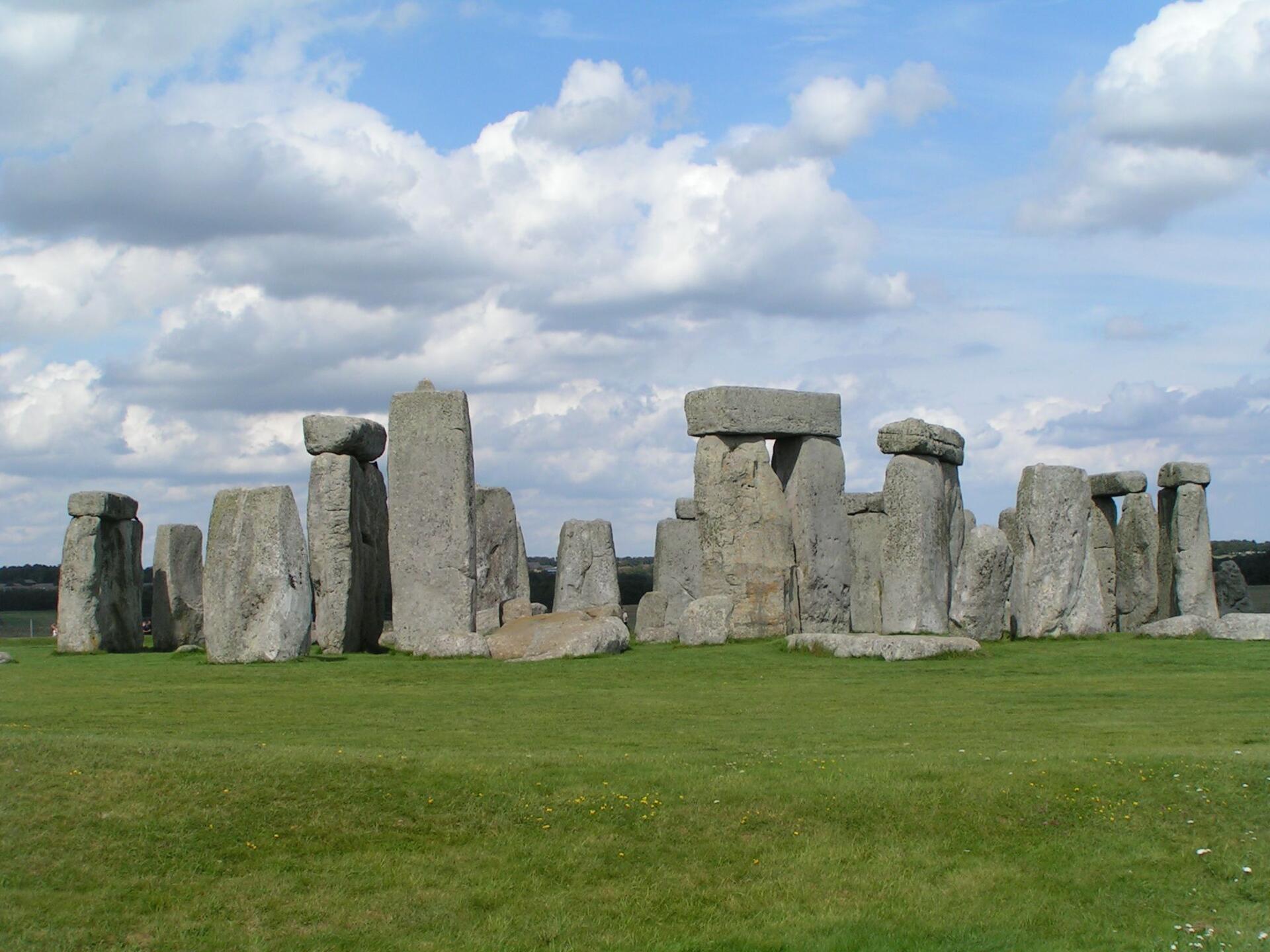
Wallboat, Public domain
World Heritage Research
Discover scientific research and academic studies that deepen our understanding of Stonehenge, Avebury and Associated Sites from its history and significance to its conservation, management, and contemporary challenges.
-
Origins of the sarsen megaliths at Stonehenge
New geochemical evidence reveals that the massive sarsen megaliths at Stonehenge likely originated from West Woods, Wiltshire. This discovery challenges previous assumptions about their source and sheds light on Neolithic transportation practices. Researchers analyzed trace elements in stone samples using advanced techniques, including laser ablation inductively coupled plasma mass spectrometry (LA-ICP-MS). The findings suggest that the stones were quarried locally, transported over significant distances, and shaped with remarkable precision—implying sophisticated engineering capabilities during the late Neolithic period.
Nash, D. J., Ciborowski, T. J. R., Ullyott, J. S., Pearson, M. P., Darvill, T., Greaney, S., Maniatis, G., & Whitaker, K. A. (2020). Origins of the sarsen megaliths at Stonehenge. Science Advances, 6(31). https://doi.org/10.1126/sciadv.abc0133
View Publication Record | Read Publication -
Stonehenge remodelled
A new chronology for Stonehenge's construction and burial sequence, anchored by Bayesian radiocarbon dating, reveals five distinct prehistoric stages. This study integrates excavation data with advanced modeling to propose a more precise timeline, linking the monument's evolution to neighboring sites in its vicinity. While absolute certainty remains elusive due to the site's complexity, this comprehensive approach significantly advances our understanding of Stonehenge's development, providing a robust foundation for future public engagement and research.
Darvill, T., Marshall, P., Pearson, M. P., & Wainwright, G. (2012). Stonehenge remodelled. Antiquity, 86(334), 1021–1040. https://doi.org/10.1017/s0003598x00048225
View Publication Record | Read Publication -
The Stonehenge Hidden Landscapes Project
The Stonehenge Hidden Landscapes Project has revealed significant previously unknown features surrounding the iconic Stonehenge monument, challenging the notion of its 'blank' landscape. Using advanced ground-based geophysical techniques, researchers mapped and visualized landscape-scale data within a three-dimensional data cube, uncovering ritual elements and symbolic structures that provide new insights into the site's development over time. This approach shifts focus from studying Stonehenge itself to examining its broader environmental context, offering a more comprehensive understanding of its cultural significance.
Gaffney, C., Gaffney, V., Neubauer, W., Baldwin, E., Chapman, H., Garwood, P., Moulden, H., Sparrow, T., Bates, R., Löcker, K., Hinterleitner, A., Trinks, I., Nau, E., Zitz, T., Floery, S., Verhoeven, G., & Doneus, M. (2012). The Stonehenge Hidden Landscapes Project. Archaeological Prospection, 19(2), 147–155. Portico. https://doi.org/10.1002/arp.1422
View Publication Record | Read Publication