World Heritage Identification Number: 583
World Heritage since: 1991
Category: Cultural Heritage
WHE Type: Buildings & Architectural Ensembles
Transboundary Heritage: No
Endangered Heritage: No
Country: 🇫🇮 Finland
Continent: Europe
UNESCO World Region: Europe and North America
Map
The Fortress of Suomenlinna: A Unique Blend of History and Scenic Beauty
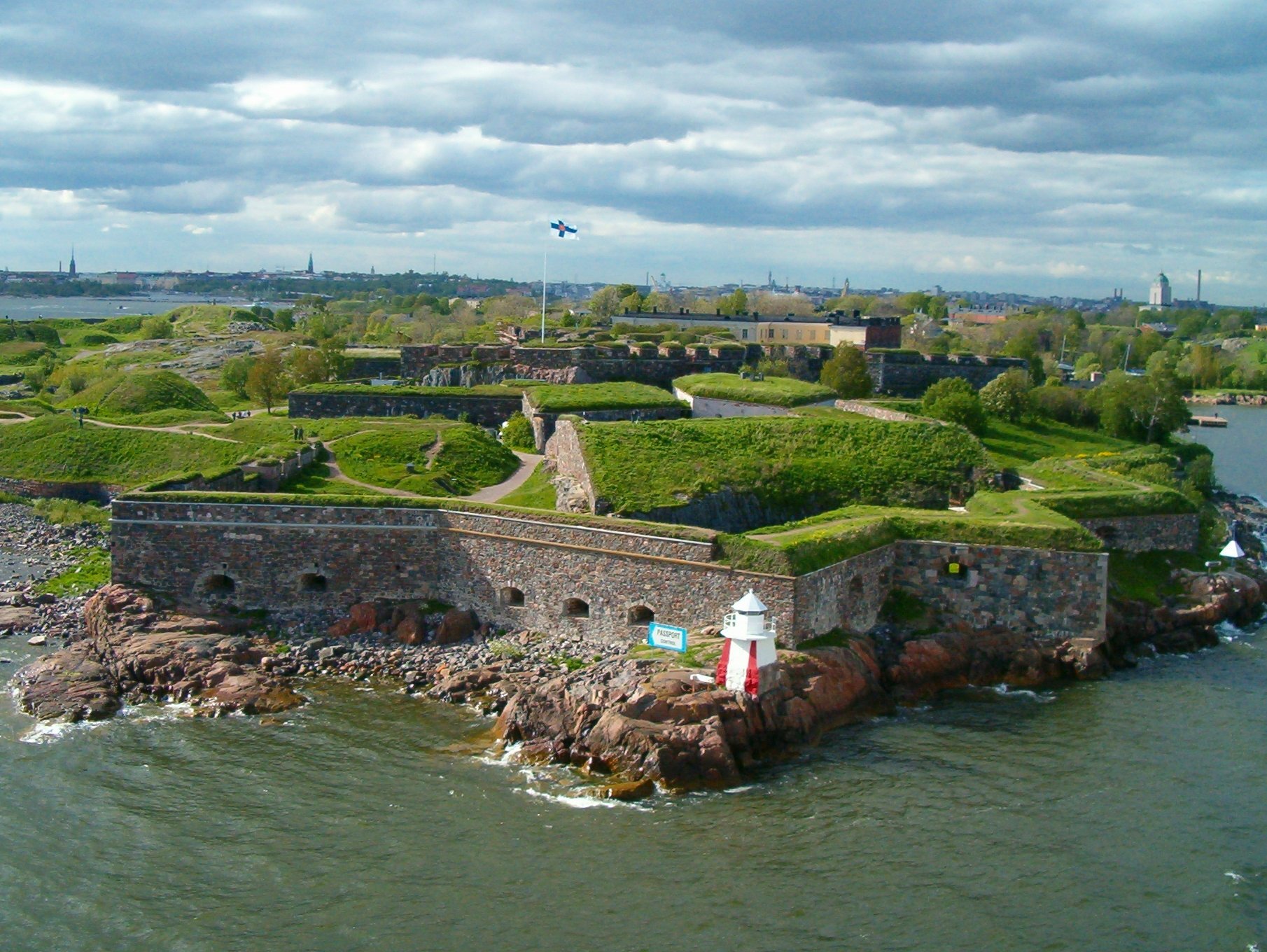
The Fortress of Suomenlinna, also known as Sveaborg, stands as a testament to the rich history and architectural prowess of the 18th century. Inscribed as a UNESCO World Heritage Site in 1991, this remarkable sea fortress is nestled within a cluster of eight islands situated approximately four kilometers southeast of Helsinki, Finland's bustling city center.
More to come…UNESCO Description of the World Heritage Site
Built in the second half of the 18th century by Sweden on a group of islands located at the entrance of Helsinki's harbour, this fortress is an especially interesting example of European military architecture of the time.
UNESCO Justification of the World Heritage Site
Criterion (iv): In the history of military architecture, the Fortress of Suomenlinna is an outstanding example of general fortification principles of the 17th and 18th centuries, notably the bastion system, and also showcases individual characteristics.
Encyclopedia Record: Suomenlinna
Suomenlinna, or Sveaborg, is a sea fortress composed of eight islands, of which six have been fortified. Located about four kilometres (2.5 mi) southeast of the city center of Helsinki, Finland, Suomenlinna is a popular destination for both tourists and locals, who enjoy it as a picturesque picnic site.Additional Site Details
Area: 210 hectares
Number of Components: 1
Coordinates: 60.14722 , 24.98722
World Heritage Research
Discover scientific research and academic studies that deepen our understanding of Fortress of Suomenlinna from its history and significance to its conservation, management, and contemporary challenges.
-
An Archaeological Study of an Underwater Cannon Site in the Sea Fortress Suomenlinna, the Baltic Sea
An archaeological analysis of an underwater cannon site at the sea fortress Suomenlinna reveals that the studied cannon likely originated from a coastal defense system, rather than a Swedish warship located nearby. The research focused on one barrel and carriage, employing material culture studies to determine its original context. By examining the cannon's characteristics and comparing them with known ship-based artifacts, the study sheds light on the reuse of cannons in Suomenlinna's history, particularly around its church. This finding contributes to understanding the fortress's strategic significance during the Swedish era (c. 1450–1850) and the broader material culture of naval defense in the Baltic Sea.
Koivikko, M., Aakala, T., Brchisky, S., Cleasby, D., Hyttinen, K., Jokinen, J. J., Le Rudulier, X., & Näsänen, L. (2026). An Archaeological Study of an Underwater Cannon Site in the Sea Fortress Suomenlinna, the Baltic Sea. Material Culture in the Swedish Navy, c. 1450-1850, 139–165. https://doi.org/10.4324/9781003699408-7
View Publication Record | Read Publication -
In the Glow of Suomenlinna
The construction of Suomenlinna (formerly Sveaborg) marked a pivotal moment in Helsinki's development, transforming it from a modest settlement into one of the Swedish Kingdom's most dynamic harbor towns. This transformation was driven by the strategic expansion of the Russian Empire and French subsidies, which funded the fortress's development between 1748 and 1809. The fortress, designed with Enlightenment-influenced military architecture, attracted officers with Continental war experience, fostering cultural and economic growth in Helsinki. However, its fate shifted dramatically during the Napoleonic Wars, culminating in its capitulation to Russian forces in 1808 and Sweden's subsequent loss of Finland under the Peace Treaty of 1809. This historical analysis highlights Suomenlinna's role as a catalyst for urban development and cultural exchange, while also underscoring its geopolitical significance during a turbulent period.
Meinander, H. (2026). In the Glow of Suomenlinna. Helsinki, 41–76. https://doi.org/10.1093/oso/9780197848357.003.0002
View Publication Record | Read Publication -
The Capital City
The strategic shift of Finland's administrative capital from Turku to Helsinki in 1812, following the Russo-Swedish War, was pivotal in shaping Helsinki's development and its role in Finnish national identity formation. This transition, driven by Russian Tsar Alexander I, leveraged Helsinki's proximity to St. Petersburg and the defensive strength of the Fortress of Suomenlinna (formerly Sveaborg), which served as a naval base protecting Russia from Western threats. The subsequent neoclassical urban renewal attracted Russian-speaking merchants and, with the relocation of the university in 1828, positioned Helsinki as a cultural and intellectual hub. This study highlights how geopolitical decisions and architectural transformations coalesced to define Helsinki's identity and its enduring significance as a center of Finnish national consciousness.
Meinander, H. (2026). The Capital City. Helsinki, 77–120. https://doi.org/10.1093/oso/9780197848357.003.0003
View Publication Record | Read Publication -
Introduction to Maritime Archaeology in the Post-Medieval Nordic Context
Post-medieval Nordic maritime archaeology reveals intensified sea-human interactions due to technological advancements, globalization, trade, and warfare, with shipwrecks like the Vasa providing unprecedented insights into historical contexts. This study examines submerged heritage, including scuttled ships from the UNESCO World Heritage Site Suomenlinna, Finland, and merchant vessel wrecks that trace early modern trade networks. Multidisciplinary approaches, such as analyzing material culture and maritime graffiti, offer nuanced perspectives on human lives and historical narratives.
Koivikko, M. (2026). Introduction to Maritime Archaeology in the Post-Medieval Nordic Context. The Oxford Handbook of Post-Medieval Archaeology in the Nordic Countries, 703–714. https://doi.org/10.1093/9780197756690.003.0043
View Publication Record | Read Publication -
Exploring the Submerged Heritage
Modern technologies, including multi-beam echosounders and photogrammetry, have revealed the submerged scars of past wars within the underwater landscape of Suomenlinna sea fortress. These remnants, such as deliberately placed ship hulls used as defensive obstacles during the Crimean War (1853–1856), offer a tangible connection to historical conflicts preserved in the Baltic Sea. The study highlights how these archaeological remains, despite their complex formation processes and location in active water areas, serve as enduring places of memory for past events. By integrating underwater investigation with archival records and historical narratives, researchers can reconstruct missing links that deepen our understanding of the fortress's strategic use during wartime.
Koivikko, M. (2026). Exploring the Submerged Heritage. The Oxford Handbook of Post-Medieval Archaeology in the Nordic Countries, 753–768. https://doi.org/10.1093/9780197756690.003.0046
View Publication Record | Read Publication -
Burning The Bull
The Viaporin Kekri ceremony, an ancient harvest ritual revived on the UNESCO World Heritage Site of Suomenlinna, offers new ecological and cultural significance in an era of industrialization and climate change. Through a 2018 residency at the Helsinki International Artist Programme (HIAP), Tamara Searle observed how this ritual performance, rooted in nature, adapts to contemporary global challenges. The study highlights the ceremony's evolving role as both a preservation of tradition and a means for modern audiences to reconnect with environmental narratives. Searle's interdisciplinary approach—combining performance practice, anthropology, and ecology—reveals the ritual's potential to foster resilience and awareness in a changing world.
Searle, T. (2025). Burning The Bull. The Performance Studies Reader, 156–164. https://doi.org/10.4324/9781003282969-24
View Publication Record | Read Publication -
Sivoneniella epilithica gen. et sp. nov., (Leptolyngbyaceae, Cyanobacteria), from Suomenlinna Fortress (UNESCO World Heritage Site), Finland
Researchers have identified and described a new genus of cyanobacteria, Sivoneniella epilithica, from the epilithic habitats of Suomenlinna Fortress, a UNESCO World Heritage Site in Finland. This discovery highlights the unexplored taxonomic diversity of terrestrial cyanobacteria inhabiting rock surfaces, which play a crucial role in ecological succession. Using a comprehensive polyphasic approach—including phylogenetic, genomic, and chemical analyses—the study established Sivoneniella as a distinct genus within the family Leptolyngbyaceae. The findings also revealed that these strains lack known cyanotoxins and exhibit no inhibitory effects on pathogenic bacteria or fungi, suggesting potential biotechnological applications. This work advances our understanding of cyanobacterial diversity in terrestrial ecosystems and underscores the significance of preserving such unique habitats.
Christodoulou, M., B. Dextro, R., Wahlsten, M., Oivanen, P., Fewer, D. P., & Fiore, M. F. (2025). Sivoneniella epilithica gen. et sp. nov., (Leptolyngbyaceae, Cyanobacteria), from Suomenlinna Fortress (UNESCO World Heritage Site), Finland. European Journal of Phycology, 61(1), 79–98. https://doi.org/10.1080/09670262.2025.2592827
View Publication Record | Read Publication