World Heritage Identification Number: 135
World Heritage since: 1980
Category: Cultural Heritage
WHE Type: Buildings & Architectural Ensembles
Transboundary Heritage: No
Endangered Heritage: Yes
Country: 🇵🇦 Panama
Continent: Americas
UNESCO World Region: Latin America and the Caribbean
Map
Fortifications on the Caribbean Side of Panama: Portobelo-San Lorenzo - A Testimony to Spanish Military Architecture
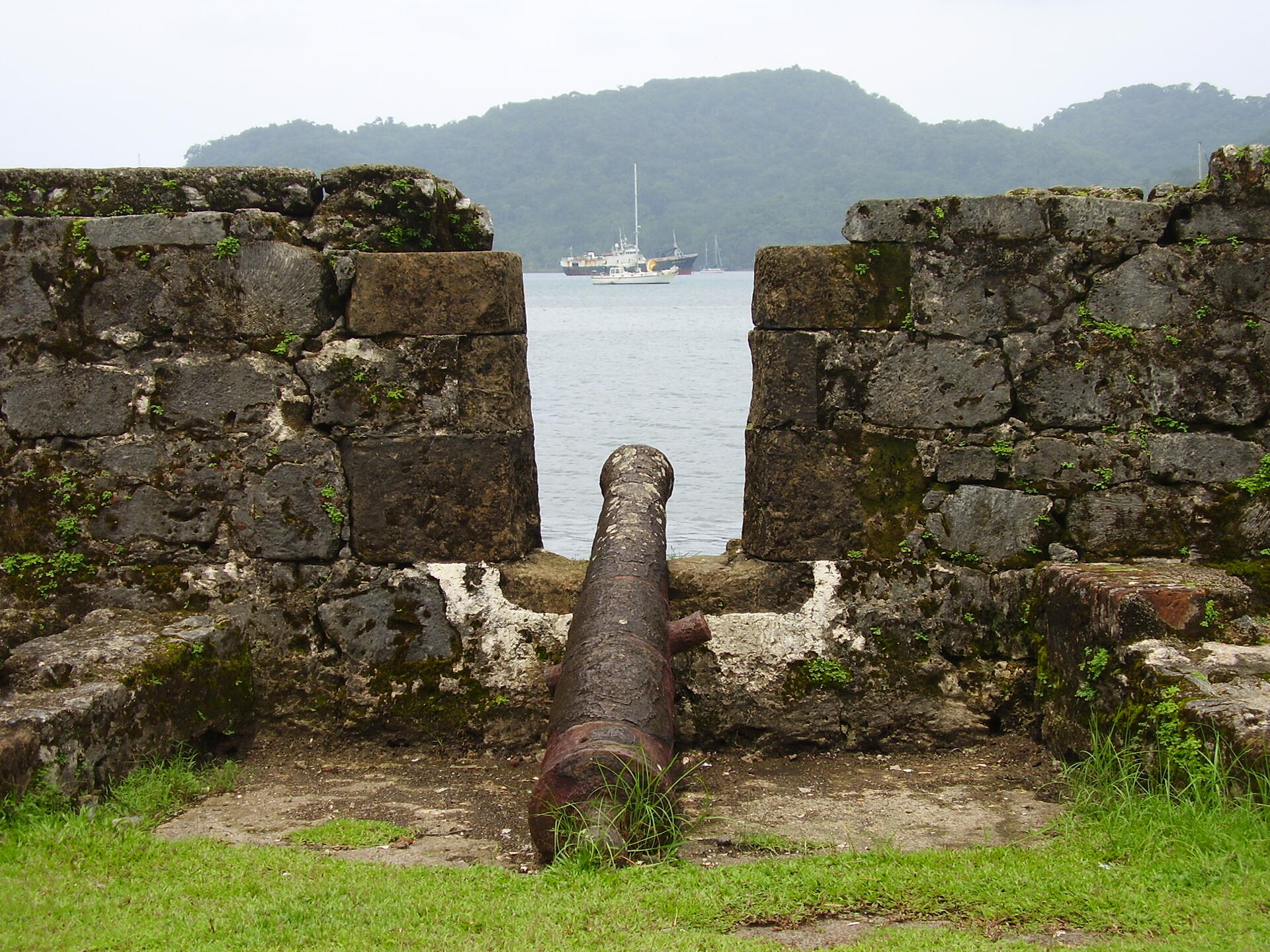
The Fortifications on the Caribbean Side of Panama: Portobelo-San Lorenzo, inscribed as a UNESCO World Heritage Site in 1980, stand as a remarkable testament to the architectural prowess of the Spanish Empire during the 17th and 18th centuries. Situated along the Caribbean coastline of Colón Province in Panama, these military constructions offer a unique glimpse into the defensive strategies employed by the Spanish Crown to safeguard transatlantic trade routes.
More to come…UNESCO Description of the World Heritage Site
Magnificent examples of 17th- and 18th-century military architecture, these Panamanian forts on the Caribbean coast form part of the defence system built by the Spanish Crown to protect transatlantic trade.
UNESCO Justification of the World Heritage Site
Criterion (i): The Fortifications on the Caribbean Side of Panama: Portobelo-San Lorenzo are a masterpiece of human creative genius. Portobelo is a remarkable example of an open fortified town, destroyed and built several times. San Lorenzo underwent the same process of renovations along the colonial era.
Criterion (iv): The Fortifications on the Caribbean Side of Panama: Portobelo-San Lorenzo, a group of late 16th, 17th and 18th century fortifications, are among the most characteristic adaptations of Spanish military architecture to tropical climate and landscape features, and represent the structural and technological development of military structures in the Caribbean.
Encyclopedia Record: Fortifications on the Caribbean Side of Panama: Portobelo-San Lorenzo
The fortifications on the Caribbean Side of Panama: Portobelo-San Lorenzo are military constructions, built by the Spanish Empire during the 17th and 18th centuries on the Caribbean coastline of Colón Province in Panama. The ruins are located on the coast of the province of Colón. In view of their cultural importance, the sites have been inscribed by UNESCO in 1980 as a World Heritage Site under Criteria (i) and (iv), with the description, "Magnificent examples of 17th- and 18th-century military architecture, these Panamanian forts on the Caribbean coast form part of the defence system built by the Spanish Crown to protect transatlantic trade."Additional Site Details
Area: Not available
Number of Components: 2
(iv) — Outstanding example of a type of building or landscape
Coordinates: 9.553888889 , -79.65583333
World Heritage Research
Discover scientific research and academic studies that deepen our understanding of Fortifications on the Caribbean Side of Panama: Portobelo-San Lorenzo from its history and significance to its conservation, management, and contemporary challenges.
-
Situación Actual de las Áreas Protegidas en la Provincia de Colón, Panamá: Marco Descriptivo para una Mejor Gestión y Manejo
A significant increase in threats to protected areas in Colón, Panama, is jeopardizing their ecological integrity. The study reveals diverse challenges across four key sites—Parque Nacional Portobelo, Bosque Protector y Paisaje Protegido San Lorenzo, Área Recreativa Lago Gatún, and Paisaje Protegido de Isla Galeta—highlighting the need for urgent intervention. Researchers analyzed social, administrative, economic, legal, natural resource, and cultural dimensions using fieldwork and institutional data, identifying gaps in management effectiveness. Recommendations include strategic partnerships, enhanced education, scientific knowledge expansion, and increased trained personnel to mitigate threats and improve conservation outcomes.
Ortiz, O., Moreno de Niño, Y., Vargas Cusatti, U., De La Cruz Cabrera, V., & Lanuza-Garay, A. (2020). SITUACIÓN ACTUAL DE LAS ÁREAS PROTEGIDAS EN LA PROVINCIA DE COLÓN, PANAMÁ: MARCO DESCRIPTIVO PARA UNA MEJOR GESTIÓN Y MANEJO. Tecnociencia, 22(2), 151–174. https://doi.org/10.48204/j.tecno.v22n2a8
View Publication Record | Read Publication -
How Can Climate Change Affect the UNESCO Cultural Heritage Sites in Panama?
Climate change is projected to significantly accelerate the deterioration of UNESCO World Heritage Sites in Panama, particularly those constructed with vulnerable materials. Research using high-resolution climate models (EC-Earth) predicts increased surface recession, biomass accumulation, and salt crystallization damage by midcentury (2039–2068), compared to recent decades (1979–2008). The study analyzed construction materials and local meteoclimatic conditions at Panamá Viejo and the Fortresses of Portobelo-San Lorenzo, combining historical data with future projections under a high greenhouse gas emission scenario. These findings highlight urgent conservation challenges for Panamanian heritage sites facing intensified environmental stressors.
Ciantelli, C., Palazzi, E., Von Hardenberg, J., Vaccaro, C., Tittarelli, F., & Bonazza, A. (2018). How Can Climate Change Affect the UNESCO Cultural Heritage Sites in Panama? Geosciences, 8(8), 296. https://doi.org/10.3390/geosciences8080296
View Publication Record | Read Publication -
Portobelo y el San Lorenzo del Chagres: Perspectivas imperiales, siglos XVI–XIX
A comprehensive two-volume work by Alfredo Castillero Calvo sheds new light on Portobelo and San Lorenzo, revealing their pivotal role in the Spanish imperial trade system from the 16th to 19th centuries. The study demonstrates that despite the decline of the Galeones trade after 1664, Portobelo remained a critical hub for transisthmian commerce, defense, and urban life, with its fortifications playing a key role in deterring foreign invasions, such as Edward Vernon's failed 1742 assault. Castillero Calvo's exhaustive analysis, based on original research from Spanish archives, explores the evolution of Portobelo's defenses, military finance, and societal dynamics, while contextualizing Panama's place within broader Spanish American history. The work also highlights the resilience of local elites in commerce and their shifting economic dependence post-fairs.
Kuethe, A. J. (2018). Portobelo y el San Lorenzo del Chagres: Perspectivas imperiales, siglos XVI–XIX. Hispanic American Historical Review, 98(4), 707–709. https://doi.org/10.1215/00182168-7160369
View Publication Record | Read Publication -
Plan de Estrategias para la Protección y Conservación de los Fuertes de Portobelo y San Lorenzo
A collaborative strategy plan by the Santa Maria la Antigua Catholic University (USMA) and Panama's National Directorate of Historical Heritage (DNPH) outlines actionable measures to protect and conserve the Fortifications of Portobelo and San Lorenzo, aiming to remove them from UNESCO's World Heritage in Danger list. The plan addresses structural deterioration, institutional advancements, and resource creation based on ICOMOS recommendations post-2014 advisory mission. It emphasizes understanding the forts' historical-cultural attributes to preserve their Outstanding Universal Value (OUV). Experts in monumental architectural restoration lead this initiative, leveraging international expertise to guide Panama's heritage conservation efforts.
Cid, P. (2017). Plan de Estrategias para la Protección y Conservación de los Fuertes de Portobelo y San Lorenzo. Investigación Y Pensamiento Crítico, 5(1), 41–68. https://doi.org/10.37387/ipc.v5i1.64
View Publication Record | Read Publication -
San Fernando Batteries in Portobelo - Panama: building materials characterization and the environmental impact evaluation
Preliminary findings from mineralogical and petrographic analyses reveal critical insights into the degradation of construction materials at the San Fernando Batteries, a 17th–18th century Spanish fortress on Panama's Caribbean coast. Using Polarized Light Microscopy (PLM), Environmental Scanning Electron Microscopy (ESEM-EDX), and X-Ray Diffraction (XRD), researchers identified environmental impacts on the site’s conservation. The study, part of a collaboration between ISAC-CNR, the Patronato de Portobelo y San Lorenzo, and the University of Ferrara, aims to safeguard this UNESCO-listed heritage by understanding how materials like stone and mortar deteriorate due to climate and pollution. These methods provide a foundation for targeted preservation strategies.
Ciantelli, C., Bonazza, A., Sabbioni, C., Suñé Martínez, R. A., & Vaccaro, C. (2015). San Fernando Batteries in Portobelo - Panama: building materials characterization and the environmental impact evaluation. MODERN AGE FORTIFICATIONS of the MEDITERRANEAN COAST - DEFENSIVE ARCHITECTURE OF THE MEDITERRANEAN (FORTMED2015). https://doi.org/10.4995/fortmed2015.2015.1754
View Publication Record | Read Publication