World Heritage Identification Number: 1138
World Heritage since: 2005
Category: Natural Heritage
WHE Type: Protected Areas & National Parks
Transboundary Heritage: No
Endangered Heritage: No
Country: 🇵🇦 Panama
Continent: Americas
UNESCO World Region: Latin America and the Caribbean
Map
Coiba National Park and Its Special Zone of Marine Protection: A Biodiversity Haven in the Gulf of Chiriqui
Located off the southwestern coast of Panama, Coiba National Park and its Special Zone of Marine Protection constitute a significant conservation area that safeguards the rich biodiversity of the Gulf of Chiriqui. Established in 2005 by UNESCO as a World Heritage Site, this protected region encompasses Coiba Island, 38 smaller islands, and the surrounding marine areas.
More to come…UNESCO Description of the World Heritage Site
Coiba National Park, off the southwest coast of Panama, protects Coiba Island, 38 smaller islands and the surrounding marine areas within the Gulf of Chiriqui. Protected from the cold winds and effects of El Niño, Coiba’s Pacific tropical moist forest maintains exceptionally high levels of endemism of mammals, birds and plants due to the ongoing evolution of new species. It is also the last refuge for a number of threatened animals such as the crested eagle. The property is an outstanding natural laboratory for scientific research and provides a key ecological link to the Tropical Eastern Pacific for the transit and survival of pelagic fish and marine mammals.
UNESCO Justification of the World Heritage Site
Criterion (ix): Despite the short time of isolation of the islands of the Gulf of Chiriquí on an evolutionary timeframe, new species are being formed, which is evident from the levels of endemism reported for many groups (mammals, birds, plants), making the property an outstanding natural laboratory for scientific research. Furthermore the Eastern Pacific reefs, such as those within the property, are characterized by complex biological interactions of their inhabitants and provide a key ecological link in the Tropical Eastern Pacific for the transit and survival of numerous pelagic fish as well as marine mammals.
Criterion (x): The forests of Coiba Island possess a high variety of endemic birds, mammals and plants. Coiba Island also serves as the last refuge for a number of threatened species that have largely disappeared from the rest of Panama, such as the Crested Eagle and the Scarlet Macaw. Furthermore the marine ecosystems within the property are repositories of extraordinary biodiversity conditioned to the ability of the Gulf of Chiriquí to buffer against temperature extremes associated to El Niño/Southern Oscilation phenomenon. The property includes 760 species of marine fishes, 33 species of sharks and 20 species of cetaceans. The islands within the property are the only group of inshore islands in the tropical eastern Pacific that have significant populations of trans-Pacific fishes, namely, Indo-Pacific species that have established themselves in the eastern Pacific.
Encyclopedia Record: Coiba
Coiba is the largest island in Central America, with an area of 494 km2 (191 sq mi), off the Pacific coast of the Panamanian province of Veraguas. It is part of the Montijo District of that province.Additional Site Details
Area: 270,125 hectares
Number of Components: 1
(x) — Contains most important habitats for biodiversity
Coordinates: 7.433 , -81.766
IUCN World Heritage Outlook
The 2025 Conservation Outlook on Coiba National Park and its Special Zone of Marine Protection reports the following assessment:
Source: International Union for Conservation of Nature (IUCN) · View assessment
Image
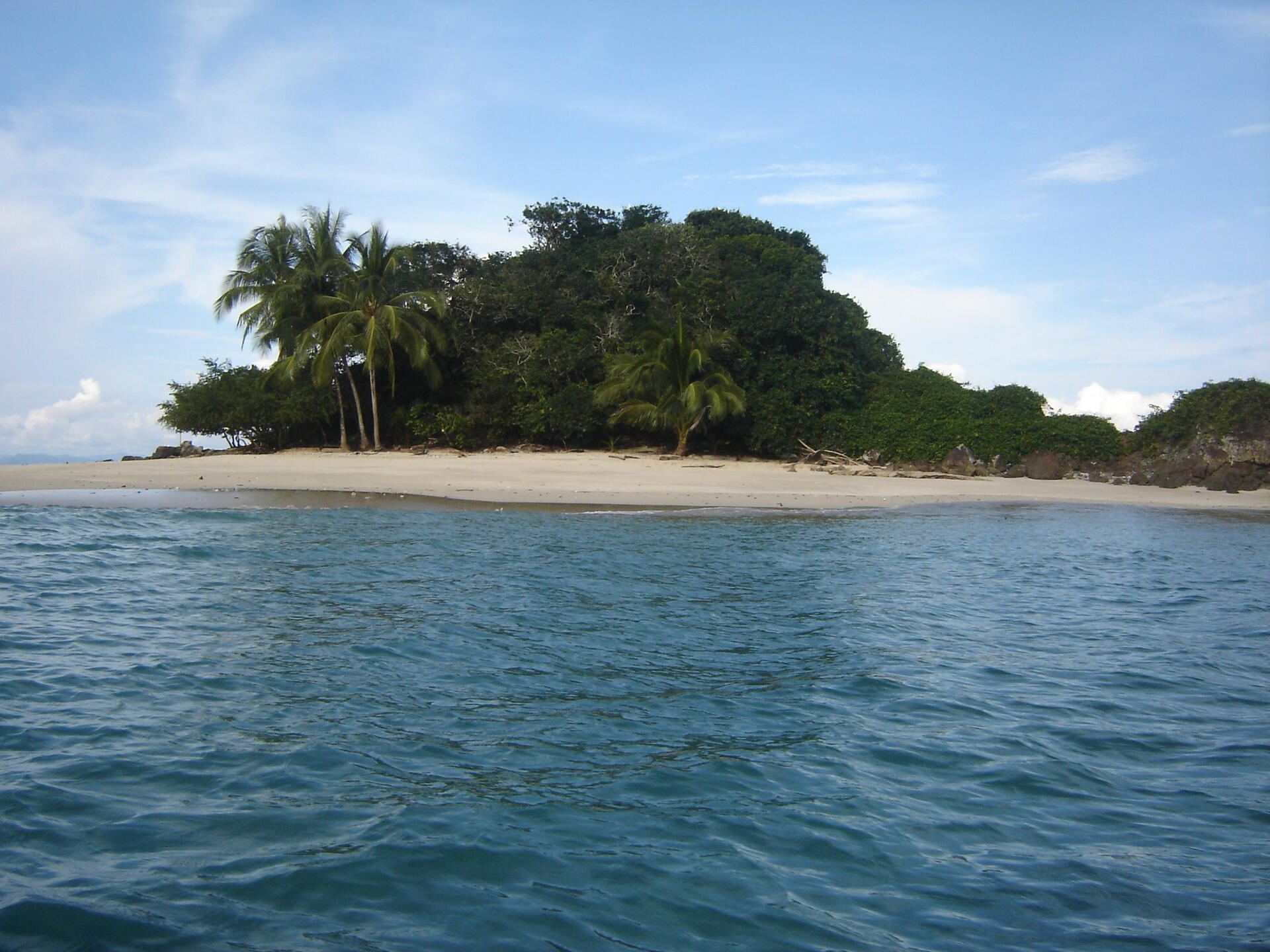
© Seibert, CC BY-SA 4.0 Resized from original. (This derivative is under the same CC BY-SA license.)
World Heritage Research
Discover scientific research and academic studies that deepen our understanding of Coiba National Park and its Special Zone of Marine Protection from its history and significance to its conservation, management, and contemporary challenges.
-
De cárcel a patrimonio mundial: historia del impacto ambiental en la Isla Penal de Coiba, Panamá (1872-2023)
Coiba Island, once a penal colony and now a UNESCO World Heritage Site, has undergone significant environmental transformations over 150 years. The study identifies nine distinct periods of land use and disturbance, revealing that despite extensive human activity—including selective logging, multi-stratified agroforestry, and cattle ranching—approximately 80% of the island remains covered by mature forest. Key findings include the presence of long-lasting fallow periods (33-9 years) creating a gradient of succession from the center to the east, and contrasting contemporary sites with divergent histories. These insights underscore the resilience of Coiba's ecosystems but also highlight the need for long-term studies to fully understand the legacy of anthropogenic perturbations.
Garrido Pérez, E. I., & Mali Mali Bastidas, N. (2026). De cárcel a patrimonio mundial: historia del impacto ambiental en la Isla Penal de Coiba, Panamá (1872-2023). Revista Veritas de Difusão Científica, 6(3), 4713–4748. https://doi.org/10.61616/rvdc.v6i3.1174
View Publication Record | Read Publication -
Fish spawning aggregations in the Gulf of Chiriqui, Panamanian Pacific: six years of monitoring
A six-year monitoring effort in the Gulf of Chiriquí, Panamanian Pacific, has documented fish spawning aggregations (FSAs) for seven species, including three snappers, one jack, one grouper, and one wrasse. These aggregations were observed at multiple sites within Coiba National Park (CNP) and, for the first time, in the Islas Secas Archipelago (ISA). The study revealed that FSAs are associated with environmental conditions such as water column stratification, cold-water intrusion, thermocline shoaling, and decreased dissolved oxygen, all correlated with temperature dynamics. Spawning events were most frequent during morning hours. This research expands the known diversity of FSA-forming species in CNP from three to seven and provides new documentation for ISA.
Robles P., Y. A., Vega, Á. J., Montes S., L. A., Sánchez-Carles, E. E., & Lombardo G., R. C. (2026). Agregaciones de desove de peces en el Golfo de Chiriquí, Pacífico panameño: seis años de monitoreo. Revista de Biología Tropical, 74(1), e2026203. https://doi.org/10.15517/0wk2ee74
View Publication Record | Read Publication -
Centruroides bicolor
Centruroides bicolor, a scorpion species native to Panama and Costa Rica, exhibits significant ecological diversity within the UNESCO World Heritage Site of Coiba National Park and its Special Zone of Marine Protection. This study documents its distribution across multiple provinces in Panama, including Bocas del Toro, Chiriquí, and Veraguas, highlighting its adaptability to various microhabitats such as intradomiciliary spaces, under stones, logs, and within dry tree trunks. The research compiles extensive material examined from over 200 specimens collected between 1975 and 2026, providing critical data on the species' habitat preferences and geographic range. Notably, C. bicolor's presence in Coiba Island underscores its role in marine-protected areas, contributing to biodiversity studies in tropical ecosystems.
Miranda, R. J., De Armas, L. F., Cleghorn, J., Lezcano, J. J., Castillo, L. Y., Cambra, R. A., & Murgas, I. L. (2026). Centruroides bicolor. Zenodo. https://doi.org/10.5281/ZENODO.19173246
View Publication Record | Read Publication -
Genetic and taxonomic data corroborate the existence of lemon shark, Negaprion brevirostris (Carchariniformes: Carcharhinidae) (Poey, 1868) in Coiba National Park, Panama
Researchers have confirmed the presence of lemon sharks (Negaprion brevirostris) in Coiba National Park, Panama, marking the first documented occurrence of this species in the Eastern Tropical Pacific marine corridor. Genetic analysis of six young-of-the-year individuals collected from Boca Grande estuary revealed a 99% similarity with known lemon shark sequences, corroborating morphological identification. This discovery expands the known distribution of the species and provides foundational genetic data for Coiba National Park, with sequences deposited in GenBank for future comparative studies. The findings underscore the importance of Boca Grande estuary as a critical nursery area and offer insights for enhanced management strategies, including potential shark sanctuary designation.
Díaz-Ferguson, E., Justo-Riverol, S., & Barreiros, J. P. (2026). Genetic and taxonomic data corroborate the existence of lemon shark, Negaprion brevirostris (Carchariniformes: Carcharhinidae) (Poey, 1868) in Coiba National Park, Panama. Marine Biodiversity, 56(3). https://doi.org/10.1007/s12526-026-01663-z
View Publication Record | Read Publication -
Herpetofaunal richness and beta diversity between an offshore archipelago of the Eastern Tropical Pacific and adjacent mainland
Coiba Island National Park (CNP), an offshore archipelago separated from the mainland around 12,000–14,000 years ago, exhibits distinct herpetofaunal communities compared to adjacent mainland Panama. While reptile richness is similar between CNP and the mainland (maximum 21 vs. 25 species), amphibian diversity is notably lower in CNP (maximum 5 spp.) than on the mainland (maximum 13 spp.). The study, combining visual surveys, pitfall traps, and existing data, suggests that reptile richness may be underestimated due to limited sampling. Two new records—Oscaecilia sp. and the Turniptail gecko Techadactylus rapicauda—were identified for CNP. The findings imply that herpetofaunal diversity in CNP is influenced by heterogeneous vegetation, small-island effects, and possibly historical anthropogenic factors, warranting further investigation.
Flores, E. E. (2026). Herpetofaunal richness and beta diversity between an offshore archipelago of the Eastern Tropical Pacific and adjacent mainland. The Herpetological Journal, 36(3), 158–168. https://doi.org/10.33256/36.3.158168
View Publication Record | Read Publication -
Rise and spread of a social tradition of interspecies abduction
Researchers document the emergence and spread of a non-adaptive social tradition—'howler abduction'—in wild white-faced capuchin monkeys (Cebus capucinus imitator) within Coiba National Park, Panama. Over 15 months, five immature males were observed carrying infant howler monkeys (Alouatta palliata coibensis), a behavior with no clear adaptive function. The tradition originated from a single subadult male innovator and spread to four others in one capuchin group, which is also known for its unique stone tool-use tradition. The study suggests that the same ecological and social conditions fostering adaptive cultural innovations, such as tool-use, may also drive non-adaptive traditions in non-human primates.
Goldsborough, Z., Crofoot, M. C., Jacobson, O. T., Corewyn, L., Rosario-Vargas, E. d., León, J., & Barrett, B. J. (2025). Rise and spread of a social tradition of interspecies abduction. Current Biology, 35(10), R375–R376. https://doi.org/10.1016/j.cub.2025.03.056
View Publication Record | Read Publication -
The Trichoptera of Panama XXVIII. Nine new species of microcaddisflies (Trichoptera, Hydroptilidae)
Researchers have identified nine new species of microcaddisflies (Trichoptera, Hydroptilidae) from the Coiba National Park and its Special Zone of Marine Protection in Panama. These discoveries, including Oxyethira jaramillosp. nov., Neotrichia afuerasp. nov., and seven others, bring the total number of caddisfly species known in Panama to 544, spanning 15 families and 56 genera. The new species were predominantly collected on the Soná Peninsula or offshore islands within the park, expanding the region's biodiversity record. This study contributes to the broader documentation of Trichoptera diversity in Panama, with implications for understanding aquatic ecosystems and conservation priorities.
Armitage, B. J., Harris, S. C., & Rodriguez, V. (2025). The Trichoptera of Panama XXVIII. Nine new species of microcaddisflies (Trichoptera, Hydroptilidae). Neotropical Biology and Conservation, 20(2), 125–147. https://doi.org/10.3897/neotropical.20.e148738
View Publication Record | Read Publication