World Heritage Identification Number: 1315
World Heritage since: 2009
Category: Cultural Heritage
WHE Type: Infrastructure & Industry
Transboundary Heritage: No
Endangered Heritage: No
Country: 🇮🇷 Iran (Islamic Republic of)
Continent: Asia
UNESCO World Region: Asia and the Pacific
Map
Shushtar Historical Hydraulic System: A Masterpiece of Creative Genius
The Shushtar Historical Hydraulic System, inscribed as a UNESCO World Heritage Site in 2009, is a testament to ancient engineering prowess and the harmonious integration of human settlements with their natural environment. This intricate network of dams, bridges, canals, and structures dates back to the Sasanian era, located in the modern-day Iranian city of Shushtar.
More to come…UNESCO Description of the World Heritage Site
Shushtar, Historical Hydraulic System, inscribed as a masterpiece of creative genius, can be traced back to Darius the Great in the 5th century B.C. It involved the creation of two main diversion canals on the river Kârun one of which, Gargar canal, is still in use providing water to the city of Shushtar via a series of tunnels that supply water to mills. It forms a spectacular cliff from which water cascades into a downstream basin. It then enters the plain situated south of the city where it has enabled the planting of orchards and farming over an area of 40,000 ha. known as Mianâb (Paradise). The property has an ensemble of remarkable sites including the Salâsel Castel, the operation centre of the entire hydraulic system, the tower where the water level is measured, dams, bridges, basins and mills. It bears witness to the know-how of the Elamites and Mesopotamians as well as more recent Nabatean expertise and Roman building influence.
UNESCO Justification of the World Heritage Site
Criterion (i): The Shushtar Hydraulic System is testimony to a remarkably accomplished and early overall vision of the possibilities afforded by diversion canals and large weir-dams for land development. It was designed and completed in the 3rd century CE for sustainable operation and is still in use today. It is a unique and exceptional ensemble in terms of its technical diversity and its completeness that testifies to human creative genius.
Criterion (ii): The Shushtar Historical Hydraulic System is a synthesis of diverse techniques brought together to form a remarkably complete and large-scale ensemble. It has benefited from the ancient expertise of the Elamites and Mesopotamians in canal irrigation, and then that of the Nabateans; Roman technicians also influenced its construction. Its many visitors marvelled at it and were in turn inspired. It testifies to the exchange of considerable influences in hydraulic engineering and its application throughout antiquity and the Islamic period under the various Iranian dynasties.
Criterion (v): Shushtar is a unique and exceptionally complete example of hydraulic techniques developed during ancient times to aid the occupation of semi-desert lands. By diverting a river flowing down the mountains, using large-scale civil engineering structures and the creation of canals, it made possible multiple uses for the water across a vast territory: urban water supply, agricultural irrigation, fish farming, mills, transport, defence system, etc. It testifies to a technical culture dating back eighteen centuries serving the sustainable development of a human society, in harmony with its natural and urban environment.
Encyclopedia Record: Shushtar Historical Hydraulic System
The Shushtar Historical Hydraulic System is a complex irrigation system of the island city Shushtar from the Sasanian era. It consists of 13 dams, bridges, canals and structures which work together as a hydraulic system.Additional Site Details
Area: 240.4152 hectares
Number of Components: 1
(ii) — Significant interchange of human values
(v) — Outstanding example of traditional human settlement
Coordinates: 32.0186111111 , 48.8358333333
Image
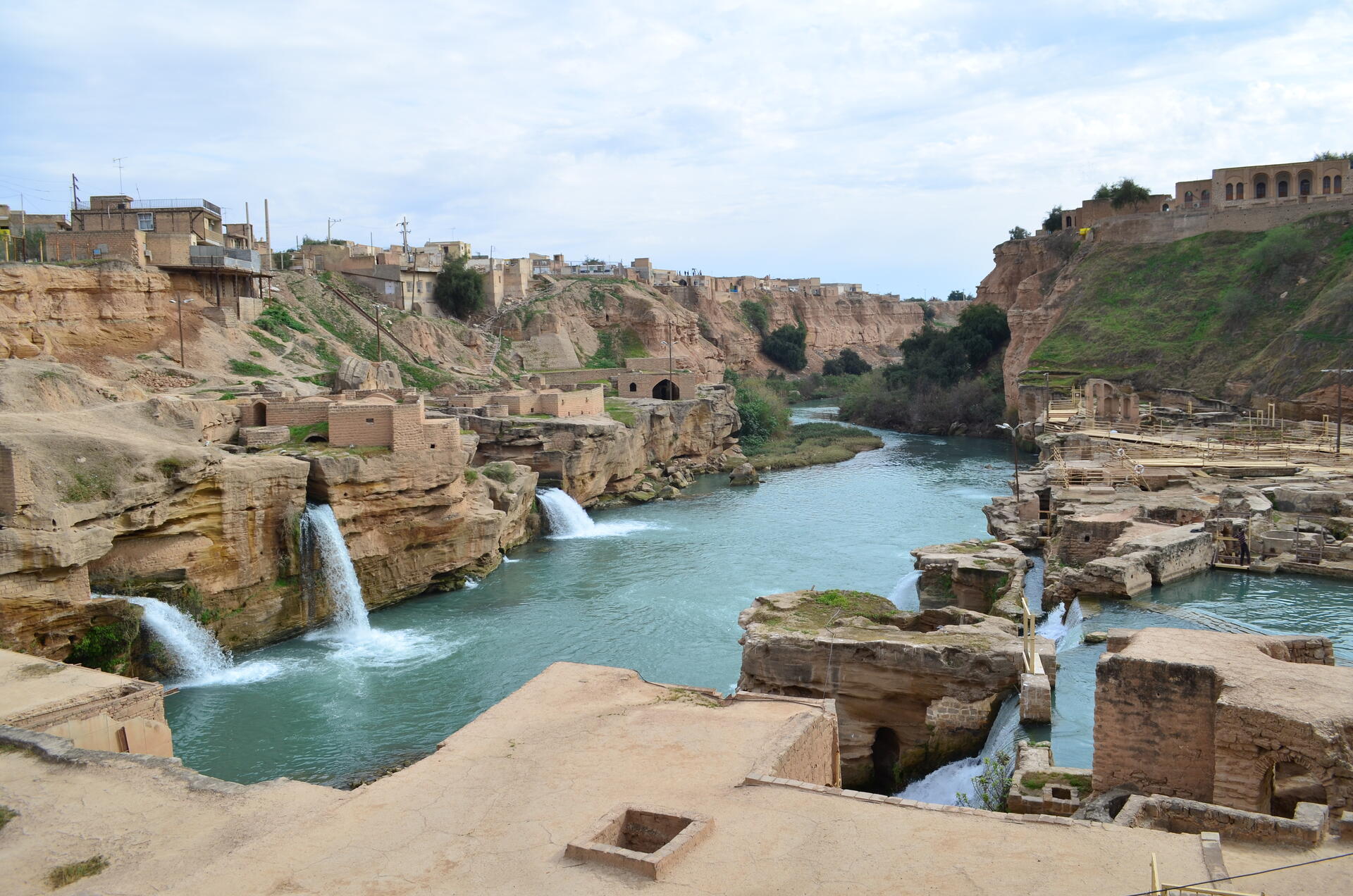
© Darafsh, CC BY-SA 3.0 Resized from original. (This derivative is under the same CC BY-SA license.)
World Heritage Research
Discover scientific research and academic studies that deepen our understanding of Shushtar Historical Hydraulic System from its history and significance to its conservation, management, and contemporary challenges.
-
Building Resilience in Cultural Landscapes: Exploring the Role of Transdisciplinary and Participatory Planning in the Recovery of the Shushtar Historical Hydraulic System
Transdisciplinary and participatory planning significantly enhances the resilience of cultural landscapes, such as the Shushtar Historical Hydraulic System (SHHS), against climate change risks. The study highlights that active local community involvement in developing and implementing resilience strategies is crucial for their success. Key elements like accurate identification and communication, capacity building, trust-building, and sufficient funding were found to be essential. The research combines a systematic literature review with an analysis of the SHHS's recovery process during the 2019 flooding in Khuzestan Province, Iran, demonstrating the effectiveness of these approaches in mitigating natural hazards.
Shirvani Dastgerdi, A., & Kheyroddin, R. (2023). Building Resilience in Cultural Landscapes: Exploring the Role of Transdisciplinary and Participatory Planning in the Recovery of the Shushtar Historical Hydraulic System. Sustainability, 15(13), 10433. https://doi.org/10.3390/su151310433
View Publication Record | Read Publication -
Rehabilitation of the river’s role in historic urban landscape of Shushtar, Iran
Shushtar, Iran, exemplifies a historic urban landscape shaped by sustainable human-nature interactions, particularly through its renowned hydraulic system. Recognized as a UNESCO World Heritage Site since 2009, the city's identity was deeply rooted in its river and water management, which facilitated nearly all aspects of daily life. However, modernization has eroded this connection, diminishing both the physical and spiritual ties between residents and their environment. This study focuses on reviving Shushtar’s unique values through landscape architecture and design, aiming to restore the city's daily life dynamics without resorting to museum-like preservation. By leveraging innovative approaches, the research seeks to re-establish the perceptual and functional relationships that once defined this historic urban ecosystem.
Sabbagh-Ziarani, P. Rehabilitation of the river’s role in historic urban landscape of Shushtar, Iran. https://doi.org/10.33915/etd.12025
View Publication Record | Read Publication