World Heritage Identification Number: 410
World Heritage since: 1987
Category: Natural Heritage
WHE Type: Protected Areas & National Parks
Transboundary Heritage: No
Endangered Heritage: No
Country: 🇲🇽 Mexico
Continent: Americas
UNESCO World Region: Latin America and the Caribbean
Map
Sian Ka'an Biosphere Reserve: A Natural Treasure of the Yucatan Peninsula
The Sian Ka'an Biosphere Reserve, located on the eastern coast of the Yucatan Peninsula in Mexico, is a testament to the rich biodiversity and cultural heritage of the region. In the Mayan language, Sian Ka'an translates to 'Origin of the Sky', a fitting name for this vast expanse that encompasses tropical forests, mangroves, marshes, and a significant marine section intersected by the Mesoamerican Barrier Reef.
More to come…UNESCO Description of the World Heritage Site
In the language of the Mayan peoples who once inhabited this region, Sian Ka'an means 'Origin of the Sky'. Located on the east coast of the Yucatán peninsula, this biosphere reserve contains tropical forests, mangroves and marshes, as well as a large marine section intersected by a barrier reef. It provides a habitat for a remarkably rich flora and a fauna comprising more than 300 species of birds, as well as a large number of the region's characteristic terrestrial vertebrates, which cohabit in the diverse environment formed by its complex hydrological system.
UNESCO Justification of the World Heritage Site
Criterion (vii): The aesthetics and beauty of Sian Ka´an derive from the relatively undisturbed interface of sea and land along a well-conserved coastline. The mosaic of landscape elements is diverse in shapes, forms and colours allowing intriguing views and impressions. Noteworthy and rare natural phenomena include the Cenotes, water-filled natural sinkholes hosting specialised communities of life and the Petenes, tree islands emerging from the swamps. Both are connected by underground freshwater systems, jointly forming an invaluable and fragile treasure for future generations.
Criterion (x): The scale and conservation status of Sian Ka'an and its ecosystem diversity support a fascinating range of life forms. Over 850 vascular plants, including 120 woody species, have been confirmed in what is assumed to be a still incomplete inventory. In terms of fauna, noteworthy representatives among the more than 100 documented mammals include endangered species like Black-handed Spider Monkey, Yucatan Black Howler Monkey and the Central American Tapir. A small population of the vulnerable West Indian Manatee occurs in the coastal waters. Some 330 bird species have been recorded, 219 of them breeding in Sian Ka'an. Amphibians and reptiles are represented by more than 40 recorded species, among them the vulnerable American Crocodile and four of the six turtle species found along the Mexican coast, all reproducing within the property. The isolation of some of the Cenotes led to the evolution of several species which are locally endemic to single sinkholes. With some 80 recorded species of reef-building coral the portion of the Mesoamerican Reef within the property is one of the richest in Mexico. Jointly with the many other aquatic habitats it harbours more than 400 species of fish and a wealth of other marine life.
Encyclopedia Record: Sian Kaʼan Biosphere Reserve
Sian Kaʼan Biosphere Reserve is a biosphere reserve in Tulum Municipality in the Mexican state of Quintana Roo. It was established in 1986 and became a UNESCO World Heritage Site in 1987.Additional Site Details
Area: 528,000 hectares
Number of Components: 1
(x) — Contains most important habitats for biodiversity
Coordinates: 19.38333 , -87.79167
IUCN World Heritage Outlook
The 2025 Conservation Outlook on Sian Ka'an reports the following assessment:
Source: International Union for Conservation of Nature (IUCN) · View assessment
Image
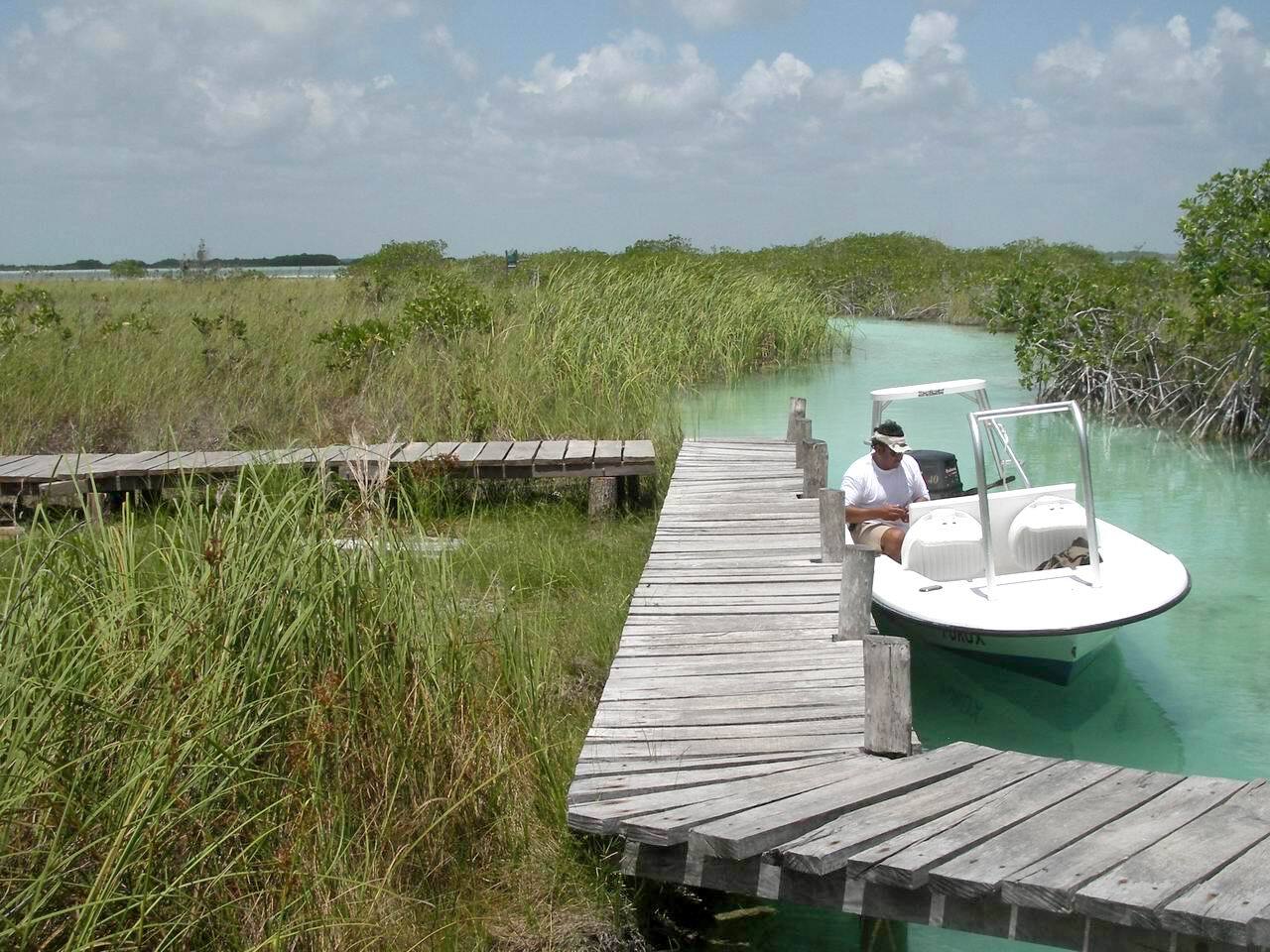
© Tschips, CC BY-SA 3.0 Resized from original. (This derivative is under the same CC BY-SA license.)
World Heritage Research
Discover scientific research and academic studies that deepen our understanding of Sian Ka'an from its history and significance to its conservation, management, and contemporary challenges.
-
Reproductive isolation in two strains of the marine rotifer Brachionus cf. ibericus (Rotifera, Monogononta) from Quintana Roo, México
Researchers have identified reproductive isolation between two distinct strains of the marine rotifer Brachionus cf. ibericus in Quintana Roo, Mexico, marking a significant discovery within the Yucatán Peninsula's biodiversity. The study, conducted by Marin-Chan et al., isolated and cultured 23 clones from the northwest (Cancún) and southeast (Sian Ka'an) regions, revealing differences in female production, male development, and resting egg hatching rates. Cross-mating experiments confirmed reproductive barriers between the strains, leading to the proposal of two distinct populations: Brachionus cf. ibericus 'Cancún' strain and 'Sian Ka'an' strain. This finding contributes to understanding the evolutionary dynamics of this ecologically and economically important species complex.
Marin-Chan, A. G., Pérez-Yáñez, D., Acosta-González, G., & Alvarado-Flores, J. (2026). Reproductive isolation in two strains of the marine rotifer Brachionus cf. ibericus (Rotifera, Monogononta) from Quintana Roo, México. Biodiversity Data Journal, 14. https://doi.org/10.3897/bdj.14.e128770
View Publication Record | Read Publication -
Evaluating Tour Boat Compliance With Dolphin‐Watching Guidelines in the Sian Ka'an Biosphere Reserve
A striking 98% of dolphin-watching tour boats in Sian Ka'an Biosphere Reserve violated local guidelines, with proximity to dolphins being the most common infraction. The study, using boat observations and drone footage, also found that 95% of dolphin directional changes occurred away from boat trajectories, while 55% showed increased swimming speeds during interactions. These findings highlight the urgent need for stricter monitoring and enforcement of dolphin-watching guidelines to protect local bottlenose dolphin populations and ensure sustainable tourism practices.
Paredes‐Torres, L. M., Castelblanco‐Martínez, D. N., Niño‐Torres, C. A., Garcés‐Cuartas, N., & Ramos, E. A. (2025). Evaluating Tour Boat Compliance With Dolphin‐Watching Guidelines in the Sian Ka’an Biosphere Reserve. Marine Mammal Science, 41(3). Portico. https://doi.org/10.1111/mms.70004
View Publication Record | Read Publication -
Multi‐Scale Habitat Selection of Greater Caribbean Manatees in Sian Ka'an Biosphere Reserve, Mexico
Greater Caribbean manatees (Trichechus manatus manatus) in Sian Ka'an Biosphere Reserve, Mexico, are more likely to inhabit areas near seafloor depressions and closer to land, with habitat preferences varying significantly across spatial scales. This study is the first to model manatee habitat selection at multiple scales—study area and 1-km buffer—using GPS data from 102 opportunistic encounters and a pseudo-absence approach. It found that proximity to seafloor depressions increased manatee presence at both scales, while land proximity was a significant factor only at the larger scale. The research underscores the ecological importance of seafloor features for manatees and highlights the necessity of multi-scale approaches in habitat selection studies.
Gagnon, É., Castelblanco‐Martínez, N., Ramos, E. A., Aguilera‐Miranda, I. D., Velasco, J. A., Brady, B., Rieucau, G., & Martin, J. G. A. (2025). Multi‐Scale Habitat Selection of Greater Caribbean Manatees in Sian Ka’an Biosphere Reserve, Mexico. Marine Mammal Science, 42(1). Portico. https://doi.org/10.1111/mms.70072
View Publication Record | Read Publication -
Community engagement and human perception in crocodile conservation: preliminary steps in Sian Ka’an Biosphere Reserve
A study on community engagement and human perception in crocodile conservation within Sian Ka'an Biosphere Reserve, Mexico, reveals that most local respondents (69%) dedicate 2–10 minutes to crocodile observation during wildlife tourism activities. The majority (97%) approach crocodiles at a safe distance of 5–10 meters without feeding them, while only 3% engage in potentially harmful practices like feeding. Despite this, 89% of respondents believe current observation practices are adequate, though workshops on crocodile biology and conservation were positively received, indicating a need for educational reinforcement. The research suggests that developing a communication program to educate both new and established tourism service providers could enhance conservation efforts and mitigate potential negative impacts on crocodile behavior.
Benítez-Moreno, J. A., Cedeño-Vázquez, J. R., & Castelblanco-Martínez, D. N. (2024). Community engagement and human perception in crocodile conservation: preliminary steps in Sian Ka’an Biosphere Reserve. Frontiers in Conservation Science, 5. https://doi.org/10.3389/fcosc.2024.1297960
View Publication Record | Read Publication -
The Yucatán mouse opossum (Tlacuatzin gaumeri) in Quintana Roo, México
Research confirms the presence of the Yucatán mouse opossum (Tlacuatzin gaumeri) in Quintana Roo, Mexico, extending its known geographic distribution by 139 km eastward from the Yucatán Peninsula. This discovery, derived from curatorial records and citizen science observations, marks the first documentation of this marsupial in Quintana Roo, reinforcing its endemicity to the region. The study utilized scientific literature, museum collections, GBIF data, and iNaturalistMX records, with spatial analysis conducted using QGIS 3.36.2. While the species' presence aligns with one protected area, its conservation status remains undetermined, yet this finding enriches the faunal inventory of the Yucatán Peninsula.
Cervantes, F. A., & Rivas-Villegas, A. L. (2024). The Yucatán mouse opossum (Tlacuatzin gaumeri) in Quintana Roo, México. Therya Notes, 5, 228–231. https://doi.org/10.12933/therya_notes-24-177
View Publication Record | Read Publication -
Tipologías de la gobernanza territorial en la pesca de langosta espinosa en las reservas de la biósfera de Sian Ka'an y Banco Chinchorro, Quintana Roo, México
A new framework categorizes governance dynamics of spiny lobster fisheries into three distinct typologies, revealing how trust and social networks shape conservation outcomes in Sian Ka'an and Banco Chinchorro biosphere reserves. The study identifies participatory governance—marked by equitable decision-making and strong institutions—as critical for sustainable resource management. In contrast, exclusionary and conflict-driven models lack cooperation, leading to weak conservation practices. A third typology highlights transitional phases where communities rebuild social cohesion toward responsible fishing cultures. This approach clarifies the diverse institutional pathways influencing local development trajectories in these UNESCO World Heritage Sites.
Velázquez Durán, V. M., & Rosales Ortega, R. (2023). Tipologías de la gobernanza territorial en la pesca de langosta espinosa en las reservas de la biósfera de Sian Ka’an y Banco Chinchorro, Quintana Roo, México. Sociedad Y Ambiente, (26), 1–29. https://doi.org/10.31840/sya.vi26.2751
View Publication Record | Read Publication -
Jaguar (Panthera onca) spatial ecology outside protected areas in the Selva Maya
A jaguar population persists outside protected areas in the Selva Maya, Mexico, despite human presence. Research using satellite telemetry revealed that four male jaguars maintained home ranges of 101.5 km² (±75.9) in the dry season and 172 km² (±107.3) in the rainy season, with core areas of 17.54 km² (±16.2) and 29.07 km² (±16.2), respectively. No significant seasonal differences were found for home ranges or core areas. Jaguars preferred forest or young secondary growth over disturbed areas, indicating resilience in unprotected landscapes. The study highlights the importance of landscape-level conservation to protect remaining tropical mature forests and promote long-term secondary growth, ensuring jaguar survival amid tourism-driven threats.
González–Gallina, A., Equihua, M., Pérez-Garduza, F., Iglesias-Henández, J. A., Oliveras de Ita, A., Chacón-Hernández, A., Vázquez-Zúñiga, O., & Hidalgo-Mihart, M. G. (2022). Jaguar (Panthera onca) spatial ecology outside protected areas in the Selva Maya. Animal Biodiversity and Conservation, 131–144. https://doi.org/10.32800/abc.2022.45.0131
View Publication Record | Read Publication