World Heritage Identification Number: 791
World Heritage since: 1996
Category: Cultural Heritage
WHE Type: Historic Cities & Urban Areas
Transboundary Heritage: No
Endangered Heritage: No
Country: 🇲🇽 Mexico
Continent: Americas
UNESCO World Region: Latin America and the Caribbean
Map
Exploring the Majestic Pre-Hispanic Town of Uxmal: A Testament to Ancient Maya Civilization
The Pre-Hispanic Town of Uxmal, nestled within the lush, tropical landscape of the Yucatan Peninsula in Mexico, stands as a captivating testament to the ingenuity, artistic prowess, and astronomical knowledge of the ancient Maya civilization. Inscribed as a UNESCO World Heritage Site in 1996, this remarkable city offers visitors a unique glimpse into the rich cultural heritage that once thrived in the heart of Mesoamerica.
More to come…UNESCO Description of the World Heritage Site
The Mayan town of Uxmal, in Yucatán, was founded c. A.D. 700 and had some 25,000 inhabitants. The layout of the buildings, which date from between 700 and 1000, reveals a knowledge of astronomy. The Pyramid of the Soothsayer, as the Spaniards called it, dominates the ceremonial centre, which has well-designed buildings decorated with a profusion of symbolic motifs and sculptures depicting Chaac, the god of rain. The ceremonial sites of Uxmal, Kabah, Labna and Sayil are considered the high points of Mayan art and architecture.
UNESCO Justification of the World Heritage Site
Criterion (i) : The ruins of the ceremonial structures at Uxmal, Kabah, Labná and Sayil represent the pinnacle of late Maya art and architecture in their design, layout, and ornamentation.
Criterion (ii) : The richness of the iconography in Uxmal´s buildings is a tangible expression of the complex Maya cosmogony and of the intimate relation they held with their environment. The art and architecture at Uxmal and its neighbouring sites furthermore bears witness to the migration of styles from the Rio Bec and Chenes region, as well as from central México.
Criterion (iii) : The greatness of the monuments and the magnificence of the architectural styles found at Uxmal reveal the importance of this city as a capital for economic and socio-political development of the prehispanic Maya civilization. The complex of Uxmal and its three related towns of Kabah, Labná and Sayil admirably demonstrate the social and economic structure of late Maya society before it disappeared in the Terminal Classic Period.
Encyclopedia Record: Uxmal
Uxmal is an ancient Maya city of the classical period located in present-day Mexico. It is considered one of the most important archaeological sites of Maya culture, along with Palenque, Chichen Itza and Calakmul in Mexico, Caracol and Xunantunich in Belize, and Tikal in Guatemala. It is located in the Puuc region of the western Yucatán Peninsula, and is considered one of the Maya cities most representative of the region's dominant architectural style. It was designated a UNESCO World Heritage Site along with the nearby ruins of Kabah, Sayil and Labna.Additional Site Details
Area: 2,059.8 hectares
Number of Components: 4
(ii) — Significant interchange of human values
(iii) — Unique or exceptional testimony to a cultural tradition
Coordinates: 20.36166667 , -89.77027778
Image
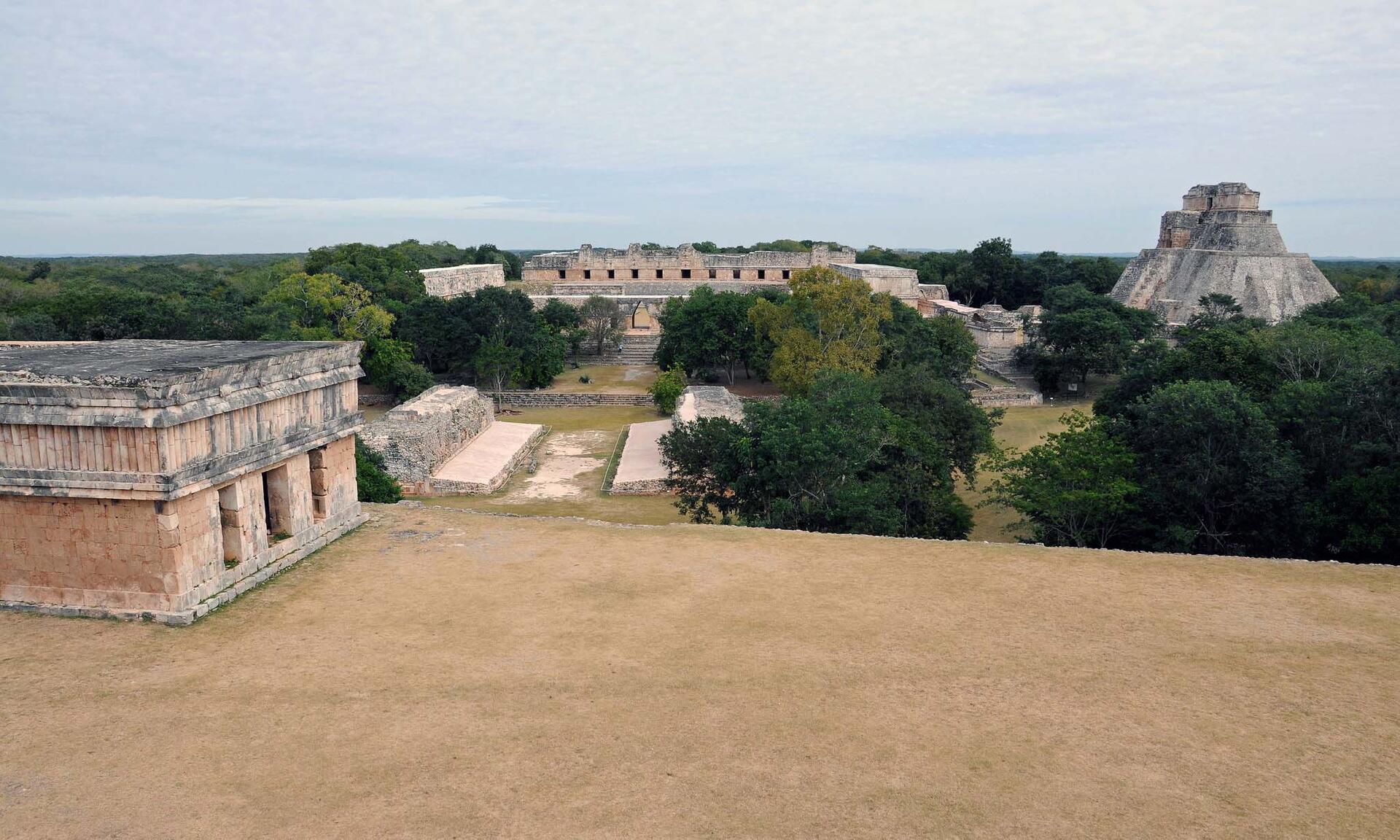
© Adrian Hernandez, CC BY-SA 4.0 Resized from original. (This derivative is under the same CC BY-SA license.)