World Heritage Identification Number: 36
World Heritage since: 1979
Category: Cultural Heritage
WHE Type: Historic Cities & Urban Areas
Transboundary Heritage: No
Endangered Heritage: No
Country: 🇹🇳 Tunisia
Continent: Africa
UNESCO World Region: Arab States
Map
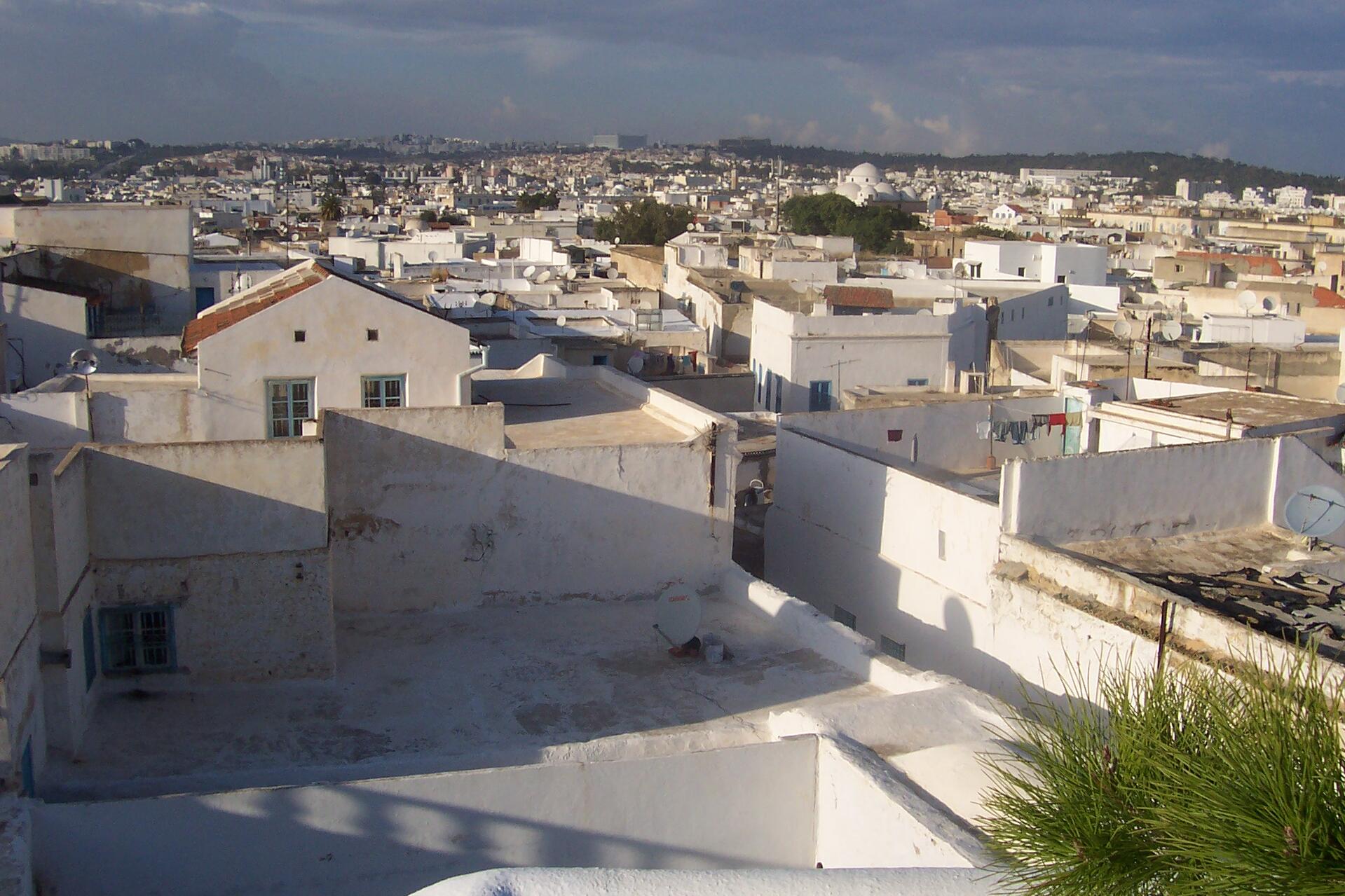
The Medina of Tunis: A Testament to the Wealth and Grandeur of the Islamic World
The Medina of Tunis, located in the heart of the Tunisian capital, stands as a testament to the rich history and cultural heritage of the Islamic world. Inscribed as a UNESCO World Heritage Site in 1979, this ancient city quarter offers a unique glimpse into the grandeur and splendor that once marked Tunis as one of the most significant cities in the Islamic realm during the Almohad and Hafsid periods (12th to 16th centuries).
More to come…UNESCO Description of the World Heritage Site
Under the Almohads and the Hafsids, from the 12th to the 16th century, Tunis was considered one of the greatest and wealthiest cities in the Islamic world. Some 700 monuments, including palaces, mosques, mausoleums, madrasas and fountains, testify to this remarkable past.
UNESCO Justification of the World Heritage Site
Criterion (ii): The relay role played by the Medina of Tunis between the Maghreb, Southern Europeand the East encouraged exchanges of influences in the field of the arts and architecture over many centuries.
Criterion (iii): As an important city and the capital of different dynasties (from the Banu Khurassan, to the Husseinits), the Medina of Tunis bears outstanding witness to the civilizations of Ifriqiya (essentially from the 10th century).
Criterion (v): The Medina of Tunis is an example of a human settlement that has conserved the integrity of its urban fabric with all its typo-morphological components. The impact of socio-economic change has rendered this traditional settlement vulnerable and it should be fully protected.
Encyclopedia Record: Medina of Tunis
The Medina of Tunis is the medina quarter of Tunis, the capital of Tunisia. It has been a UNESCO World Heritage Site since 1979.Additional Site Details
Area: 296.41 hectares
Number of Components: 1
(iii) — Unique or exceptional testimony to a cultural tradition
(v) — Outstanding example of traditional human settlement
Coordinates: 36.81667 , 10.16667
World Heritage Research
Discover scientific research and academic studies that deepen our understanding of Medina of Tunis from its history and significance to its conservation, management, and contemporary challenges.
-
From Inscription to Implementation: Practical Approaches to Heritage Valorization in the Maghreb
UNESCO World Heritage inscription has not consistently delivered on its promise of sustainable heritage management, as shown by contrasting outcomes in the medinas of Fes and Tunis. While Fes benefited from centralized governance and large-scale restoration through ADER-Fès, leading to international visibility but at the cost of limited community involvement and tourism-driven development, Tunis lacked institutional continuity yet saw vibrant civic initiatives that, however, suffered from a lack of integrated planning. The study proposes a practice-oriented framework for post-inscription heritage governance, emphasizing binding strategies, urban integration, balanced institutional design, community co-governance, diversified financing, and systematic monitoring to ensure sustainable and inclusive heritage management.
Chebbi, B. (2026). From Inscription to Implementation: Practical Approaches to Heritage Valorization in the Maghreb. Journal of Heritage Management, 11(1), 9–27. https://doi.org/10.1177/24559296261418490
View Publication Record | Read Publication -
Outside the Discipline, Inside the Data: A Retrospective Account of an Undocumented Tunisian Language Corpus in an Extractivist Research Context
A previously undocumented corpus of Tunisian language interviews, collected during a five-day fieldwork period in 2022, has been retroactively deposited and made reusable. This corpus—comprising 152 structured interviews with residents of the Medina of Tunis buffer zone—was unintentionally generated by an architect researcher working outside traditional linguistics or data science disciplines. The interviews were conducted, transcribed in Tunisian, and translated into French but lacked formal documentation, deposition, or citation as a dataset. Now archived on Zenodo, this work serves as both a case study of extractive research practices and a cautionary account for humanities and built-environment researchers who may inadvertently collect valuable linguistic data without recognizing its potential for broader reuse.
Stiti, K. (2026). Outside the Discipline, Inside the Data: A Retrospective Account of an Undocumented Tunisian Language Corpus in an Extractivist Research Context. Journal of Open Humanities Data, 12, 66. https://doi.org/10.5334/johd.525
View Publication Record | Read Publication -
Geographies of Heritage Authenticity: Spatial Interaction, Narrative Performance and Emotional Attachment at Medina of Tunis
Heritage authenticity at UNESCO World Heritage Sites is not solely tied to monuments but is dynamically shaped by spatial interactions, narrative exchanges, and emotional experiences. A study of the Medina of Tunis during the 'Medina of Lights' festival (2025) revealed that the medina's physical layout—such as narrow streets and landmarks like Zitouna Mosque—guides visitor perceptions, while resident narratives, when delivered with cultural sincerity, enhance authenticity even if adapted for tourists. Sensory-rich festival experiences further foster emotional attachments, turning some visitors into heritage advocates. The research, based on qualitative interviews with 25 international tourists from 12 countries, used thematic analysis to identify these key themes, offering insights for scholars and tourism planners on preserving and strengthening heritage authenticity through resident engagement and genuine cultural exchange.
SHABOU, R., & SOBAIH, A. E. E. (2026). GEOGRAPHIES OF HERITAGE AUTHENTICITY: SPATIAL INTERACTION, NARRATIVE PERFORMANCE AND EMOTIONAL ATTACHMENT AT MEDINA OF TUNIS. Geojournal of Tourism and Geosites, 66(2 supplement), 1729–1737. https://doi.org/10.30892/gtg.662spl42-1803
View Publication Record | Read Publication -
Cultural revitalization and tourist conversion of historical monuments: The cases of the ancient medinas of Fez and Tunis
A strategic approach to cultural revitalization and economic development is successfully applied in the UNESCO-listed medinas of Fez and Tunis, demonstrating that repurposing vacant historical buildings preserves architectural integrity while injecting contemporary functions into heritage sites. This method avoids the pitfalls of constructing new structures, instead breathing life into underused spaces such as mosques, mausoleums, madrasas, and traditional houses—key components of these medinas' cultural and artisanal appeal. The study highlights significant investments in heritage rehabilitation, proving that such initiatives can sustainably develop historic centers while maintaining their authenticity.
BOUKIL, M. (2025). Cultural revitalization and tourist conversion of historical monuments: The cases of the ancient medinas of Fez and Tunis. Vernacular Architecture, 47, 165–171. https://doi.org/10.21741/9781644903391-19
View Publication Record | Read Publication -
Exploring the Hidden Dimension in the Islamic Architecture: The Medina of Tunis as a Study Case
The Medina of Tunis embodies a hidden dimension where mythological, sacred, ritual, and legendary elements shape living spaces and practices. This study reveals how cosmogony, the imaginary, and hidden dimensions influence urban and architectural design, acting as mirrors reflecting worldviews. By focusing on auto-centric processes—where inhabitant practices and representation systems interact—the research uncovers an unsuspected facet of Islamic architecture's lived experiences. The approach combines field survey with analysis of symbolic and spatial relationships, offering a nuanced understanding of how these intangible forces structure urban landscapes.
Moussa, M. B. (2025). Exploring the Hidden Dimension in the Islamic Architecture: The Medina of Tunis as a Study Case. International Journal of Research and Scientific Innovation, XII(IV), 385–402. https://doi.org/10.51244/ijrsi.2025.12040037
View Publication Record | Read Publication -
Participatory Heritage Documentation: Low-cost Photogrammetry of Decayed Historic Buildings in the Medina of Tunis
Low-cost, community-led photogrammetry emerges as a viable tool for documenting and assessing the condition of decayed historic buildings in resource-limited settings. A collaborative effort between local civil society and academic partners successfully applied image-based photogrammetry to Fondok El Henna, an abandoned caravanserai in the UNESCO-listed Medina of Tunis, identifying key agents of deterioration such as water ingress, biological growth, and human-induced damage. This modular approach, combining field data collection by locally trained teams with remote processing by experts, demonstrated that affordable photogrammetry can produce accurate 3D models while lowering technical barriers and enhancing local conservation capacity. The methodology not only supports heritage preservation but also serves as a scalable model for documenting neglected sites globally, particularly in contexts lacking conventional resources or institutional support.
Cruz, M., & Albuerne, A. (2025). Participatory Heritage Documentation: Low-cost Photogrammetry of Decayed Historic Buildings in the Medina of Tunis. The International Archives of the Photogrammetry, Remote Sensing and Spatial Information Sciences, XLVIII-M-9-2025, 375–382. https://doi.org/10.5194/isprs-archives-xlviii-m-9-2025-375-2025
View Publication Record | Read Publication -
Community-driven hospitality: a boutique hotel’s model for sustainable growth
A boutique hotel in the Medina of Tunis demonstrates that sustainable hospitality can drive both profitability and community revitalization by integrating local hiring, informal supplier sourcing, and immersive cultural programming. This model, rooted in heritage tourism, reinvests profits locally while fostering guest engagement and staff retention. Unlike top-down industry standards, this approach emerges from within informal economies and preservation efforts, offering actionable strategies for boutique hotels in culturally rich or under-resourced urban areas. The study, based on fieldwork and practitioner collaboration, provides real-world guidance to balance profit with place-based impact.
Kelepouris, C., & Ben Gacem, L. (2025). Community-driven hospitality: a boutique hotel’s model for sustainable growth. International Hospitality Review, 1–5. https://doi.org/10.1108/ihr-07-2025-0071
View Publication Record | Read Publication