World Heritage Identification Number: 498
World Heritage since: 1988
Category: Cultural Heritage
WHE Type: Historic Cities & Urban Areas
Transboundary Heritage: No
Endangered Heritage: No
Country: 🇹🇳 Tunisia
Continent: Africa
UNESCO World Region: Arab States
Map
The Medina of Sousse: A Testament to Islamic Architecture in Tunisia
The Medina of Sousse, located in the governorate of Sousse, Tunisia, stands as a testament to the rich history and architectural prowess of the early Islamic era in North Africa. Inscribed as a UNESCO World Heritage Site in 1988, this medieval city offers a unique glimpse into the region's past, particularly during the Aghlabid period (800-909).
More to come…UNESCO Description of the World Heritage Site
Sousse was an important commercial and military port during the Aghlabid period (800–909) and is a typical example of a town dating from the first centuries of Islam. With its kasbah, ramparts, medina (with the Great Mosque), Bu Ftata Mosque and typical ribat (both a fort and a religious building), Sousse was part of a coastal defence system.
UNESCO Justification of the World Heritage Site
Criterion (iii): With the Ribat, the Kasbah, ramparts, Bou Ftata Mosque and the Great Mosque, the Medina of Sousse bears exceptional witness to the civilization of the first centuries of the Hegira. The Medina was conceived according to a regular plan with its meridian axis running from Bab el Kabli to the ribat and the ancient interior port, and its east-west axis running from Bab el Jedid to Bab el Gharbi. It constitutes a precocious and interesting example of an Islamic city.
Criterion (iv): The most ancient and best conserved of all, the Ribat of Sousse, is an outstanding example of this type of construction, with its rectangular enclosure flanked with towers and turrets, pierced with a single gate on the south, an inner courtyard rising over two levels with thirty-five cells opening onto it, a mosque on the southern side of the first storey, with its south-east facing tower, added in 821, serving as both a minaret and watch tower, from where signals from the Ribat could be transmitted to Monastir.
Criterion (v): The Medina of Sousse constitutes an outstanding example of Arabo-Muslim and Mediterranean architecture that reflects a particular traditional way of life. This typology, which has become vulnerable through the impact of irreversible socio-economic changes and modern life, constitutes a precious heritage that must be safeguarded and protected.
Encyclopedia Record: Medina of Sousse
The Medina of Sousse is a Medina quarter in Sousse, Governorate of Sousse, Tunisia. Designated by the UNESCO a World Heritage Site in 1988, it is a typical example of the architecture of the early centuries of Islam in Maghreb. It encompasses a Kasbah, fortifications and the Great Mosque of Sousse. The Medina today houses the Archaeological Museum of Sousse. A number of Punic steles were discovered in the Medina, between the Ribat and the Great Mosque, in the 19th and 20th centuries.Additional Site Details
Area: 31.68 hectares
Number of Components: 1
(iv) — Outstanding example of a type of building or landscape
(v) — Outstanding example of traditional human settlement
Coordinates: 35.82778 , 10.63861
Image
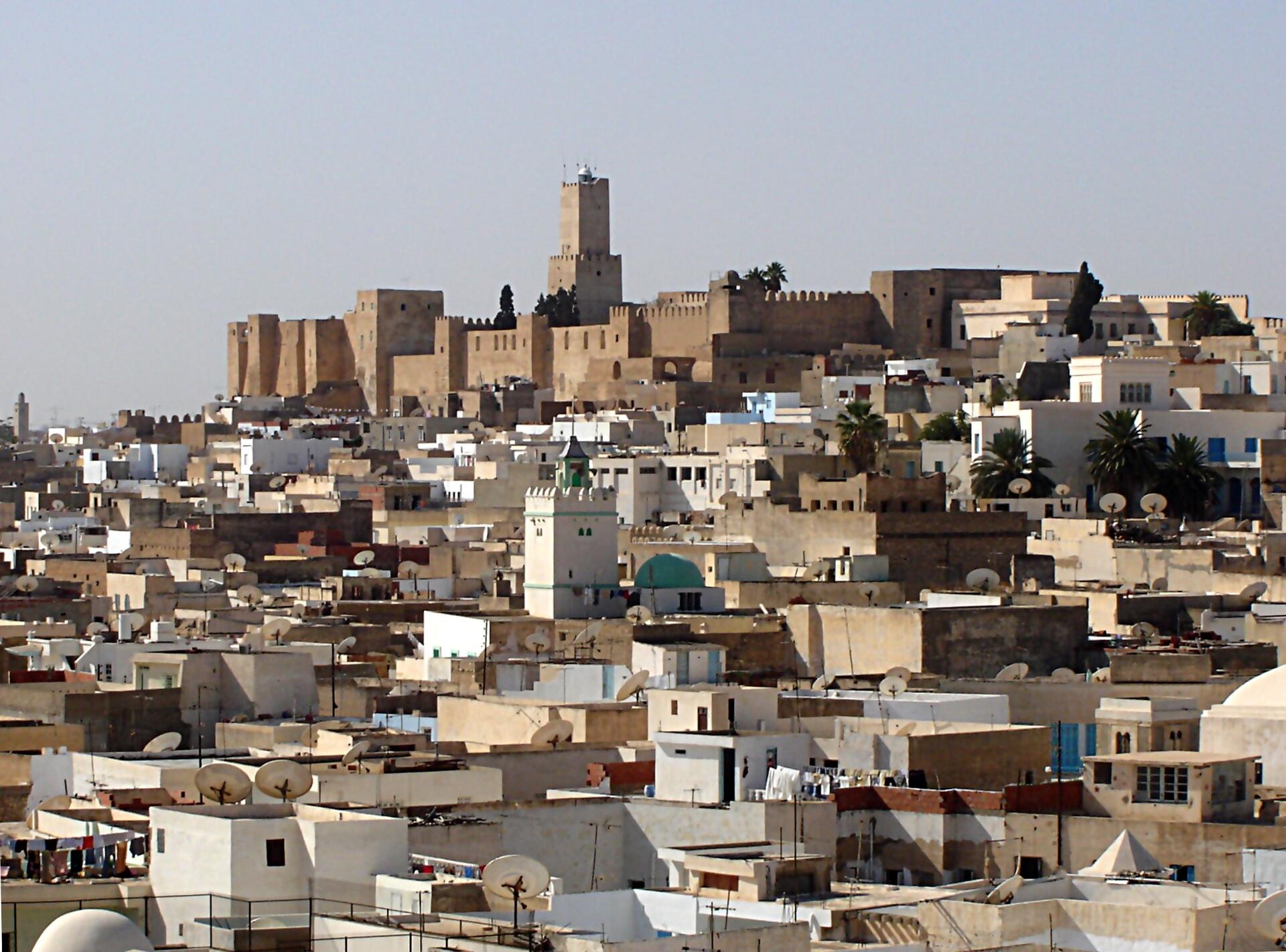
© BishkekRocks 15:01, 29 December 2005 (UTC), CC BY-SA 3.0 Resized from original. (This derivative is under the same CC BY-SA license.)
World Heritage Research
Discover scientific research and academic studies that deepen our understanding of Medina of Sousse from its history and significance to its conservation, management, and contemporary challenges.
-
Varias observaciones sobre el yacimiento arqueológico conocido como "Maison des/aux Banquettes" en Susa (Túnez)
Archaeological research on the 'Maison des/aux Banquettes' site in Sousse, Tunisia, reveals critical insights into its unique spatial arrangement and significance within the ancient city of Hadrumetum. Despite being discovered in 1968, this site remains understudied and overlooked, both by the public and authorities, exacerbating its deteriorating condition. The study highlights the urgent need for conservation efforts, as the site is located in the buffer zone of the UNESCO-listed Medina of Sousse. It also underscores the broader threat posed by urban expansion and globalization to the city's archaeological heritage, emphasizing the lack of governmental response to these pressures.
Hamrouni, M.-R., & Gharbi, Y. (2025). Several observations regarding the archaeological site known as “Maison des/aux Banquettes” in Sousse (Tunisia). Índice Histórico Español, (138), 67–97. https://doi.org/10.1344/ihe2025.138.4
View Publication Record | Read Publication -
Assessment of residential settlement planning in Medina, based on climate adaptability
Traditional urban morphology in the Medina of Sousse demonstrates remarkable climate adaptability, particularly in promoting natural ventilation, solar gain, and thermal comfort control. The study reveals that grouped houses arranged in linear blocks with courtyards are highly effective in semi-arid climates, reducing heat loss through exterior envelopes while maintaining comfortable indoor and outdoor environments, especially during summer months. This ancient urban planning model serves as a low-energy, low-carbon prototype for sustainable housing solutions. By analyzing design strategies such as daylighting and natural ventilation conditions, researchers provide insights that can guide future urban planners in preserving heritage while optimizing climate responsiveness.
Benzarti ep Ghedas, H., Abdelmajid, J., & Coloma Pico, E. (2023). Assessment of residential settlement planning in Medina, based on climate adaptability. E3S Web of Conferences, 418, 1002. https://doi.org/10.1051/e3sconf/202341801002
View Publication Record | Read Publication -
Reconversion du tribunal religieux « Dar Echaraa » dans la médina de Sousse (Tunisie) en un espace culturel contemporain
Dar Echaraa, a 17th-century religious tribunal in the Medina of Sousse, has undergone a remarkable transformation from a decaying judicial site to a thriving contemporary cultural hub. Once abandoned after Tunisia's secularization and legal reforms, this historic monument—characterized by its wide courtyard, ochre-stone walls, and intricate carvings—was restored through UNESCO-backed initiatives involving local and international collaborations. The study assesses the impacts of this requalification on the monument's heritage value and cultural significance. By comparing its former judicial function to its current role as a space for events, seminars, and leisure, the research highlights how architectural conversion has revitalized Dar Echaraa, turning it into a symbol of dynamic heritage preservation and community engagement.
Youssef, Z. (2022). Reconversion du tribunal religieux « Dar Echaraa » dans la médina de Sousse (Tunisie) en un espace culturel contemporain. In Situ, 48. https://doi.org/10.4000/insitu.36327
View Publication Record | Read Publication -
Recherches sur la résurgence du vocabulaire sémitique dans le langage religieux des provinces romaines d'Afrique : le cas du terme moctor
A recent analysis of a Latin inscription from the Medina of Sousse, Tunisia, reveals the resurgence of Semitic religious vocabulary in Roman Africa. The term moctor, identified as an unprecedented clerical function, is traced to the Semitic root KTR/QTR, meaning 'offering incense.' This finding suggests a cultural continuity between Phoenicio-Punic traditions and Roman religious practices in North Africa, particularly in cities with deep Phoenician roots. The study supports broader evidence of Semitic linguistic influence persisting in Roman provincial contexts, underscoring the enduring impact of ancient Near Eastern cults on local religious language.
Naddari, L., & Hamrouni, M. R. (2018). Recherches sur la résurgence du vocabulaire sémitique dans le langage religieux des provinces romaines d’Afrique : le cas du terme moctor. Libyan Studies, 49, 171–176. https://doi.org/10.1017/lis.2018.9
View Publication Record | Read Publication -
La ville européenne de Sousse : naissance d’un paysage urbain
French colonial urban planning in Sousse, Tunisia, demonstrated a heightened sensitivity to landscape design compared to other North African cities. This study reveals how the colonizing power intentionally crafted Sousse's European cityscape through meticulous archival analysis and iconographic examination of maps, postcards, architectural plans, and historical photographs. The research identifies three key aspects: the establishment and growth of European cities in North Africa, the distinct characteristics of Sousse's urban landscape, and its symbiotic relationship with the historic medina. By contrasting Sousse with other colonial cities, the study underscores the unique emphasis on visual and spatial aesthetics during French occupation.
Ghannouchi, A. (2012). La ville européenne de Sousse : naissance d’un paysage urbain. Projets de Paysage, 7. https://doi.org/10.4000/paysage.16949
View Publication Record | Read Publication