World Heritage Identification Number: 65
World Heritage since: 1979
Category: Cultural Heritage
WHE Type: Historic Cities & Urban Areas
Transboundary Heritage: No
Endangered Heritage: No
Country: 🇬🇹 Guatemala
Continent: Americas
UNESCO World Region: Latin America and the Caribbean
Map
A Historical Journey Through Antigua Guatemala: A UNESCO World Heritage Site
Antigua Guatemala, often simply referred to as Antigua, is a captivating city nestled in the central highlands of Guatemala. Established in the early 16th century, it served as the capital of the Captaincy General of Guatemala from 1543 until 1773, leaving behind an impressive legacy of Baroque-influenced architecture and urban planning. This rich historical heritage earned Antigua the designation as a UNESCO World Heritage Site in 1973.
More to come…UNESCO Description of the World Heritage Site
Antigua, the capital of the Captaincy-General of Guatemala, was founded in the early 16th century. Built 1,500 m above sea-level, in an earthquake-prone region, it was largely destroyed by an earthquake in 1773 but its principal monuments are still preserved as ruins. In the space of under three centuries the city, which was built on a grid pattern inspired by the Italian Renaissance, acquired a number of superb monuments.
UNESCO Justification of the World Heritage Site
Criterion (ii): Antigua Guatemala contains living traces of Spanish culture with its principal monuments, built in the Baroque style of the 18th century preserved today as ruins. Antigua Guatemala was a centre for the exportation of religious images and statues to the rest of the American continent and to Spain during the 17th and 18th centuries.
Criterion (iii): Antigua Guatemala is one the earliest and outstanding examples of city planning in Latin America in which the basic grid plan, dating from 1543, has been maintained. Its religious, private and government buildings are outstanding evidences of Spanish colonial architecture in Antigua.
Criterion (iv): The many churches and monasteries in Antigua Guatemala testify to the influence of the Christian church, during the colonial period, on every aspect of daily life in the city. Barroco antigueño developed in this area, a regional adaptation of the Baroque style designed to withstand the earthquakes common in the region.
Encyclopedia Record: Antigua Guatemala
Antigua Guatemala, commonly known as Antigua or La Antigua, is a city in the central highlands of Guatemala. The city was the capital of the Captaincy General of Guatemala from 1543 through 1773, with much of its Baroque-influenced architecture and layout dating from that period. Antigua Guatemala serves as the capital of the homonymous municipality and the Sacatepéquez Department.Additional Site Details
Area: Not available
Number of Components: 9
(iii) — Unique or exceptional testimony to a cultural tradition
(iv) — Outstanding example of a type of building or landscape
Coordinates: 14.556504 , -90.73381
Image
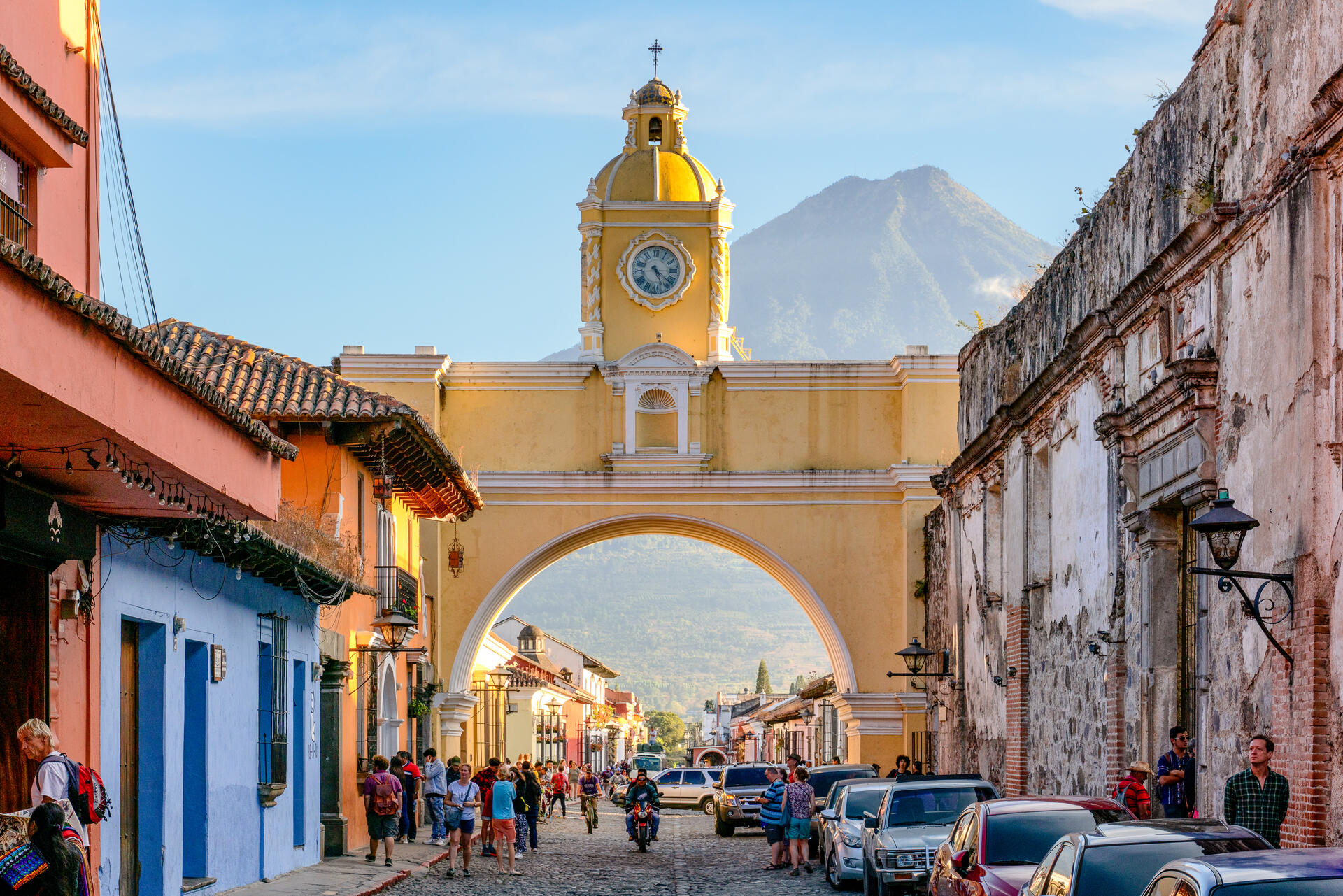
© Chad Davis, CC BY-SA 2.0 Resized from original. (This derivative is under the same CC BY-SA license.)
World Heritage Research
Discover scientific research and academic studies that deepen our understanding of Antigua Guatemala from its history and significance to its conservation, management, and contemporary challenges.
-
Antigua, Guatemala, Street Food Vendors
In Antigua, Guatemalastreet food vendors persist despite strict regulations, operating in what the study terms 'gray space.' This concept, drawn from urban theory (Lefebvre, Harvey), highlights how vendors navigate ambiguous legal boundaries through everyday practices. The research reveals that spatial permissibility allows these vendors to thrive, challenging formal city governance while fulfilling livelihood needs. Long-term ethnographic observations captured interactions among vendors, handicraft sellers, tourists, and officials, demonstrating that rights to the city are exercised informally yet effectively in public spaces.
Little, W. E. (2020). Antigua, Guatemala, Street Food Vendors. Revista Del CESLA: International Latin American Studies Review, (25), 209–232. https://doi.org/10.36551/2081-1160.2020.25.209-232
View Publication Record | Read Publication -
The Role of NGOs in Touristic Securitization: The Case of La Antigua Guatemala
NGOs play a dual role in touristic securitization, making Western tourists feel safe while inadvertently perpetuating inequalities and human insecurities for local, often indigenous, populations. This study focuses on La Antigua Guatemala, a key tourism destination, to analyze how international NGOs contribute to and engage in securing tourism. While they enhance tourist safety, the research reveals that touristic securitization reinforces existing power imbalances, particularly affecting poor Guatemalans whom NGOs aim to assist. The findings highlight how this process both reflects and exacerbates intersecting inequalities, creating distinct worlds of (in)security.
Becklake, S. (2019). The Role of NGOs in Touristic Securitization: The Case of La Antigua Guatemala. Space and Culture, 23(1), 34–47. https://doi.org/10.1177/1206331219871888
View Publication Record | Read Publication -
The Practices and Politics of Heritage in Antigua Guatemala
Heritage politics in Antigua Guatemala reveal how UNESCO and state regulations intersect with tourism economies, shaping urban aesthetics and everyday practices. The study finds that residents' heritage aesthetics, influenced by materiality and cultural performance, lead to unexpected political outcomes tied to economic activities. Using Latour's assemblage theory and Rancière's aesthetic regimes, the research interprets the heterogeneous contributions of the cityscape—particularly the Arch of Santa Catalina—to social, economic, and political dynamics. This approach demonstrates how heritage sites function as assemblages that articulate with daily practices, challenging conventional understandings of urban heritage management.
Little, W. E. (2018). The Practices and Politics of Heritage in Antigua Guatemala. Anthropological Quarterly, 91(4), 1269–1302. https://doi.org/10.1353/anq.2018.0065
View Publication Record | Read Publication -
Turismo y patrimonio: un plan integral para La Antigua Guatemala
La Antigua Guatemala faces significant challenges due to population growth, increased tourism, traffic congestion, inadequate monument protection, and environmental pollution. A Master Plan, financed by the Government of Canary Islands (Spain), was developed to address these issues. The study proposes La Antigua as a 'creative city,' aiming to diversify economic activities beyond tourism while mitigating urban speculation on agricultural land. The research reflects on methodological approaches, noting the lack of reliable urban planning information and cartography. It updates previous analyses on La Antigua's role as a tourist destination, highlighting its challenges, opportunities, and risks.
Martín Hernández, M., & Guerrero González, B. (2016). Turismo y patrimonio: un plan integral para La Antigua Guatemala. ACE: Architecture, City and Environment, 11(31), 157–176. https://doi.org/10.5821/ace.11.31.4654
View Publication Record | Read Publication -
Urban Economies and Spatial Governmentalities in the World Heritage City of Antigua, Guatemala
A new mobile form of street vending has emerged in Antigua, Guatemala, due to changes in municipal regulations and policing priorities. This study examines how spatial governmentality—both horizontal and vertical—shapes the economic practices of Maya street vendors within the UNESCO World Heritage City's sociopolitically constructed spaces. By applying Foucault’s concept of 'governmentality,' the research reveals that these governance dynamics influence why certain street economies persist while others evolve, offering insights into the interplay between urban regulation and informal economic adaptation.
Little, W. E. (2015). Urban Economies and Spatial Governmentalities in the World Heritage City of Antigua, Guatemala. Economic Anthropology, 2(1), 42–62. Portico. https://doi.org/10.1002/sea2.12017
View Publication Record | Read Publication -
Police and Security in the World Heritage City of Antigua, Guatemala
Antigua, Guatemala faces growing security challenges that contradict its image as a tranquil colonial city. Research reveals that both locals and tourists are increasingly concerned about crime, particularly tourism-related offenses and drug trafficking, which the city was ill-prepared to handle. The study employs ethnographic methods, focusing on police dynamics, to explore the ambiguous attitudes of Antigüeños and Maya communities toward law enforcement. It highlights how tourism's lens interacts with policing, challenging perceptions shaped by the site's heritage status. The findings draw on theories of 'spectacle' (Debord), 'state of exception' (Agamben), and 'system nervous' (Taussig) to contextualize these tensions within a transnational tourist framework.
Little, W. E. (2014). Police and Security in the World Heritage City of Antigua, Guatemala. The Journal of Latin American and Caribbean Anthropology, 19(3), 396–417. Portico. https://doi.org/10.1111/jlca.12102
View Publication Record | Read Publication -
Contribución de los cafetales bajo sombra en la conservación de murciélagos en la Antigua Guatemala, Guatemala
A study in Antigua Guatemala revealed that shaded coffee plantations, while supporting a diverse array of bat species, may not fully function as ecological corridors for forest-dwelling bats. Researchers found that while both shaded coffee plantations and remaining forest habitats hosted 12 bat species, the composition differed significantly: plantations favored generalist frugivorous species like Artibeus, Dermanura, and Sturnira, whereas forests harbored more specialized and landscape-sensitive species such as Phyllostomus discolor and Myotis keaysi. Despite no significant difference in overall diversity between habitats, the study estimated a 42% complementarity index, suggesting limited overlap in bat communities. This indicates that while shaded coffee plantations contribute to bat conservation, they may not effectively connect forest patches for certain species.
Kraker-Castañeda, C., & Pérez-Consuegra, S. G. (2011). Contribución de los cafetales bajo sombra en la conservación de murciélagos en la Antigua Guatemala, Guatemala. Acta Zoológica Mexicana (N.S.), 27(2), 291–303. https://doi.org/10.21829/azm.2011.272754
View Publication Record | Read Publication