World Heritage Identification Number: 1686
World Heritage since: 2023
Category: Natural Heritage
WHE Type: Natural Landscapes & Geographic Features
Transboundary Heritage: No
Endangered Heritage: No
Country: 🇨🇦 Canada
Continent: Americas
UNESCO World Region: Europe and North America
Map
Anticosti Island: A Palaeontological Treasure Trove
Anticosti Island, located in the Gulf of St. Lawrence, off the coast of Quebec, Canada, is a unique and significant geological site that offers a remarkable glimpse into Earth's ancient past. Inscribed as a UNESCO World Heritage Site in 2023, Anticosti stands out as the most complete and best-preserved palaeontological record of the first mass extinction of animal life, which occurred approximately 447-437 million years ago.
More to come…UNESCO Description of the World Heritage Site
Situated on the island of Anticosti, the largest island in Quebec, this property is the most complete and best preserved palaeontological record of the first mass extinction of animal life, 447-437 million years ago. It contains the best preserved fossil record of marine life covering 10 million years of Earth history. The abundance, diversity, and exquisite preservation of the fossils are exceptional and allow for world-class scientific work. Thousands of large bedding surfaces allow the observation and study of shell and sometimes soft-bodied animals that lived on the shallow sea floor of an ancient tropical sea.UNESCO Justification of the World Heritage Site
Criterion (viii): Anticosti is the best natural laboratory in the world for the study of fossils and sedimentary strata from the first mass extinction of life, at the end of the Ordovician period, which represents an important milestone in the history of Earth. It contains the largest stratigraphic record in thickness and the most complete, and best-preserved fossil record of marine life covering 10 million years of Earth history, from the Upper Ordovician to the Lower Silurian, 447-437 million years ago. The abundance, diversity, and state of conservation of the fossils are exceptional and allow for world-class scientific work. Thousands of large bedding surfaces allow the observation and study of shell and sometimes soft-bodied animals that lived on the shallow sea floor of an ancient tropical sea. These animals were buried by the continual passage of strong storms, which completely preserved the organisms and the ecological structure of the ancient marine communities. The exquisite preservation of the fossil shells allows the analysis of their geochemical composition to identify ancient climatic and oceanographic signals, and to study in depth the causes of the mass extinction of life at the end of the Ordovician period.
Encyclopedia Record: Anticosti Island
Anticosti Island is a large but sparsely populated island belonging to the Canadian province of Quebec. It lies in the Gulf of St. Lawrence, and is separated from mainland Quebec by the Jacques Cartier and Honguedo straits. Administratively, it forms a municipality of the Côte-Nord region.Additional Site Details
Area: 18,240 hectares
Number of Components: 1
Coordinates: 49.5386111111 , -63.2452777778
IUCN World Heritage Outlook
The 2025 Conservation Outlook on Anticosti reports the following assessment:
Source: International Union for Conservation of Nature (IUCN) · View assessment
Image
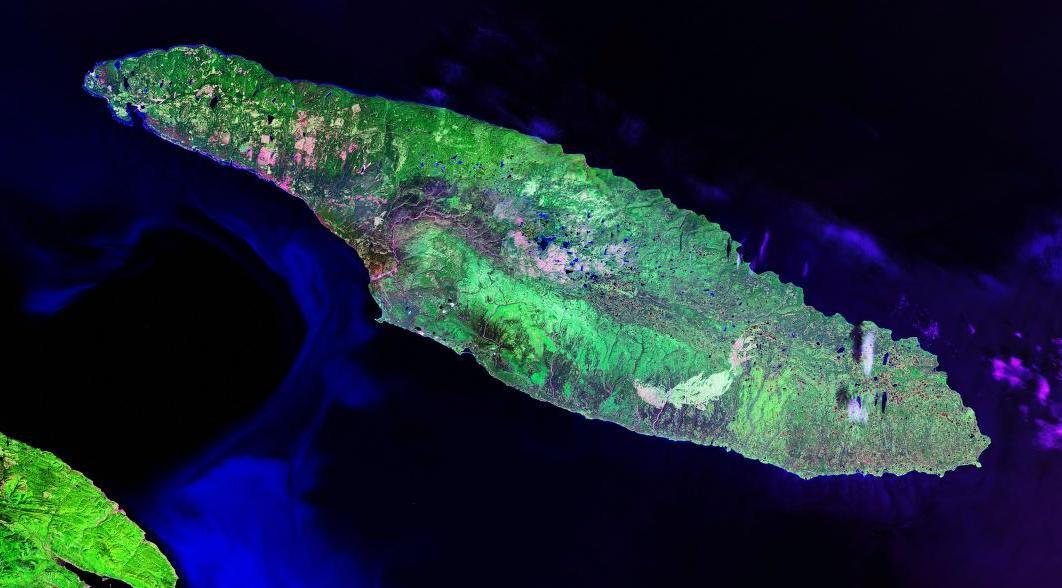
NASA, Public domain
World Heritage Research
Discover scientific research and academic studies that deepen our understanding of Anticosti from its history and significance to its conservation, management, and contemporary challenges.
-
Terminal Ordovician carbon isotope stratigraphy and glacioeustatic sea-level change across Anticosti Island (Quebec, Canada)
A detailed carbon isotope analysis of Ordovician-Silurian boundary strata on Anticosti Island, Quebec, reveals that the Hirnantian positive carbon isotope excursion—characteristic of global records—peaks at ~4.5‰ in carbonate rocks. This excursion, coupled with glacioeustatic sea-level fluctuations, suggests that sea-level drawdown and subsequent rise were not perfectly synchronized with the isotopic shift. The study proposes that the entire Hirnantian Stage on Anticosti is confined to the Laframboise and lower Fox Point Members, supported by a combined litho- and chemostratigraphic approach. Discontinuities in the isotope curve across proximal-to-distal transects further indicate diachroneity in sedimentary deposits, with oncolite beds transgressing westward while Becscie limestones prograded eastward. The findings align with the 'weathering' hypothesis for the Hirnantian carbon isotope excursion, providing insights into terminal Ordovician climate dynamics.
Jones, D. S., Fike, D. A., Finnegan, S., Fischer, W. W., Schrag, D. P., & McCay, D. (2011). Terminal Ordovician carbon isotope stratigraphy and glacioeustatic sea-level change across Anticosti Island (Quebec, Canada). Geological Society of America Bulletin, 123(7-8), 1645–1664. https://doi.org/10.1130/b30323.1
View Publication Record | Read Publication -
Chitinozoan biostratigraphy of a new Upper Ordovician stratigraphic framework for Anticosti Island, Canada
A new Upper Ordovician stratigraphic framework for Anticosti Island, Canada, reveals significant east-west correlations between the Ellis Bay and Vauréal formations, resolving long-standing discrepancies. Chitinozoan biostratigraphy demonstrates that most strata of the Ellis Bay Formation at the eastern end correlate with the mid-upper Vauréal Formation in the west, while the Schmitt Creek and Mill Bay members of the Vauréal are older than the uppermost Vauréal eponym members. The study also identifies a Hirnantian age for the gamachiana Zone and provides insights into the timing and magnitude of the Hirnantian Isotopic Carbon Excursion (HICE), aligning with global stratigraphic data from China and Scotland. This research integrates chitinozoan, geochemical, sedimentological, and sequence stratigraphic data to refine understanding of Upper Ordovician stratigraphy.
Achab, A., Asselin, E., Desrochers, A., Riva, J. F., & Farley, C. (2010). Chitinozoan biostratigraphy of a new Upper Ordovician stratigraphic framework for Anticosti Island, Canada. Geological Society of America Bulletin, 123(1-2), 186–205. https://doi.org/10.1130/b30131.1
View Publication Record | Read Publication