World Heritage Identification Number: 1671
World Heritage since: 2023
Category: Cultural Heritage
WHE Type: Buildings & Architectural Ensembles
Transboundary Heritage: No
Endangered Heritage: No
Country: 🇮🇩 Indonesia
Continent: Asia
UNESCO World Region: Asia and the Pacific
Map
The Cosmological Axis of Yogyakarta: A Cultural and Spiritual Journey
The Cosmological Axis of Yogyakarta, inscribed as a UNESCO World Heritage Site in 2023, is a unique and captivating testament to the rich cultural heritage of Java, Indonesia. This six-kilometer north-south axis, positioned to link Mount Merapi and the Indian Ocean, serves as the spiritual and political heart of Yogyakarta, a city renowned for its classical Javanese arts and culture.
More to come…UNESCO Description of the World Heritage Site
The central axis of Yogyakarta was established in the 18th century by Sultan Mangkubumi, and has continued from that time as a centre of government and Javanese cultural traditions. The six kilometre north-south axis is positioned to link Mount Merapi and the Indian Ocean, with the Kraton (palace) at its centre, and key cultural monuments lining the axis to the north and south that are connected through rituals. It embodies key beliefs about the cosmos in Javanese culture, including the marking of the cycles of life.UNESCO Justification of the World Heritage Site
Criterion (ii): The Cosmological Axis of Yogyakarta and its Historic Landmarks exhibits an important interchange of human values and ideas between different belief systems related to Javanese animism and ancestor worship, Hinduism and Buddhism from India, Sufi Islam from either India or the Middle East, and Western influences, which were adapted and integrated into the beliefs and culture of the Mataram Kingdoms over hundreds of years. This important and complex interchange of values is demonstrated by the tangible and intangible attributes of the cultural ensemble evident in the property’s spatial planning, architecture and monuments, as well as ceremonies and festivals.
Criterion (iii): The Cosmological Axis of Yogyakarta and its Historic Landmarks bears an exceptional testimony to Javanese civilisation and living cultural traditions after the 16th century. The Sultanate of Ngayogyakarta Hadiningrat remains the centre for Javanese civilisation and its maintenance and development through the cultural traditions and practices including governance, customary law (paugeran), arts, literature, festivals, and ceremonies. The property is associated with Javanese rituals relating to the cycle of life, venerating ancestors, coronations and royal occasions, Islamic days, and connection with the forces of nature. The Tata Rakiting Wewangunan concept has its origins in Mataram Royal courts since the 16th century and refers to the holistic management of the tangible and intangible aspects of the Sultanate of Ngayogyakarta Hadiningrat, including the uses of space along the axis and in the Kraton Complex.
Encyclopedia Record: Yogyakarta
Yogyakarta is the capital city of the Special Region of Yogyakarta in Indonesia, in the south-central part of the island of Java. As the only Indonesian royal city still ruled by a monarchy, Yogyakarta is regarded as an important centre for classical Javanese fine arts and culture such as ballet, batik textiles, drama, literature, music, poetry, silversmithing, visual arts, and wayang puppetry. Renowned as a centre of Indonesian education, Yogyakarta is home to a large student population and dozens of schools and universities, including Gadjah Mada University, the country's largest institute of higher education and one of its most prestigious.Additional Site Details
Area: 42.22 hectares
Number of Components: 1
(iii) — Unique or exceptional testimony to a cultural tradition
Coordinates: -7.8013888889 , 110.3647777778
Image
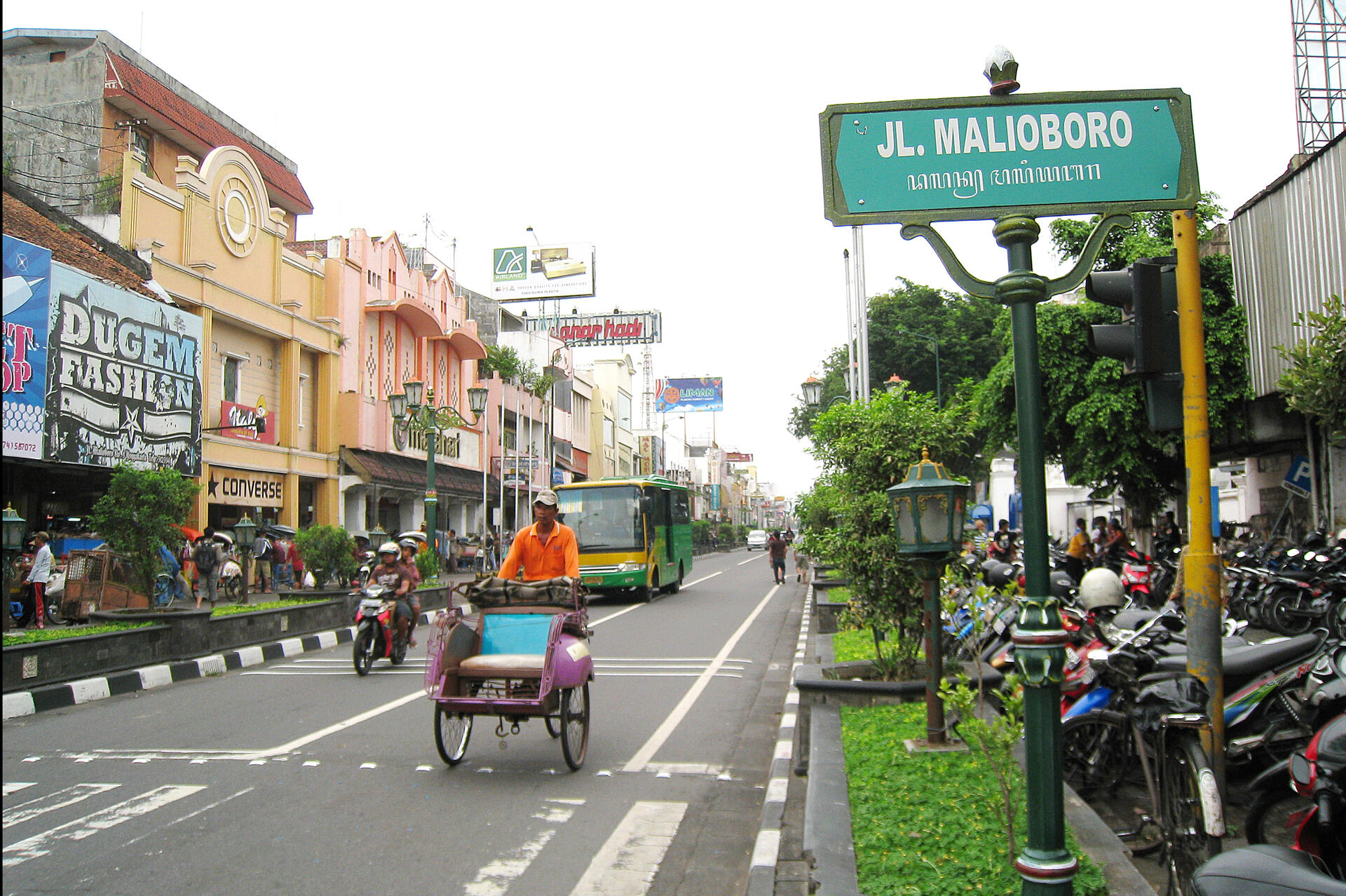
© Gunawan Kartapranata, CC BY-SA 3.0 Resized from original. (This derivative is under the same CC BY-SA license.)
World Heritage Research
Discover scientific research and academic studies that deepen our understanding of The Cosmological Axis of Yogyakarta and its Historic Landmarks from its history and significance to its conservation, management, and contemporary challenges.
-
Application of Singular Value Decomposition for Image Compression of Yogyakarta Cosmological Axis in Digital Learning in Vocational Education
Research demonstrates that Singular Value Decomposition (SVD) is an effective method for compressing high-resolution images of the Yogyakarta Cosmological Axis without significantly degrading visual quality. The study found that most critical visual information can be retained using only a small number of dominant singular values, allowing for substantial file size reduction while preserving key details like object contours and structural characteristics. This enables efficient storage and transmission in digital learning systems, supporting vocational education with high-quality yet compact visual media. The approach balances compression ratio with image fidelity, as measured by Mean Squared Error (MSE), Peak Signal-to-Noise Ratio (PSNR), Structural Similarity Index (SSIM), and Compression Ratio (CR). These findings validate SVD as a robust tool for developing contextually relevant digital learning resources.
Sahria, Y., Sudira, P., & Salim, M. H. M. (2026). Application of Singular Value Decomposition for Image Compression of Yogyakarta Cosmological Axis in Digital Learning in Vocational Education. International Journal of Engineering, Science and Information Technology, 6(1), 11–22. https://doi.org/10.52088/ijesty.v6i1.1732
View Publication Record | Read Publication -
Territorial claims and the privatization of public spaces in the Tugu Yogyakarta heritage area
Research on the Cosmological Axis of Yogyakarta reveals that public spaces within heritage areas, such as Margo Utomo Street near Tugu Yogyakarta, are increasingly privatized by food vendors and customers through territorial claims. These claims, marked by both physical and non-physical elements, create a social gap between paid and unpaid spaces, altering spatial patterns and the symbolic meaning of the site. The study identifies two typologies of privatization: one driven by vendors personalizing their workspaces and another by customers marking their movement areas. This shift poses challenges to the site's sustainability and philosophical significance, highlighting the need for inclusive urban planning to preserve cultural and spatial integrity. The research applied a qualitative case study approach using Altman’s concept of public territory to analyze these dynamics.
Wiyatiningsih, Respati, A. D., Mandayu, C. O., & Hartono, S. (2026). Territorial claims and the privatization of public spaces in the Tugu Yogyakarta heritage area. ARTEKS : Jurnal Teknik Arsitektur, 11(1), 239–248. https://doi.org/10.30822/arteks.v11i1.4828
View Publication Record | Read Publication -
Transformation of Management of the Cultural Landscape of the Yogyakarta Special Region
A study reveals that the management of Yogyakarta's cultural landscape, following UNESCO's 2023 inscription of the Cosmological Axis of Philosophy, risks disrupting historical continuity due to a focus on physical restoration rather than community engagement. Despite adopting Historic Urban Landscape (HUL) principles, current practices fail to reflect its core tenets. The research, employing case studies and literature reviews, demonstrates that Yogyakarta's cultural landscape has evolved through spatial and political processes, driven by the Yogyakarta Specialty Law. It suggests that integrating HUL's six-phase identification with the Yogyakarta Strategic Regional Development instrument could bridge power structures and communities, but requires a new ad-hoc institution to ensure effective implementation.
Sudrajad, R. A., & Achmadi, A. (2026). Transformation of Management of the Cultural Landscape of the Yogyakarta Special Region. Heritage & Society, 1–39. https://doi.org/10.1080/2159032x.2026.2706474
View Publication Record | Read Publication -
Managing Viewpoints Priority for Heritage Sites' Visual Integrity: A Case Study of the Cosmological Axis of Yogyakarta
A study on the Cosmological Axis of Yogyakarta (CAY) reveals that visual integrity, crucial for Outstanding Universal Value (OUV), is not solely dependent on geometric alignment but also on visual clarity and legibility. The research identifies 32 priority viewpoints from an initial 42 GIS-mapped points, proposing a three-tier classification system to guide heritage management amid urban development pressures. This approach combines spatial analysis, field observations, and expert validation, addressing the lack of standardized technical parameters for viewpoint prioritization in World Heritage Sites.
Prabowo, J. H., & Pramitasari, D. (2026). Managing Viewpoints Priority for Heritage Sites’ Visual Integrity: A Case Study of the Cosmological Axis of Yogyakarta. Civil Engineering and Architecture, 14(4), 3307–3321. https://doi.org/10.13189/cea.2026.140437
View Publication Record | Read Publication -
Sustainable mobility as a climate adaptation response in protected world heritage areas using Perception of Outstanding Universal Value: The Case of Cosmological Axis of Yogyakarta Indonesia
Sustainable mobility solutions, such as low-emission public transportation and expanded pedestrian infrastructure, can effectively mitigate traffic-related emissions while preserving the Outstanding Universal Value (OUV) of UNESCO World Heritage Sites. A study on the Cosmological Axis of Yogyakarta, designated in 2023, demonstrates that targeted interventions—such as low-emission zones and improved transit networks—can address congestion hotspots without compromising cultural or ecological integrity. Researchers used geospatial analysis, emission modeling, and stakeholder surveys to identify critical traffic patterns and air quality risks, revealing that while most areas remain stable, high-congestion zones require urgent action. These findings provide actionable strategies for urban planners and policymakers to balance climate adaptation with heritage preservation in rapidly urbanizing protected areas.
Kresnanto, N. C., Putri, W. H., Raharti, R., & Luthfiana, D. N. (2025). Sustainable mobility as a climate adaptation response in protected world heritage areas using Perception of Outstanding Universal Value: The Case of Cosmological Axis of Yogyakarta Indonesia. BIO Web of Conferences, 155, 7004. https://doi.org/10.1051/bioconf/202515507004
View Publication Record | Read Publication -
Local Government Social Media Strategy for Public Awareness and Heritage Preservation
A local government's social media strategy for the UNESCO-listed Cosmological Axis of Yogyakarta demonstrates effective public engagement in heritage preservation. By leveraging Instagram, the approach combines visually engaging narratives, infographics, and live event coverage to segment content for residents, tourists, and cultural enthusiasts. This method bridges traditional Javanese cosmological values with modern digital communication techniques, providing a replicable model for preserving heritage sites in the digital age. The study employed qualitative methodologies, including in-depth interviews, observations, and focus group discussions, to analyze the strategy's impact on awareness and preservation efforts.
Ayu Ardhanariswari, K., Hendariningrum, R., Rachmawati, I., & Wahyu Pratiwi, K. (2025). Local Government Social Media Strategy for Public Awareness and Heritage Preservation. SHS Web of Conferences, 212, 4039. https://doi.org/10.1051/shsconf/202521204039
View Publication Record | Read Publication -
Daily needs stores in the collective memory and living heritage of Malioboro, Yogyakarta city, Indonesia
Retail stores selling daily necessities, which operated in Malioboro, Yogyakarta between 1950 and 2010, constitute a significant part of the area's collective memory and contribute to its multicultural folk heritage. This finding highlights the importance of preserving intangible cultural elements alongside tangible ones in this UNESCO-recognized cosmological axis. The study employed qualitative methods including observation, semi-structured interviews, and cognitive mapping with 27 informants from nine subdistricts around Malioboro. It reveals how elderly residents' narratives shape Malioboro's living heritage, emphasizing the need for a commodity-based spatial configuration that balances daily needs and tourism-related products to support both heritage preservation and commercial sustainability.
Pramitasari, D., Anggi, M., Isnaemi, L. D., & Gultom, Y. Z. (2025). Daily needs stores in the collective memory and living heritage of Malioboro, Yogyakarta city, Indonesia. Journal of Asian Architecture and Building Engineering, 25(5), 4507–4522. https://doi.org/10.1080/13467581.2025.2540081
View Publication Record | Read Publication