World Heritage Identification Number: 592
World Heritage since: 1991
Category: Cultural Heritage
WHE Type: Religious Sites & Sacred Architecture
Transboundary Heritage: No
Endangered Heritage: No
Country: 🇮🇩 Indonesia
Continent: Asia
UNESCO World Region: Asia and the Pacific
Map
Exploring the Majestic Borobudur Temple Compounds: A Journey Through Time and Culture
The Borobudur Temple Compounds, inscribed as a UNESCO World Heritage Site in 1991, stand as a testament to the rich cultural and spiritual heritage of Indonesia. Located in the heart of Central Java, these temples offer a remarkable fusion of art, architecture, and religious symbolism that continues to captivate visitors from around the world.
The site is situated in a particularly dramatic landscape, flanked by two twin volcanic ranges—Sundoro–Sumbing to the west and Merbabu–Merapi to the east. Comprising three main temples—Borobudur, Mendut Temple, and Pawon Temple—the Borobudur Temple Compounds are aligned along a roughly straight axis, a feature often associated with their shared origins during the Shailendra dynasty between the 8th and 9th centuries CE.
The most renowned of the trio is Borobudur itself, a monumental structure that exemplifies the ingenuity of ancient Javanese artisans. Built upon a stepped, pyramid-like base with five square terraces, the temple rises into three circular platforms before culminating in a large central stupa. The walls and balustrades are adorned with over 2,500 intricately carved relief panels, depicting scenes from the Jatakas—the stories of the previous lives of the Gautama Buddha—as well as narratives from Buddhist cosmology. These carvings provide profound insight into the spiritual and philosophical worldview of the time.
The architectural design of Borobudur reflects a symbolic representation of the Buddhist universe. The lower levels correspond to Kamadhatu, the realm of desire; the middle terraces represent Rupadhatu, the world of form; and the upper circular platforms embody Arupadhatu, the formless realm of enlightenment. Ascending the monument thus mirrors the spiritual journey toward liberation. At the summit, 72 openwork stupas encircle the central dome, each containing a serene Buddha statue, reinforcing the site’s meditative and symbolic significance.
The construction of the Borobudur Temple Compounds reflects remarkable engineering sophistication for its time. Built primarily from andesite stone without mortar, the structure relies on precisely interlocking blocks that ensure stability despite its immense scale. It also incorporates an advanced drainage system, with hidden channels and spouts designed to manage the region’s heavy tropical rainfall.
Located approximately two kilometers to the east, Mendut Temple complements Borobudur with its own distinctive features. Inside, a large seated Buddha is flanked by the Bodhisattva Avalokiteshvara and Vajrapani, reflecting important aspects of Mahayana Buddhist belief. Further along the axis lies Pawon Temple, a smaller yet elegant structure whose precise function remains a subject of scholarly interpretation.
Beyond their architectural brilliance, the temples illustrate the far-reaching cultural and religious exchanges that shaped Southeast Asia during this period. The Borobudur complex stands as a testament to the spread and adaptation of Buddhism across the region, as well as to the sophisticated artistic and engineering capabilities of its builders.
Although Borobudur is best known today as an ancient monument, it also functions as a living spiritual landscape. Each year, Buddhist pilgrims follow a ceremonial route from Mendut Temple through Pawon Temple to Borobudur during Vesak celebrations, commemorating the birth, enlightenment, and passing of the Buddha. This modern ritual reflects the temple’s enduring religious significance.
However, this continuity was not uninterrupted. Following the decline of the Shailendra-era Buddhist kingdoms and later shifts in Java’s political and religious landscape—including the gradual rise of Islam—the temple complex was eventually abandoned. Over time, it became obscured by volcanic ash and dense vegetation, likely influenced by eruptions of nearby Mount Merapi.
After centuries of neglect, Borobudur underwent a major restoration effort in the 20th century, led by UNESCO in collaboration with the Indonesian government. Today, the site attracts more than one million visitors each year, serving both as a place of pilgrimage and as one of the world’s most significant cultural landmarks.
Altogether, the Borobudur Temple Compounds represent more than monumental architecture; they embody the spiritual ideals of wisdom, compassion, and enlightenment central to Buddhist philosophy. Exploring these temples offers not only a journey through history but also a deeper understanding of the cultural and spiritual traditions that continue to shape Indonesia and the wider world.
UNESCO Description of the World Heritage Site
This famous Buddhist temple, dating from the 8th and 9th centuries, is located in central Java. It was built in three tiers: a pyramidal base with five concentric square terraces, the trunk of a cone with three circular platforms and, at the top, a monumental stupa. The walls and balustrades are decorated with fine low reliefs, covering a total surface area of 2,500 m2. Around the circular platforms are 72 openwork stupas, each containing a statue of the Buddha. The monument was restored with UNESCO's help in the 1970s.
UNESCO Justification of the World Heritage Site
Criterion (i): Borobudur Temple Compounds with its stepped, unroofed pyramid consisting of ten superimposing terraces, crowned by a large bell-shaped dome is a harmonious marriage of stupas, temple and mountain that is a masterpiece of Buddhist architecture and monumental arts.
Criterion (ii): Borobudur Temple Compounds is an outstanding example of Indonesia’s art and architecture from between the early 8th and late 9th centuries that exerted considerable influence on an architectural revival between the mid-13th and early 16th centuries.
Criterion (vi): Laid out in the form of a lotus, the sacred flower of Buddha, Borobudur Temple Compounds is an exceptional reflection of a blending of the very central idea of indigenous ancestor worship and the Buddhist concept of attaining Nirvana. The ten mounting terraces of the entire structure correspond to the successive stages that the Bodhisattva has to achieve before attaining to Buddhahood.
Encyclopedia Record: Borobudur Temple Compounds
Borobudur Temple Compounds is the World Heritage designation of the area of three Buddhist temples in Central Java, Indonesia. It comprises Borobudur, Mendut, and Pawon. The temples were built during the Shailendra dynasty around the 8th and 9th centuries CE and fall on a straight line.Additional Site Details
Area: 25.51 hectares
Number of Components: 3
(ii) — Significant interchange of human values
(vi) — Directly associated with events or living traditions
Coordinates: -7.60778 , 110.20361
Image
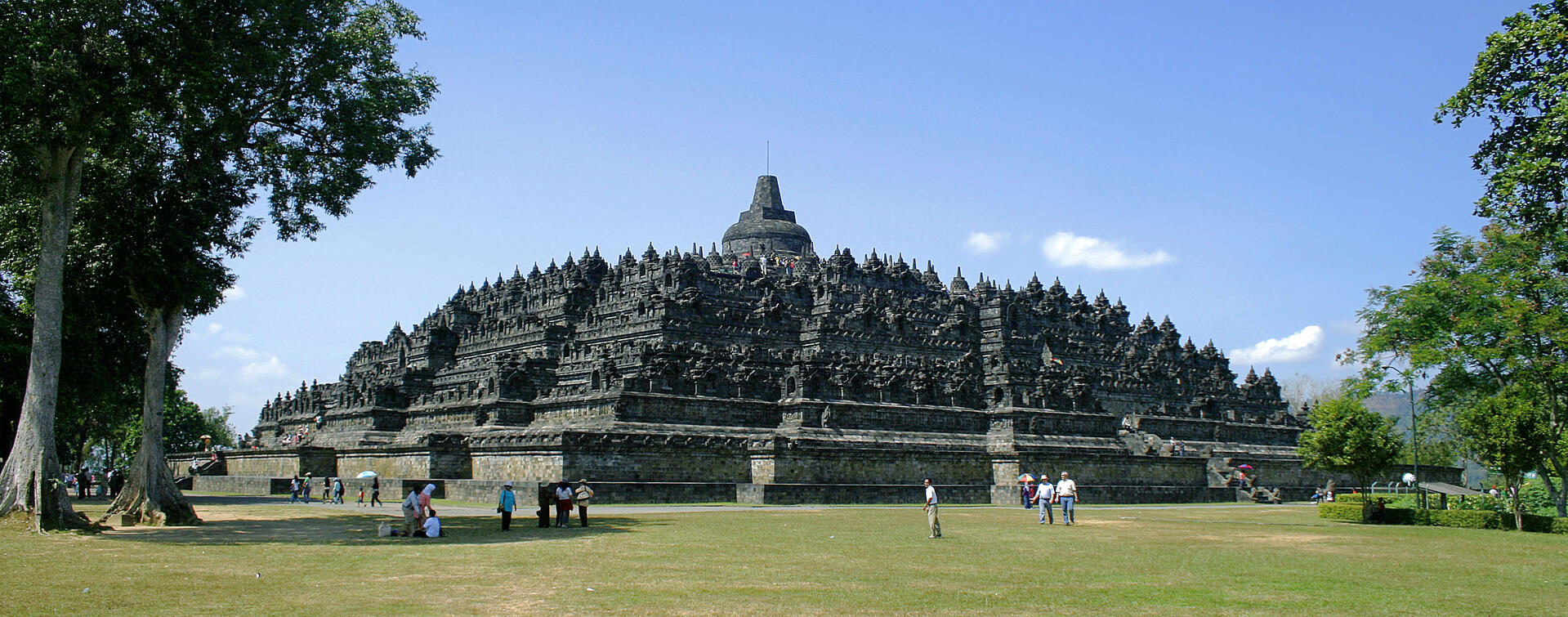
© Gunawan Kartapranata, CC BY-SA 3.0 Resized from original. (This derivative is under the same CC BY-SA license.)
World Heritage Research
Discover scientific research and academic studies that deepen our understanding of Borobudur Temple Compounds from its history and significance to its conservation, management, and contemporary challenges.
-
The Effect of Service Quality and Heritage Tourism on Tourist Loyalty: The Case of Borobudur Temple
Tourist loyalty to Borobudur Temple is significantly influenced by service quality and price, with responsiveness and tangibles playing key roles. A study of 248 domestic and international visitors found that high satisfaction from responsive service and competitive pricing directly enhances loyalty. While communication quality impacts satisfaction, tangible elements like physical infrastructure are crucial for fostering long-term visitor attachment. These insights suggest that refining service delivery—particularly in responsiveness and price management—could boost Borobudur’s appeal as a UNESCO World Heritage Site, aligning with its potential to rival destinations like Angkor Wat.
Sasongko, G., Kameo, D. D., Siwi, V. N., Wahyudi, Y., & Huruta, A. D. (2025). The Effect of Service Quality and Heritage Tourism on Tourist Loyalty: The Case of Borobudur Temple. Heritage, 8(2), 77. https://doi.org/10.3390/heritage8020077
View Publication Record | Read Publication -
Auditory Experience Identification Through Soundscape Approach in Borobudur Temple
Research at Borobudur Temple, a UNESCO World Heritage site in Central Java, reveals that the auditory environment significantly shapes visitor experiences. The study identifies key soundscape elements and their perceptual impact on visitors, using field measurements of sound intensity and adapted questionnaires based on ISO/TS 12913-2 standards. Findings highlight how acoustic attributes influence cultural perception, offering a foundation for soundscape management strategies to enhance visitor engagement while preserving the site's auditory heritage.
Ola, F. B., & Kristi, I. C. (2025). Auditory Experience Identification Through Soundscape Approach in Borobudur Temple. International Journal of Architecture and Urbanism, 9(1), 120–130. https://doi.org/10.32734/ijau.v9i1.18259
View Publication Record | Read Publication -
Design and Development of a Smart Tourism Mobile Application for Borobudur: A Pilot Study
A pilot study of a smart tourism mobile application for Borobudur Temple Compounds, a UNESCO World Heritage site, revealed significant usability flaws despite its potential to enhance visitor experience. The app, designed with interactive maps and informational features, was tested using predefined scenarios and evaluated against ISO 9241-11 standards. While basic information functions performed well, navigation errors and user frustration were high, indicating marginal usability (average SUS score of 62.9). This data-driven analysis highlights critical design shortcomings while offering actionable insights for iterative development in cultural heritage tourism technology.
Nurcahyo, R. S., Habibi, Moh., Pratama, A. R., Nugroho, L. E., Fahlesi, H. F., & Fuady, I. N. (2025). Design and Development of a Smart Tourism Mobile Application for Borobudur: A Pilot Study. 2025 9th International Conference on Information Technology, Information Systems and Electrical Engineering (ICITISEE), 305–310. https://doi.org/10.1109/icitisee68184.2025.11355092
View Publication Record | Read Publication -
Aspect-Based Sentiment Analysis of Borobudur Temple Reviews Use Support Vector Machine Algorithm
An analysis of Borobudur Temple reviews reveals that accessibility and visual image are the most critical aspects needing improvement to enhance visitor satisfaction. Using Support Vector Machine (SVM) algorithm, researchers identified these areas as having the highest concentration of negative sentiment, which could significantly impact tourism growth. The study highlights the importance of aspect-based sentiment analysis in managing tourist attractions effectively. However, the model's accuracy was limited to 0.8148 due to imbalanced data distribution across aspects and reviews.
Yudianto, M. R. A., Sukmasetya, P., Hasani, R. A., & Maimunah. (2024). Aspect-Based Sentiment Analysis of Borobudur Temple Reviews Use Support Vector Machine Algorithm. E3S Web of Conferences, 500, 1005. https://doi.org/10.1051/e3sconf/202450001005
View Publication Record | Read Publication -
Cultural, nutritional and microbial perspectives of tuak, a traditional Balinese beverage
Tuak, a traditional Balinese palm wine, stands as a culturally significant and economically valuable beverage deeply rooted in Indonesian history. This review reveals its complex nutritional profile, rich in monosaccharides (glucose, fructose), disaccharides (sucrose, maltose), organic acids, bioactive compounds (saponins, phenols, terpenoids, alkaloids, flavonoids), minerals, alcohols, and aromatic compounds. Microbial analysis highlights the dominant role of Saccharomyces cerevisiae, Saccharomyces chevalieri, Zymomonas mobilis, and Candida tropicalis in its fermentation process, derived from ambient air and plant-associated microbes. The study combines desktop research with field surveys to explore tuak's socio-economic importance, cultural heritage, and potential for tourism development while addressing challenges in quality improvement and economic value enhancement. This comprehensive perspective offers insights into preserving traditional beverage production and celebrating cultural heritage.
Wijaya, L., Sumerta, I. N., Napitupulu, T. P., Kanti, A., Keim, A. P., Howell, K., & Sudiana, I. M. (2024). Cultural, nutritional and microbial perspectives of tuak, a traditional Balinese beverage. Journal of Ethnic Foods, 11(1). https://doi.org/10.1186/s42779-024-00221-x
View Publication Record | Read Publication -
Enhancing Sentiment Analysis Accuracy in Borobudur Temple Visitor Reviews through Semi-Supervised Learning and SMOTE Upsampling
A sentiment analysis model for Borobudur Temple visitor reviews achieved an accuracy rate of 83.68% after applying the Synthetic Minority Oversampling Technique (SMOTE). This represents a significant improvement over the initial accuracy of 60.59%, demonstrating the effectiveness of SMOTE in enhancing sentiment analysis outcomes. The study employed a semi-supervised learning approach, partitioning data into labeled and unlabeled sets for automatic labeling using the Multinomial Naïve Bayes algorithm. Preprocessing steps included data cleaning, tokenization, and stop word removal. These findings suggest that SMOTE upsampling can substantially refine sentiment analysis in tourist reviews, with potential applications in destination recommendation systems.
Agustina, C., Purwanto, P., & Farikhin, F. (2024). Enhancing Sentiment Analysis Accuracy in Borobudur Temple Visitor Reviews through Semi-Supervised Learning and SMOTE Upsampling. Journal of Advances in Information Technology, 15(4), 492–499. https://doi.org/10.12720/jait.15.4.492-499
View Publication Record | Read Publication -
The Integration of Kansei Engineering and Kano Model on Natural Language Processing (NLP) to Support Development of Service Product in the Borobudur Temple Tourism
A novel integration of Natural Language Processing (NLP), Kansei Engineering, and the Kano model identified critical service quality attributes to enhance visitor satisfaction at Borobudur Temple Compounds. Analyzing TripAdvisor data, researchers extracted key sentiments such as 'exit,' 'morning,' 'temple,' 'sunrise,' and 'heat,' alongside unlisted but necessary factors like ticket pricing, elephant enclosure management, and pamphlets. The study revealed two primary areas for improvement: the distance between facilities and the management of the elephant cage, both deemed unenjoyable by visitors. This approach offers a data-driven strategy to optimize tourism services at this UNESCO World Heritage Site, balancing visitor expectations with operational efficiency.
Azzam, A., Jati, N. P., & Maghfiroh, M. (2024). The Integration of Kansei Engineering and Kano Model on Natural Language Processing (NLP) to Support Development of Service Product in the Borobudur Temple Tourism. International Journal on Advanced Science, Engineering and Information Technology, 14(2), 600–607. https://doi.org/10.18517/ijaseit.14.2.19290
View Publication Record | Read Publication