World Heritage Identification Number: 1333
World Heritage since: 2011
Category: Cultural Heritage
WHE Type: Cultural Landscapes
Transboundary Heritage: No
Endangered Heritage: No
Country: 🇪🇹 Ethiopia
Continent: Africa
UNESCO World Region: Africa
Map
Konso Cultural Landscape: A Living Testimony to Ethiopian Traditions
The Konso Cultural Landscape, located in the highlands of Ethiopia's Konso Zone, is a remarkable testament to the resilience and ingenuity of human culture. Inscribed as a UNESCO World Heritage Site in 2011, this arid region showcases the enduring legacy of a community that has thrived in a challenging environment for over four centuries.
More to come…UNESCO Description of the World Heritage Site
Konso Cultural Landscape is an arid property of stone walled terraces and fortified settlements in the Konso highlands of Ethiopia. It constitutes a spectacular example of a living cultural tradition stretching back 21 generations (more than 400 years) adapted to its dry hostile environment. The landscape demonstrates the shared values, social cohesion and engineering knowledge of its communities. The site also features anthropomorphic wooden statues - grouped to represent respected members of their communities and particularly heroic events - which are an exceptional living testimony to funerary traditions that are on the verge of disappearing. Stone steles in the towns express a complex system of marking the passing of generations of leaders.
UNESCO Justification of the World Heritage Site
Criterion (iii): The Konso Cultural Landscape integrates spectacularly executed dry stone terrace works, which are still actively used by the Konso people, who created them. They bear testimony to the enormous efforts required to use the otherwise hostile environment in an area that covers over 230 square km, an effort which stands as an example of major human achievement.The association between these stone terraces and the fortified towns in their midst are features of an exceptional cultural landscape, which also bears testimony toa living tradition of stele erection. The Konso erect stone steles to commemorate and mark the transfer of responsibility from the older generation to the younger. Konso are among the last stele-erecting people and thus their continuous practice presents an exceptional testimony to an ongoing cultural tradition.
Criterion (v): The relation of the stone terraces and the fortified towns of Konso Cultural Landscape, and its highly organized social system, illustrates an outstanding example of a traditional human settlement and land-use, based on common values that have resulted in the creation of the Konso cultural and socio-economic fabric.The dry stone terraces show a sophisticated adaptive strategy to the environment and the labor needed to construct these terraces necessitated a strong cohesion and unified bond among the clans. This interaction with the environment is based on indigenous engineering knowledge and requires traditional work divisions, which are still utilized to consistently perform maintenance and conservation works.
Encyclopedia Record: Karati
Karati (Karat) is a town in south-western Ethiopia and the capital of the Konso Zone in the new South Ethiopia Regional State. Situated 20 km north of the Sagan River at an elevation of 1,650 metres (5,410 ft), it is also called Pakawle by some of the neighboring inhabitants. The town and the surrounding villages were inscribed on the UNESCO World Heritage List in 2011 as a cultural landscape for its unique cultural traditions and importance for the Konso people.Additional Site Details
Area: 23,000 hectares
Number of Components: 1
(v) — Outstanding example of traditional human settlement
Coordinates: 5.3 , 37.4
Image
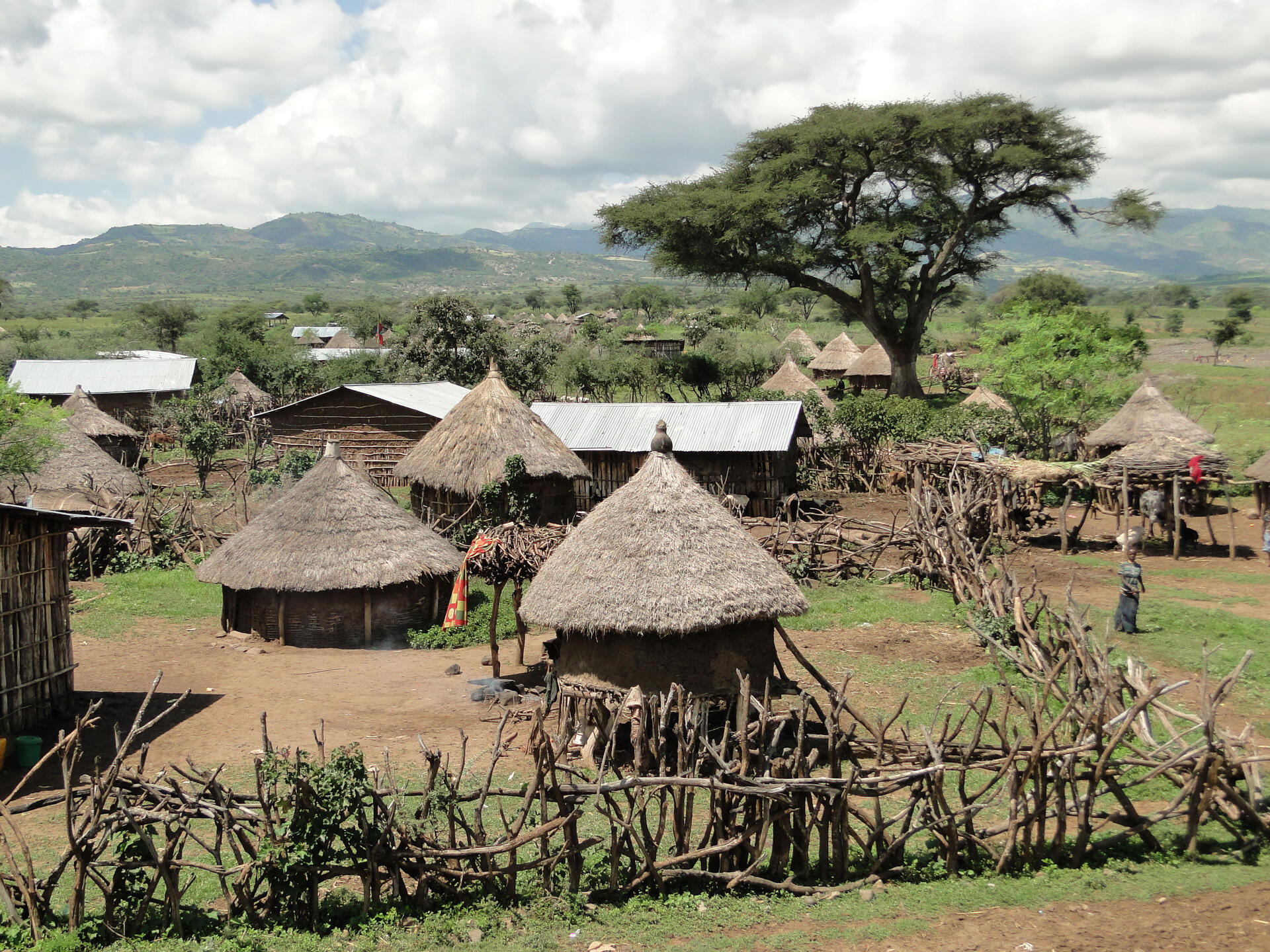
© Bernard Gagnon, CC BY-SA 3.0 Resized from original. (This derivative is under the same CC BY-SA license.)
World Heritage Research
Discover scientific research and academic studies that deepen our understanding of Konso Cultural Landscape from its history and significance to its conservation, management, and contemporary challenges.
-
Detection and characterization of meteorological drought and its impacts in the UNESCO designated world heritage site of Konso Cultural Landscape, southern Ethiopia
Recent droughts, particularly severe in 1999, 2000, 2009, 2011, and 2022, are threatening the UNESCO World Heritage Site of Konso Cultural Landscape in southern Ethiopia. These droughts have significantly reduced agricultural productivity, disrupting traditional harvest rituals critical for intergenerational knowledge transfer. Additionally, they have altered architectural designs and pushed communities toward nonfarm livelihoods due to worsening conditions. The study used Climate Hazards Group InfraRed Precipitation Stations data (1981–2022) alongside qualitative methods to analyze drought patterns via the Standard Precipitation Index across wet seasons and annual scales, revealing higher frequency and severity in seasonal timescales. These findings underscore urgent policy needs for adaptation strategies to sustain the landscape's cultural integrity.
Assen, Y. M., Kura, A. L., Degefu, M. A., Gella, A., & Yesuph, A. Y. (2025). Detection and characterization of meteorological drought and its impacts in the UNESCO designated world heritage site of Konso Cultural Landscape, southern Ethiopia. Discover Environment, 3(1). https://doi.org/10.1007/s44274-025-00486-2
View Publication Record | Read Publication -
Climate Change Threats to UNESCO-Designated World Heritage Sites: Empirical Evidence from Konso Cultural Landscape, Ethiopia
Climate change is significantly threatening the UNESCO World Heritage Site of Konso Cultural Landscape, Ethiopia, with rising temperatures and erratic rainfall patterns leading to severe environmental and societal impacts. Research using satellite-gauge-station data (1981–2020) and temperature records (1987–2020) revealed significant increases in heavy rainfall days, wet-day precipitation, and extreme heat events, exacerbating flooding, soil erosion, and biodiversity loss. These changes are disrupting traditional livelihoods, agricultural productivity, and cultural practices, posing risks to the site's integrity and the resilience of smallholder farmers. The study underscores the urgent need for localized climate adaptation strategies to protect this global cultural asset.
Assen, Y. M., Kura, A. L., Dube, E. E., Mensuro, G. K., Debelo, A. R., & Gure, L. B. (2024). Climate Change Threats to UNESCO-Designated World Heritage Sites: Empirical Evidence from Konso Cultural Landscape, Ethiopia. Sustainability, 16(19), 8442. https://doi.org/10.3390/su16198442
View Publication Record | Read Publication -
Smallholder farmers’ perceptions, coping and adaptation strategies to climate variability in the UNESCO designated cultural landscapes of Konso, Ethiopia
Smallholder farmers in the UNESCO-listed Konso Cultural Landscape of Ethiopia perceive climate variability as a significant threat, with late-onset rains, shortened rainy seasons, and recurring droughts being the most pronounced manifestations. These changes are linked to increased weed and pest infestations, as well as heat-induced diseases. The study found that education, access to credit, extension services, and climate information positively influence farmers' perceptions and adaptation strategies, such as terracing, agroforestry, and irrigation. Policy interventions focusing on diversifying livelihoods and improving access to reliable climate data are recommended to enhance adaptive capacity and reduce vulnerability.
Gashure, S., & Wana, D. (2023). Smallholder farmers’ perceptions, coping and adaptation strategies to climate variability in the UNESCO designated cultural landscapes of Konso, Ethiopia. Local Environment, 28(10), 1243–1262. https://doi.org/10.1080/13549839.2023.2202379
View Publication Record | Read Publication -
Tourism and Its Contribution to Households’ Income in Konso Zone, SNNP Region, Ethiopia
A study on the Konso Cultural Landscape in Ethiopia reveals that tourism contributes only 3.87% to household income, despite being a key economic development strategy. The research identifies cultural landscapes, arts, and music as primary tourist attractions while highlighting significant challenges such as limited access to financing, inadequate heritage preservation, and poor marketing. Using descriptive analysis and Tobit regression models, the study finds that household tourism income is positively influenced by the age of the household head, family size, and credit access, but negatively correlated with land size. Recommendations include promoting tourism, expanding employment opportunities, improving heritage protection, and enhancing strategic development to address these barriers.
Kasho, K., Taye Dadi, Melkamu Mada, & Asfaw Abadi. (2023). TOURISM AND ITS CONTRIBUTION TO HOUSEHOLDS’ INCOME IN KONSO ZONE, SNNP REGION, ETHIOPIA. Ethiopian Journal of Business and Social Science, 5(1), 37–56. https://doi.org/10.59122/134f53ad
View Publication Record | Read Publication -
Smallholders’ adoption of climate-smart practices in Konso, Ethiopia
In the UNESCO World Heritage Site of Konso, Ethiopia, smallholder farmers' adoption of climate-smart agriculture (CSA) practices is significantly influenced by education, landholding size, income, access to climate information, credit, and extension services. A multinomial logit model analysis revealed these factors as key determinants for the uptake of terracing, agroforestry, and intercropping. Despite these efforts, food security remains under threat due to unreliable rainfall patterns. The study highlights the potential for external support, such as regular weather forecasts, affordable credit, and crop insurance, to bolster local livelihoods and sustain the indigenous farming system in this culturally significant landscape.
Gashure, S., & Wana, D. (2022). Smallholders’ adoption of climate-smart practices in Konso, Ethiopia. International Journal of Environmental Studies, 80(5), 1349–1360. https://doi.org/10.1080/00207233.2022.2043115
View Publication Record | Read Publication -
Spatiotemporal climate variability and trends in UNESCO designated Cultural Landscapes of Konso, Ethiopia
Rainfall in the UNESCO-listed Konso Cultural Landscape, Ethiopia, shows contrasting trends between seasons: annual and summer (Kiremt) rainfall increased by 3.16 mm/year and 0.42 mm/year respectively, while spring (Belg) rainfall declined by 1.12 mm/year from 1983 to 2016. This spatiotemporal variability, analyzed using satellite-gauge data, the Mann-Kendall test, and Standardized Precipitation Index (SPI), reveals a growing frequency and severity of droughts—particularly in rainfed farming areas—threatening food security for smallholder farmers. The findings underscore the need for agroecological adaptation strategies to safeguard both socioeconomic resilience and the integrity of this unique cultural landscape.
Gashure, S., & Wana, D. (2021). Spatiotemporal climate variability and trends in UNESCO designated Cultural Landscapes of Konso, Ethiopia. African Geographical Review, 42(2), 107–124. https://doi.org/10.1080/19376812.2021.1997611
View Publication Record | Read Publication -
The Continuing Significance of Rural Landscapes in the Urban Century
Rural landscapes, particularly those shaped by historical agricultural practices, remain crucial to food security and sustainable development despite rapid urbanization. A study highlights the enduring significance of such landscapes, exemplified by Konso terraces in Ethiopia, Marakwet irrigation in Kenya, and Engaruka terraces in Tanzania. These landscapes, formed through intensive agriculture, reflect complex interactions between environmental factors, social structures, and political dynamics over centuries. The research emphasizes the importance of understanding historical context—such as wars, epidemics, and migrations—to grasp contemporary landscape transformations. It also underscores the role of interregional connections and landesque capital (long-term investments in land) in maintaining agricultural productivity. While the study builds on earlier work from 2004, it notes that rural landscapes are undergoing profound changes due to infrastructure development like new tarmac roads, posing both challenges and opportunities for sustainable development.
Watson, L. (2014). The Continuing Significance of Rural Landscapes in the Urban Century. Rural Landscapes: Society, Environment, History, 1(1). https://doi.org/10.16993/rl.ab
View Publication Record | Read Publication