World Heritage Identification Number: 1641
World Heritage since: 2023
Category: Cultural Heritage
WHE Type: Cultural Landscapes
Transboundary Heritage: No
Endangered Heritage: No
Country: 🇪🇹 Ethiopia
Continent: Africa
UNESCO World Region: Africa
Map
The Gedeo Cultural Landscape: A Testament to Ancient Agroforestry Practices and Indigenous Knowledge
The Gedeo Cultural Landscape, located in the Gedeo Zone of southern Ethiopia, stands as a remarkable testament to the ancient agroforestry practices and indigenous knowledge of the Gedeo people. Inscribed on the UNESCO World Heritage List in 2023, this region stretches along the eastern edge of the Main Ethiopian Rift, showcasing a unique blend of natural beauty, historical significance and ongoing cultural practices that have shaped the identity of the Gedeo people for generations.
The landscape reflects a centuries-old, and possibly millennia-old, tradition of agroforestry, demonstrating the accumulated knowledge and ingenuity of the Gedeo people across generations. Home to more than 250,000 people within the inscribed property, the dense settlement is characterized by its multilayered cultivation system, which involves growing different crops and tree species within the same plot of land. Large trees provide protective canopies for enset, also known as false banana, which serves as the main food crop, while coffee and other plants grow beneath them.
This traditional agroforestry approach not only ensures the sustainability of the land but also contributes to the region's biodiversity by providing habitats for numerous plant and animal species. Passed down through generations, this agricultural knowledge demonstrates the ingenuity of the Gedeo people in making productive use of their land while maintaining a close relationship with the surrounding environment.
One of the most striking features of the Gedeo Cultural Landscape is the presence of sacred forests. These forests play a crucial role in the religious beliefs and practices of the Gedeo people, who use them for rituals associated with their traditional religion. Carefully preserved and managed by local communities, these sacred spaces also protect indigenous trees and medicinal plants, contributing to the region's ecological diversity. Their continued preservation reflects the deep connection between the Gedeo people, their spiritual traditions and the natural environment that sustains their way of life.
Another distinctive aspect of the cultural landscape is the abundance of megalithic monuments scattered throughout the region. These monuments include clusters of stone steles and distinctive structures, some of which have phallic forms. Revered as important cultural landmarks, they provide a tangible connection to the history and traditions of the Gedeo people. Elders in the community and traditional leaders continue to play an important role in preserving these monuments, ensuring that their cultural significance is passed down to future generations.
The Gedeo Cultural Landscape serves as a living example of how traditional knowledge and sustainable practices can coexist harmoniously with modern life. Customary institutions, including the Songo council of elders and the Ballee system, help sustain traditional knowledge, guide community relationships and support the management of natural resources.
However, changing livelihoods, pressure on agricultural land and the weakening of some traditional institutions present challenges to the continued preservation of this heritage. The efforts of local communities to maintain their agroforestry systems, sacred forests and cultural monuments demonstrate the importance of safeguarding both the physical landscape and the traditions that have shaped it over generations.
Today, the Gedeo Cultural Landscape represents an important contribution to the world's cultural and natural heritage. Its unique agroforestry practices, sacred forests, megalithic monuments and traditional governance systems oillustrate how human communities can develop enduring relationships with their environment. Its inscription as a UNESCO World Heritage Site recognizes the international significance of this living cultural landscape while highlighting the need to safeguard the knowledge, practices and natural resources that sustain it.
UNESCO Description of the World Heritage Site
The property lies along the eastern edge of the Main Ethiopian Rift, on the steep escarpments of the Ethiopian highlands. An area of agroforestry, it utilizes multilayer cultivation with large trees sheltering indigenous enset, the main food crop, under which grow coffee and other shrubs. The area is densely populated by the Gedeo people whose traditional knowledge support local forest management. Within the cultivated mountain slopes are sacred forests traditionally used by local communities for rituals associated with the Gedeo religion, and along the mountain ridges are dense clusters of megalithic monuments, which came to be revered by the Gedeo and cared for by their elders.UNESCO Justification of the World Heritage Site
Criterion (iii): The Gedeo Cultural Landscape is an exceptional testimony to the long-standing and still living indigenous Gedeo cultural tradition of agroforestry with its layered cultivation of mature trees providing shelter for enset, and more recently coffee as well as shrubs and other food crops. For centuries, or perhaps even millennia, in what is now the southwest of Ethiopia, these traditional agroforestry practices have provided a sustainable living for communities, based on traditional knowledge and belief systems that reserved certain parts of the forest as sacred areas and protected megalithic clusters of steles as ritual sites.
Criterion (v): The Gedeo Cultural Landscape is as an outstanding example of how communities over time have devised systems to optimising the constraints and opportunities of their natural environment. The Gedeo indigenous Ballee system combines customary laws, rules, regulations, norms, and codes of social relations to govern interactions with nature. The resulting landscape not only supports the highest density of population in Africa, but it also maintains harmony with species, rich biodiversity and produces high quality organic coffee. It is though highly vulnerable to a range of social and economic pressures that are threatening its resilience and sustainability.
Encyclopedia Record: Gedeo Cultural Landscape
The Gedeo Cultural Landscape is a region of the Gedeo Zone, part of the South Ethiopia Regional State in south-central Ethiopia. It stretches across the eastern flank of the Main Ethiopian Rift, ranging from 1,307 to 3,072 metres above sea level. The region is home to roughly 2,550,000 Gedeo people. Dotted with sacred forests and megalithic monuments, the region has been the homeland of the Gedeo people for thousands of years. Traditional agroforestry is practiced in the region by the Gedeo people. Because of these traditional practices, its long history of occupation, and the cultural importance of the region, the Gedeo Cultural Landscape was inscribed on the UNESCO World Heritage List in 2023.Additional Site Details
Area: 29,620 hectares
Number of Components: 1
(v) — Outstanding example of traditional human settlement
Coordinates: 6.2488888889 , 38.2877777778
Image
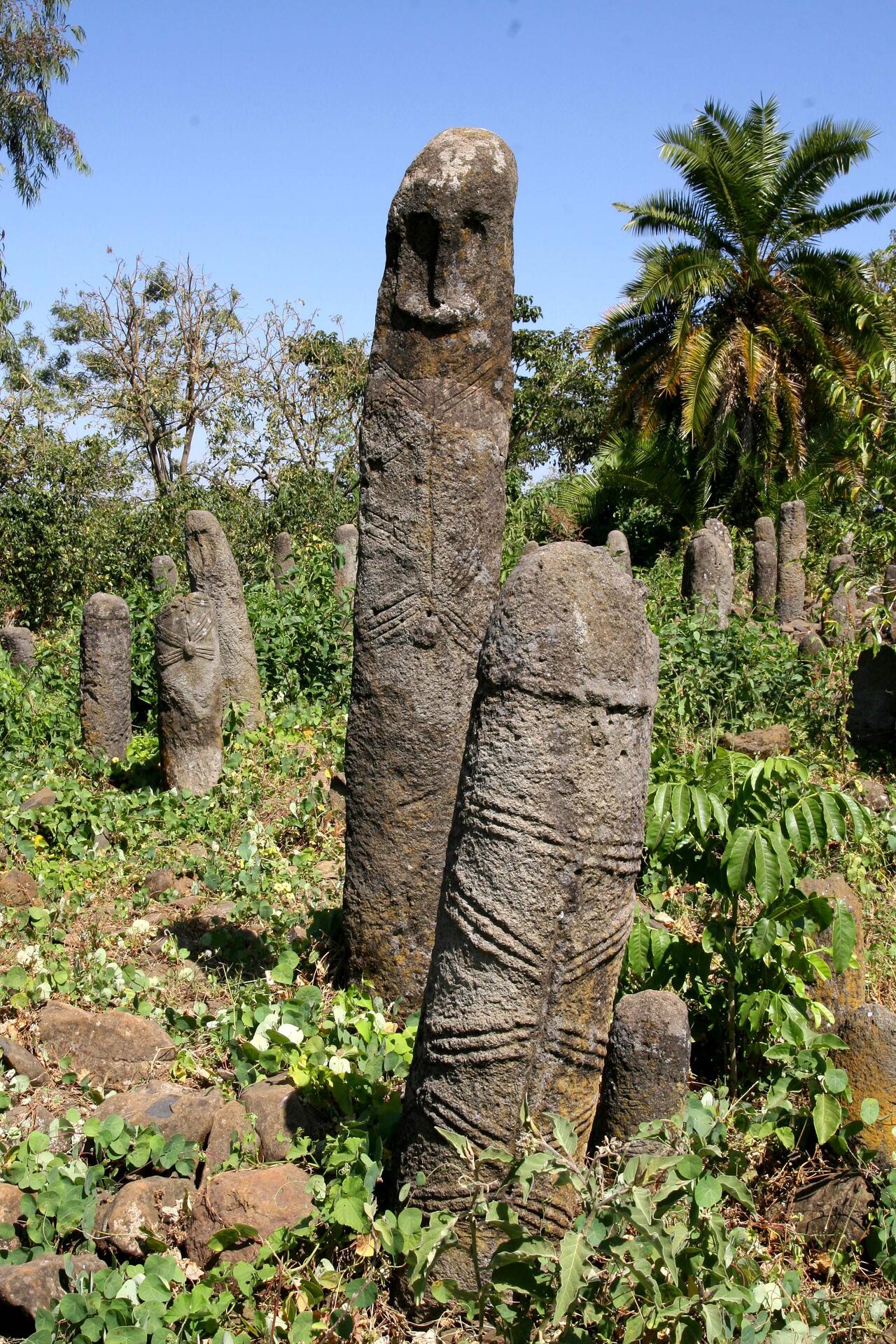
© Arminius1000, CC BY-SA 4.0 Resized from original. (This derivative is under the same CC BY-SA license.)
World Heritage Research
Discover scientific research and academic studies that deepen our understanding of The Gedeo Cultural Landscape from its history and significance to its conservation, management, and contemporary challenges.
-
Enset Landraces: Conservation, Distribution, and Use in an Enset‐Based Agricultural System
Enset, a vital food security crop for over 25% of Ethiopia's population, supports diverse landraces adapted to varied ecological conditions, serving as food, animal feed, medicine, and fiber. A study across Hadiya, Gedeo, Gurage, Kembata Tembaro zones, and Basketo Special Woreda revealed moderate to high enset landrace diversity, with 274 vernacular names recorded but only 106 actively cultivated. Despite this, no significant differences in diversity were observed among sites. Food value was identified as the primary driver of landrace selection and abundance. The research employed in-depth interviews, surveys, group discussions, and field observations to analyze distribution and richness using Simpson’s diversity, Shannon–Wiener, and Margalef’s indices. The findings underscore the importance of maintaining landrace diversity and traditional knowledge for sustainable enset agriculture, resilience, and food security.
Kibatu, T., Feyissa, T., Demissew, S., & Muleta, D. (2025). Enset Landraces: Conservation, Distribution, and Use in an Enset‐Based Agricultural System. Scientifica, 2025(1). Portico. https://doi.org/10.1155/sci5/7440580
View Publication Record | Read Publication -
Ethiopia: Enhancing Landscape Connectivity Through Agroforests
Agroforests in the Gedeo Cultural Landscape of Ethiopia serve as critical biodiversity havens and landscape connectors, mimicking natural forests to support sustainable agroforestry practices. These systems enhance on-farm conservation, environmental resilience, and livelihoods while acting as buffers against deforestation and fragmentation. They provide habitats for disturbance-sensitive species, conserve native tree gene pools, and facilitate ecological connectivity through corridors and stepping stones. Additionally, the diverse species composition in Gedeo agroforests significantly contributes to biomass and carbon storage, aiding climate change mitigation. Despite their ecological and socio-economic benefits, these agroforests face threats from land degradation, monoculture cash crops, climate change, market limitations, financial constraints, and insufficient technical knowledge.
Tesfay, H. M., & Negash, M. (2025). Ethiopia: Enhancing Landscape Connectivity Through Agroforests. Ecological Connectivity of Forest Ecosystems, 521–534. https://doi.org/10.1007/978-3-031-82206-3_28
View Publication Record | Read Publication -
Challenges and opportunities for ecotourism development: A case study in dilla university botanical and ecotourism garden, South Ethiopia
A study on the Dilla University Botanical and Ecotourism Garden, established in 2017 for biodiversity conservation and ecotourism in South Ethiopia's Gedeo Zone, reveals significant potential for sustainable ecotourism development. The garden's diverse flora, fauna, attractive landscapes, cultural resources, and rivers serve as key attractions. Opportunities include the unique natural and agro-forestry ecosystems, proximity to Saron Lodge, and a variety of cultural attractions. However, challenges such as low community benefits, inadequate participation, lack of an ecotourism plan, unsustainable resource use, insufficient accommodation, and absence of local guides hinder progress. The study recommends integrating communities into ecotourism development to address these issues effectively.
Israel Petros, M., & Firew, A. (2020). Challenges and opportunities for ecotourism development: A case study in dilla university botanical and ecotourism garden, South Ethiopia. Global Journal of Ecology, 154–163. https://doi.org/10.17352/gje.000035
View Publication Record | Read Publication -
Indigenous ways of environmental protection in Gedeo community, Southern Ethiopia: A socio-ecological perspective
Indigenous beliefs, sacred sites, and cultural practices in the Gedeo community of southern Ethiopia play a crucial role in environmental conservation. Sacred forests, protected by social taboos and traditional rules (seera), exhibit higher tree biodiversity and better preservation compared to adjacent non-sacred farming habitats. These mechanisms limit human interference, such as tree cutting or harming wildlife, except for ritual purposes with cultural elders' consent. The study highlights that indigenous knowledge (IK) is an effective tool for conserving degraded tropical ecosystems and mitigating climate change impacts. However, factors like religious monotheism, changing social norms, and the erosion of ancestral beliefs threaten these traditional practices, necessitating formal legal enforcement to safeguard sacred forests.
Maru, Y., Gebrekirstos, A., & Haile, G. (2020). Indigenous ways of environmental protection in Gedeo community, Southern Ethiopia: A socio-ecological perspective. Cogent Food & Agriculture, 6(1), 1766732. https://doi.org/10.1080/23311932.2020.1766732
View Publication Record | Read Publication