World Heritage Identification Number: 111
World Heritage since: 2023
Category: Natural Heritage
WHE Type: Protected Areas & National Parks
Transboundary Heritage: No
Endangered Heritage: No
Country: 🇪🇹 Ethiopia
Continent: Africa
UNESCO World Region: Africa
Map
Bale Mountains National Park: A Unique Landscape Mosaic in Ethiopia's Highlands
The Bale Mountains National Park, inscribed into the UNESCO World Heritage List in 2023, stands as a testament to the remarkable beauty and biodiversity found within the Ethiopian Highlands. Spanning over 2,150 square kilometers, this protected area offers a captivating landscape that has been sculpted by various geological processes, including ancient lava outpourings, glaciation, and the influence of the Great Rift Valley.
More to come…UNESCO Description of the World Heritage Site
This property protects a landscape mosaic of extraordinary beauty that is shaped by the combined forces of ancient lava outpourings, glaciation and the dissection by the Great Rift Valley. It features volcanic peaks and ridges, dramatic escarpments, sweeping valleys, glacial lakes, lush forests, deep gorges and numerous waterfalls, creating exceptional natural beauty. The property harbours diverse and unique biodiversity at ecosystem, species and genetic levels, and five major rivers originate within the Park, estimated to supply water and support the livelihoods of millions of people in and beyond Ethiopia.UNESCO Justification of the World Heritage Site
Criterion (vii): The property protects a landscape mosaic of extraordinary beauty that is shaped by the combined forces of ancient lava outpourings, glaciation and the dissection by the Great Rift Valley. It features volcanic peaks and ridges, dramatic escarpments, sweeping valleys, glacial lakes, lush forests, deep gorges and numerous waterfalls, creating an exceptional natural beauty. The altitudinal gradient of the park spans almost 2,900 metres from the highest peak standing at 4,377 m a.s.l. (Tullu Dimtu) down to approximately 1,500 m a.s.l. in the Harenna Forest. The altitudinal gradient not only creates vibrant changes in topography, soil, vegetation and species assemblages but constantly changing, breath-taking vistas. Amongst scattered wetlands and rocky outcrops, the iconic Giant Lobelias break the skyline above the otherwise stunted afro-alpine vegetation of the Sanetti Plateau, a harsh and aesthetically stunning high altitude environment. Unusual striations, or boulder grooves, mark the shallow hillsides, a natural phenomenon, which remains an enigma to geologists and glaciologists. Dropping from the plateau, the Harenna and the adjacent Mena Angetu form the second largest moist tropical forest in Ethiopia, transitioning in some areas into the country’s only remaining patches of cloud forest. This, combined with the plateaus, complete a unique, majestic landscape with an extraordinary natural aesthetic.
Criterion (x): The property harbours diverse and unique biodiversity at ecosystem, species and genetic levels. The Sanetti Plateau and the slopes of the Bale Mountains National Park above 3,500 m a.s.l. encompass the largest intact and contiguous expanse of afro-alpine habitat in the world further adding to the importance of the property as a rare large-scale remnant of this habitat. Uniquely, the afro-alpine of the Bale Mountains continues to be intricately linked to intact and large-scale expanses of forest, wetland and grassland ecosystems and habitats. More than 80% of all species found in the afro-montane habitat are endemic. Bale Mountains National Park is home to 1,660 documented species of flowering plants, 177 of which are endemic to Ethiopia and 31 exclusively to the Bale Mountains. The forests of the Bale Mountains serve as a genetic reservoir for Wild Forest Coffee and countless medicinal plant species. 79 mammal species have been recorded in the park; 23 of these are endemic, including eight rodent species. There are 363 documented bird species, including over 170 recorded migratory bird species, such as wintering and passing raptors, including the Greater Spotted Eagle. While the afro-alpine habitats are not conspicuously rich in terms of plant species, more than 80 % of all species found in this type of habitat are endemic, an extreme degree of endemism by any standard. The afro-alpine has been recognized as a globally significant place in literally all major global conservation priority-setting exercises. At the time of inscription, the Harenna Shrew, the Giant Mole Rat, the Malcolm’s Ethiopian Toad, the Bale Mountains Tree Frog and the Bale Mountains Frog can only be found in the Bale Mountains. The property hosts an estimated two-thirds of the global population of the endemic Mountain Nyala, the most important population of the endemic Ethiopian Wolf and it is home to the Menelik’s Bushbuck, an endemic subspecies. The Bale Monkey is endemic to the Ethiopia Highlands, east of the Rift Valley and is restricted to the bamboo belt of the Bale Mountains and the Sidamo Highlands.
Encyclopedia Record: Bale Mountains National Park
Bale Mountains National Park is a national park in Ethiopia. The park encompasses an area of approximately 2,150 km2 (830 sq mi) in the Bale Mountains and Sanetti Plateau of the Ethiopian Highlands.Additional Site Details
Area: 215,000 hectares
Number of Components: 1
(x) — Contains most important habitats for biodiversity
Coordinates: 6.7977777778 , 39.7488888889
Image
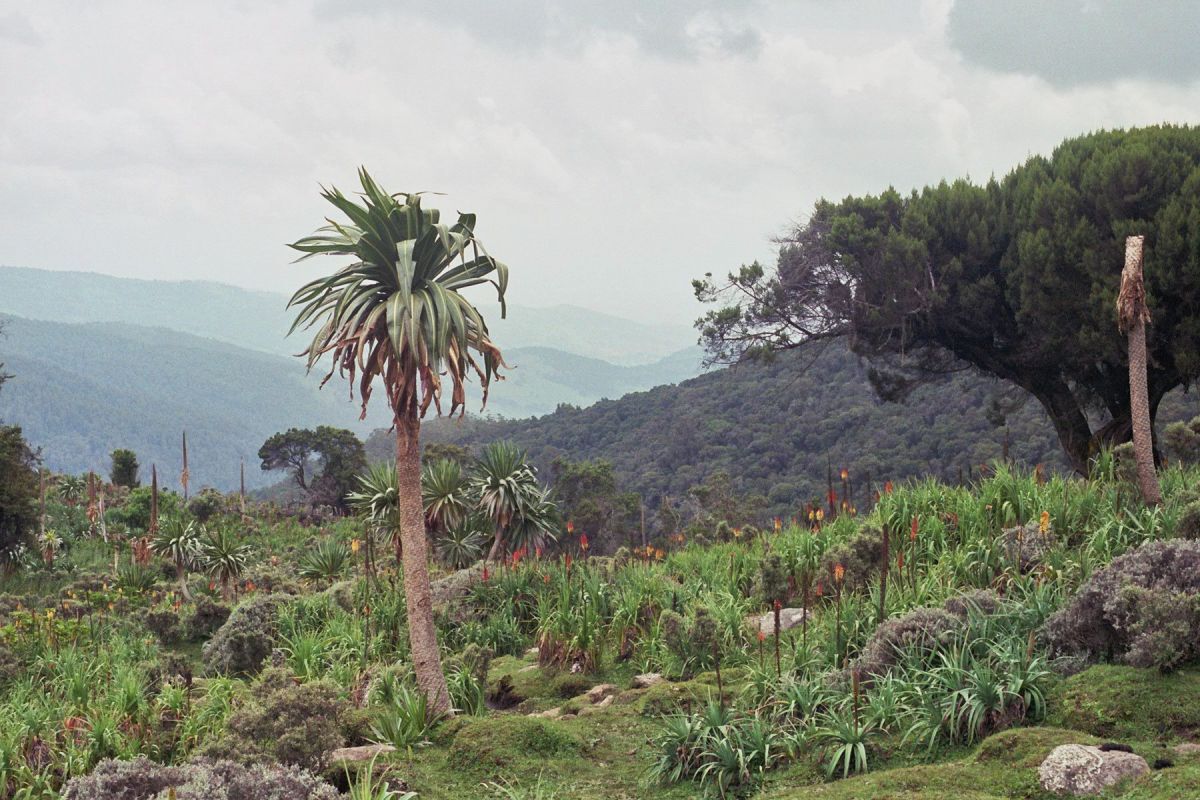
© AGoetzke, CC BY-SA 2.0 Resized from original. (This derivative is under the same CC BY-SA license.)
World Heritage Research
Discover scientific research and academic studies that deepen our understanding of Bale Mountains National Park from its history and significance to its conservation, management, and contemporary challenges.
-
Perception of local communities on protected areas: lessons drawn from the Bale Mountains National Park, Ethiopia
Local communities' perceptions of protected areas, particularly the Bale Mountains National Park in Ethiopia, reveal that top-down management approaches hinder sustainability and community engagement. The study highlights the need for improved communication, short-term economic benefits, and the establishment of multistakeholder platforms to foster dialogue and co-production of knowledge. These measures are crucial for addressing unhealthy relationships between communities and protected areas, which can be mitigated through continuous meetings, awareness-raising campaigns, and integrating income-generating activities. The research used household surveys, key informant interviews, and focus group discussions to gather data, emphasizing the importance of understanding complex human-environment interactions to tailor effective management strategies.
Gulte, E., Tadele, H., Haileslassie, A., & Mekuria, W. (2023). Perception of local communities on protected areas: lessons drawn from the Bale Mountains National Park, Ethiopia. Ecosystems and People, 19(1). https://doi.org/10.1080/26395916.2023.2227282
View Publication Record | Read Publication -
Humans-livestock predators conflict in the Central and Eastern Part of Bale Mountains National Park, Ethiopia
A significant human-livestock predator conflict is evident in the Central and Eastern part of Bale Mountains National Park, Ethiopia. Over the past decade, 3,320 livestock were predated, costing households approximately $347,460.53, which constitutes 27.45% of their monthly income. Major predators include spotted hyenas, olive baboons, and Ethiopian wolves, with sheep and cattle being the primary targets. The study attributes this conflict to human settlement, agricultural practices, overgrazing, deforestation for charcoal production, and deliberate fires. Mitigation efforts are suggested to focus on securing livestock enclosures, providing regular compensation, and raising awareness about the importance of protected areas.
Sebsibe, I. (2022). Humans-livestock predators conflict in the Central and Eastern Part of Bale Mountains National Park, Ethiopia. BMC Ecology and Evolution, 22(1). https://doi.org/10.1186/s12862-022-02065-y
View Publication Record | Read Publication -
The Effects of Landscape Change on Plant Diversity and Structure in the Bale Mountains National Park, Southeastern Ethiopia
Human-induced landscape changes significantly impact plant diversity and structure in the Bale Mountains National Park, Ethiopia. The study found that increased patch number positively correlates with species richness, diversity, and basal area (p < 0.05), while larger mean patch size negatively affects these metrics (p < 0.05). Edge habitats exhibit higher species richness and diversity compared to interior areas, though the latter shows greater woody plant basal area. Despite its ecological importance, the park faces threats from human settlements, overgrazing, and fire, which are reducing its biodiversity and ecosystem services. The research suggests that integrated environmental management strategies are crucial to mitigate these impacts.
Muhammed, A., & Elias, E. (2021). The Effects of Landscape Change on Plant Diversity and Structure in the Bale Mountains National Park, Southeastern Ethiopia. International Journal of Ecology, 2021, 1–13. https://doi.org/10.1155/2021/6628282
View Publication Record | Read Publication -
An exploratory study of ecotourism services quality (ESQ) in Bale Mountains National Park (BMNP), Ethiopia: using an ECOSERV model
A revised ECOSERV model, tailored for ecotourism contexts, identifies that the current ecotourism services quality (ESQ) in Bale Mountains National Park (BMNP), Ethiopia, falls short of visitor expectations. This study, based on surveys of 293 international visitors, revealed a significant service gap, indicating negative disconfirmation and highlighting the need for park management to address these deficiencies to enhance visitor satisfaction and competitiveness. The model, comprising seven ESQ dimensions and 28 attributes, provides a framework for improving ecotourism experiences in protected areas.
Aseres, S. A., & Sira, R. K. (2019). An exploratory study of ecotourism services quality (ESQ) in Bale Mountains National Park (BMNP), Ethiopia: using an ECOSERV model. Annals of Leisure Research, 23(3), 386–406. https://doi.org/10.1080/11745398.2019.1642769
View Publication Record | Read Publication -
Attitudes and perceptions of the local people towards benefits and conflicts they get from conservation of the Bale Mountains National Park and Mountain Nyala (Tragelaphus buxtoni), Ethiopia
Local communities near Bale Mountains National Park, Ethiopia, show mixed attitudes towards conservation, with 55% experiencing conflicts and 26% benefiting. Key benefits include leasing horses to tourists (62%) and guiding (44%), while major conflicts involve fear of relocation (84%) and livestock grazing restrictions (74%). Despite these challenges, 80% support the park's conservation efforts, particularly for the endangered mountain nyala. Benefit distribution was perceived as inequitable (83%), and attitudes varied by livelihood strategy but not proximity or settlement duration. The study suggests potential for enhanced cooperation to improve conservation outcomes.
Yosef, M. (2015). Attitudes and perceptions of the local people towards benefits and conflicts they get from conservation of the Bale Mountains National Park and Mountain Nyala (Tragelaphus buxtoni), Ethiopia. International Journal of Biodiversity and Conservation, 7(1), 28–40. https://doi.org/10.5897/ijbc2014.0792
View Publication Record | Read Publication -
Effectiveness and cost efficiency of monitoring mountain nyala in Bale Mountains National Park, Ethiopia
A cost-effective monitoring protocol for the endangered mountain nyala (Tragelaphus buxtoni) in Bale Mountains National Park, Ethiopia, offers significant financial savings without compromising effectiveness. The study found that total counts, despite underestimating population size, were more precise and required only 12% of the resources needed compared to distance sampling. This method also demonstrated greater power to detect changes in population size, making it a viable alternative for long-term conservation efforts in resource-limited protected areas like BMNP. The research highlights the importance of evaluating cost efficiency alongside effectiveness when selecting monitoring protocols.
Kinahan, A., & Bunnefeld, N. (2012). Effectiveness and cost efficiency of monitoring mountain nyala in Bale Mountains National Park, Ethiopia. Endangered Species Research, 18(2), 105–114. https://doi.org/10.3354/esr00438
View Publication Record | Read Publication -
Floristic composition and structure of the dry Afromontane forest at Bale Mountains National Park, Ethiopia
Excessive cutting of ecologically, economically, and medically important tree species has been identified as a significant threat to the Dry Afromontane Forest in Bale Mountains National Park, Ethiopia. The study, conducted between July 2003 and June 2004 across three sites (Adelle, Boditi, and Gaysay) at altitudes ranging from 3010 to 3410 meters, documented 230 species belonging to 58 families. Analysis revealed five homogeneous vegetation clusters, with tree densities of 766 and 458 individuals per hectare in Adelle and Boditi forests, respectively. Juniperus procera and Hagenia abyssinica contributed significantly to the basal area, accounting for 43% and 57%, respectively. The study highlighted that both Adelle and Boditi forests are at an early secondary stage of development, with clear evidence of selective logging impacting population structures.
Yineger, H., Kelbessa, E., Bekele, T., & Lulekal, E. (2011). Floristic composition and structure of the dry Afromontane forest at Bale Mountains National Park, Ethiopia. SINET: Ethiopian Journal of Science, 31(2). https://doi.org/10.4314/sinet.v31i2.66551
View Publication Record | Read Publication -
An analysis of long-term trends in the abundance of domestic livestock and free-roaming dogs in the Bale Mountains National Park, Ethiopia
Livestock and free-roaming dogs in the Bale Mountains National Park, Ethiopia, pose significant threats to the survival of the Ethiopian wolf (Canis simensis) by degrading its habitat and transmitting diseases. A 21-year study revealed no significant change in livestock numbers in the Web valley, where grazing is seasonal but intense, while numbers have risen on the Sanetti plateau, with year-round grazing at lower intensity. Livestock use in the Web valley correlated positively with vegetation productivity, as measured by NDVI, suggesting a link between primary productivity and grazing patterns. However, no strong seasonality was observed on the Sanetti plateau. The study highlights the potential for livestock to degrade wolf habitat and increase disease risks, emphasizing the need for sustainable management strategies.
Vial, F., Sillero-Zubiri, C., Marino, J., Haydon, D. T., & Macdonald, D. W. (2010). An analysis of long-term trends in the abundance of domestic livestock and free-roaming dogs in the Bale Mountains National Park, Ethiopia. African Journal of Ecology, 49(1), 91–102. https://doi.org/10.1111/j.1365-2028.2010.01233.x
View Publication Record | Read Publication -
Demography and dynamics of mountain nyala Tragelaphus buxtoni in the Bale Mountains National Park, Ethiopia
A significant decline of 45% in the mountain nyala population (Tragelaphus buxtoni) was observed in Bale Mountains National Park, Ethiopia, between 2003 and 2005, with an annual decrease of 2%-5%. The study attributed this reduction to anthropogenic factors such as competition with livestock for forage, habitat encroachment, and poaching. Population density varied significantly between sub-populations (Dinsho Sanctuary and Gaysay/Adelay), with the Dinsho group being isolated, potentially limiting their access to mates and suitable habitats. The population size was estimated at 830-908 individuals, despite an increase in mean density due to habitat contraction. Demographic parameters remained stable over three years, suggesting that the decline was not due to random variations but likely driven by human activities.
Mamo, Y., Pinard, M. A., & Bekele, A. (2010). Demography and dynamics of mountain nyala Tragelaphus buxtoni in the Bale Mountains National Park, Ethiopia. Current Zoology, 56(6), 660–669. https://doi.org/10.1093/czoolo/56.6.660
View Publication Record | Read Publication