World Heritage Identification Number: 1087
World Heritage since: 2004
Category: Cultural Heritage
WHE Type: Buildings & Architectural Ensembles
Transboundary Heritage: No
Endangered Heritage: No
Country: 🇩🇪 Germany
Continent: Europe
UNESCO World Region: Europe and North America
Map
The Town Hall and Roland Statue on Bremen's Market Square: Symbols of Civic Autonomy and Sovereignty
The Town Hall and Roland statue on Bremen's Market Square stand as significant symbols of civic autonomy and sovereignty within the historical context of the Holy Roman Empire. These architectural wonders, located in the north-western region of Germany, have been recognized by UNESCO as World Heritage Sites since 2004.
The Old Town Hall, constructed in the early 15th century, represents the city's affiliation with the Hanseatic League. This powerful commercial and defensive confederation of merchant guilds and market towns dominated trade in northern Europe during the Middle Ages. The Old Town Hall, a superb example of a medieval Saalgeschossbau (hall building) in the Gothic style, showcases intricate architectural details typical of this period, such as pointed arches and ribbed vaults.
In the early 17th century, the Old Town Hall underwent a transformation as it was renovated in the Weser Renaissance style. This architectural movement, found along the Weser river and extending to neighboring regions like Lower Saxony and Westphalia, combined traditional elements of the Renaissance with local influences. The result was a harmonious blend of the old and the new, reflecting the evolving identity of Bremen at the time.
The Old Town Hall is notable for being one of the few European town halls of the late Middle Ages that has never been destroyed. Its ground floor was used for merchants and public gatherings, while the upper floor contained the main festivity hall — reflecting how the building combined civic-government functions with economic and market functions.
A new Town Hall was constructed adjacent to the Old Town Hall in the early 20th century, forming part of an ensemble that survived the devastating bombardments during World War II. This modern structure, while respecting the historical significance of its neighbor, offers a stark contrast in terms of architectural style. The new Town Hall (1909–1913) is part of the historic ensemble, but the core heritage valu lies in the old Gothic hall, the later Renaissance façade, and the Roland statue.
Standing tall among the buildings on the market square is the iconic statue of Roland, erected in 1404 as a symbol of market rights and freedom. The statue depicts Roland, a paladin of the first Holy Roman Emperor Charlemagne, who famously participated in the Battle of Roncevaux Pass. The stone figure itself stands approximately 5.5 meters tall, but its total height, including its pedestal and Gothic canopy, reaches an impressive 10.21 meters, making it the largest free-standing statue of the German Middle Ages. Its placement facing the cathedral adds to the rich tapestry of stories and legends that surround the city.
The Town Hall and Roland statue on Bremen's Market Square offer a captivating glimpse into the city's past, embodying the spirit of civic autonomy and sovereignty that defined the Holy Roman Empire. Their preservation and recognition as UNESCO World Heritage Sites ensure their continued importance in understanding the evolution of European cities and their role in shaping the continent's cultural landscape.
UNESCO Description of the World Heritage Site
The Town Hall and the statue of Roland on the marketplace of Bremen in north-west Germany are outstanding representations of civic autonomy and sovereignty, as these developed in the Holy Roman Empire in Europe. The old town hall was built in the Gothic style in the early 15th century, after Bremen joined the Hanseatic League. The building was renovated in the so-called Weser Renaissance style in the early 17th century. A new town hall was built next to the old one in the early 20th century as part of an ensemble that survived bombardment during the Second World War. The statue stands 5.5 m tall and dates back to 1404.
UNESCO Justification of the World Heritage Site
Criterion (iii): The Bremen Town Hall and Roland bear an exceptional testimony to the civic autonomy and sovereignty, as these developed in the Holy Roman Empire.
Criterion (iv): The Bremen Town Hall and Roland are an outstanding ensemble representing civic autonomy and market freedom. The town hall represents the medieval Saalgeschossbau-type of hall construction, as well as being an outstanding example of the so-called Weser Renaissance in Northern Germany. The Bremen Roland is the most representative and one of the oldest of Roland statues erected as a symbol of market rights and freedom.
Criterion (vi): The ensemble of the Town Hall and Roland of Bremen with its symbolism is directly associated with the development of the ideas of civic autonomy and market freedom in the Holy Roman Empire. The Bremen Roland is referred to a historical figure, paladin of Charlemagne, who became the source for the French ‘chanson de geste’ and other medieval and Renaissance epic poetry.
Encyclopedia Record: Bremen Roland
The Bremen Roland is a statue of Roland, erected in 1404. It stands in the market square (Rathausplatz) of Bremen, Germany, facing the cathedral, and shows Roland, paladin of the first Holy Roman Emperor Charlemagne and hero of the Battle of Roncevaux Pass.Additional Site Details
Area: 0.287 hectares
Number of Components: 1
(iv) — Outstanding example of a type of building or landscape
(vi) — Directly associated with events or living traditions
Coordinates: 53.07597222 , 8.807472222
Image
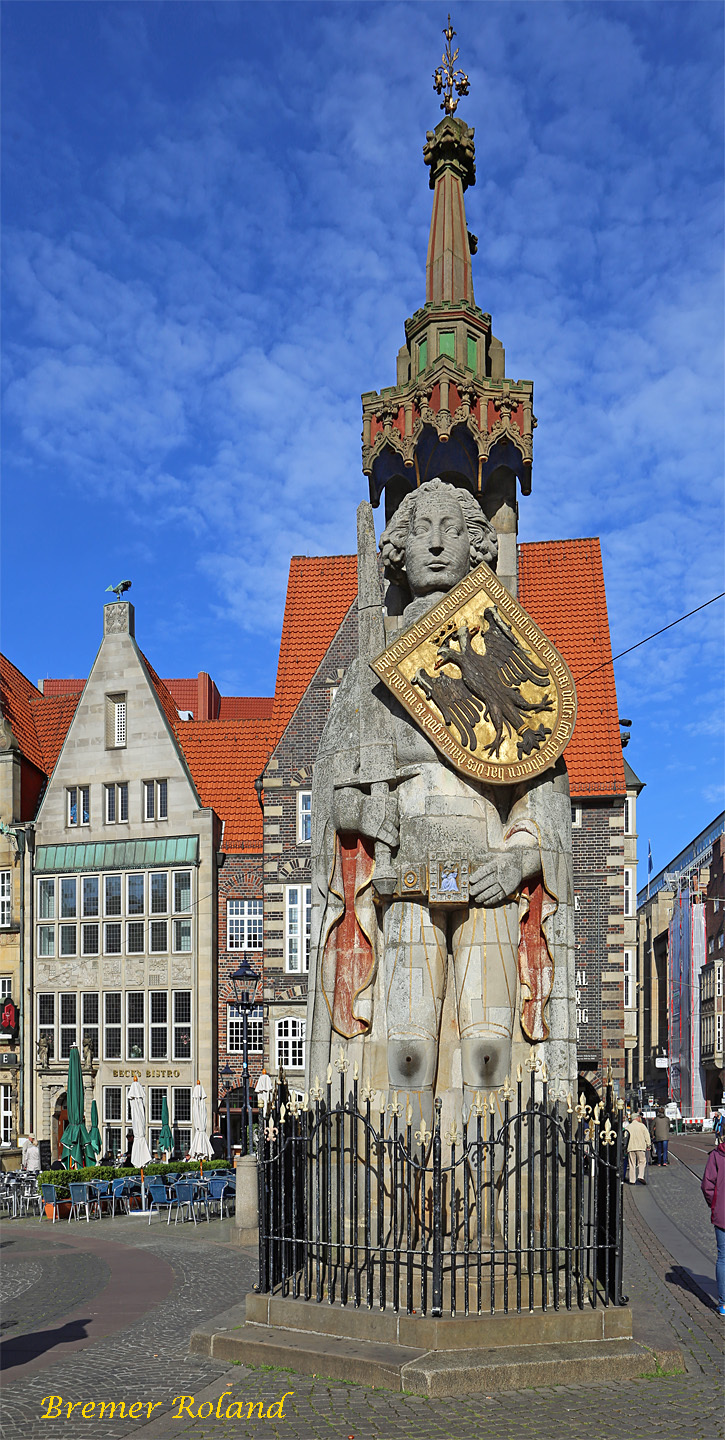
© W. Bulach, CC BY-SA 4.0 Resized from original. (This derivative is under the same CC BY-SA license.)
World Heritage Research
Discover scientific research and academic studies that deepen our understanding of Town Hall and Roland on the Marketplace of Bremen from its history and significance to its conservation, management, and contemporary challenges.
-
Town Hall and Roland on the marketplace of Bremen
The Town Hall and Roland on the marketplace of Bremen stand as a testament to the civic autonomy and sovereignty that emerged during the Holy Roman Empire. Constructed between 1405 and 1410, the Old Town Hall exemplifies Gothic architecture with its distinctive two-story hall structure, arcade, balustrade, and high roof. The site also features the historic Bremen Roland statue, which has undergone multiple restorations over centuries, with Elm limestone stones being replaced by Obernkirchen Sandstone. This ensemble represents a significant cultural and architectural heritage, reflecting the political and social developments of medieval Europe.
Pätzold, J. (2021). Town Hall and Roland on the marketplace of Bremen. Natural Stone and World Heritage, 3–6. https://doi.org/10.1201/9780367823061-2
View Publication Record | Read Publication -
UNESCO Sites in Germany
The Town Hall and Roland on the Marketplace of Bremen, recognized as a UNESCO World Heritage Site since 2004, represent a unique ensemble symbolizing civic autonomy and sovereignty within the Holy Roman Empire. The site comprises two distinct structures: the Old Town Hall, built in Gothic style at the turn of the 15th century, and the New Town Hall, constructed in Neo-Renaissance style in the early 20th century. The stone statue of Roland, erected in 1404, stands as a enduring symbol of Bremen's historical rights and privileges. Notably, this ensemble survived World War II intact, preserving its architectural and cultural significance. The study examines the evolution of this site through its various architectural phases, including a significant renovation in the early 17th century that incorporated elements of Weser Renaissance style. This research contributes to the understanding of how historical structures adapt while retaining their symbolic value over centuries.
Ehling, A., Häfner, F., & Siedel, H. (2021). UNESCO sites in Germany. Natural Stone and World Heritage, 1–58. https://doi.org/10.1201/9780367823061-1
View Publication Record | Read Publication