World Heritage Identification Number: 1366
World Heritage since: 2011
Category: Cultural Heritage
WHE Type: Religious Sites & Sacred Architecture
Transboundary Heritage: No
Endangered Heritage: No
Country: 🇹🇷 Türkiye
Continent: Asia
UNESCO World Region: Europe and North America
Map
The Selimiye Mosque and Its Social Complex: A Masterpiece of Ottoman Architecture
The Selimiye Mosque and its Social Complex, situated in the historic city of Edirne, Turkey, stands as a testament to the architectural prowess of the Ottoman Empire during the 16th century. Commissioned by Sultan Selim II and designed by the renowned architect Mimar Sinan, this monumental structure has been recognized as a UNESCO World Heritage Site since 2011.
More to come…UNESCO Description of the World Heritage Site
The square Mosque with its single great dome and four slender minarets, dominates the skyline of the former Ottoman capital of Edirne. Sinan, the most famous of Ottoman architects in the 16th century, considered the complex, which includes madrasas (Islamic schools), a covered market, clock house, outer courtyard and library, to be his best work. The interior decoration using Iznik tiles from the peak period of their production testifies to an art form that remains unsurpassed in this material. The complex is considered to be the most harmonious expression ever achieved of the Ottoman külliye, a group of buildings constructed around a mosque and managed as a single institution.
UNESCO Justification of the World Heritage Site
Criterion (i): The Selimiye Mosque Complex at Edirne is a masterpiece of the human creative genius of the architect Sinan, the most famous of all Ottoman architects in the 16th century. The single great dome supported by eight pillars has a diameter of 31.5 over a prayer space of 45mx36m, and with its four soaring minarets it dominates the city skyline. The innovative structural design allowed numerous windows creating an extraordinary illuminated interior. The mosque complex was recognised by Sinan himself as his most important architectural work.
Criterion (iv): The Selimiye Mosque with its cupola, spatial concept, architectural and technological ensemble and location crowning the cityscape illustrates a significant stage in human history, the apogee of the Ottoman Empire. The interior decoration using Iznik tiles from the peak period of their production testifies to a great art form never to be excelled in this material. The mosque with its charitable dependencies represents the most harmonious expression ever achieved of the külliye, this most peculiarl Ottoman type of complex.
Encyclopedia Record: Selimiye Mosque, Edirne
The Selimiye Mosque is an Ottoman imperial mosque, located in the city of Edirne, Turkey. It was commissioned by Sultan Selim II and was built by the imperial architect Mimar Sinan between 1568 and 1575. It was considered by Sinan to be his masterpiece and is one of the highest achievements of Islamic architecture as a whole and Ottoman architecture in particular.Additional Site Details
Area: 2.5 hectares
Number of Components: 1
(iv) — Outstanding example of a type of building or landscape
Coordinates: 41.6777777778 , 26.5594444444
Image
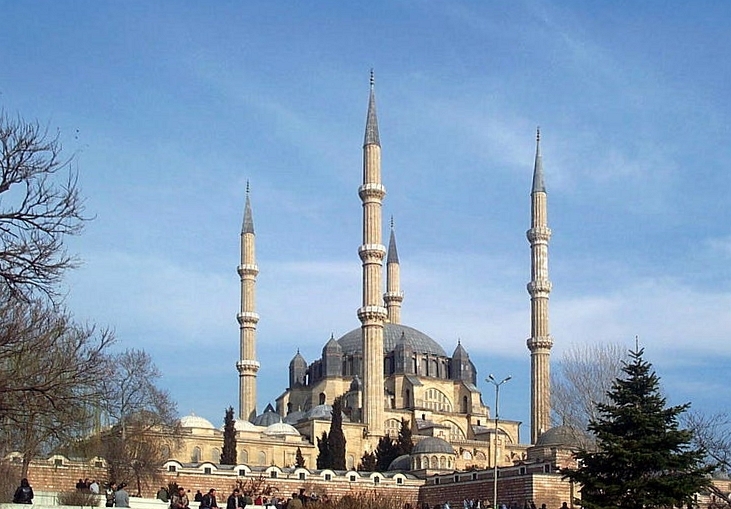
© Nevit Dilmen, CC BY-SA 3.0 Resized from original. (This derivative is under the same CC BY-SA license.)
World Heritage Research
Discover scientific research and academic studies that deepen our understanding of Selimiye Mosque and its Social Complex from its history and significance to its conservation, management, and contemporary challenges.
-
Unlocking Sinan’s Architectural Language: Modular Design Through Geometric Recursion
Research reveals that Ottoman architect Mimar Sinan likely employed a recursive geometric modulation system, rooted in circles and squares, to design his architectural masterpieces. This methodology, evident in the Privy Chamber of Sultan Murad III and the Selimiye Mosque, demonstrates a deliberate and consistent application of modular geometry that underpins both aesthetic and structural elements. The study, which also examines Sinan’s early work, Haseki Hürrem Bath, suggests this approach was not coincidental but rather a foundational design tool. By focusing on geometric discipline over speculative symbolism, the research proposes Sinan’s mastery lay in a refined system of modulation, offering new insights into his architectural language.
Diker, H. F. (2026). Unlocking Sinan’s Architectural Language: Modular Design Through Geometric Recursion. Nexus Network Journal, 28(1), 271–297. https://doi.org/10.1007/s00004-025-00857-5
View Publication Record | Read Publication -
Spatial Investigation and Structural Analysis of the Narthex in Ottoman Mosques: The Case of Edirne Selimiye Mosque
A structural analysis of the narthex in Mimar Sinan’s Edirne Selimiye Mosque reveals robust seismic resilience, challenging conventional assumptions about Ottoman architectural engineering. Using finite element modeling (ANSYS Workbench), researchers evaluated three parallel models—including the existing structure—to assess spatial, geometric, and material parameters under dynamic earthquake loads. Findings demonstrate innovative static and dynamic strategies that integrate aesthetic harmony with functional stability, offering insights applicable to preserving similar UNESCO World Heritage Sites. This study bridges architectural history and engineering, providing a framework for assessing structural integrity in historic Ottoman mosques.
Bostan, E., Şeker, B. Ş., & Yılmaz, L. (2026). SPATIAL INVESTIGATION AND STRUCTURAL ANALYSIS OF THE NARTHEX IN OTTOMAN MOSQUES: THE CASE OF EDIRNE SELIMIYE MOSQUE. Architecture and Engineering, 11(1), 3–18. https://doi.org/10.23968/2500-0055-2026-11-1-3-18
View Publication Record | Read Publication -
Implementation and Design Issues at the Intersection of Architectural Components in the Classical Period Ottoman Mosques
Classical period Ottoman mosques, often perceived as flawless architectural marvels, reveal significant inconsistencies in their design and implementation. A study analyzing the Selimiye Mosque and other notable structures—using observational and photogrammetric methods—identified morphological anomalies at key intersections, such as facades, minarets, and annexes. These irregularities, including breaks in continuity of mouldings and clashes between components, suggest that Ottoman architecture relied on flexible, on-site adjustments rather than rigid, pre-planned templates. The findings challenge the notion of a deterministic design process, highlighting the dynamic interplay between original layouts and subsequent interventions driven by practical needs.
ZEYREK, M., & BİNAN, C. Ş. (2026). Implementation and Design Issues at the Intersection of Architectural Components in the Classical Period Ottoman Mosques. Zenodo. https://doi.org/10.5281/ZENODO.20735692
View Publication Record | Read Publication -
Selimiye as a commemorative monument in modern Turkey
A transnational dimension emerges in the formation of national memory surrounding the Selimiye Mosque, revealing its contested role as a symbolic site during the dissolution of the Ottoman Empire. The study analyzes commemorative practices through newspaper reports from Greece, Turkey, and Bulgaria, alongside international media, to demonstrate how the monument's heritage has been strategically framed across borders. This research highlights the complex interplay between architectural heritage and nation-building, particularly in Edirne, where multiple states vied for influence. By focusing on the reception of commemorations, it uncovers how transnational narratives shaped local remembrance of the city's liberation.
Sezgin, A. (2025). Selimiye as a commemorative monument in modern Turkey. British Journal of Middle Eastern Studies, 53(1), 130–154. https://doi.org/10.1080/13530194.2024.2443917
View Publication Record | Read Publication -
Ending a Historical Debate: A Comparative Study of Sinan’s Challenge in Edirne Selimiye Mosque to Surpass the Dome of Istanbul’s Hagia Sophia
Advanced laser scanning technology resolves a centuries-old architectural debate, confirming that the dome of Edirne Selimiye Mosque, designed by Ottoman master Sinan, surpasses that of Istanbul’s Hagia Sophia. This finding dispels long-standing speculation about whether Sinan’s work could rival the Byzantine masterpiece, now definitively settled through precise measurements and rigorous comparative analysis. The study employs cutting-edge documentation techniques to provide concrete data, addressing gaps in prior research and clarifying historical claims made by Sinan himself. By leveraging modern surveying methods, this research not only advances architectural history but also demonstrates the transformative potential of technology in resolving enduring controversies.
Dabanli, Ö. (2025). Ending a Historical Debate: A Comparative Study of Sinan’s Challenge in Edirne Selimiye Mosque to Surpass the Dome of Istanbul’s Hagia Sophia. Journal of Architectural Engineering, 31(3). https://doi.org/10.1061/jaeied.aeeng-1711
View Publication Record | Read Publication -
Virtual Reality for Immersive Visualisation of Turkish Cultural Heritages
Virtual Reality (VR) technology, leveraging Head Mounted Displays (HMDs), offers transformative potential for the preservation and visualization of cultural heritage. This study demonstrates how VR, combined with 3D documentation and modeling tools, can provide immersive, interactive experiences that enhance scientific communication for historical monuments—even those damaged, destroyed, or geographically inaccessible. Through a collaboration between BİMTAŞ (Istanbul) and the Photogrammetry & Laser Scanning Laboratory (Hamburg), three Turkish landmarks—Selimiye Mosque in Edirne, Rumeli Hisarı fortress in Istanbul, and the Çatalca İnceğiz Caves—were reconstructed using the HTC Vive VR system. The resulting virtual environments allow first-person exploration, showcasing VR's capability to bridge gaps between physical preservation challenges and public engagement with cultural heritage.
Kersten, T. P., & Büyüksalih, G. (2025). Virtual Reality for Immersive Visualisation of Turkish Cultural Heritages. The International Archives of the Photogrammetry, Remote Sensing and Spatial Information Sciences, XLVIII-M-6-2025, 161–167. https://doi.org/10.5194/isprs-archives-xlviii-m-6-2025-161-2025
View Publication Record | Read Publication -
Ethnic Appropriation of Folk Narratives and Architecture in the Post-Ottoman Balkans
Nationalist movements in the Balkans appropriated Ottoman architectural heritage, including the Selimiye Mosque, by reinterpreting local folk narratives about master builders. These narratives, resembling the myth of Icarus, became tools for ethnic identity formation during interstate tensions in Thrace (1930s–1940s). The study reveals how transnational debates over these stories clashed with nationalist syncretism, exposing tensions between cultural continuity and national identity construction. Analyzing archival records and historical discourse, the research demonstrates the political instrumentalization of folklore in post-Ottoman heritage politics.
Sezgin, A. (2025). Ethnic Appropriation of Folk Narratives and Architecture in the Post-Ottoman Balkans. Balkan Araştırma Enstitüsü Dergisi, 14(1), 213–249. https://doi.org/10.30903/baed.1723226
View Publication Record | Read Publication