
World Heritage Identification Number: 914
World Heritage since: 1999
Category: Natural Heritage
WHE Type: Protected Areas & National Parks
Transboundary Heritage: Yes
Endangered Heritage: No
Country: Mozambique, South Africa
Continent: Africa
UNESCO World Region: Africa
Map
Transboundary Conservation: iSimangaliso Wetland Park - Maputo National Park
The iSimangaliso Wetland Park - Maputo National Park (ISWP-MNP) is a unique transboundary protected area that straddles the border between South Africa and Mozambique. Established in 1999, this expansive conservation region encompasses a variety of ecosystems, including terrestrial, coastal, and marine environments, making it a haven for nearly 5,000 species.
More to come…UNESCO Description of the World Heritage Site
The iSimangaliso Wetland Park – Maputo National Park is a transboundary extension to South Africa’s iSimangaliso Wetland Park, inscribed in 1999. It includes terrestrial, coastal, and marine ecosystems, and is home to nearly 5,000 species. The site complements iSimangaliso’s conservation values, enhancing biodiversity protection across the Maputaland ecoregion. It features diverse habitats, including lakes, lagoons, mangroves, and coral reefs. The park lies within the Maputaland-Pondoland-Albany Hotspot, reflecting high endemism and ongoing natural processes, and underscores long-standing regional conservation cooperation.
UNESCO Justification of the World Heritage Site
Criterion (vii): iSimangaliso Wetland Park – Maputo National Park includes a diverse mosaic of terrestrial, coastal and marine land and seascapes of exceptional beauty, with superlative scenic vistas along its coastline. From the clear waters of the Indian Ocean punctuated by colourful coral reefs to wide intact sandy beaches, a forested cordon of dunes and a network of wetlands, grasslands, estuarine systems, forests, freshwater lakes, mangroves, seagrass beds, coral reefs and savannah, the property has a richly textured landscape and exceptional aesthetic qualities. Outstanding natural phenomena include the shifting salinity status within Lake St. Lucia linked to wet and dry climatic cycles, the spectacle of large numbers of nesting turtles on the beaches and the abundance of marine megafauna including dolphins and migrating whales and Whale Shark and the large aggregations of waterfowl and large breeding colonies of pelicans, storks, herons and terns and the site’s contribution to the East Asia-East Africa global flyway for migratory birds along the east coast of Africa.
Criterion (ix): The combination of fluvial, marine and aeolian processes in iSimangaliso Wetland Park – Maputo National Park has resulted in a variety of landforms. The property’s transitional geographic location between sub-tropical and tropical Africa, as well as its coastal setting, have resulted in significant species and ecosystem diversity, including freshwater lakes and coastal lagoons, mangroves, seagrass meadows, and dunes. Speciation processes in the larger Maputaland Centre of Endemism, which this property sits within, are also ongoing and contribute another element to the diversity and interplay of evolutionary processes at work in the property. In the marine components of the site, the sediments being transported by the Agulhas Current are trapped by submarine canyons on the continental shelf allowing for remarkably clear waters for the development of coral reefs. The interplay of this diverse environmental processes is further marked by major floods and coastal storms.
Criterion (x): The extensive range of interconnected habitats across terrestrial, coastal and marine areas within the property support a significant diversity of African biota, including numerous threatened and endemic species of flora and fauna. The species recorded for iSimangaliso are extensive, and population sizes for most of them remain viable. The over 6,500 plant and animal (including 521 bird) species recorded in iSimangaliso Wetland Park include 11 species endemic to the protected area, 108 species endemic to South Africa, and 467 species listed as threatened in South Africa. Of the 4,935 species recorded in Maputo National Park at the time of the extension, 104 are assessed as threatened or near threatened according to the IUCN Red List of Threatened species, and 184 are endemic or near endemic to Mozambique (5), southern Africa (95) and the Western Indian Ocean (135). Notably, the vulnerable Loggerhead Turtle and Leatherback Turtle nest along the property’s coastal dunes and sandy beaches, making it the second most important nesting site in the Indian Ocean. The extensive and diverse seagrass meadows in the waters of Inhaca Island’s western shores in Maputo National Park, including vulnerable species such as Cape Dwarf-Eelgrass, shelter the last remaining Dugong population of Maputo Bay.
Encyclopedia Record: Maputo National Park
Maputo National Park is a national park in Mozambique, located on Maputo Bay, approximately 100 kilometers southeast of the city of Maputo. With an area of 1,718 km2, it is part of Matutuíne District of the Maputo Province, and also of the Inhaca Island of the city of Maputo.Additional Site Details
Area: 397,471 hectares
Number of Components: 2
(ix) — Outstanding example representing ecological and biological processes
(x) — Contains most important habitats for biodiversity
Coordinates: -27.8388888889 , 32.55
IUCN World Heritage Outlook
The 2025 Conservation Outlook on iSimangaliso Wetland Park reports the following assessment:
Source: International Union for Conservation of Nature (IUCN) · View assessment
Image
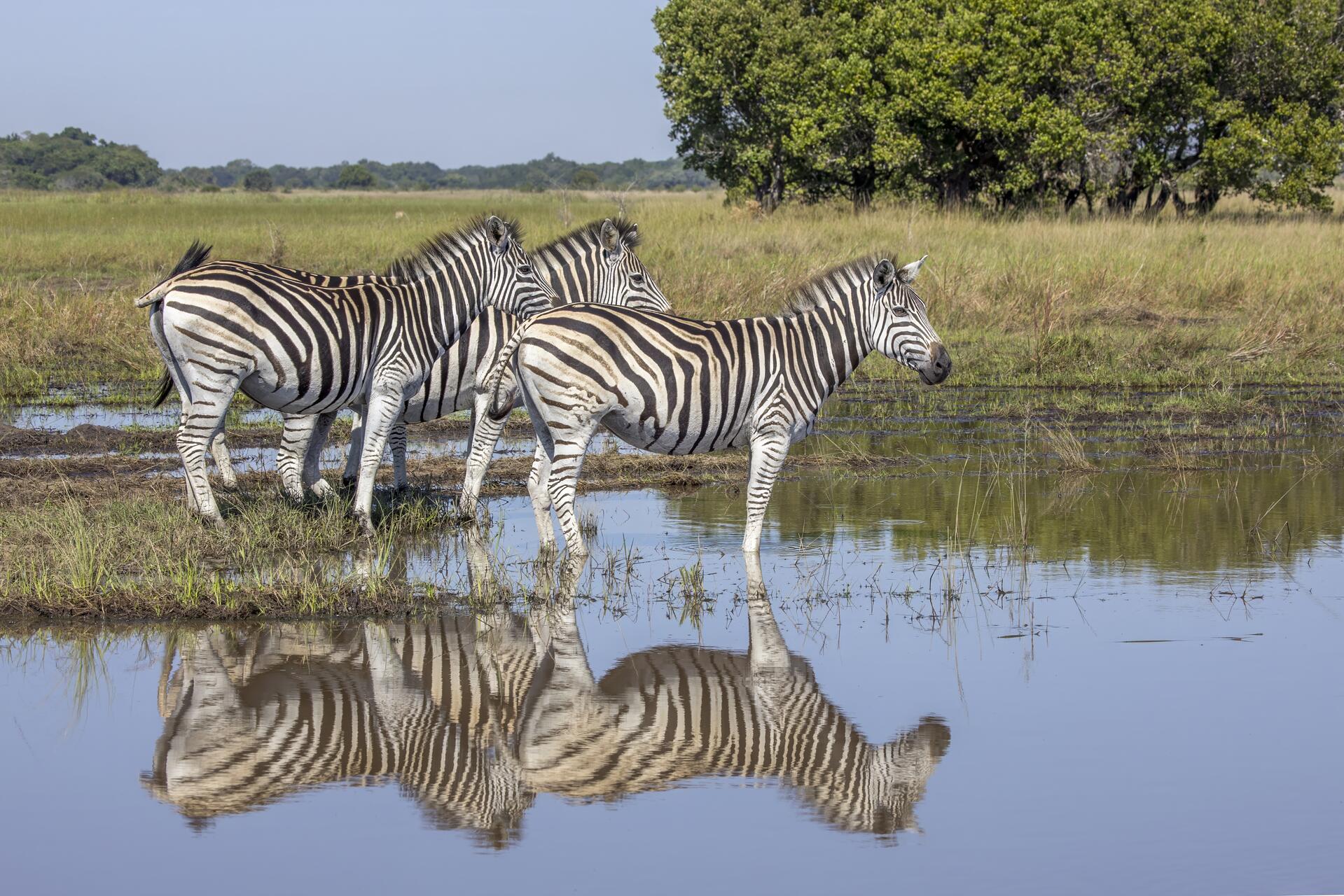
© Charles J. Sharp, CC BY-SA 4.0 Resized from original. (This derivative is under the same CC BY-SA license.)
World Heritage Research
Discover scientific research and academic studies that deepen our understanding of iSimangaliso Wetland Park – Maputo National Park from its history and significance to its conservation, management, and contemporary challenges.
-
Critical inquiry into ecologicalally responsive architecture : a case study of the Isimangaliso Wetland Park (KwaZulu-Natal)
A critical inquiry into ecologically responsive architecture at iSimangaliso Wetland Park, South Africa, reveals that integrating traditional building techniques with modern sustainable technologies can significantly enhance conservation efforts and support the park's vision as a UNESCO World Heritage site. The study found that existing architectural structures in the park lack consistency and cultural identity, highlighting the potential for a 'Hybrid Model'—proposed by Yahya and Hassanpour (2022)—to bridge this gap. This model combines traditional indigenous practices from communities like the Thonga and Zulu with ecological principles, promoting the use of locally sourced materials and advancing sustainability. The research emphasizes the importance of preserving South Africa's natural resource base, aligning with Sustainable Development Goal 11, and advocates for a shift toward a green economy to ensure the long-term viability of heritage sites.
Subkaran, T. Critical inquiry into ecologicalally responsive architecture : a case study of the Isimangaliso Wetland Park (KwaZulu-Natal). https://doi.org/10.51415/10321/6408
View Publication Record | Read Publication -
Molecular detection and characterisation of Theileria parva and other Theileria species in cattle-associated ticks from southern Mozambique
A study investigating tick-borne protozoa in southern Mozambique confirms the presence of Theileria parva, a pathogen responsible for East Coast fever (ECF), in local cattle-associated ticks. Researchers analyzed 326 ticks from six farms, identifying four species: Rhipicephalus microplus, R. evertsi, Amblyomma hebraeum, and R. appendiculatus. Molecular screening detected T. parva in 11 ticks, with phylogenetic analysis revealing low genetic diversity among isolates, except for one divergent isolate found in A. hebraeum. Additionally, Theileria velifera was identified in a single specimen. These findings underscore the need for ongoing surveillance to monitor the spread and impact of these pathogens on cattle production in the region.
Zhang, T., Dotto, G., Grillini, M., Franzo, G., Afonso, S., Neves, L., Cassini, R., & Mucache, H. (2026). Molecular detection and characterisation of Theileria parva and other Theileria species in cattle-associated ticks from southern Mozambique. Veterinary Parasitology: Regional Studies and Reports, 74, 101573. https://doi.org/10.1016/j.vprsr.2026.101573
View Publication Record | Read Publication -
Clustering tourists’ perceptions of Marine Protected Areas: A comparative study in Southern Africa
A comparative analysis of tourists' perceptions of Marine Protected Areas (MPAs) in Southern Africa reveals a stark contrast between South African and Mozambican visitors. While both groups recognize the ecological value of MPAs, South African tourists predominantly exhibit strong support for conservation efforts, whereas Mozambican tourists tend to be more skeptical or passive. This study, conducted through quantitative surveys of 504 participants at Ponta do Ouro Partial Marine Reserve (Mozambique) and Table Mountain National Park MPA (South Africa), underscores the need for targeted communication strategies that emphasize the broader social, economic, and cultural benefits of MPAs to foster sustainable stakeholder support. The findings highlight regional differences in conservation attitudes and provide actionable insights for marketing and management practices.
Meyer, M., & Lucrezi, S. (2027). Clustering tourists’ perceptions of Marine Protected Areas: A comparative study in Southern Africa. Marine Policy, 195, 107269. https://doi.org/10.1016/j.marpol.2026.107269
View Publication Record | Read Publication -
The Ethical Behaviour Paradox in Protected Areas: A Study of Visitor Conduct at Isimangaliso Wetland Park, South Africa
A significant ethical paradox exists between visitors' strong pro-environmental values and their actual behavior at UNESCO World Heritage Site iSimangaliso Wetland Park. Despite expressing high support for conservation ethics, visitors often fail to translate these values into practice on-site. The study, based on a questionnaire with 23 ethical behavior (EB) indicators and responses from 323 participants, used paired-sample t-tests to confirm this gap statistically. Findings suggest that management strategies—such as nudging techniques and enhanced environmental interpretation—are needed to bridge the divide between visitors' stated intentions and real-world actions.
Kuseni, M., & Hermann, U. P. (2026). The Ethical Behaviour Paradox in Protected Areas: A Study of Visitor Conduct at Isimangaliso Wetland Park, South Africa. Studia Periegetica, 50(2), 2204. https://doi.org/10.58683/sp.2204
View Publication Record | Read Publication -
Tsetse flies, trypanosomes, hosts and microbiome diversity at agricultural–conservation interfaces in Mozambique
A comprehensive molecular analysis of tsetse flies, trypanosomes, and their hosts at the agricultural–conservation interface in Mozambique reveals complex diversity patterns shaping African animal trypanosomosis (AAT) transmission. Four tsetse species were identified, with trypanosome prevalence ranging from 65% to 90%, dominated by Trypanosoma brucei and T. godfreyi. Wildlife hosts, particularly warthogs, and humans emerged as key contributors to parasite cycles, while microbiome profiling highlighted dominant symbionts like Wigglesworthia and Wolbachia. The study demonstrates that tsetse species strongly influence trypanosome diversity and host selection, with location playing a secondary role. These findings underscore the intricate dynamics of AAT transmission at human–wildlife–livestock interfaces, providing critical insights for One Health control strategies.
Brito, D. R. A., Mulandane, F. C., Cossa, N. V., Mucache, H. N., Moo-Millan, J. I., Manzanilla, V., Boulangé, A., Waleckx, E., & Neves, L. (2026). Tsetse flies, trypanosomes, hosts and microbiome diversity at agricultural–conservation interfaces in Mozambique. Parasites & Vectors. https://doi.org/10.1186/s13071-026-07660-2
View Publication Record | Read Publication -
Structure and Composition of a Coastal Dune Forest in Maputo National Park, Mozambique
A coastal dune forest in Maputo National Park, Mozambique, exhibits remarkable species adaptability to high environmental heterogeneity, marked by low water availability and few nutrients. The study identified 89 tree species, with Drypetes natalensis, Diospyros inhacaensis, and Vepris lanceolata being the most abundant. Contrary to expectations, no significant relationship was found between tree community structure and environmental variables, suggesting that these species thrive in diverse and challenging conditions. This insight underscores the resilience of coastal dune forests and their potential for conservation strategies on the east and southeast coasts of Africa. The research employed 20 plots across the forest, sampling 2,524 individuals with a diameter at breast height (DBH) greater than 2.5 cm to assess species composition and environmental interactions.
Ferreira, E. S. A., Dias, H. M., Zorzanelli, J. P. F., & Duarte, V. B. R. (2026). Structure and Composition of a Coastal Dune Forest in Maputo National Park, Mozambique. Floresta E Ambiente, 33. https://doi.org/10.1590/2179-8087-floram-2026-0027
View Publication Record | Read Publication -
Participação comunitária na gestão das áreas de conservação
A study on the iSimangaliso Wetland Park – Maputo National Park reveals that while community participation is integral to sustainable conservation governance, it faces significant constraints. The research highlights that mechanisms such as Community Management Committees and benefit-sharing programs are in place but are hindered by limited decision-making influence for local communities, human-wildlife conflicts, insufficient capacity building, and lack of transparency in benefit management. These findings underscore the need to strengthen community participation to achieve more inclusive governance, balancing biodiversity conservation with sustainable development. The study employed a qualitative approach, including bibliographic research, direct observation, and semi-structured interviews with park administrators and community residents, analyzed through content analysis and information triangulation.
Macuvule, E. L. (2026). Participación comunitaria en la gestión de las áreas de conservación. Revista Sítio Novo, 10, e2241. https://doi.org/10.47236/2594-7036.2026.v10.2241
View Publication Record | Read Publication