World Heritage Identification Number: 672
World Heritage since: 1994
Category: Natural Heritage
WHE Type: Natural Landscapes & Geographic Features
Transboundary Heritage: No
Endangered Heritage: No
Country: 🇻🇳 Viet Nam
Continent: Asia
UNESCO World Region: Asia and the Pacific
Map
Ha Long Bay – Cat Ba Archipelago: Vietnam’s Iconic Landscape of Limestone and Sea
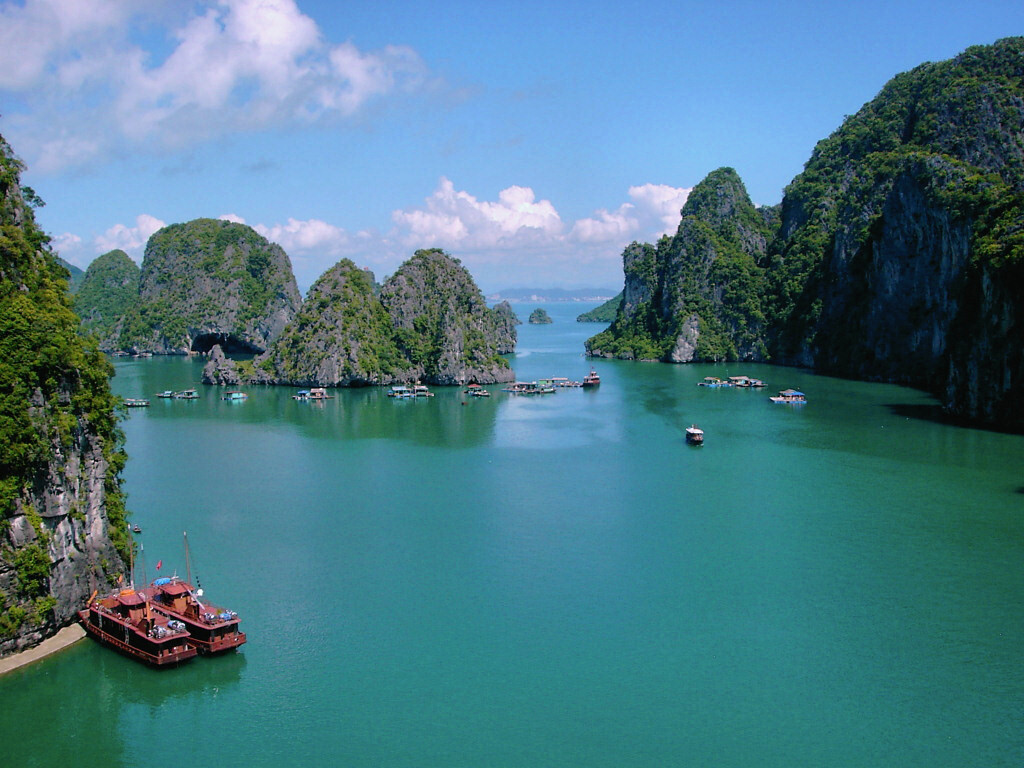
Ha Long Bay – Cat Ba Archipelago, a mesmerizing natural wonder nestled in the northeastern region of Vietnam, is a UNESCO World Heritage Site that offers an extraordinary blend of breathtaking landscapes, remarkable biodiversity, and fascinating cultural history. This expansive seascape, spanning approximately 65,650 hectares, comprises more than 1,100 islands and islets, each unique in size, shape, and beauty.
The name Ha Long Bay, translating to "descending dragon," reflects a legendary story in Vietnamese culture in which dragons descended to protect the Vietnamese people. The name also evokes the dramatic limestone formations that rise majestically from the emerald waters. These magnificent structures have been shaped over millions of years by geological processes, including tectonic activity, erosion, and the dissolution of limestone, creating a captivating landscape that has earned its place among the world's most remarkable natural wonders.
Ha Long Bay – Cat Ba Archipelago is renowned as one of the world's most extensive and spectacular examples of marine-invaded tower karst. The fengcong (clusters of connected conical peaks) and fenglin (isolated tower formations) karst landscapes found here are exceptionally beautiful, providing a unique geological spectacle shaped by the interaction between limestone, water, and tropical environmental processes.
Beyond its geological significance, Ha Long Bay – Cat Ba Archipelago supports a rich diversity of ecosystems, including limestone forests, mangroves, coral communities, seagrass beds, and marine habitats. The area is home to numerous rare and endemic species, including the critically endangered Cat Ba langur, one of the world's rarest primates. The surrounding waters support a variety of marine life, while the islands provide refuge for many plants and animals adapted to the region's distinctive limestone environment.
In addition to its natural splendor, Ha Long Bay – Cat Ba Archipelago holds important historical and cultural significance. The region has been inhabited for thousands of years, with archaeological evidence revealing prehistoric human settlements and long-standing connections between local communities and the sea. Ancient caves and grottoes, such as Sung Sot Cave (Surprise Cave) and Dau Go Cave (Wooden Stakes Cave), showcase spectacular underground chambers decorated with stalactites and stalagmites formed through natural geological processes.
The inclusion of the Cat Ba Archipelago greatly strengthens the ecological importance of the World Heritage Site. Cat Ba Island, much of which is protected within Cat Ba National Park, contains valuable limestone forest ecosystems and provides critical habitat for endangered species. The connection between Ha Long Bay and Cat Ba creates a unified landscape in which marine, coastal, and terrestrial environments interact, enhancing the conservation value of the entire region.
Ha Long Bay was first inscribed as a UNESCO World Heritage Site in 1994, recognizing its exceptional natural beauty. The property was later expanded in 2023 to include the Cat Ba Archipelago, forming the combined World Heritage Site known as Ha Long Bay – Cat Ba Archipelago. Its designation recognizes the area's outstanding geological, scenic, and ecological values while emphasizing the importance of preserving this exceptionalnatural landscape for future generations.
Today, Ha Long Bay – Cat Ba Archipelago continues to enchant visitors with its otherworldly beauty, geological wonders, rich biodiversity, and cultural heritage. Whether exploring the labyrinthine caves, kayaking through calm waters between towering limestone pillars, hiking through island forests, or admiring the dramatic coastal scenery, this remarkable destination offers an unforgettable experience.
UNESCO Description of the World Heritage Site
Covering an area of 65,650 ha and including 1,133 islands and islets, Ha Long Bay - Cat Ba Archipelago is located in the Northeast of Viet Nam, within Quang Ninh Province and Hai Phong City. Comprised of a multitude of limestone islands of islets rising from the sea, in a variety of sizes and shapes and presenting picturesque, unspoiled nature, Ha Long Bay - Cat Ba Archipelago is a spectacular seascape sculpted by nature. As the most extensive and best known example of marine - invaded tower karst, Ha Long Bay - Cat Ba Archipelago is one of the world’s mots important areas of fengcong (clusters of conical peaks) and fenglin (isolated tower features) karst. Additionally, the exceptionally beautiful landscape is also dominated by the typical ecosystems.
UNESCO Justification of the World Heritage Site
Criterion (vii): Ha Long Bay - Cat Ba Archipelago is a spectacular coastal landscape, and an outstanding example of fengcong and fenglin karst formed in humid tropical conditions. The limestone karst terrain has been invaded by the sea, to create a multitude of majestic limestone towers and features of shore erosion, including notches and caves. Cat Ba Archipelago provides spectacular views of the vegetated islands, marine lakes and limestone towers, with sheer cliffs plunging into the sea. It also includes the largest island in the region, with an inaccessible wilderness interior, marked by steep and rocky forested peaks, hosting important ecosystems that are the home to threatened species.
Criterion (viii): Ha Long Bay - Cat Ba Archipelago is the most extensive example of marine-invaded tower karst globally, and one of the world's most important areas of fengcong (clusters of conical peaks) and fenglin (isolated tower features) karst. Abundant lakes, occupying drowned dolines, are one of the distinctive features of the fengcong karst, with some appearing to be tidal. Possessing a tremendous diversity of caves and other landforms derived from the unusual geomorphological process of marine invaded tower karst, the caves are of three main types: remnants of phreatic caves, old karstic foot caves, and marine notch caves. The property also displays the full range of karst formation processes on a very large scale and over a very long period of geological time. This provides a unique and extensive reservoir of data for the future understanding of geoclimatic history and the nature of karst processes in a complex environment. With the addition of Cat Ba Archipelago, the property comprises all the stages of the process of sea-inundation of tropical karst as well as three main types of caves (ancient marine notch caves, old karstic foot caves and notch caves).
Encyclopedia Record: Hạ Long Bay
Hạ Long Bay or Halong Bay is a bay located in Northeastern Vietnam. The name Hạ Long means "descending dragon". The bay is administered by the cities of Hạ Long and Cẩm Phả in Quảng Ninh province. It features thousands of limestone karsts and islets in various shapes and sizes, for which it is listed as a UNESCO World Heritage Site and a popular travel destination. The bay is also part of a larger area that includes Bai Tu Long Bay to the northeast and Cát Bà Island to the southwest, with these zones sharing similar geological, geographical, geomorphological, climate, and cultural characteristics.Additional Site Details
Area: 65,650 hectares
Number of Components: 1
(viii) — Outstanding example representing major earth stages
Coordinates: 20.8327777778 , 107.1611111111
IUCN World Heritage Outlook
The 2025 Conservation Outlook on Ha Long Bay - Cat Ba Archipelago reports the following assessment:
Source: International Union for Conservation of Nature (IUCN) · View assessment
World Heritage Research
Discover scientific research and academic studies that deepen our understanding of Ha Long Bay - Cat Ba Archipelago from its history and significance to its conservation, management, and contemporary challenges.
-
Di sản Vịnh Hạ Long trong tầm nhìn liên giá trị
Ha Long Bay, recognized for its outstanding natural landscape and geological significance since 1994, has expanded its global heritage status to include the Cat Ba Archipelago in 2023. This study proposes a developmental orientation for Ha Long Bay by examining its inter-value relationships within the broader cultural context of Quang Ninh Province. Through an integrated approach, it explores the potential additional values beyond tourism, offering insights into sustainable socio-economic development and heritage conservation. The research employs an inter-value perspective to assess Ha Long Bay's multifaceted contributions to global heritage systems.
Nguyễn Văn Kim. (2025). Ha Long Bay Heritage through an Inter-Value Lens. Tạp Chí Khoa Học Liên Ngành Và Nghệ Thuật, 1(2), 17–28. https://doi.org/10.64711/f6vd7a88
View Publication Record | Read Publication -
Sponge’s biodiversity in the limestone islands in Vietnam sea
A comprehensive survey of sponge biodiversity in Vietnam's limestone islands, including Ha Long Bay and the Cat Ba Archipelago, identified 54 species across 33 genera and 24 families. Ha Long Bay exhibited the highest diversity (53 species), while the Ba Lua archipelago had the least (3 species). Sponges were most abundant in coral reefs (48 species) compared to mud or sand bottoms (4 species). Biomass varied significantly, with 11 sites showing high potential for medicinal drug development. The study, conducted between 2017 and 2020 across 41 sampling points, provides critical insights into the ecological richness of these UNESCO World Heritage Sites.
Thung, D. C., Ngai, N. D., & Thuy, L. T. (2020). Sponge’s biodiversity in the limestone islands in Vietnam sea. Tạp Chí Khoa Học Và Công Nghệ Biển, 20(4), 417–425. https://doi.org/10.15625/1859-3097/15307
View Publication Record | Read Publication -
An Integrated Approach in Management of ‘Halong Bay – Cat Ba Limestone Island Marine Area’, Vietnam
Halong Bay and its adjacent Cat Ba and Long Chau archipelagos, recognized as a unique cluster of limestone islands with global heritage significance, face challenges due to administrative separation. Despite Halong Bay being designated a UNESCO World Natural Heritage Site in 1994, the proposal for Cat Ba-Long Chau's inclusion was only submitted in 2014. The study highlights that while these areas share geological and ecological similarities, their divided governance presents unprecedented institutional hurdles for UNESCO recognition. However, an integrated management approach was adopted in 2015, designating the 'Halong Bay – Catba limestone island marine area' as an Ecologically and Biologically Significant Marine Area (EBSA). This decision underscores the potential for sustainable conservation-based economic development, benefiting not only the local regions but also Vietnam and global heritage preservation efforts.
Chu Hoi, N. (2019). An Integrated Approach in Management of ‘Halong Bay – Cat Ba Limestone Island Marine Area’, Vietnam. VNU Journal of Science: Policy and Management Studies. https://doi.org/10.25073/2588-1116/vnupam.4192
View Publication Record | Read Publication -
Marine biodiversity in Ha Long bay and Cat Ba archipelago
Ha Long Bay - Cat Ba Archipelago, Vietnam's largest limestone island system, exhibits exceptional marine biodiversity with 4,622 species of plants and animals, including 16 on the Vietnam Red List and 114 on the IUCN List. This diversity spans seven tropical limestone ecosystems—rainforest, cave, mangrove, tidal, coral reef, and soft-bottom—highlighting its global conservation value under UNESCO criteria (ix and x). The study, analyzing both terrestrial and marine species distribution, underscores the site's potential as a World Heritage Site due to its high endemism and rare species presence. Research involved systematic species documentation, emphasizing ecological significance for heritage designation.
Thung, D. C., Ngai, N. D., Thao, D. V., Sinh, N. V., & Dong, D. M. (2019). Marine biodiversity in Ha Long bay and Cat Ba archipelago. Tạp Chí Khoa Học Và Công Nghệ Biển, 19(3), 363–369. https://doi.org/10.15625/1859-3097/19/3/13174
View Publication Record | Read Publication