
World Heritage Identification Number: 357
World Heritage since: 1985
Category: Mixed Cultural Heritage and Natural Heritage
WHE Type: Protected Areas & National Parks
Transboundary Heritage: No
Endangered Heritage: No
Country: 🇹🇷 Türkiye
Continent: Asia
UNESCO World Region: Europe and North America
Map
Exploring the Unique Landscape of Göreme National Park and the Rock Sites of Cappadocia
Göreme National Park and the Rock Sites of Cappadocia, located in central Turkey, offer a fascinating glimpse into the rich history and geology of the region. This UNESCO World Heritage Site, inscribed in 1985, spans nearly 100 square kilometers and is situated within Nevşehir Province.
The park's most striking feature is its distinctive, water- and wind-sculpted landscape. The soft volcanic rock of the region has been eroded over millennia, resulting in a series of towering fairy chimneys, conical rock formations, and vast valleys. These geological wonders create a surreal, otherworldly atmosphere that draws visitors from around the globe.
Within this extraordinary landscape lie numerous churches and monastic complexes, providing a unique insight into Byzantine art, particularly from the post-Iconoclastic period. The richly decorated frescoes adorning these sanctuaries provide a vivid window into the religious beliefs and artistic traditions of the time. Among the most renowned examples is the Dark Church (Karanlık Kilise), celebrated for the remarkable preservation and intensity of its frescoes depicting biblical scenes.
In addition to its religious heritage, the Cappadocia region contains an extensive array of historical dwellings, troglodyte villages, and underground settlements carved directly into the rock. These subterranean complexes developed over many centuries, with origins possibly dating to earlier periods and significant expansion during the Byzantine era. They reflect the adaptive strategies of local communities in response to both environmental conditions and periods of insecurity.
One of the most notable examples is the Derinkuyu Underground City, which—together with Kaymaklı Underground City—forms part of the serial UNESCO World Heritage property of Göreme National Park and the Rock Sites of Cappadocia. This vast, multi-level complex extends several stories underground and could shelter thousands of people. Its labyrinthine corridors, storage chambers, stables, and churches illustrate how early Christian communities used these spaces as refuges during times of threat.
Beyond its historical and cultural significance, Göreme National Park and the Rock Sites of Cappadocia also boast outstanding natural beauty. Hot-air balloon flights offer panoramic views of the sculpted landscape at sunrise, while extensive hiking trails allow visitors to explore valleys, rock formations, and historic sites at ground level.
Altogether, Göreme National Park and the Rock Sites of Cappadocia stand as a powerful testament to the interaction between natural processes and human creativity. With its stunning landscapes, ancient churches, and subterranean settlements, the site offers an enduring and unforgettable record of life in central Anatolia.
UNESCO Description of the World Heritage Site
In a spectacular landscape, entirely sculpted by erosion, the Göreme valley and its surroundings contain rock-hewn sanctuaries that provide unique evidence of Byzantine art in the post-Iconoclastic period. Dwellings, troglodyte villages and underground towns – the remains of a traditional human habitat dating back to the 4th century – can also be seen there.
UNESCO Justification of the World Heritage Site
Criterion (i): Owing to their quality and density, the rupestral sanctuaries of Cappadocia constitute a unique artistic achievement offering irreplaceable testimony to the post-iconoclastic Byzantine art period.
Criterion (iii): The rupestral dwellings, villages, convents and churches retain the fossilized image of a province of the Byzantine Empire between the 4th century and the arrival of the Seljuk Turks (1071). Thus, they are the essential vestiges of a civilization which has disappeared.
Criterion (v): Cappadocia is an outstanding example of a traditional human settlement which has become vulnerable under the combined effects of natural erosion and, more recently, tourism.
Criterion (vii): In a spectacular landscape dramatically demonstrating erosional forces, the Göreme Valley and its surroundings provide a globally renowned and accessible display of hoodoo landforms and other erosional features, which are of great beauty, and which interact with the cultural elements of the landscape.
Encyclopedia Record: Göreme Historical National Park
Göreme Historical National Park is a national park in Cappadocia in central Turkey. It occupies an area of nearly 100 km2 and is located in Nevşehir Province. It became a UNESCO World Heritage Site in 1985 under the name Göreme National Park and the Rock Sites of Cappadocia. The park features a rocky, water- and wind-eroded landscape with a network of ancient, interconnecting underground settlements.Additional Site Details
Area: 9,883.81 hectares
Number of Components: 7
(iii) — Unique or exceptional testimony to a cultural tradition
(v) — Outstanding example of traditional human settlement
(vii) — Contains superlative natural phenomena or beauty
Coordinates: 38.66667 , 34.85
IUCN World Heritage Outlook
The 2025 Conservation Outlook on Göreme National Park and the Rock Sites of Cappadocia reports the following assessment:
Source: International Union for Conservation of Nature (IUCN) · View assessment
Image
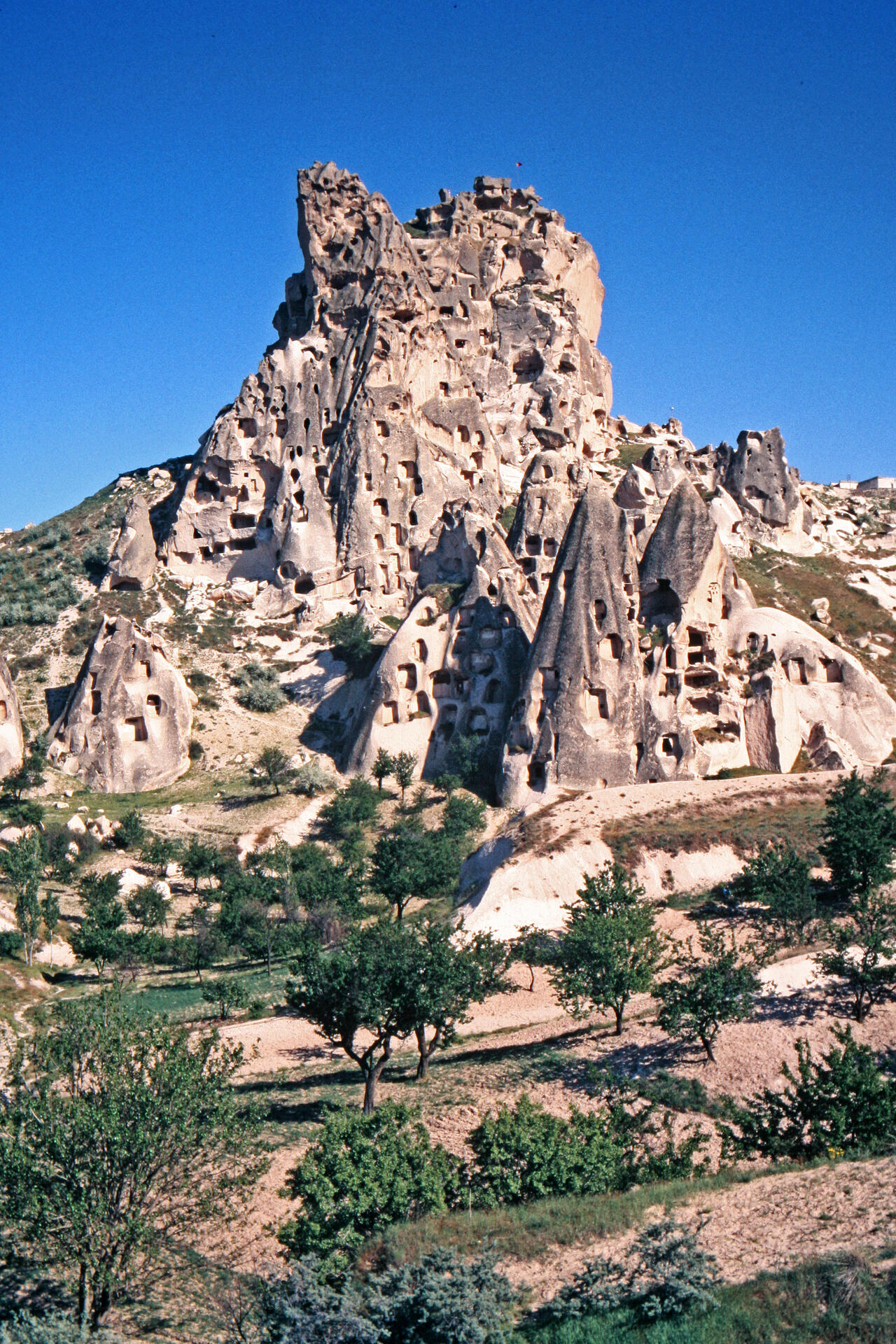
© W. Bulach, CC BY-SA 4.0 Resized from original. (This derivative is under the same CC BY-SA license.)
World Heritage Research
Discover scientific research and academic studies that deepen our understanding of Göreme National Park and the Rock Sites of Cappadocia from its history and significance to its conservation, management, and contemporary challenges.
-
Translating Chivalry. The Ethics and Aesthetics of Warfare in the Age of the Komnenoi (1081-1204)
Chivalry, traditionally associated with medieval Europe, emerged as a shared aesthetic and ethical framework among the Byzantine military elite during the Komnenoi dynasty (1081–1204). This study reveals that warfare was glamorized in Byzantium, mirroring parallel developments in the Latin West and Islamic world, through the restructuring of aristocratic identity around martial ideals. By analyzing visual, textual, and material evidence—including rock-cut churches in Cappadocia, lead seals, coins, and icons—the research demonstrates how chivalric conventions diffused across the Mediterranean, shaping representational strategies and artistic expression. The study also highlights the role of performance, classical antiquity manipulation, and ornamentation in enhancing warrior identities, offering a nuanced reinterpretation of word-image relations and ephemeral cultural practices.
Berardi, C. (2025). Translating Chivalry. The Ethics and Aesthetics of Warfare in the Age of the Komnenoi (1081-1204) [University of Michigan]. https://doi.org/10.7302/27289
View Publication Record | Read Publication -
Computer-Assisted Reading Tools Marks: First Step of a Promising Protocol
A groundbreaking multi-modal method integrating rock-cut structures into archaeological studies has been developed, offering new insights into the construction phases and occupation sequences of Göreme 4b church in Cappadocia. This interdisciplinary approach combines building archaeology, traceology, photogrammetry, and computer-assisted analysis to create high-resolution 3D models, relational databases, and GIS-based vectorisation of stratigraphic units (SUs). The study revealed previously unseen features such as a Christian cross near a tomb and confirmed that initial excavation proceeded from the top down. It also identified multiple phases of tool use, including quarry picks and polkas. While more time-consuming than traditional methods, this systematic protocol significantly enhances interpretive precision and can be extended to larger areas and other structures. Future developments may include artificial intelligence for automated tool mark recognition, underscoring the potential of digital technologies in refining structural analysis and conservation strategies.
Lamesa, A., Botica, N., & Bernardes, P. (2025). Computer-Assisted Reading Tools Marks: First Step of a Promising Protocol. Journal of Computer Applications in Archaeology, 8(1), 264–281. https://doi.org/10.5334/jcaa.221
View Publication Record | Read Publication -
Épitaphes paléochrétiennes et médiévales d’Eğri Taş kilisesi à Ihlara en Cappadoce
A comprehensive reexamination of paleochristian and medieval epitaphs from the Eğri Taş kilisesi complex in Ihlara Valley, Cappadocia, reveals previously unknown inscriptions and corrects readings of existing ones. Through three fieldwork trips (2006, 2012, 2019), researchers identified thirteen unpublished epitaphs and refined eleven known ones, dating them to two distinct periods: late antique (likely 6th century) and medieval (9th–11th centuries). These findings significantly expand the corpus of Christian funerary epigraphy in Cappadocia, offering new insights into burial practices and historical occupation phases at this UNESCO World Heritage Site.
Xenaki, M. (2024). Épitaphes paléochrétiennes et médiévales d’Eğri Taş kilisesi à Ihlara en Cappadoce. Gephyra, 27, 109–170. https://doi.org/10.37095/gephyra.1352086
View Publication Record | Read Publication -
Determination of Satisfaction Levels of Individuals Participating in Cultural Tourism With ChatGPT
A novel application of ChatGPT demonstrates its potential to revolutionize the analysis of tourist satisfaction by accurately parsing and interpreting online comments from UNESCO World Heritage Sites, including Göreme National Park. The study found that ChatGPT effectively identifies both positive and negative factors influencing visitor experiences across multiple landmarks such as Zelve Open Air Museum, Paşabağı, Güray Museum, and Kaymaklı Underground City. By assigning satisfaction scores to these factors, the AI tool provides a quantitative measure of tourist feedback, offering deeper insights into cultural tourism dynamics. This approach enhances traditional methods of sentiment analysis, paving the way for more nuanced evaluations in heritage site management.
Yaşar, E., Tür, E., Yayla, E., & Öztürk, İ. (2024). Determination of Satisfaction Levels of Individuals Participating in Cultural Tourism With ChatGPT. Cultural, Gastronomy, and Adventure Tourism Development, 89–110. https://doi.org/10.4018/979-8-3693-3158-3.ch004
View Publication Record | Read Publication -
Assessing the Impact of Lichens on Saint Simeon Church, Paşabağ Valley (Cappadocia, Turkey): Potential Damaging Effects versus Protection from Rainfall and Winds
Lichen colonization on Saint Simeon Church, part of the UNESCO World Heritage Site Göreme National Park and the Rock Sites of Cappadocia, primarily offers protective benefits against weathering rather than causing damage. A multidisciplinary study found that lichens form encrustations with calcium oxalate layers, which mitigate water penetration and eolian erosion, reducing deterioration on the northwest side of the church despite exposure to wind-driven rain (WDR) and freezing-thawing cycles. In contrast, the northeast side, with lower lichen coverage, showed more severe weathering. The research highlights the potential for integrating lichen bioprotection into conservation strategies to enhance monument preservation.
Casanova Municchia, A., Giordani, P., Taniguchi, Y., & Caneva, G. (2024). Assessing the Impact of Lichens on Saint Simeon Church, Paşabağ Valley (Cappadocia, Turkey): Potential Damaging Effects versus Protection from Rainfall and Winds. Applied Sciences, 14(16), 6943. https://doi.org/10.3390/app14166943
View Publication Record | Read Publication -
Byzantine Rock-Cut Architecture in Cappadocia and Beyond: The State of Scholarship
Rock-cut architecture, long overlooked in Byzantine studies, is now recognized as a primary means for Byzantine society to engage with and transform its environment. This critical review synthesizes current scholarship on rock-cut sites in Cappadocia, highlighting their excellent preservation and potential to enrich research on spatial practices, economic activities, and daily life. The study emphasizes the interplay between rock-cut and masonry traditions, exploring practical motivations and sacred associations behind their use. It also identifies methodological challenges and future directions, advocating for a nuanced understanding of Byzantine landscapes through appropriate theoretical frameworks.
Günay, G. (2024). Byzantine Rock-Cut Architecture in Cappadocia and Beyond: The State of Scholarship. Valonia: A Journal of Anatolian Pasts, 1(1), 35–63. https://doi.org/10.5505/valonia.2024.43531
View Publication Record | Read Publication -
An Adventure Tourism Story in the Branding Process: Hot Air Balloon Management Successes in Cappadocia
Cappadocia's hot air balloon rides have become a globally sought-after adventure tourism experience, significantly enhancing the region's branding and appeal. The study identifies three key factors contributing to this success: the region's unique geological landscape, which provides a stunning backdrop for ballooning; strong collaboration among stakeholders, ensuring safety, efficiency, and visitor satisfaction; and strategic marketing efforts that integrate balloon rides with other tourism offerings like cave hotels and historical sites. These findings offer practical insights for destination managers aiming to leverage adventure tourism in branding efforts.
Kelek, B. S. (2023). AN ADVENTURE TOURISM STORY IN THE BRANDING PROCESS: HOT AIR BALLOON MANAGEMENT SUCCESSES IN CAPPADOCIA. Pressacademia. LOCKSS. https://doi.org/10.17261/pressacademia.2023.1794
View Publication Record | Read Publication
