World Heritage Identification Number: 358
World Heritage since: 1985
Category: Cultural Heritage
WHE Type: Religious Sites & Sacred Architecture
Transboundary Heritage: No
Endangered Heritage: No
Country: 🇹🇷 Türkiye
Continent: Asia
UNESCO World Region: Europe and North America
Map
The Architectural Marvel of the Great Mosque and Hospital of Divriği
The Great Mosque and Hospital of Divriği, located in the Sivas Province of Turkey, stands as a testament to the rich cultural heritage and architectural prowess of the medieval Islamic world. Built in 1228–1229 by the local dynasty of the Mengujekids, this complex is nestled in the upper town, beneath the citadel. Its intricate stone carvings and unique architecture have earned it a place on UNESCO's World Heritage List since 1985.
More to come…UNESCO Description of the World Heritage Site
This region of Anatolia was conquered by the Turks at the beginning of the 11th century. In 1228–29 Emir Ahmet Shah founded a mosque, with its adjoining hospital, at Divrigi. The mosque has a single prayer room and is crowned by two cupolas. The highly sophisticated technique of vault construction, and a creative, exuberant type of decorative sculpture – particularly on the three doorways, in contrast to the unadorned walls of the interior – are the unique features of this masterpiece of Islamic architecture.
UNESCO Justification of the World Heritage Site
Criterion (i): A unique artistic achievement, this cultural property in itself represents one of Islamic architecture's most beautiful built spaces.
Criterion (iv): The Divriği Mosque is an outstanding example of a Seljuk mosque in Anatolia, as it neither has a courtyard, colonnades nor an uncovered ablutions basin, but rather organizes all religious functions in an enclosed area, owing perhaps to the harshness of the climate. A charitable foundation, the contiguous hospital makes an already exceptional ensemble even more interesting, thanks to a princely command.
Encyclopedia Record: Divriği Great Mosque and Hospital
Divriği Great Mosque and Hospital was built in 1228–1229 by the local dynasty of the Mengujekids in the small Anatolian town of Divriği, now in Sivas Province, Turkey. The complex is in the upper town, below the citadel. The exquisite stone carvings and eclectic architecture of the complex places it among the most important works of architecture in Anatolia and led to its inclusion on UNESCO's World Heritage List in 1985.Additional Site Details
Area: 2,016 hectares
Number of Components: 1
(iv) — Outstanding example of a type of building or landscape
Coordinates: 39.371271 , 38.121826
Image
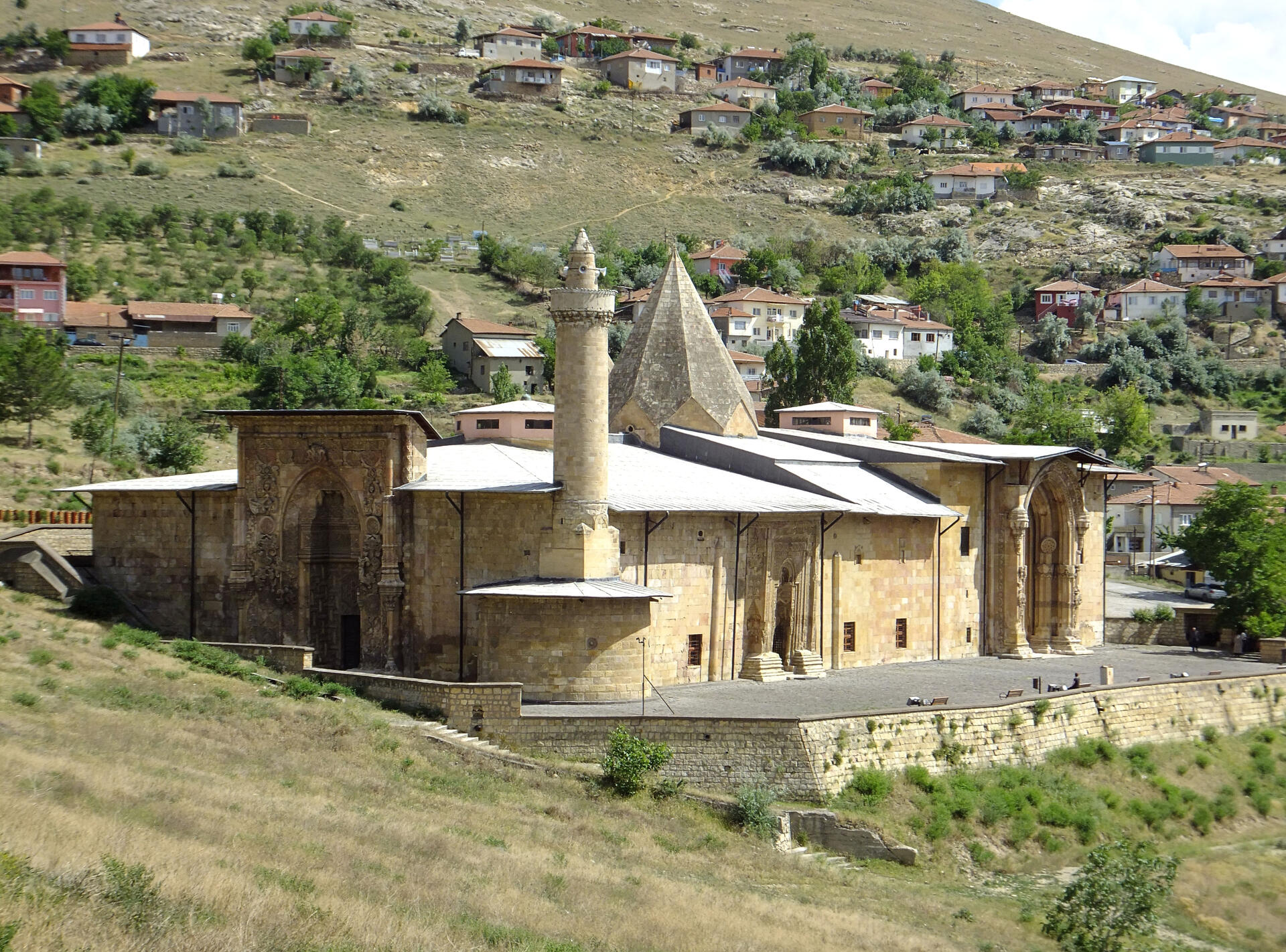
© R Prazeres, CC BY-SA 4.0 Resized from original. (This derivative is under the same CC BY-SA license.)
World Heritage Research
Discover scientific research and academic studies that deepen our understanding of Great Mosque and Hospital of Divriği from its history and significance to its conservation, management, and contemporary challenges.
-
Divriği’s architectural plasticity: Study in Seljuk innovation and cross-cultural analogy
The Great Mosque and Hospital of Divriği, constructed in the early 1220s under the joint patronage of Ahmed Şah and Turan Melek, stands as a groundbreaking fusion of Seljuk architectural innovation and sculptural artistry. This study reveals how the complex, attributed to master builder Hürremşah of Ahlat and his cosmopolitan workshop, defies conventional Anatolian Seljuk design by integrating high-relief stone carving, vegetal motifs, and rigorous structural techniques into a courtyard-less, multi-aisled mosque plan. The ensemble’s portals, particularly the North Portal and Darüşşifa entrance, exhibit unprecedented plastic dynamism, drawing heuristic parallels with later European Gothic and Baroque styles without implying direct influence. The research highlights Divriği’s unique programmatic complexity, including a modified four-iwan scheme, lanterned dome, and integrated mausoleum, positioning it as a monumental example where architecture transcends into sculpture through local craftsmanship.
Sönmez, N. Y. Ş. (2025). Divriği’s architectural plasticity: Study in Seljuk innovation and cross-cultural analogy. Architecture Papers of the Faculty of Architecture and Design STU, 30(4), 20–29. https://doi.org/10.2478/alfa-2025-0021
View Publication Record | Read Publication -
Divriği Hospital - Medieval Healing Venue and Its Acoustic Characteristics
Research on the Divriği Great Mosque and Hospital reveals that its architecture supports optimal acoustic conditions for sound reception, aligning with medieval healing practices. The study, which analyzed a 3D model of the hospital built in 1228/1229 by the Mengüjeck dynasty, demonstrates that the venue's design enhances the effects of music therapy through environmental soundscape integration and the use of makams (musical modes). This suggests that Anatolian Seljuk hospitals were intentionally constructed to serve as both healing spaces and acoustic venues, blending functional and therapeutic purposes. The findings underscore the role of architectural acoustics in medieval medical practices.
Mihaljinec, I., & Eser, E. (2022). Divriği Hospital - Medieval Healing Venue and Its Acoustic Characteristics. Randwick International of Social Science Journal, 3(1), 67–83. https://doi.org/10.47175/rissj.v3i1.376
View Publication Record | Read Publication -
The Construction and Geometric Analysis of Main Iwan Spiral Centered Flat Vault of Divrigi Hospital
The Great Mosque and Hospital of Divriği, dating back to the 13th century, features one of the most intricate stone vaults in Anatolia, characterized by six groins that spiral around a central axis within an uneven octagon. This unique geometric design, distinct from other vaults of its time, suggests a sophisticated understanding of geometry and construction techniques. A study reconstructed this main iwan vault using hypotheses developed at Madrid's 'Taller de Construcción Gótica,' confirming its exceptional nature by comparing it to similar structures in Aksaray Sultan Khan and Sivas Buruciye Madrasa. The findings indicate that the Divriği vault may serve as a prototype for other spiral vaults built in the same century, highlighting its architectural significance.
ATAK, S. (2020). THE CONSTRUCTION AND GEOMETRIC ANALYSIS OF MAIN IWAN SPIRAL CENTERED FLAT VAULT OF DIVRIGI HOSPITAL. International Refereed Journal of Design and Architecture, 0(35), 0. https://doi.org/10.17365/tmd.2020.1.3
View Publication Record | Read Publication