World Heritage Identification Number: 1488
World Heritage since: 2015
Category: Cultural Heritage
WHE Type: Cultural Landscapes
Transboundary Heritage: No
Endangered Heritage: No
Country: 🇹🇷 Türkiye
Continent: Asia
UNESCO World Region: Europe and North America
Map
Diyarbakır Fortress and Hevsel Gardens Cultural Landscape: A Historical and Cultural Treasure in Southeastern Anatolia
The Diyarbakır Fortress and Hevsel Gardens Cultural Landscape, inscribed as a UNESCO World Heritage Site in 2015, offers a unique blend of history, culture, and natural beauty in southeastern Anatolia, Turkey. This site, located on an escarpment of the Upper Tigris River Basin, has been a significant center since the Hellenistic period, providing a testament to the region's rich past and enduring cultural heritage.
More to come…UNESCO Description of the World Heritage Site
Located on an escarpment of the Upper Tigris River Basin that is part of the so-called Fertile Crescent, the fortified city of Diyarbakır and the landscape around has been an important centre since the Hellenistic period, through the Roman, Sassanid, Byzantine, Islamic and Ottoman times to the present. The site encompasses the Inner castle, known as İçkale and including the Amida Mound, and the 5.8 km-long city walls of Diyarbakır with their numerous towers, gates, buttresses, and 63 inscriptions. The site also includes the Hevsel Gardens, a green link between the city and the Tigris that supplied the city with food and water, the Anzele water source and the Ten-Eyed Bridge.
UNESCO Justification of the World Heritage Site
Criterion (iv): The rare and impressive Diyarbakır Fortress and the associated Hevsel Gardens illustrate a number of significant historical periods within this region from the Roman period until the present through its extensive masonry city walls and gates (including many repairs and additions), inscriptions, gardens/fields and the landscape setting in relation to the Tigris River.
Encyclopedia Record: Fortifications of Diyarbakır
The Fortifications of Diyarbakır are a set of fortifications enclosing the historical district of Sur in Diyarbakır, Turkey. They consist of an inner fortress, the citadel, and an outer ring of city walls.Additional Site Details
Area: 521.23 hectares
Number of Components: 1
Coordinates: 37.9031 , 40.2393083333
Image
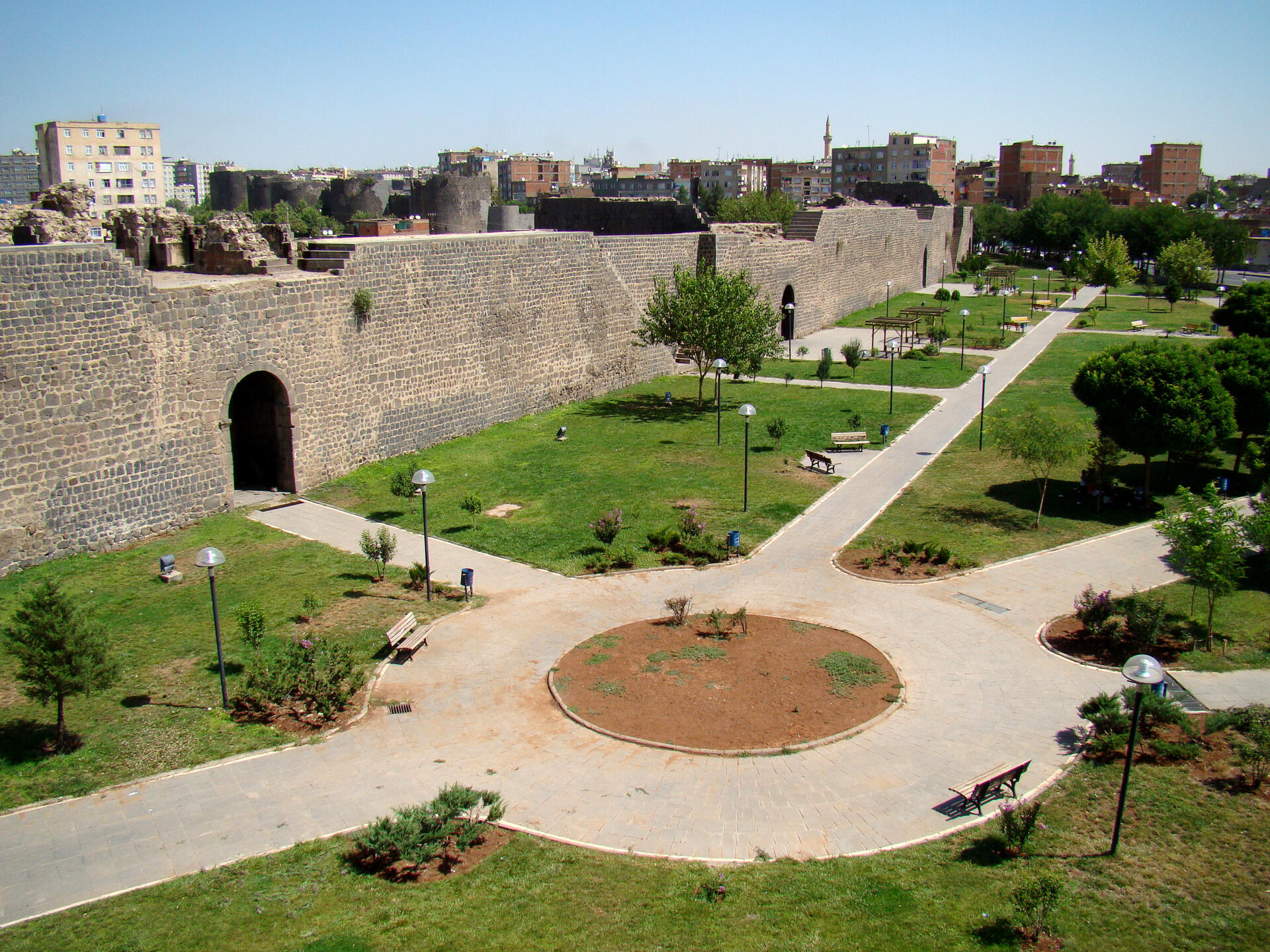
© Bjørn Christian Tørrissen, CC BY-SA 3.0 Resized from original. (This derivative is under the same CC BY-SA license.)
World Heritage Research
Discover scientific research and academic studies that deepen our understanding of Diyarbakır Fortress and Hevsel Gardens Cultural Landscape from its history and significance to its conservation, management, and contemporary challenges.
-
Integration of Geographic Information system (GIS) analysis into street renewal criteria: the case study of Diyarbakır Gazi Street
A context-sensitive conservation approach for historical streets, balancing architectural authenticity with contemporary urban needs, is demonstrated through the renewal of Diyarbakır Gazi Street. This study identifies analytical criteria for street rehabilitation that prioritize pedestrian-oriented spatial arrangements while preserving social, cultural, and economic dynamics—key to sustaining living heritage in UNESCO-listed sites like Diyarbakır's Sur district. Methodologically, the research integrates GIS-based spatial assessments with archival analysis and literature reviews, revealing how adaptive design can harmonize historical identity with modern urban functionality.
Kakdaş Ateş, D., & Akalp, S. (2026). Integration of Geographic Information system (GIS) analysis into street renewal criteria: the case study of Diyarbakır Gazi Street. İDealkent, (51). https://doi.org/10.31198/idealkent.1661129
View Publication Record | Read Publication -
Patrimonio per la Pace in un Mondo Pieno di Conflitti
UNESCO World Heritage Site inscriptions can both foster peace and inadvertently exacerbate conflicts, as demonstrated by the contrasting experiences of Ani and Diyarbakır Fortress. While Ani's 2016 inscription was celebrated for its potential to promote global harmony, the same process highlighted tensions surrounding Diyarbakır Fortress, where Kurdish heritage preservation clashes with Turkish military interventions. Activist groups accused UNESCO of indifference, underscoring the complex interplay between cultural heritage, human rights, and social relations in conflict-ridden regions. The study analyzes these dynamics through a case analysis of the 40th Committee session, revealing how inscription processes can trigger or mitigate conflicts, offering insights into the broader implications for heritage management in divided societies.
Dinler, M. (2023). Patrimonio per la Pace in un Mondo Pieno di Conflitti. Restauro Archeologico, 30(1). https://doi.org/10.36253/rar-14351
View Publication Record | Read Publication -
Audit Design: Know-how to Monitor Community Knowledge Transfer in World Heritage Management Systems
A semi-automated method called Audit Design has been developed to quantify and audit knowledge transfer from local communities to management plans in World Heritage Sites (WHS). This approach, validated using Knowledge Representation and Natural Language Processing techniques, assesses five levels of knowledge transfer and generates precise natural language representations. Applied to the Diyarbakır Fortress and Hevsel Gardens Cultural Landscape WHS, it offers a reliable tool for monitoring inclusiveness and ensuring community ideas are effectively integrated into management plans. The method addresses a gap in the literature by providing a systematic way to evaluate the effectiveness of participative engagement initiatives in WHS management.
PARLAK, G., De SOUZA, C. B., CERUTTI, F., & De RIBAUPIERRE, H. (2023). Audit Design: Know-how to Monitor Community Knowledge Transfer in World Heritage Management Systems. Zenodo. https://doi.org/10.5281/ZENODO.8204433
View Publication Record | Read Publication -
The Effect of a Cultural Landscape Area on Urban Green Spaces: Case Study of Diyarbakir Fortress and Hevsel Gardens
A significant increase in urban green space, from 18.22 to 37.75 square meters per capita, was observed in Diyarbakır's Sur District due to the integration of cultural landscapes like the Diyarbakır Fortress and Hevsel Gardens. This study quantifies how heritage areas, intertwined with culture, nature, and historical architecture, enhance both green space availability and parking capacity (16.64 square meters per person). The research employed field observations, development plans, land records, and digital mapping to analyze the impact of these landscapes on urban functionality. It recommends stricter buffer zone regulations with sustainable, long-term planning that balances traditional and modern elements while maintaining ecological equilibrium.
BİÇEN, A. (2023). The Effect of a Cultural Landscape Area on Urban Green Spaces: Case Study of Diyarbakir Fortress and Hevsel Gardens. İnsan Ve Sosyal Bilimler Dergisi, 6(2), 343–376. https://doi.org/10.53048/johass.1371471
View Publication Record | Read Publication -
Muğla Karabağlar Yaylası’nın Kadim Üretim ve Peyzaj Değerlerinin Dünya Kültürel Peyzaj Alanları Çerçevesinde Değerlendirilmesi
Muğla Karabağlar Yaylası demonstrates significant potential for inclusion in the UNESCO World Cultural Heritage List as a cultural landscape, owing to its unique micro-climatic conditions, rich biodiversity, including endemic species and agricultural diversity, and distinctive rural architectural typology. The study evaluates the plateau's eligibility using qualitative comparative analysis, comparing it with two established UNESCO sites: Honghe Hani Rice Terraces and Diyarbakır Fortress and Hevsel Gardens. Findings suggest that its sensitive ecosystem, cultural identity, and production values align closely with UNESCO criteria for cultural landscapes, positioning it as a strong candidate for future recognition.
Cesur, H. C., & Karakaya Ayalp, E. (2023). Muğla Karabağlar Yaylası’nın Kadim Üretim ve Peyzaj Değerlerinin Dünya Kültürel Peyzaj Alanları Çerçevesinde Değerlendirilmesi. Geographies, Planning and Tourism Studios, 3(1), 24–39. https://doi.org/10.5505/gpts.2023.68077
View Publication Record | Read Publication -
Découvrir les jardins de l’Hevsel
Hevsel Gardens, part of the Diyarbakır Fortress and Hevsel Gardens Cultural Landscape, has undergone a significant rediscovery during its UNESCO World Heritage Site inscription process. This transformation has led to a re-evaluation of its historical and cultural value by experts, artists, urban planners, and local inhabitants. The research highlights key events and works that have shaped the Gardens into a recognized heritage site, emphasizing its unique significance in the region's history.
Boucly, J. (2018). Découvrir les jardins de l’Hevsel. Les Jardins de l’Hevsel, Paradis Intranquilles. https://doi.org/10.4000/books.ifeagd.2294
View Publication Record | Read Publication