World Heritage Identification Number: 448
World Heritage since: 1987
Category: Cultural Heritage
WHE Type: Natural Landscapes & Geographic Features
Transboundary Heritage: No
Endangered Heritage: No
Country: 🇹🇷 Türkiye
Continent: Asia
UNESCO World Region: Europe and North America
Map
Nemrut Dağ: A Unique Blend of Cultures atop a Taurus Mountain
Nemrut Dağ, meaning "Mountain of Nemrut" in Turkish, is a historical and archaeological site located in southeastern Turkey. This 2,134-meter high peak is part of the eastern Taurus Mountains and is renowned for its colossal statues that adorn the summit, believed to mark a royal tomb from the 1st century BC. In 1987, UNESCO recognized the significance of this site by inscribing it as a World Heritage Site.
More to come…UNESCO Description of the World Heritage Site
The mausoleum of Antiochus I (69–34 B.C.), who reigned over Commagene, a kingdom founded north of Syria and the Euphrates after the breakup of Alexander's empire, is one of the most ambitious constructions of the Hellenistic period. The syncretism of its pantheon, and the lineage of its kings, which can be traced back through two sets of legends, Greek and Persian, is evidence of the dual origin of this kingdom's culture.
UNESCO Justification of the World Heritage Site
Criterion (i): The tomb of Antiochos I of Commagene is a unique artistic achievement. The landscaping of the natural site of Nemrut Dağ is one of the most colossal undertakings of the Hellenistic period (some of the stone blocks used weigh up to nine tons).
Criterion (iii): The tomb or the Hierotheseion of Nemrut Dağ bears unique testimony to the civilization of the kingdom of Commagene. Antiochos I is represented in this monument as a descendant of Darius by his father Mithridates, and a descendant of Alexander by his mother Laodice. This semi-legendary ancestry translates in genealogical terms the ambition of a dynasty that sought to remain independent of the powers of both the East and the West.
Criterion (iv): More so than the tombs at Karakus and Eski Kahta, the tumulus at Nemrut Dağ illustrates, through the liberal syncretism of a very original pantheon, a significant, historical period. The assimilation of Zeus with Oromasdes (the Iranian god Ahuramazda), and Heracles with Artagnes (the Iranian god Verathragna) finds its artistic equivalent in an intimate mixture of Greek, Persian and Anatolian aesthetics in the statuary and the bas-reliefs.
Encyclopedia Record: Mount Nemrut
Mount Nemrut or Nemrud is a 2,134-metre-high (7,001 ft) mountain in southeastern Turkey, notable for the summit where a number of large statues are erected around what is assumed to be a royal tomb from the 1st century BC. It is one of the highest peaks in the east of the Taurus Mountains.Additional Site Details
Area: 11 hectares
Number of Components: 1
(iii) — Unique or exceptional testimony to a cultural tradition
(iv) — Outstanding example of a type of building or landscape
Coordinates: 38.03661 , 38.76369
Image
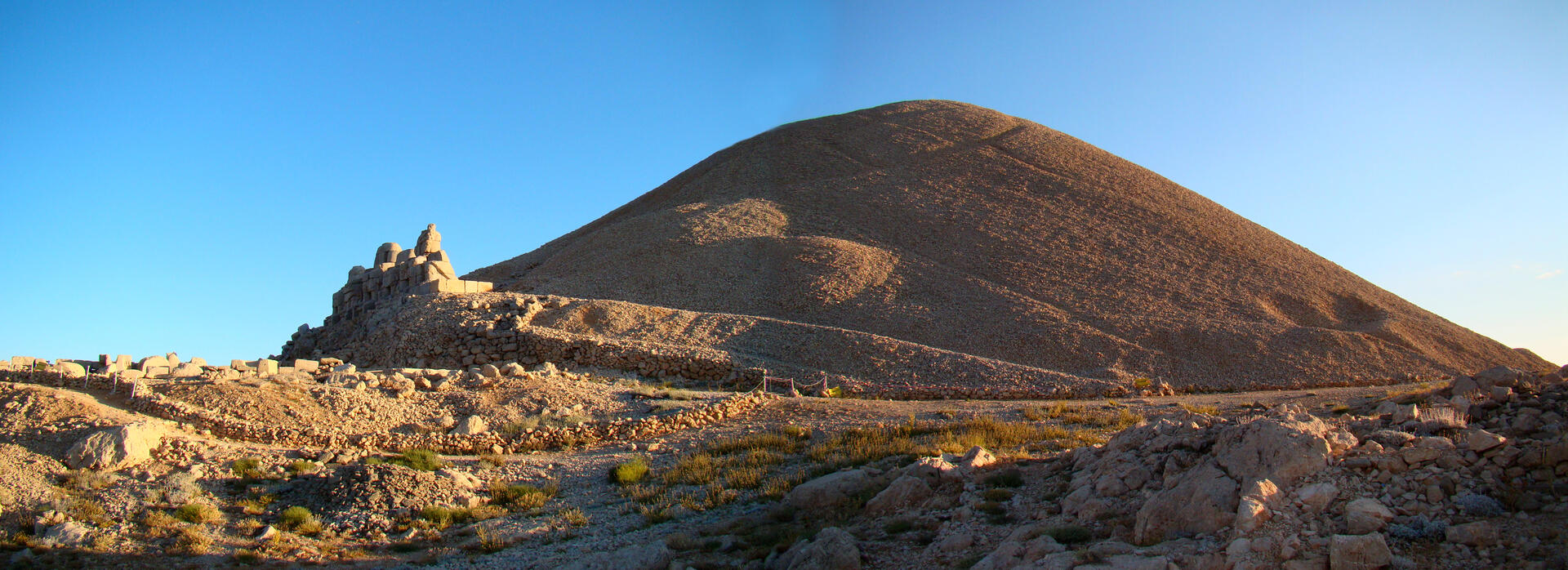
© Bjørn Christian Tørrissen, CC BY-SA 3.0 Resized from original. (This derivative is under the same CC BY-SA license.)
World Heritage Research
Discover scientific research and academic studies that deepen our understanding of Nemrut Dağ from its history and significance to its conservation, management, and contemporary challenges.
-
Machine learning approach to Nemrut Dağ and Bingöl obsidians: insights from Tūlūl al Baqarat obsidian prehistoric tools (Iraq, IV millennium BC) and volcanological implications
A machine learning approach has identified Nemrut Dağ stratovolcano in southeastern Turkey as the likely source of nine obsidian blades from the archaeological site of Tūlūl al Baqarat (Iraq), dating back to the 4th millennium BC. The study, which employed non-invasive chemical analysis and geochemical comparisons, found that these tools exhibit a unique peraluminous rhyolite composition with high zirconium content, distinguishing them from other known Turkish and Armenian obsidian sources. This discovery supports the hypothesis of extensive trade networks along the Tigris River during prehistoric times, facilitating exchange between Turkey and the South Near East as early as 4000 years ago.
Vaggelli, G., Borghi, A., Cossio, R., Ghignone, S., & Lippolis, C. (2025). Machine learning approach to Nemrut Dağ and Bingöl obsidians: insights from Tūlūl al Baqarat obsidian prehistoric tools (Iraq, IV millennium BC) and volcanological implications. Annals of Geophysics, 69(3), SY328. https://doi.org/10.4401/ag-9369
View Publication Record | Read Publication -
A machine learning approach to Nemrut Dağ and Bingöl Obsidians: non-invasive and non-destructive geochemical analyses for provenance source of Tulūl al Baqarat tools (Iraq)
A groundbreaking analysis using machine learning has identified Nemrut Dağ, a stratovolcano in southeastern Turkey, as the likely source of obsidian tools found at the archaeological site of Tulūl al Baqarat in Iraq. The study employed non-invasive and non-destructive geochemical techniques, including SEM-EDS microprobe and micro-XRF, to analyze major, minor, and trace elements in nine obsidian blades. Unlike traditional methods, machine learning provided an exhaustive discriminative approach that confirmed the tools' composition matched Nemrut Dağ's mild alkaline rhyolitic obsidians from pre-caldera eruptions. This finding supports historical evidence of extensive trade networks spanning Turkey and the South Near East during the 4th Millennium BCE, likely facilitated by riverine routes along the Tigris and Euphrates to the Persian Gulf.
Vaggelli, G., Cossio, R., Borghi, A., & Lippolis, C. (2023). A machine learning approach to Nemrut Dağ and Bingöl Obsidians: non-invasive and non-destructive geochemical analyses for provenance source of Tulūl al Baqarat tools (Iraq). https://doi.org/10.21203/rs.3.rs-3646159/v1
View Publication Record | Read Publication -
Characterization of the Obsidian Used in the Chipped Stone Industry in Kendale Hecala
Archaeological analysis of obsidian artifacts from Kendale Hecala, an Ubaid-period settlement in Southeast Anatolia, reveals that multiple obsidian sources were utilized, including Nemrut Dağ, Bingöl B, and Group 3d. This finding sheds light on the socio-cultural organization of the region during this period by demonstrating a complex distribution network for raw materials. The study employed macro-observations and handheld X-ray fluorescence (XRF) analysis to characterize the obsidian samples, followed by multivariate data analysis to identify source varieties. These techniques allowed researchers to trace the operational sequence of the lithic industry, providing insights into the settlement's technological practices and economic strategies.
Muşkara, Ü., & Konak, A. (2022). Characterization of the Obsidian Used in the Chipped Stone Industry in Kendale Hecala. Quaternary, 5(1), 3. https://doi.org/10.3390/quat5010003
View Publication Record | Read Publication -
Analytical Investigation of Obsidian Tools from Kurdistan Province, Iran: Determination of Exchange Paths During the Chalcolithic Period
A groundbreaking analysis of Chalcolithic obsidian tools from Kurdistan, Iran, reveals distinct exchange pathways during this period. Using X-ray fluorescence and neutron activation analysis, researchers traced the origins of artifacts from Namashir, Ghazikhan, and Galali to sources in Anatolia and Armenia. Notably, Early to Late Chalcolithic 1 tools from Namashir were sourced from Meydan Dağ, while Late Chalcolithic 1 tools from Galali originated from Nemrut Dağ. The study also found that during the Late Chalcolithic 2, multiple sources and exchange paths emerged, indicating evolving trade networks. This research sheds light on the complex movement of cultural materials in ancient times.
Mucheshi, A. S., Esna-Ashari, A., Glascock, M. D., Oga, A., & Karimi, Z. (2021). ANALYTICAL INVESTIGATION OF OBSIDIAN TOOLS FROM KURDISTAN PROVINCE, IRAN: DETERMINATION OF EXCHANGE PATHS DURING THE CHALCOLITHIC PERIOD. Zenodo. https://doi.org/10.5281/ZENODO.5727492
View Publication Record | Read Publication