
World Heritage Identification Number: 354
World Heritage since: 1995
Category: Natural Heritage
WHE Type: Natural Landscapes & Geographic Features
Transboundary Heritage: Yes
Endangered Heritage: No
Country: Canada, United States of America
Continent: Americas
UNESCO World Region: Europe and North America
Map
Waterton-Glacier International Peace Park: A Transboundary Testament to Peace and Nature Conservation
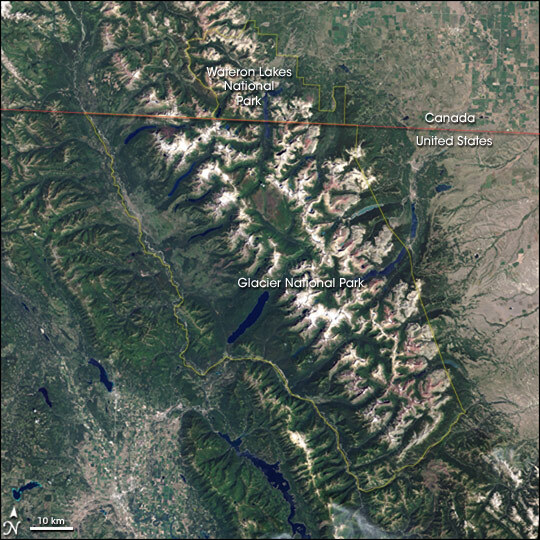
The Waterton-Glacier International Peace Park, established in 1932, stands as a testament to the enduring spirit of peace and cooperation between Canada and the United States. This unique transboundary park straddles the international border, uniting Waterton Lakes National Park in Alberta, Canada, and Glacier National Park in Montana, USA. The park’s designation as a UNESCO World Heritage Site, granted in 1995, underscores its exceptional natural beauty, biodiversity, and cultural significance.
Geographically, the park spans more than 4,556 square kilometers (over 1.1 million acres), encompassing a diverse range of ecosystems that include prairies, forests, alpine meadows, and glaciers. The park’s namesake features—Waterton Lake and Glacier National Park’s remaining glaciers—contribute to its breathtaking landscapes. Notably, the park is home to several well-known glaciers, including the iconic Grinnell Glacier, many of which have been shrinking rapidly due to climate change.
The park's rich biodiversity is another key attraction. Between 60 and 70 species of mammals inhabit the transboundary park, including grizzly bears, mountain goats, elk, moose, and wolves. Additionally, the park boasts an impressive array of birdlife, with over 260 bird species recorded within its boundaries. The park's flora is equally diverse, featuring coniferous forests dominated by lodgepole pine, whitebark pine, and Engelmann spruce.
The park’s cultural history is equally fascinating. Indigenous peoples, including the Blackfoot Confederacy (Siksikaitsitapi) and the Ktunaxa Nation, have inhabited the region for over 12,000 years, leaving behind a rich cultural legacy that includes traditional stories, sacred landscapes, and archaeological sites. European settlers arrived in the 19th century, establishing ranches and homesteads, some of which still exist today.
Today, the park serves as a sanctuary for nature lovers, adventurers, and those seeking solace in the wilderness. Activities within the park range from hiking and camping to wildlife viewing and photography. The park also offers educational programs and research opportunities, contributing to a deeper understanding of its ecosystems and conservation needs.
Altogether, the Waterton-Glacier International Peace Park embodies the harmonious coexistence of nature and human stewardship. Its transboundary status symbolizes the shared commitment of Canada and the United States to preserve this pristine wilderness for future generations. As a UNESCO World Heritage Site, it serves as a beacon of hope for global conservation efforts, reminding us of the importance of preserving our planet's natural wonders and fostering cross-border cooperation.
UNESCO Description of the World Heritage Site
In 1932 Waterton Lakes National Park (Alberta, Canada) was combined with the Glacier National Park (Montana, United States) to form the world's first International Peace Park. Situated on the border between the two countries and offering outstanding scenery, the park is exceptionally rich in plant and mammal species as well as prairie, forest, and alpine and glacial features.
UNESCO Justification of the World Heritage Site
Criterion (vii): Both national parks were originally designated by their respective nations because of their superlative mountain scenery, their high topographic relief, glacial landforms and abundant diversity of wildlife and wildflowers.
Criterion (ix): The property occupies a pivotal position in the Western Cordillera of North America, resulting in the evolution of plant communities and ecological complexes that occur nowhere else in the world. Maritime weather systems unimpeded by mountain ranges to the north and south allow plants and animals characteristic of the Pacific Northwest to extend to and across the continental divide in the park. To the east, prairie communities nestle against the mountains with no intervening foothills, producing an interface of prairie, montane and alpine communities. The International Peace Park includes the headwaters of three major watersheds, which drain through significantly different biomes to different oceans. The biogeographical significance of this tri-ocean divide is increased by the many vegetated connections between the headwaters. The net effect is to create a unique assemblage and high diversity of flora and fauna concentrated in a small area.
Encyclopedia Record: Waterton-Glacier International Peace Park
The Waterton-Glacier International Peace Park is the union of Waterton Lakes National Park in Canada and Glacier National Park in the United States. Both parks are declared Biosphere Reserves by UNESCO and their union as a World Heritage Site.Additional Site Details
Area: 457,614 hectares
Number of Components: 2
(ix) — Outstanding example representing ecological and biological processes
Coordinates: 48.99605556 , -113.9041667
IUCN World Heritage Outlook
The 2025 Conservation Outlook on Waterton-Glacier International Peace Park reports the following assessment:
Source: International Union for Conservation of Nature (IUCN) · View assessment
Image
Jesse Allen, NASA Earth Observatory, using data obtained courtesy of the University of Maryland’s Global Land Cover Facility., Public domain
World Heritage Research
Discover scientific research and academic studies that deepen our understanding of Waterton Glacier International Peace Park from its history and significance to its conservation, management, and contemporary challenges.
-
Views from the Lake: International Harmony and Historical Erasure in Photographs of the Waterton-Glacier International Peace Park
Photographic representations of the Waterton-Glacier International Peace Park, from 19th-century topographical images to modern tourism materials, have long symbolized international harmony and cross-border unity. However, these visual narratives strategically erase the colonial history of boundary-making and the displacement of Indigenous communities, whose lands were divided by the 49th parallel. By analyzing recurrent visual tropes of openness and harmony, this study reveals how colonial photographic practices reinforced a narrative of unity while obscuring violence, exclusion, and environmental exploitation. The research employs a critical analysis of historical photographs and documentation to expose these contradictions, offering a nuanced perspective on the park's symbolic significance.
Cavaliere, E. A. (2025). Views from the Lake: International Harmony and Historical Erasure in Photographs of the Waterton-Glacier International Peace Park. RACAR : Revue d’Art Canadienne, 50(2), 58–82. https://doi.org/10.7202/1125280ar
View Publication Record | Read Publication -
Exploring Peace within the Cognitive-Affective Structure of the Destination Image of Glacier National Park
Peace designation significantly influences the destination image of Glacier National Park (GNP), a component of Waterton-Glacier International Peace Park, by shaping visitors' affective experiences and behavioral intentions. A conceptual model tested with survey data from 379 park visitors revealed that natural environment, social atmosphere, peace designation, and infrastructure collectively impact the affective image of GNP. Social atmosphere, peace designation, and affective image were key predictors of visitors' behavioral intentions, underscoring the potential for peace designations to enhance visitor engagement and management strategies in national parks.
Bigart, E., Freimund, W., & Dalenberg, D. (2023). Exploring Peace within the Cognitive-Affective Structure of the Destination Image of Glacier National Park. Leisure Sciences, 47(5), 915–938. https://doi.org/10.1080/01490400.2023.2170496
View Publication Record | Read Publication -
Immersing Students in Conservation and Community
A study highlights the Swan Valley, Montana, as a critical component of the Crown of the Continent ecosystem, recognized for its ecological integrity and biodiversity. This region, adjacent to Glacier-Waterton International Peace Park, supports diverse wildlife including grizzly bears, wolves, and lynx, while also being culturally significant to the Confederated Salish and Kootenai Tribes. The research emphasizes the importance of immersive educational approaches in fostering conservation awareness among students, leveraging the valley's unique attributes as a living laboratory for community engagement and ecological study.
Parker, M. (2023). Immersing Students in Conservation and Community. Putting the Local in Global Education, 256–263. https://doi.org/10.4324/9781003446606-24
View Publication Record | Read Publication -
Bighorn sheep associations: understanding tradeoffs of sociality and implications for disease transmission
Research on bighorn sheep (Ovis canadensis) near the Waterton-Glacier International Peace Park reveals that social behavior, particularly direct contact rates, is influenced by intrinsic factors like relatedness and age, as well as extrinsic factors such as land cover type and season. The study found that direct contacts were more frequent among same-sex dyads and groups with overlapping summer home ranges, peaking during winter-spring when movement speeds were low and sufficient collared individuals were present. Contact probabilities decreased with habitat quality, driven by variables related to survival, including terrain ruggedness, distance to escape terrain, and canopy cover. Additionally, the analysis identified population barriers corresponding with prior disease exposure metrics, suggesting that social contact patterns play a crucial role in disease transmission dynamics. This research provides valuable insights into the fitness tradeoffs of sociality and its implications for conservation strategies.
Tosa, M. I., Biel, M. J., & Graves, T. A. (2023). Bighorn sheep associations: understanding tradeoffs of sociality and implications for disease transmission. PeerJ, 11, e15625. Portico. https://doi.org/10.7717/peerj.15625
View Publication Record | Read Publication -
Clashing Values, the Blackfeet, and a Measure of Success in the Badger-Two Medicine
A study on the Badger-Two Medicine region highlights the clash between indigenous cultural preservation and ecological conservation values. The research emphasizes the significance of this sacred Blackfeet territory, which spans nearly 30,000 square miles in Montana's Rocky Mountain Front. This area, part of the Crown of the Continent, is renowned for its untrammeled wilderness, hosting critical populations of large carnivores and native fish, as well as vast natural wildlife corridors. The study explores how these ecological values intersect with indigenous perspectives, particularly those of the Blackfeet Confederacy, who have inhabited the region since time immemorial. It also examines the challenges and potential for success in balancing these competing priorities within protected public lands.
(Ed.). (2020). Clashing Values, the Blackfeet, and a Measure of Success in the Badger-Two Medicine. A Third Way, 57–69. https://doi.org/10.1017/9781108697743.006
View Publication Record | Read Publication -
Functional flows: an environmental flow regime benefits riparian cottonwoods along the Waterton River, Alberta
An environmental flow regime implemented in the Waterton River, Alberta, significantly benefited riparian cottonwoods (Populus trichocarpa and P. angustifolia) by increasing minimum flows and introducing gradual recession after spring peaks. The study found that these 'functional flows' enhanced tree growth and colonization, particularly by raising the minimum discharge from 0.93 to 2.27 m³/s. Tree ring analyses revealed improved growth patterns in established trees, while spatial distributions indicated that cottonwood colonization elevated with increased flow. Historical comparisons across four dam operation intervals—pre-dam, early post-dam, drought period, and environmental flow regime—highlighted the ecological benefits of regulated flows for riparian ecosystems.
Foster, S. G., Mahoney, J. M., & Rood, S. B. (2017). Functional flows: an environmental flow regime benefits riparian cottonwoods along the Waterton River, Alberta. Restoration Ecology, 26(5), 921–932. Portico. https://doi.org/10.1111/rec.12654
View Publication Record | Read Publication -
Thermal tolerance of meltwater stoneflyLednia tumananymphs from an alpine stream in Waterton–Glacier International Peace Park, Montana, USA
Research on the meltwater stonefly Lednia tumana reveals critical insights into its thermal tolerance limits, with lethal temperature maxima (LTM) of 32.3 ± 0.28°C and 31.05 ± 0.78°C under acclimation temperatures of 8.5°C and 15°C, respectively. While these metrics did not show statistically significant differences, they suggest potential vulnerabilities to rising stream temperatures in alpine ecosystems. The study employed controlled water bath experiments to measure critical thermal maxima (CTM) and LTM, providing a foundation for assessing the impacts of climate change on this species, which is limited to glacial and snowmelt-driven streams in the Waterton–Glacier International Peace Park and a candidate for endangered species listing. Predicted chronic temperature maxima were 20.6°C and 20.2°C for the two acclimation treatments, underscoring the need for further research on long-term thermal effects.
Treanor, H. B., Giersch, J. J., Kappenman, K. M., Muhlfeld, C. C., & Webb, M. A. H. (2013). Thermal tolerance of meltwater stoneflyLednia tumananymphs from an alpine stream in Waterton–Glacier International Peace Park, Montana, USA. Freshwater Science, 32(2), 597–605. https://doi.org/10.1899/12-100.1
View Publication Record | Read Publication