World Heritage Identification Number: 1597
World Heritage since: 2019
Category: Cultural Heritage
WHE Type: Protected Areas & National Parks
Transboundary Heritage: No
Endangered Heritage: No
Country: 🇨🇦 Canada
Continent: Americas
UNESCO World Region: Europe and North America
Map
Writing-on-Stone / Áísínai’pi: A Cultural Landscape of Rock Art and Indigenous Tradition
Writing-on-Stone / Áísínai’pi, inscribed as a UNESCO World Heritage Site in 2019, is located in southern Alberta, Canada, near the border with the United States, within the semi-arid Great Plains of North America. The property lies primarily within Writing-on-Stone Provincial Park, a protected area that preserves one of the most significant concentrations of Indigenous rock art on the North American Plains. Its official description highlights its distinctive landscape, deep cultural history, and enduring importance to the Blackfoot Confederacy (Siksikáíítsitapi).
A key reason for the UNESCO designation of Writing-on-Stone / Áísínai’pi lies in its Outstanding Universal Value as a cultural landscape. The site contains one of the largest concentrations of rock art on the North American Plains, with thousands of petroglyphs and pictographs spread throughout the Milk River Valley. These works represent a continuous tradition of artistic and spiritual expression spanning thousands of years. Importantly, the surrounding landforms—hoodoos, cliffs, and the river valley—are inseparable from their meaning, forming a sacred landscape that reflects the worldview and cosmology of the Blackfoot Confederacy.
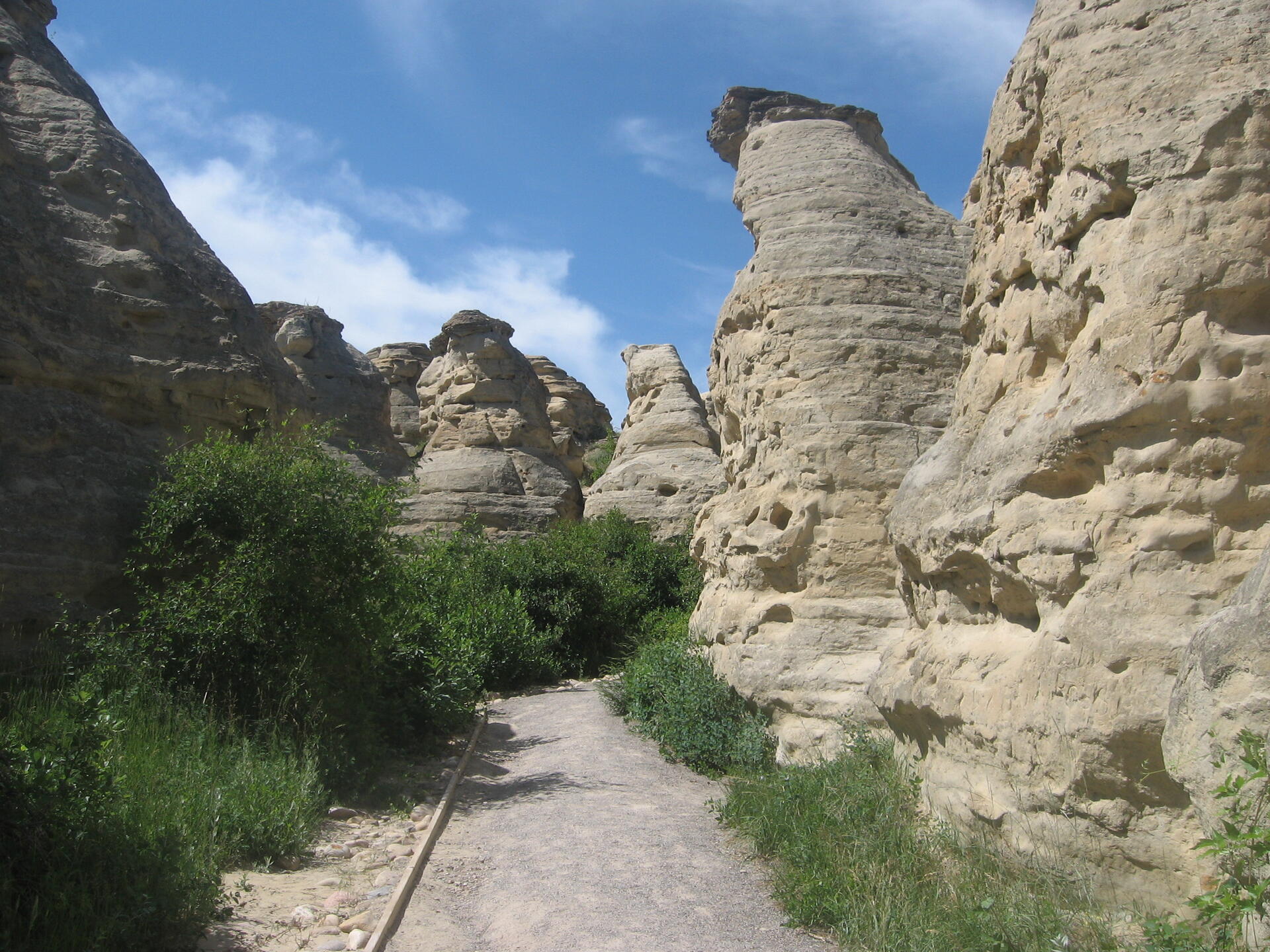
The landscape of Writing-on-Stone / Áísínai’pi is shaped by the Milk River Valley, which cuts through the otherwise flat terrain. This valley hosts a remarkable concentration of hoodoos – tall, thin, irregularly shaped rock formations created by erosion. These formations create a striking setting for the numerous petroglyphs and pictographs carved and painted onto the sandstone cliffs. According to Blackfoot tradition, many of these images represent messages and teachings associated with Sacred Beings, reflecting a profound spiritual connection to the land.
Archaeological evidence suggests that human presence in the area dates back approximately 4,500 years. Inscriptions found at the site span a period ranging from the prehistoric era through the time of early contact with Europeans. The rock art depicts various subjects, including animals, humans, and abstract designs, offering insights into the beliefs, customs, and daily life of the early inhabitants.
For the Blackfoot people, Áísínai’pi (meaning "it is pictured/written") remains a vital spiritual site where ancestors communicated with the spirit world. Centuries-old traditions continue to be upheld through ceremonies and a profound reverence for these hallowed grounds. The site plays an essential role in the Blackfoot way of life, serving as a source of inspiration, education, and connection to their ancestral heritage.
The significance of the World Heritage Site also lies in its continuity into the present day. It remains a living cultural site where traditions, teachings, and spiritual practices are still maintained by Blackfoot communities. Some of the rock art includes imagery from the contact period, such as horses and firearms, illustrating how Indigenous peoples adapted to changing circumstances. Protected and managed by the Province of Alberta in cooperation with Indigenous groups, the site stands not only as a record of the past but as an enduring center of cultural identity and spiritual connection.
In addition to its cultural importance, Writing-on-Stone / Áísínai’pi boasts exceptional natural beauty. The park covers a vast expanse of prairie landscape, making it one of the largest protected prairie areas in Alberta. Visitors can explore the diverse ecosystems found within the park, from grasslands teeming with wildlife to the dramatic rock formations along the Milk River.
The preservation and protection of Writing-on-Stone / Áísínai’pi are essential not only for the conservation of its unique cultural and natural heritage but also for honoring the ongoing relationship between the Blackfoot people and their ancestral lands. As a UNESCO World Heritage Site, the property serves as a testament to the rich tapestry of human history that unfolded across the Great Plains and the enduring resilience of indigenous cultures in the face of change.
UNESCO Description of the World Heritage Site
The property is located on the northern edge of the semi-arid Great Plains of North America, on the border between Canada and the United States of America. The Milk River Valley dominates the topography of this cultural landscape, which is characterized by a concentration of pillars or hoodoos – columns of rock sculpted by erosion into spectacular shapes. The Blackfoot Confederacy (Siksikáíítsitapi) left engravings and paintings on the sandstone walls of the Milk River Valley, bearing testimony to messages from Sacred Beings. Dated in situ archaeological remains cover a period between ca. 4,500 BP - 3,500 years BP and the Contact Period. This landscape is considered sacred to the Blackfoot people, and their centuries-old traditions are perpetuated through ceremonies and in enduring respect for the places.
UNESCO Justification of the World Heritage Site
Criterion (iii): The sacred landscape and the rock art of Writing-on-Stone / Áísínai’pi provide exceptional testimony to the living cultural traditions of the Blackfoot people. According to Blackfoot beliefs, spiritual powers inhabit the earth, and the characteristics of the landscape and the rock art in the property reflect tangible, profound and permanent links with this tradition. The viewsheds of the sacred valley, with high grassland prairies, also contribute to its sacred character and influence traditional cultural practices.
Encyclopedia Record: Writing-on-Stone Provincial Park
Writing-on-Stone Provincial Park is located about 100 kilometres (60 mi) southeast of Lethbridge, Alberta, Canada, or 44 kilometres (30 mi) east of the community of Milk River, and straddles the Milk River itself. It is one of the largest areas of protected prairie in the Alberta park system, and serves as both a nature preserve and protection for many First Nations (indigenous) rock carvings and paintings. The park is sacred to the Blackfoot and other Indigenous peoples.Additional Site Details
Area: 1,106 hectares
Number of Components: 3
Coordinates: 49.075 , -111.6333333333
World Heritage Research
Discover scientific research and academic studies that deepen our understanding of Writing-on-Stone / Áísínai’pi from its history and significance to its conservation, management, and contemporary challenges.
-
Lasioglossum ruficorne
A new taxonomic revision identifies Lasioglossum ruficorne as the senior synonym for two previously recognized species, Halictus vaporellus and Halictus pulveris, consolidating them under a single species. The study clarifies the distribution and morphological characteristics of this sweat bee, with type material examined from Nevada and Colorado, including lectotypes and syntypes. Additional specimens were collected across Canada (Alberta, British Columbia), Mexico (Baja California, Sonora), and the United States (Arizona), expanding known records. The research highlights the importance of revisiting historical collections to resolve taxonomic ambiguities, providing a foundation for future ecological studies on this species.
Hettiarachchi, T., & Gibbs, J. (2026). Lasioglossum ruficorne. Zenodo. https://doi.org/10.5281/ZENODO.22235155
View Publication Record | Read Publication -
Lasioglossum (Hemihalictus) glabriventre
A new taxonomic description of the sweat bee species Lasioglossum (Hemihalictus) glabriventre reveals distinctive morphological traits that differentiate it from similar species, such as its enlarged, broadly punctate tegula and smooth, distinctly punctate mesepisternum. The study provides a comprehensive diagnosis based on type material and additional specimens collected across Canada and the United States, including notable records from Writing-on-Stone / Áísínai’pi, a UNESCO World Heritage Site in Alberta, Canada. The research clarifies taxonomic confusion by reassigning the species to the genus Lasioglossum and offers insights into its geographical distribution, contributing to the understanding of bee biodiversity in North America.
Hettiarachchi, T., & Gibbs, J. (2026). Lasioglossum (Hemihalictus) glabriventre. Zenodo. https://doi.org/10.5281/ZENODO.22235116
View Publication Record | Read Publication -
"The Long Shadow of a Juniper Berry"
A poetic inquiry reveals how land-based experiences can foster kinship between children, the land, and each other. Through collaborative work involving an Elder, an artist, teachers, and researchers, the study demonstrates that engaging with the environment through artistic and narrative methods—such as life writing—enhances meaningful connections to place. The research highlights the transformative potential of Indigenous-led approaches in education, showing how such experiences shape broader learning outcomes and deepen ecological awareness among children.
Bartlett, S. (2023). “The Long Shadow of a Juniper Berry”. Art/Research International: A Transdisciplinary Journal, 8(1), 295–322. https://doi.org/10.18432/ari29705
View Publication Record | Read Publication -
A DStretch discovery: A Crow calling card pictograph at Writing-on-Stone
A previously unknown horse and rider pictograph, identifiable as a Crow warrior-artist's 'calling card,' has been discovered at Writing-on-Stone, Alberta, using DStretch enhancement technology. The image, exposed through digital processing of photographs from site DgOv-2, depicts the artist taunting his Blackfoot enemies, presumably celebrating a victory over them. This discovery highlights the power of DStretch in uncovering obscure rock art details, offering new insights into the cultural and historical dynamics between Indigenous groups in the region.
Keyser, J. D. (2023). A DStretch discovery: A Crow calling card pictograph at Writing-on-Stone. Plains Anthropologist, 68(266), 176–196. https://doi.org/10.1080/00320447.2024.2327018
View Publication Record | Read Publication -
“When Charcoal Was Hung”: The Story Behind the Hanging Scene Petroglyph at Writing-on-Stone
A previously undocumented petroglyph at Writing-on-Stone (Áísínai’pi) in southern Alberta depicts the execution of Blood (Káínawa) warrior Charcoal (Si’k-okskitsis), following a manhunt by the North-West Mounted Police. This discovery, supported by analysis of the Biographic art lexicon, sheds new light on historical events at the UNESCO World Heritage Site. The study combines archival research with iconographic analysis to interpret the 1897 petroglyph, which was recorded in 1976 but remained enigmatic until now.
Kaiser, D. A., Keyser, J. D., & Sundstrom, L. (2023). “When Charcoal Was Hung”: The Story Behind the Hanging Scene Petroglyph at Writing-on-Stone. Plains Anthropologist, 68(267), 229–246. https://doi.org/10.1080/00320447.2024.2409033
View Publication Record | Read Publication -
New discoveries of Vertical Series and Foothills Abstract rock art at Writing-on-Stone, DgOv-2, southern Alberta
Researchers have uncovered new instances of Vertical Series and Foothills Abstract rock art within the Writing-on-Stone Provincial Park, a region renowned for its extensive Plains Biographic and Plains Ceremonial traditions. These discoveries represent the first documented cases of these lesser-known styles in the area, challenging previous assumptions about the distribution of rock art traditions. The study describes and illustrates several panels, offering insights into their possible age, affiliation, and broader significance within the Vertical Series and Foothills Abstract traditions. While the findings are preliminary, they suggest that additional examples of these understudied styles may exist but have gone unrecognized in the past.
Turney, M., Bendiak, L., & Brink, J. W. (2021). New discoveries of Vertical Series and Foothills Abstract rock art at Writing-on-Stone, DgOv-2, southern Alberta. Plains Anthropologist, 1–38. https://doi.org/10.1080/00320447.2021.1875315
View Publication Record | Read Publication