World Heritage Identification Number: 71
World Heritage since: 1979
Category: Natural Heritage
WHE Type: Protected Areas & National Parks
Transboundary Heritage: No
Endangered Heritage: No
Country: 🇨🇦 Canada
Continent: Americas
UNESCO World Region: Europe and North America
Map
Dinosaur Provincial Park: A Paleontological Treasure Trove
Dinosaur Provincial Park, located approximately 220 kilometers east of Calgary, Alberta, Canada, is a unique and captivating destination that offers a glimpse into Earth's distant past. This UNESCO World Heritage Site, inscribed in 1979, stands out for its stunning landscapes and rich fossil deposits, providing valuable insights into the Age of Reptiles, specifically dating back around 75 million years.
More to come…UNESCO Description of the World Heritage Site
In addition to its particularly beautiful scenery, Dinosaur Provincial Park – located at the heart of the province of Alberta's badlands – contains some of the most important fossil discoveries ever made from the 'Age of Reptiles', in particular about 35 species of dinosaur, dating back some 75 million years.
UNESCO Justification of the World Heritage Site
Criterion (vii): Dinosaur Provincial Park is an outstanding example of major geological processes and fluvial erosion patterns in semi-arid steppes. These badlands stretch along 26 kilometers of high quality and virtually undisturbed riparian habitat, presenting a landscape of stark but exceptional natural beauty.
Criterion (viii): The property is outstanding in the number and variety of high quality specimens representing every known group of Cretaceous dinosaurs. The diversity affords excellent opportunities for paleontology that is both comparative and chronological. Over 350 articulated specimens from the Oldman and Dinosaur Park formations including more than 150 complete skeletons now reside in more than 30 major museums. In addition to the significant number of high quality specimens, the property contains a complete assemblage of non-dinosaurian fossil material offering an unparalleled opportunity for the study of the Late Cretaceous paleo-ecosystem.
Encyclopedia Record: Dinosaur Provincial Park
Dinosaur Provincial Park is a UNESCO World Heritage Site situated 220 kilometres east of Calgary, Alberta, Canada; or 48 kilometres (30 mi) northeast of Brooks.Additional Site Details
Area: 7,825 hectares
Number of Components: 1
(viii) — Outstanding example representing major earth stages
Coordinates: 50.76777778 , -111.4922222
IUCN World Heritage Outlook
The 2025 Conservation Outlook on Dinosaur Provincial Park reports the following assessment:
Source: International Union for Conservation of Nature (IUCN) · View assessment
Image
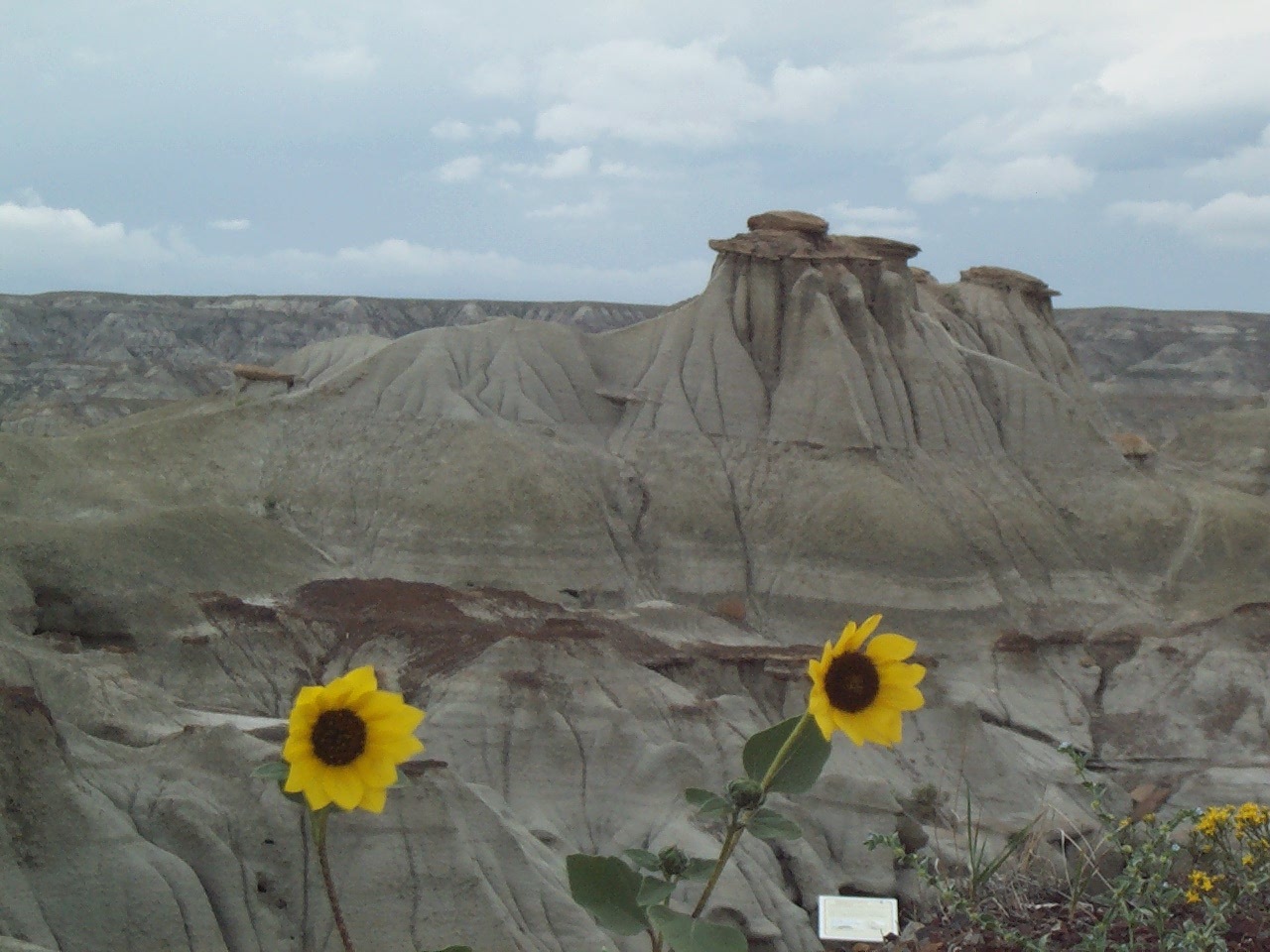
© Joanne Merriam, CC BY-SA 3.0 Resized from original. (This derivative is under the same CC BY-SA license.)
World Heritage Research
Discover scientific research and academic studies that deepen our understanding of Dinosaur Provincial Park from its history and significance to its conservation, management, and contemporary challenges.
-
New information on the holotype of “ Chasmosaurus ” russelli (Ornithischia: Ceratopsidae) necessitates the establishment of a new genus to receive the species
A re-evaluation of the holotype of Chasmosaurus russelli from Dinosaur Provincial Park, Alberta, reveals it cannot be classified within the genus Chasmosaurus or any other known chasmosaurine taxon due to its unique premaxilla and frill epiossifications. Phylogenetic analysis suggests ambiguous relationships, with the specimen potentially representing a migrant from the southern Pentaceratops clade or an independent lineage exhibiting convergent evolution of Pentaceratops-like traits. Consequently, the authors establish a new genus, Cryptarcus, to accommodate this species, refuting recent hypotheses of an evolutionary trend from Cryptarcus russelli through Pentaceratops to Terminocavus.
Holmes, R. B., Mallon, J. C., Ryan, M. J., & Evans, D. C. (2026). New information on the holotype of “ Chasmosaurus ” russelli (Ornithischia: Ceratopsidae) necessitates the establishment of a new genus to receive the species. Canadian Journal of Earth Sciences, 63, 1–20. https://doi.org/10.1139/cjes-2025-0031
View Publication Record | Read Publication -
Geochemical fingerprints of dated bentonites to constrain correlations in Cretaceous fluvial strata, Dinosaur Provincial Park, Alberta, Canada
Researchers have identified unique geochemical fingerprints and physical traits in bentonites from the Campanian-aged Dinosaur Park Formation (DPF) in Dinosaur Provincial Park, Alberta, Canada. These fingerprints enable precise correlation of fluvial strata without the need for radiometric dating, addressing longstanding challenges in stratigraphic correlation, sedimentation rate determination, and quantification of stratigraphic completeness. The study demonstrates that bentonites can be correlated over significant distances, such as the Plateau Tuff bentonite, which was traced across 12 km within the UNESCO World Heritage Site. Additionally, three previously unrecognized bentonites were identified, promising to enhance geochronological resolution in the region. This breakthrough offers a robust framework for resolving stratigraphic issues in fluvial systems and provides a model applicable to other similar environments.
Thompson, M. G. W., Durkin, P. R., Brown, C. M., Camacho, A., & Brink, K. S. (2026). Geochemical fingerprints of dated bentonites to constrain correlations in Cretaceous fluvial strata, Dinosaur Provincial Park, Alberta, Canada. Journal of Sedimentary Research, 96(2), 396–412. https://doi.org/10.2110/jsr.2025.107
View Publication Record | Read Publication -
A lithofacies-coupled palynofacies model for meandering river floodplains in the Late Cretaceous: Insights from the Dinosaur Park Formation, Alberta, Canada
A new lithofacies-coupled palynofacies model reveals that organic matter dynamics in ancient floodplains are strongly influenced by channel proximity and topography, providing a robust proxy for reconstructing fluvial paleoenvironments. The study analyzed the Late Cretaceous Dinosaur Park Formation in Alberta, Canada, identifying six recurring lithofacies and two facies associations that distinguish between channel-belt, levee, proximal floodplain, backswamp, and distal floodplain deposits. While kerogen assemblages were heterogeneous across sub-environments, total organic carbon content effectively discriminated between them, with higher values in backswamps and distal floodplains. This model demonstrates the applicability of palynofacies analysis for understanding fluvial dynamics over geological timescales.
Goonetilleke, M., Silva, R. L., Mendonça-Filho, J. G., & Durkin, P. R. (2025). A lithofacies-coupled palynofacies model for meandering river floodplains in the Late Cretaceous: Insights from the Dinosaur Park Formation, Alberta, Canada. International Journal of Coal Geology, 304, 104768. https://doi.org/10.1016/j.coal.2025.104768
View Publication Record | Read Publication -
A ceratopsid-dominated tracksite from the Dinosaur Park Formation (Campanian) at Dinosaur Provincial Park, Alberta, Canada
Researchers have uncovered the first multitaxic dinosaur footprint assemblage from the Dinosaur Park Formation at Dinosaur Provincial Park, Alberta, Canada. This rare find includes tracks from multiple ceratopsids, two tyrannosaurids, a possible ankylosaurian, and a small theropod-like taxon, with ceratopsid tracks dominating the site. The discovery suggests gregarious behavior among ceratopsids due to their regular spacing and parallel arrangement. Additionally, the tracks are the first natural moulds (concave epirelief) found in the park, providing new insights into ichnological studies. The identification of a possible ankylosaurian track is notable for its distinct pedal digits, differentiating it from other known ankylosaurian tracks. This study has already led to subsequent trackway discoveries and holds potential to transform our understanding of dinosaur behavior in badlands environments.
Bell, P. R., Pickles, B. J., Ashby, S. C., Walker, I. E., Hurst, S., Rampe, M., Durkin, P., & Brown, C. M. (2025). A ceratopsid-dominated tracksite from the Dinosaur Park Formation (Campanian) at Dinosaur Provincial Park, Alberta, Canada. PLOS One, 20(7), e0324913. https://doi.org/10.1371/journal.pone.0324913
View Publication Record | Read Publication -
First occurrence of Daspletosaurus horneri (Tyrannosauridae, Tyrannosaurinae) in the Dinosaur Park Formation of Dinosaur Provincial Park, Alberta (Treaty 7 Territory)
A significant discovery of Daspletosaurus horneri in Dinosaur Provincial Park, Alberta, marks the first occurrence of this tyrannosaurine species outside its original range in Montana. Re-examination of specimen CMN 350, initially classified as D. torosus, revealed cranial features aligning with D. horneri, including a distinct lacrimal horn morphology and dentary bowing. This finding extends the known latitudinal range of the species by approximately 350 km and provides new insights into its intraspecific variability. The discovery also supports evidence of faunal turnover within the Dinosaur Park Formation, located 49 meters above the Oldman Formation contact.
Coppock, C. C., Powers, M. J., Voris, J. T., & Currie, P. J. (2025). First occurrence of Daspletosaurus horneri (Tyrannosauridae, Tyrannosaurinae) in the Dinosaur Park Formation of Dinosaur Provincial Park, Alberta (Treaty 7 Territory). Historical Biology, 38(6), 1970–1982. https://doi.org/10.1080/08912963.2025.2532735
View Publication Record | Read Publication -
New family of fossil dragonfly (Odonata, Cavilabiata) from the late Cretaceous (Campanian) Dinosaur Park Formation, Alberta, Canada
Paleontologists have uncovered a new species of fossil dragonfly, Cordualadensa acorni, belonging to the newly described family Cordualadensidae. This discovery from Dinosaur Provincial Park (DPP) in Alberta, Canada, marks the oldest known North American fossil taxon within the group Cavilabiata and the only Mesozoic dragonfly ever recorded in Canada. The specimen provides critical evidence for the evolutionary transition of dragonflies from early Cretaceous ancestors to modern families, filling a significant gap in the fossil record. Additionally, its preservation in the Dinosaur Park Formation (DPF) suggests that insect diversity in this UNESCO World Heritage Site is far greater than previously recognized, supporting the hypothesis that Campanian Alberta's ecosystems were rich enough to sustain high trophic levels, including insect predators.
Mueller, A. S., Demers-Potvin, A. V., & Larsson, H. C. E. (2025). New family of fossil dragonfly (Odonata, Cavilabiata) from the late Cretaceous (Campanian) Dinosaur Park Formation, Alberta, Canada. Canadian Journal of Earth Sciences, 62(8), 1373–1381. https://doi.org/10.1139/cjes-2024-0162
View Publication Record | Read Publication -
An Organic Food Web Exists within the Bioapatite Inorganic Bone Surfaces of Cretaceous Dinosaurs Edmontosaurus, Triceratops and Nanotyrannus
A vibrant organic food web exists within the bioapatite inorganic bone surfaces of Cretaceous dinosaurs, including Edmontosaurus, Triceratops, and Nanotyrannus. This discovery challenges the traditional view that dinosaur bones are permineralized, revealing instead the presence of soft tissues, bacteria, fungi, and nematodes. The study found that these microbial communities metabolize endogenous organics within the bone, attracting fungivorous and bacterivorous nematodes. Additionally, evidence of insect activity, such as beetle cadavers and molts, was uncovered, suggesting a complex network of feeding relationships. The research used decalcification techniques to expose these soft tissues and microorganisms, providing substantial evidence for an active food web within dinosaur bones.
Armitage, M. H. (2025). An Organic Food Web Exists within the Bioapatite Inorganic Bone Surfaces of Cretaceous Dinosaurs Edmontosaurus, Triceratops and Nanotyrannus. Microscopy and Microanalysis, 31(Supplement_1). https://doi.org/10.1093/mam/ozaf048.945
View Publication Record | Read Publication