World Heritage Identification Number: 1542
World Heritage since: 2019
Category: Cultural Heritage
WHE Type: Archaeological Sites
Transboundary Heritage: No
Endangered Heritage: No
Country: 🇧🇭 Bahrain
Continent: Asia
UNESCO World Region: Arab States
Map
Dilmun Burial Mounds: A Unique Necropolis Spanning Over Two Millennia
The Dilmun Burial Mounds, inscribed as a UNESCO World Heritage Site in 2019, offer a fascinating glimpse into the ancient civilization that thrived on the island of Bahrain between 2200 and 1750 BCE. This extensive necropolis spans across 21 archaeological sites located primarily in the western part of the island.
More to come…UNESCO Description of the World Heritage Site
The Dilmun Burial Mounds, built between 2200 and 1750 BCE, span over 21 archaeological sites in the western part of the island. Six of these sites are burial mound fields consisting of a few dozen to several thousand tumuli. In all there are about 11,774 burial mounds, originally in the form of cylindrical low towers. The other 15 sites include 17 royal mounds, constructed as two-storey sepulchral towers. The burial mounds are evidence of the Early Dilmun civilization, around the 2nd millennium BCE, during which Bahrain became a trade hub whose prosperity enabled the inhabitants to develop an elaborate burial tradition applicable to the entire population. These tombs illustrate globally unique characteristics, not only in terms of their number, density and scale, but also in terms of details such as burial chambers equipped with alcoves.UNESCO Justification of the World Heritage Site
Criterion (iii): The Dilmun Burial Mounds represent unique sepulchral testimony to the Early Dilmun civilization over a period of 450 years. As remains of settlements are scarce and buried under thick layers of soil, the Dilmun Burial Mounds are the most extensive and most apparent evidence of the Early Dilmun culture. At the time, the newly gained prosperity allowed the island’s ancient inhabitants to develop an elaborate burial tradition applicable to the entire population. The excavated mounds provide a cross section of various social groups in the Early Dilmun society, attesting to thousands of individuals of different age, gender, and social class. They also offer crucial evidence on the evolution of elites and ruling classes. The ancient inhabitants of Bahrain understood the special geological configuration of the island and used less fertile land for the development of these extraordinary cemeteries.
Criterion (iv): The evolution of the Early Dilmun civilization is reflected in the architecture of the Dilmun Burial Mounds. Five different mound types give clues about the emergence of social hierarchies. Even though the burial mounds can be divided according to variations in size and interior design, the basic layout of the mounds remains the same throughout the 450-year period. The construction typology is exceptional. The majority of the tombs were constructed as single-storeyed small cylindrical towers while some of the bigger two-storeyed examples were built in a ziggurat-like shape. A very particular and unique characteristic of the Dilmun tumuli construction is the presence of alcoves. Depending on the occupant’s social status there can be up to six of such alcoves which were usually filled with mortuary gifts.
Encyclopedia Record: Dilmun Burial Mounds
The Dilmun Burial Mounds are a UNESCO World Heritage Site comprising necropolis areas on the main island of Bahrain dating back to the Dilmun and the Umm al-Nar culture.Additional Site Details
Area: 168.45 hectares
Number of Components: 21
(iv) — Outstanding example of a type of building or landscape
Coordinates: 26.1497222222 , 50.5127777778
Image
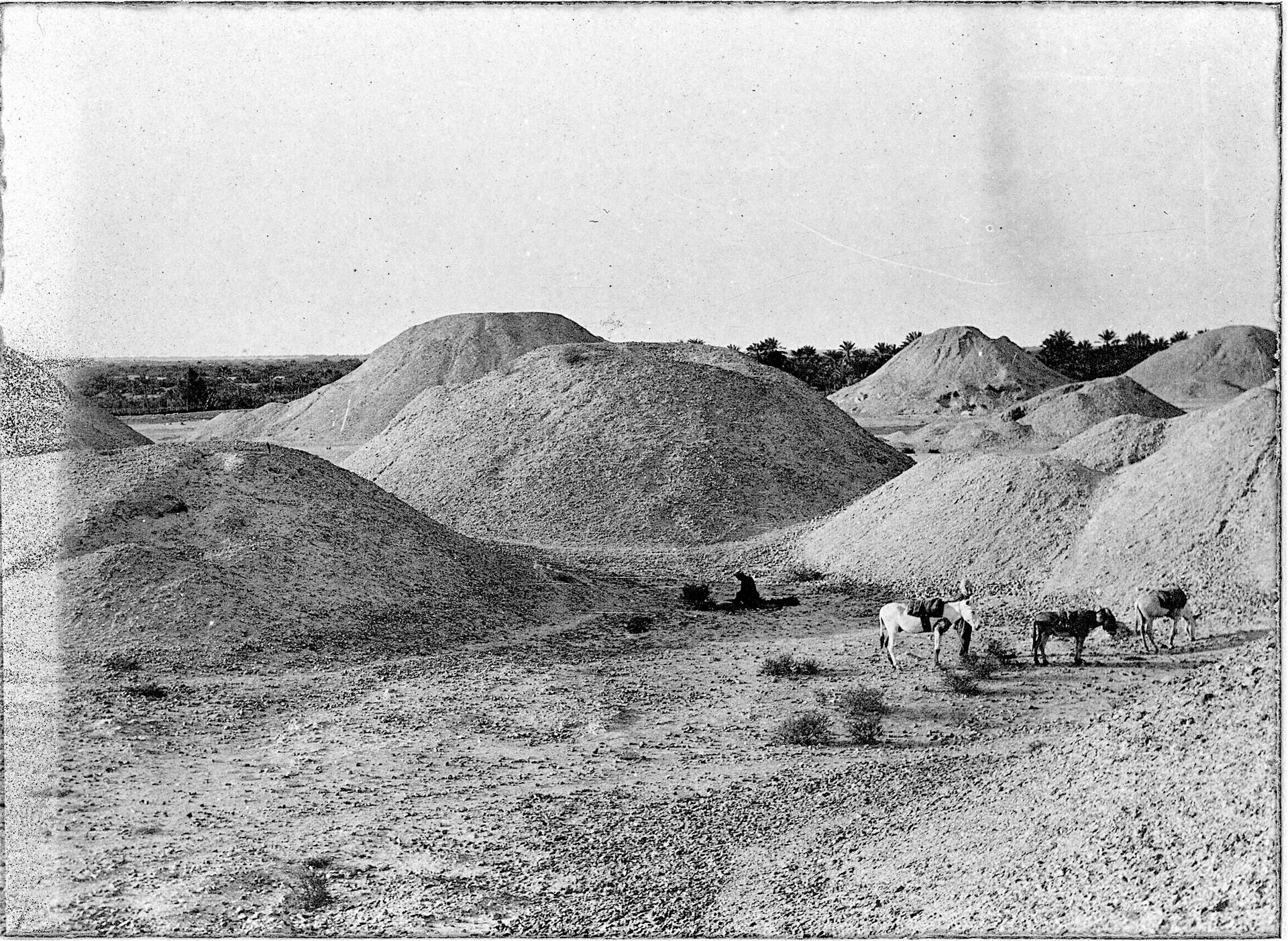
Storrs-Fox, Edwin Aubrey, Public domain
World Heritage Research
Discover scientific research and academic studies that deepen our understanding of Dilmun Burial Mounds from its history and significance to its conservation, management, and contemporary challenges.
-
Early Dilmun Burial Mounds in Bahrain: the Wâdî al-Sail Archaeological Project and the Dilmun Mapping Project
Archaeological research on Early Dilmun burial mounds in Bahrain, spanning over 100 years, reveals significant insights into the mortuary practices and social organization of a complex society that emerged on the island. Excavations, particularly those led by the Wâdî al-Sail Archaeological Project under Masashi Abe, have shed light on previously poorly understood burial practices from the Early phase of the Early Dilmun period. Additionally, the Dilmun Mapping Project, directed by Akinori Uesugi, focuses on the distribution patterns of these mounds and their role in forming extensive cemeteries. These projects collectively provide crucial clues about the origins of Dilmun, offering a deeper understanding of its social structures and cultural evolution.
Abe, M., & Uesugi, A. (2024). Early Dilmun Burial Mounds in Bahrain: the Wâdî al-Sail Archaeological Project and the Dilmun Mapping Project. Arabian Humanities, 19. https://doi.org/10.4000/1243l
View Publication Record | Read Publication -
From Dilmun to Wādī al‐Fāw: A forgotten desert corridor, c. 2000 BC
A previously unknown desert trade corridor linking the Kingdom of Dilmun on the Arabian Gulf coast with southern Saudi Arabia, likely extending to Yemen, was identified around 2000 BC. Contrary to assumptions about arid conditions in Bronze Age central Arabia, this study reveals a thriving commercial network supported by donkey trains, as evidenced by Dilmun seals, pottery, and unique burial practices at Wādī al‐Fāw. The discovery challenges existing models of cultural transmission across the region, suggesting significant linguistic, ideological, genetic, and technological exchanges during a period marked by unusually arid conditions. The research reconstructs the likely route based on archaeological evidence, including dry mummification mound burials that differ from classic Dilmun burial customs.
Laursen, S. T., & al‐Otaibi, F. (2022). From Dilmun to Wādī al‐Fāw: A forgotten desert corridor, c. 2000 BC. Arabian Archaeology and Epigraphy, 34(1), 63–86. Portico. https://doi.org/10.1111/aae.12221
View Publication Record | Read Publication -
Heritage erasure and heritage transformation: how heritage is created by destruction in Bahrain
Heritage erasure can lead to heritage transformation, as demonstrated by the case of Bahrain's Dilmun Burial Mounds. The study reveals that the destruction of these ancient burial sites due to modern development has paradoxically elevated them to significant national heritage status in Bahrain. This finding challenges conventional notions of heritage preservation and highlights the dynamic processes through which heritage is created and redefined. The research employs a comparative approach, analyzing three distinct cases: the Dilmun Burial Mounds, neglected Shia religious shrines, and the destroyed Pearl Monument from the 2011 uprising. These cases illustrate different modes of engaging with the past—preserved history, living heritage, and future-oriented transformation—shedding light on the complex interplay between destruction, identity, and national narrative in Bahrain.
Fibiger, T. (2014). Heritage erasure and heritage transformation: how heritage is created by destruction in Bahrain. International Journal of Heritage Studies, 21(4), 390–404. https://doi.org/10.1080/13527258.2014.930064
View Publication Record | Read Publication -
Landscapes of nation: Constructing national identity in the deserts of Bahrain
Bahrain's national identity is increasingly shaped by modern architectural landscapes, diverging from its historical emphasis on burial mounds and pearl monuments. This shift reflects a broader struggle to reconcile grand historical narratives with contemporary urban development, creating a coherent social construct of the nation. The study analyzes how competing idealisms—such as the reconstruction of traditional landscapes versus postmodern urban settlements—define national space in Bahrain's deserts.
Dayaratne, R. (2012). Landscapes of nation: Constructing national identity in the deserts of Bahrain. National Identities, 14(3), 309–327. https://doi.org/10.1080/14608944.2012.702744
View Publication Record | Read Publication -
Mesopotamian ceramics from the burial mounds of Bahrain, c.2250-1750 BC
A distinct two-phase pattern of Mesopotamian ceramic imports and local emulations, spanning c.2250–1750 BC, has been identified at the Dilmun burial mounds of Bahrain. The first phase, characterized by a specific vessel type exclusive to pre-Dilmun 'state' Early Type mounds, is linked to Mesopotamia's late third-millennium Magan trade network, serving as a key fossil directeur for this period. The second phase, found in compact cemeteries coinciding with Dilmun's peak, reflects the contracted Isin-Larsa network of Dilmun trade. This study reconstructs trade dynamics and political interactions between Mesopotamia and the 'Lower Sea' populations through ceramic distribution analysis.
Laursen, S. T. (2011). Mesopotamian ceramics from the burial mounds of Bahrain, c.2250-1750 BC. Arabian Archaeology and Epigraphy, 22(1), 32–47. https://doi.org/10.1111/j.1600-0471.2011.00334.x
View Publication Record | Read Publication