World Heritage Identification Number: 1192
World Heritage since: 2005
Category: Cultural Heritage
WHE Type: Archaeological Sites
Transboundary Heritage: No
Endangered Heritage: No
Country: 🇧🇭 Bahrain
Continent: Asia
UNESCO World Region: Arab States
Map
Qal’at al-Bahrain: A Millennia-Long Chronicle of Trade, Culture, and Civilization
Qal’at al-Bahrain, also known as the Bahrain Fort or Portuguese Fort, is a remarkable archaeological site situated in the heart of Bahrain. This UNESCO World Heritage Site offers a unique glimpse into the rich history, culture, and civilization that thrived in the region for millennia.
More to come…UNESCO Description of the World Heritage Site
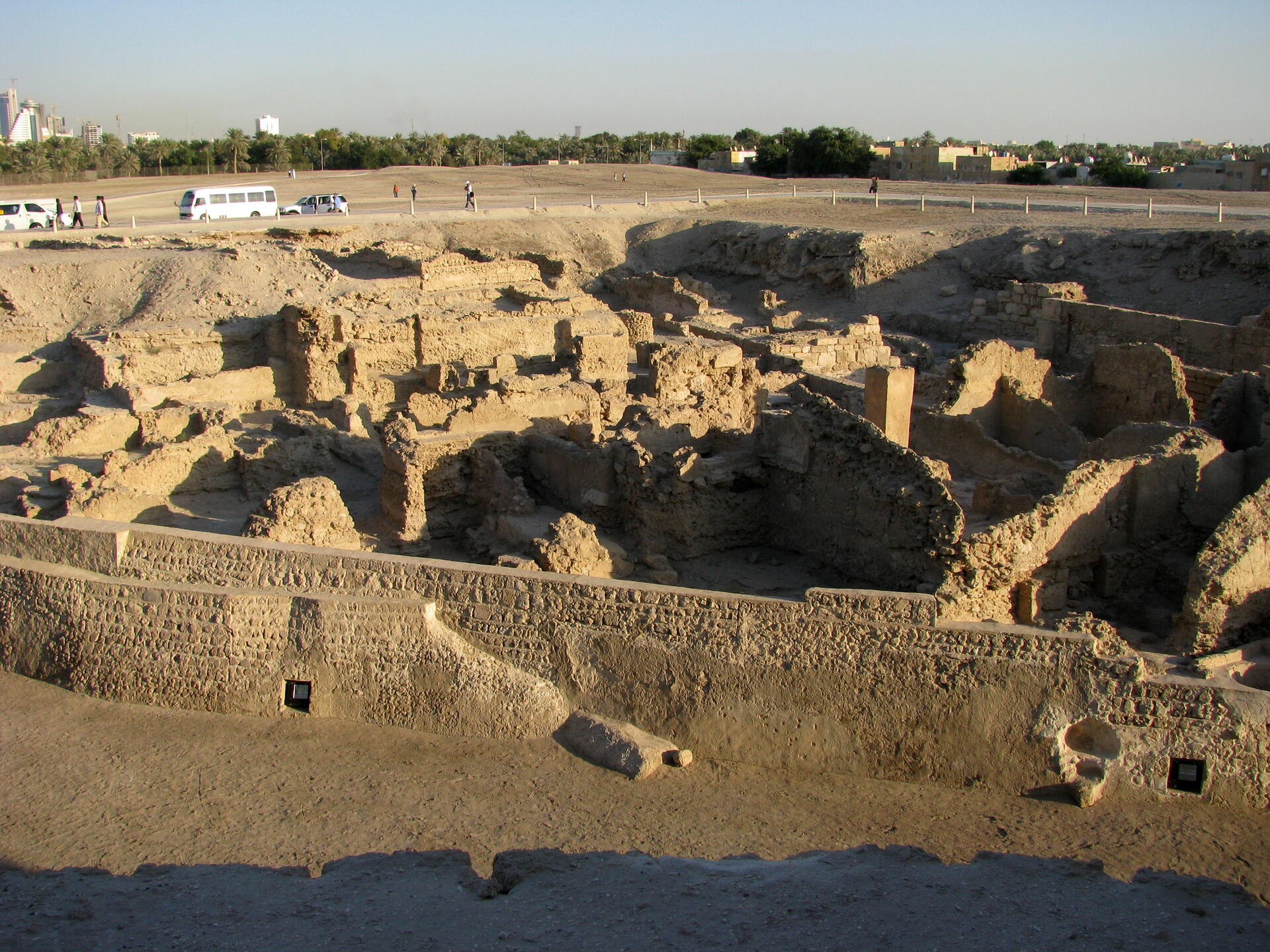
Qal’at al-Bahrain is a typical tell – an artificial mound created by many successive layers of human occupation. The strata of the 300 × 600 m tell testify to continuous human presence from about 2300 BC to the 16th century AD. About 25% of the site has been excavated, revealing structures of different types: residential, public, commercial, religious and military. They testify to the importance of the site, a trading port, over the centuries. On the top of the 12 m mound there is the impressive Portuguese fort, which gave the whole site its name, qal’a (fort). The site was the capital of the Dilmun, one of the most important ancient civilizations of the region. It contains the richest remains inventoried of this civilization, which was hitherto only known from written Sumerian references.
UNESCO Justification of the World Heritage Site
Criterion (ii): Being an important port city, where people and traditions from different parts of the then known world met, lived and practiced their commercial activities, makes the place a real meeting point of cultures - all reflected in its architecture and development. Being in addition, invaded and occupied for long periods, by most of the great powers and empires, leaved their cultural traces in different strata of the tell.
Criterion (iii): The site was the capital of one of the most important ancient civilizations of the region - the Dilmun civilization. As such this site is the best representative of this culture.
Criterion (iv): The palaces of Dilmun are unique examples of public architecture of this culture, which had an impact on architecture in general in the region. The different fortifications are the best examples of defence works from the 3rd century B.C to the 16th century AD, all on one site. The protected palm groves surrounding the site are an illustration of the typical landscape and agriculture of the region, since the 3rd century BC.
Encyclopedia Record: Qal'at al-Bahrain
The Qal'at al-Bahrain, also known as the Bahrain Fort or Portuguese Fort, is an archaeological site located in Bahrain. Archaeological excavations carried out since 1954 have unearthed antiquities from an artificial mound of 12 m (39 ft) height containing seven stratified layers, created by various occupants from 2300 BC up to the 18th century, including Kassites, Greeks, Portuguese and Persians. It was once the capital of the Dilmun civilization and was inscribed as a UNESCO World Heritage Site in 2005.Additional Site Details
Area: 70.4 hectares
Number of Components: 2
(iii) — Unique or exceptional testimony to a cultural tradition
(iv) — Outstanding example of a type of building or landscape
Coordinates: 26.23306 , 50.5272222222
World Heritage Research
Discover scientific research and academic studies that deepen our understanding of Qal’at al-Bahrain – Ancient Harbour and Capital of Dilmun from its history and significance to its conservation, management, and contemporary challenges.
-
3D Documentation Towards Heritage Conservation: A Rapid Mapping Approach Applied to Bahrain Forts
A novel integrated approach using UAV photogrammetry and portable systems has been successfully validated for 3D documentation of cultural heritage sites, addressing challenges related to accessibility and material diversity. This method, applied to the Fort component of Qal'at al-Bahraindemonstrates its potential for generating high-accuracy metric data crucial for conservation decisions. The study highlights the approach's repeatability and applicability across similar contexts, offering a sustainable solution for remote and onsite heritage documentation. This work contributes to advancing digital preservation techniques for complex archaeological sites.
Chiabrando, F., Patrucco, G., Rinaudo, F., Sammartano, G., Scolamiero, V., Vileikis, O., & Hasaltun Wosinski, M. (2022). 3D DOCUMENTATION TOWARDS HERITAGE CONSERVATION: A RAPID MAPPING APPROACH APPLIED TO BAHRAIN FORTS. The International Archives of the Photogrammetry, Remote Sensing and Spatial Information Sciences, XLIII-B2-2022, 769–776. https://doi.org/10.5194/isprs-archives-xliii-b2-2022-769-2022
View Publication Record | Read Publication