World Heritage Identification Number: 1402
World Heritage since: 2013
Category: Cultural Heritage
WHE Type: Archaeological Sites
Transboundary Heritage: No
Endangered Heritage: No
Country: 🇶🇦 Qatar
Continent: Asia
UNESCO World Region: Arab States
Map
Al Zubarah Archaeological Site: A Testimony to Ancient Trading Traditions in the Gulf Region
The Al Zubarah Archaeological Site, located on the northwestern coast of the Qatar peninsula, stands as a significant remnant of the region's rich history and thriving trading traditions. Inscribed as a UNESCO World Heritage Site in 2013, this walled coastal town offers an exceptional insight into the urban trading and pearl-diving culture that once dominated the Gulf region.
More to come…UNESCO Description of the World Heritage Site
The walled coastal town of Al Zubarah in the Persian Gulf flourished as a pearling and trading centre in the late 18th century and early 19th centuries, before it was destroyed in 1811 and abandoned in the early 1900s. Founded by merchants from Kuwait, Al Zubarah had trading links across the Indian Ocean, Arabia and Western Asia. A layer of sand blown from the desert has protected the remains of the site’s palaces, mosques, streets, courtyard houses, and fishermen’s huts; its harbour and double defensive walls, a canal, walls, and cemeteries. Excavation has only taken place over a small part of the site, which offers an outstanding testimony to an urban trading and pearl-diving tradition which sustained the region’s major coastal towns and led to the development of small independent states that flourished outside the control of the Ottoman, European, and Persian empires and eventually led to the emergence of modern day Gulf States.
UNESCO Justification of the World Heritage Site
Criterion (iii): The abandoned settlement of Al Zubarah, as the only remaining complete urban plan of an Arabian pearl-merchant town, is an exceptional testimony to the merchant and pearl trading tradition of the Persian Gulf during the 18th and 19th centuries, the almost final flourishing of a tradition that sustained the major coastal towns of the region from the early Islamic period or earlier to the 20th century.
Criterion (iv): Al Zubarah, as a fortified town linked to settlements in its hinterland, exemplifies the string of urban foundations that rewrote the political and demographic map of the Persian Gulf during the 18th and early 19th centuries through building on the strategic position of the region as a trading conduit. Al Zubarah can thus be seen as an example of the small independent states that were founded and flourished in the 18th and early 19th centuries outside the control of the Ottoman, European, and Persian empires. This period can now be seen as a significant moment in human history, when the Gulf States that exist today were founded.
Criterion (v): Al Zubarah bears a unique testimony to the human interaction with both the sea and the harsh desert environment of the region. Pearl divers’ weights, imported ceramics, depictions of dhows, fish traps, wells and agricultural activity show how the town’s development was driven by trade and commerce, and how closely the town’s inhabitants were connected with the sea and their desert hinterland. The urban landscape of Al Zubarah and its relatively intact seascape and desert hinterland are not intrinsically remarkable or unique amongst Persian Gulf settlements, nor do they exhibit unusual land management techniques. What makes them exceptional is the evidence they present as a result of complete abandonment over the last three generations. This allows them to be understood as a fossilised reflection of the way coastal trading towns harvested resources from the sea and from their desert hinterland at a specific time.
Encyclopedia Record: Zubarah
Zubarah, also referred to as Al Zubarah or Az Zubarah, is a ruined, ancient town located on the northwestern coast of the Qatar peninsula in the Al Shamal municipality, about 65 miles or 105 kilometres from the capital Doha. It was founded by the Bani Utbah tribal confederation who migrated from Kuwait in the mid-eighteenth century. It was designated a UNESCO World Heritage Site in 2013.Additional Site Details
Area: 415.66 hectares
Number of Components: 1
(iv) — Outstanding example of a type of building or landscape
(v) — Outstanding example of traditional human settlement
Coordinates: 25.9780555556 , 51.0297222222
Image
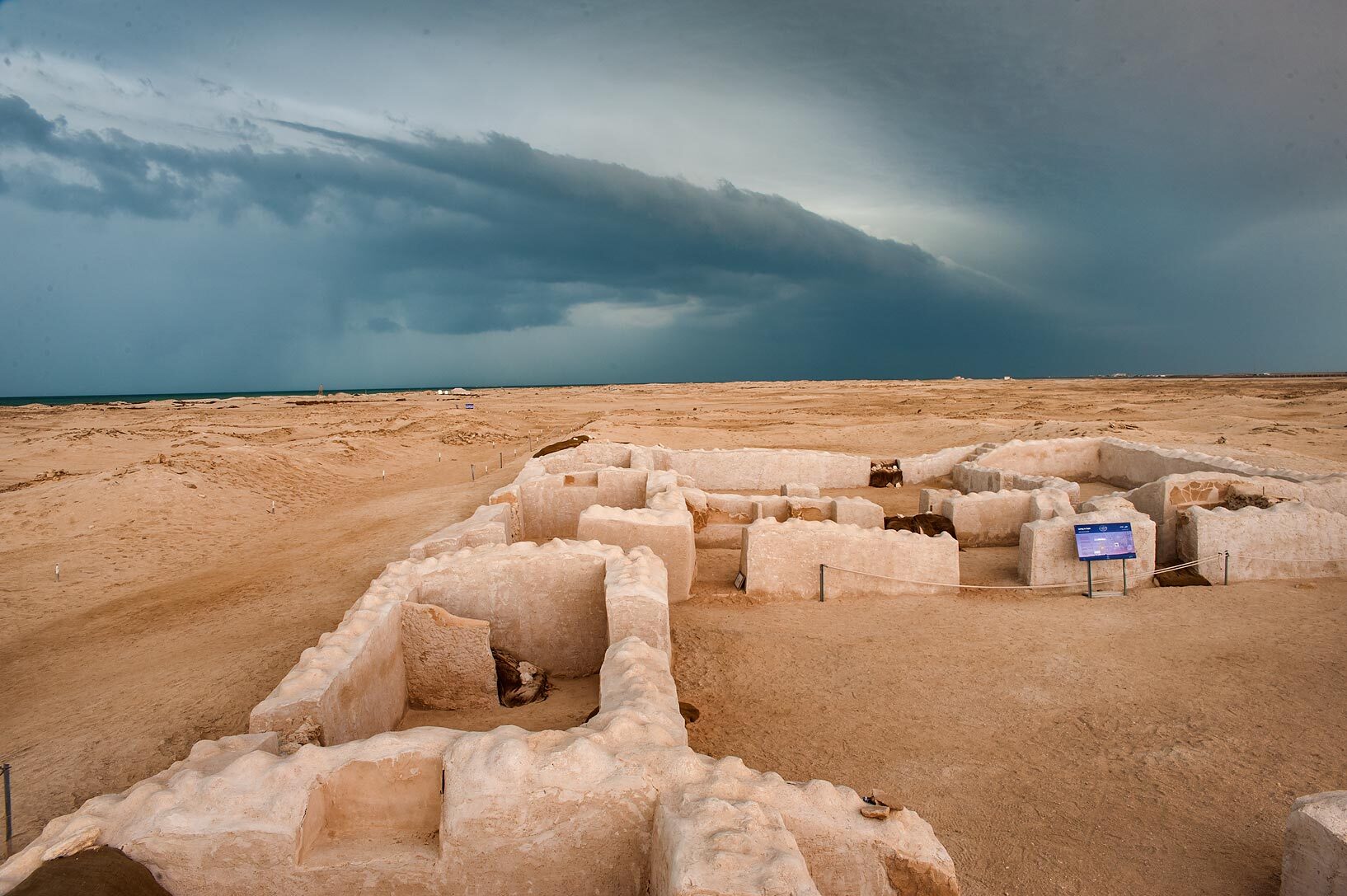
© Alex Sergeev (www.asergeev.com), CC BY-SA 3.0 Resized from original. (This derivative is under the same CC BY-SA license.)
World Heritage Research
Discover scientific research and academic studies that deepen our understanding of Al Zubarah Archaeological Site from its history and significance to its conservation, management, and contemporary challenges.
-
Society in Qatar before the Oil Industry in Light of Archaeological Evidence
Archaeological excavations in Qatar have uncovered significant remains of towns and villages from the 18th to early 20th centuries, providing unprecedented insights into pre-oil industrial society. The study focuses on two key sites: al-Zubarah, a UNESCO World Heritage Site since 2013, and Ra’s ‘Ushayrig, along with adjacent settlements like al-Ruwaydah and al-Burayqa. Analysis of architectural structures, material culture such as vessels and tools, and other artifacts reveals the communal identity and micro-history of Qatar during this period. The research highlights the importance of these sites in reconstructing the social fabric and cultural dynamics of Qatar before the oil industry's influence.
Sadeq, M. (2018). Society in Qatar before the Oil Industry in Light of Archaeological Evidence. Sociology of Islam, 6(1), 46–59. https://doi.org/10.1163/22131418-00601003
View Publication Record | Read Publication -
The urban fabric of Al Zubarah city: Unveiling an urban regeneration vision for modern urbanism in Qatar
Al Zubarah Archaeological Site, a UNESCO World Heritage Site in Qatar, offers a unique glimpse into the urban design principles of Islamic cities. The study reveals that the city's preserved urban fabric, untouched since its abandonment in the early 1900s, reflects sociocultural and economic factors that shaped its development. Analyzing the site using Petruccioli's methodological approach, which examines the urban organism, urban fabric, and building types on three scales, the research demonstrates how Al Zubarah manifests key principles of Islamic urbanism. These findings provide valuable insights for modern urban regeneration projects in Qatar, offering a vision for sustainable and culturally informed urban development.
Al-Harami, A., & Furlan, D. R. (2018). The urban fabric of Al Zubarah city: Unveiling an urban regeneration vision for modern urbanism in Qatar. Journal of Urban Regeneration and Renewal, 12(2), 151. https://doi.org/10.69554/vqlr3278
View Publication Record | Read Publication -
Imagining the past visitor specific applications for Al Zubarah Archaeological Site, Qatar
Mobile applications with augmented reality (AR) elements and interactive components have been successfully developed to enhance the visitor experience at Al Zubarah Archaeological Site, Qatar. Since its inscription on the UNESCO World Heritage List, visitor numbers have nearly tripled, necessitating innovative solutions to protect fragile remains while engaging audiences, particularly younger visitors. The applications, created in collaboration between the Qatar Islamic Archaeology and Heritage Project and DNP, aim to support the dissemination of ongoing excavation findings by providing immersive, educational experiences that encourage reflection on the site's historical significance.
Kinzel, M., & Tanaka, M. (2015). Imagining the past visitor specific applications for Al Zubarah Archaeological Site, Qatar. 2015 Digital Heritage, 723–726. https://doi.org/10.1109/digitalheritage.2015.7419608
View Publication Record | Read Publication -
“Society and Daily Life Practices in Qatar Before Oil Industry, A Historic Study in light of Texts and Archaeological Evidence”
Al-Zubarah, a 17th to mid-20th century walled town in Qatar, offers profound insights into pre-oil society and daily life practices in the Gulf region. As a UNESCO World Heritage Site, its strategic coastal location, fortified architecture, and rich material culture reveal its significance as a major pearl and trade hub. Excavations, led by Qatari missions and later the University of Copenhagen in collaboration with Qatar Museum Authority, uncovered palaces, courtyards, mosques, markets, and tools from diverse regions, providing a comprehensive view of Islamic trade planning, social structures, and cultural exchanges. This study reconstructs societal dynamics, gender roles, communal identity, and regional interactions through architectural remains, material artifacts, and textual evidence, offering a nuanced understanding of Qatar's historical landscape before the oil era.
Sadeq, M. (2013). “Society and Daily Life Practices in Qatar Before Oil Industry, A Historic Study in light of Texts and Archaeological Evidence”. Qatar Foundation Annual Research Forum Volume 2013 Issue 1. https://doi.org/10.5339/qfarf.2013.ssho-08
View Publication Record | Read Publication