World Heritage Identification Number: 1645
World Heritage since: 2021
Category: Cultural Heritage
WHE Type: Historic Cities & Urban Areas
Transboundary Heritage: No
Endangered Heritage: No
Country: 🇮🇳 India
Continent: Asia
UNESCO World Region: Asia and the Pacific
Map
Dholavira: An Ancient Urban Center of the Harappan Civilization
The ancient city of Dholavira, located on the arid island of Khadir in the Indian state of Gujarat, offers a fascinating glimpse into the past, providing valuable insights into the Harappan Civilization that flourished between approximately 3000 and 1500 BCE. Inscribed as a UNESCO World Heritage Site in 2021, this archaeological site is one of the best-preserved urban settlements from the period in Southeast Asia.
More to come…UNESCO Description of the World Heritage Site
The ancient city of Dholavira, the southern centre of the Harappan Civilization, is sited on the arid island of Khadir in the State of Gujarat. Occupied between ca. 3000-1500 BCE, the archaeological site, one of the best preserved urban settlements from the period in Southeast Asia, comprises a fortified city and a cemetery. Two seasonal streams provided water, a scarce resource in the region, to the walled city which comprises a heavily fortified castle and ceremonial ground as well as streets and houses of different proportion quality which testify to a stratified social order. A sophisticated water management system demonstrates the ingenuity of the Dholavira people in their struggle to survive and thrive in a harsh environment. The site includes a large cemetery with cenotaphs of six types testifying to the Harappan’s unique view of death. Bead processing workshops and artifacts of various kinds such as copper, shell, stone, jewellery of semi-precious stones, terracotta, gold, ivory and other materials have been found during archaeological excavations of the site, exhibiting the culture’s artistic and technological achievements. Evidence for inter-regional trade with other Harappan cities, as well as with cities in the Mesopotamia region and the Oman peninsula have also been discovered.
UNESCO Justification of the World Heritage Site
Criterion (iii): Dholavira is an exceptional example of a proto-historic Bronze Age urban settlement pertaining to the Harappan Civilization (early, mature and late Harappan phases) and bears evidence of a multi-cultural and stratified society during the 3rd and 2nd millennia BCE. The earliest evidence can be traced back to 3000 BCE during the early Harappan phase of the Harappan Civilization. This city flourished for nearly 1,500 years, representing a long continuous habitation. The excavated remains clearly indicate the origin of the settlement, its growth, zenith and the subsequent decline in the form of continuous changes in the configuration of the city, architectural elements and various other attributes.
Criterion (iv): Dholavira is an outstanding example of Harappan urban planning, with its preconceived city planning, multi-layered fortifications, sophisticated water reservoirs and drainage system, and the extensive use of stone as a building material. These characteristics reflect the unique position Dholavira held in the entire gamut of Harappan Civilization.
Encyclopedia Record: Dholavira
Dholavira is an archaeological site at Khadirbet in Bhachau Taluka of Kutch District, in the state of Gujarat in western India, which has taken its name from a modern-day village 1 kilometre (0.62 mi) south of it. This village is 165 km (103 mi) from Radhanpur. Also known locally as Kotada timba, the site contains ruins of a city of the ancient Indus Valley Civilization. Earthquakes have repeatedly affected Dholavira, including a particularly severe one around 2600 BCE.Additional Site Details
Area: 103 hectares
Number of Components: 1
(iv) — Outstanding example of a type of building or landscape
Coordinates: 23.8884083333 , 70.2133027778
Image
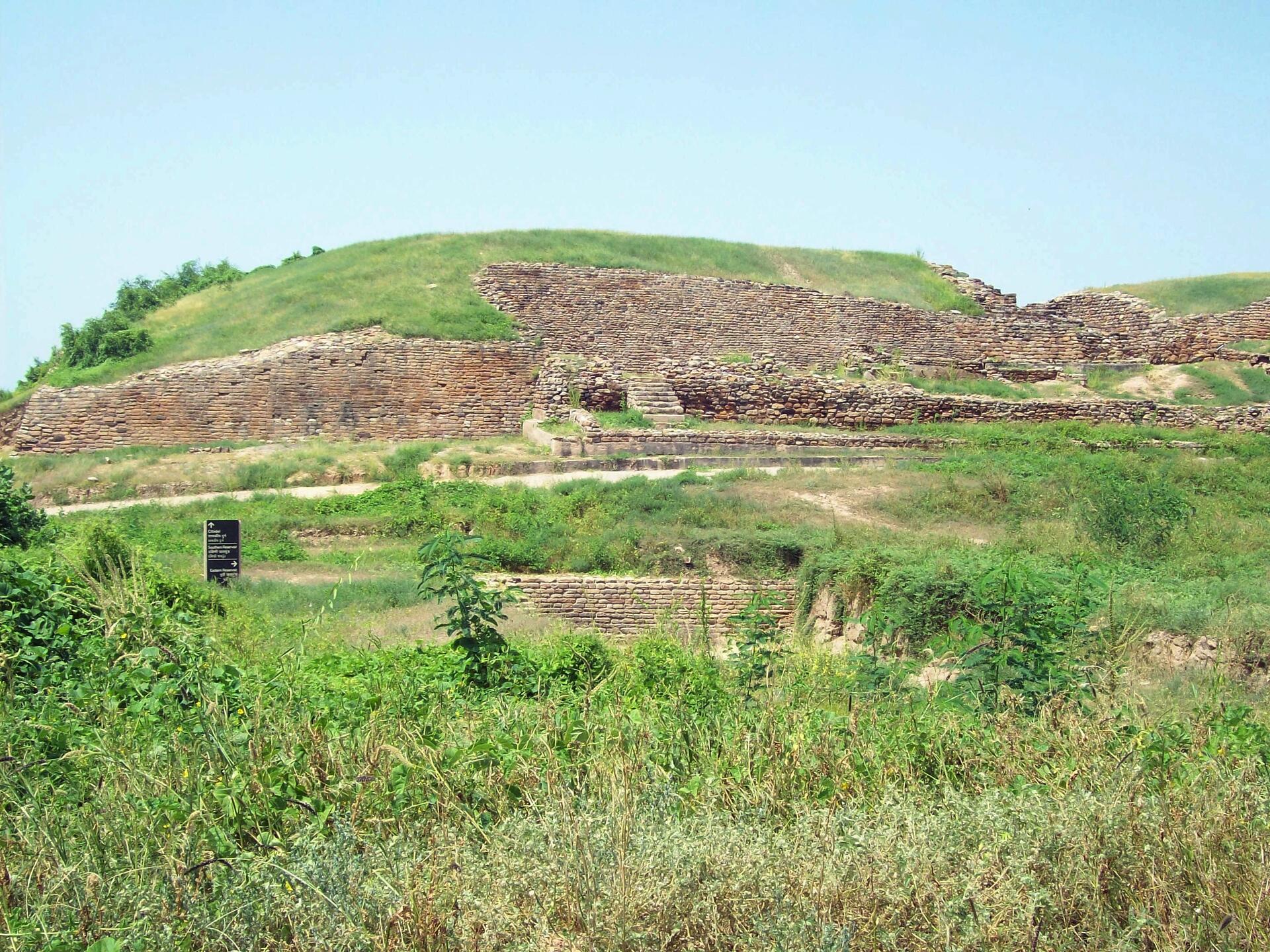
© Himalyan, CC BY-SA 3.0 Resized from original. (This derivative is under the same CC BY-SA license.)
World Heritage Research
Discover scientific research and academic studies that deepen our understanding of Dholavira: a Harappan City from its history and significance to its conservation, management, and contemporary challenges.
-
The functionalist theory of indus urbanism: A systems based reinterpretation of the Dholavira signboard and Harappan administrative protocols
A novel 'Functionalist Theory' reinterprets the Indus Valley Civilization (IVC) as a highly organized, system-driven society governed by universal iconography and standardized protocols. The Dholavira Signboard is proposed as a functional public security notice, while Indus Seals are seen as a passport/ID system, challenging traditional religious-monarchic interpretations. The theory suggests the civilization's decline was due to 'Systemic Saturation Point,' where extreme rigidity and population thinning led to logical de-urbanization rather than external conquest.
Pradeep Awana. (2026). The functionalist theory of indus urbanism: A systems based reinterpretation of the Dholavira signboard and Harappan administrative protocols [Zenodo]. https://doi.org/10.5281/ZENODO.18651580
View Publication Record | Read Publication -
Indus Valley Civilization: The Largest Integrated Urban System of the Bronze Age
The Indus Valley Civilization (c. 2600–1900 BCE) stands out as one of the largest and most spatially integrated urban systems of the Bronze Age, spanning approximately one to one and a half million square kilometers across South Asia. Key archaeological sites such as Harappa, Mohenjo-daro, Dholavira, and Lothal reveal advanced civic planning, standardized material culture, and sophisticated drainage systems, indicating a highly organized society. Evidence suggests extensive maritime and overland trade networks connecting the Indus region with Mesopotamia and the Persian Gulf, highlighting its role in early interregional commerce. Despite the undeciphered script and lack of overt royal monuments, the civilization demonstrated remarkable economic integration and standardization, challenging conventional narratives about ancient urban development.
Dubey, S. (2026). Indus Valley Civilization: The Largest Integrated Urban System of the Bronze Age. Knowledge Commons Foundation. https://doi.org/10.17613/2VVZ6-2P221
View Publication Record | Read Publication -
Recent Archaeological Findings and New Interpretations of the Indus Valley Civilization
Recent archaeological findings at UNESCO World Heritage Site Dholavira and other Indus Valley Civilization sites (c. 2600–1900 BCE) challenge long-standing assumptions about the civilization's political structure and decline, revealing instead a decentralized socio-political organization with indigenous cultural development. Using advanced techniques such as radiocarbon dating, ancient DNA analysis, satellite imagery, and paleo-environmental studies, researchers have redefined the civilization's trajectory, emphasizing gradual transformation influenced by environmental factors rather than sudden collapse due to external invasions. This interdisciplinary approach provides new insights into one of the world's earliest urban civilizations.
Ch. A. A. S. K. G. Bhavani. (2026). Recent Archaeological Findings and New Interpretations of the Indus Valley Civilization. International Journal of Advanced Research in Science Communication and Technology, 563. https://doi.org/10.48175/ijarsct-31279
View Publication Record | Read Publication -
Pre-Historic Past of Gujarat - External Linkages
Archaeological evidence from Dholavira and other Indus Valley Civilization sites in Gujarat reveals extensive maritime trade networks spanning 4500 years ago, linking the region to ports in Dilmun, Mesopotamia, and Egypt. The study identifies a sophisticated urban infrastructure, including docks, warehouses, and standardized weights/measures, suggesting advanced commercial and social organization. Analysis of steatite seals and artifacts indicates robust external linkages, with ports like Lothal and Kuntasi serving as key hubs during different phases of the civilization (early to late Harappan). The research underscores Gujarat's pivotal role in long-distance trade, contemporary to Sumerian and Egyptian civilizations.
Edward, M. R. (2026). Pre-Historic Past of Gujarat - External Linkages. Maritime Heritage of Gujarat, Kathiawad and Kutch, 66–80. https://doi.org/10.4324/9781003732037-6
View Publication Record | Read Publication -
Urban Governance and Water Management in the Indus Valley: Rethinking Early State Formation in South Asia
A groundbreaking reinterpretation of governance in the Indus Valley Civilization (c. 2600–1900 BCE) reveals that early state formation in South Asia was likely driven by institutional systems and infrastructure rather than centralized monarchy or monumental displays. Analysis of archaeological data from key urban centers, including Dholavira, Mohenjo-daro, and Harappa, demonstrates high levels of institutional coordination through standardized construction practices, regulated trade systems, and advanced water management structures. These findings challenge traditional models that prioritize kingship and monumental architecture, instead highlighting collective governance, environmental management, and civic responsibility as alternative pathways to complex political organization.
Aziz Hasan. (2026). URBAN GOVERNANCE AND WATER MANAGEMENT IN THE INDUS VALLEY: RETHINKING EARLY STATE FORMATION IN SOUTH ASIA. INTERNATIONAL EDUCATION AND RESEARCH JOURNAL - IERJ. https://doi.org/10.5281/ZENODO.19234317
View Publication Record | Read Publication -
The Concept of Sustainability in Indus Valley Civilization : A Study of Ancient Urbanization and Town Planning
The Indus Valley Civilization, thriving between 2600 and 1900 BCE, demonstrated advanced sustainable urban planning akin to modern practices. Key settlements like Harappa, Mohenjo-daro, Dholavira, and Lothal exhibited meticulous town planning with sophisticated water management systems, drainage, sanitation, and agricultural practices that harmonized human needs with environmental constraints. Notably, Dholavira featured large water reservoirs, while Lothal showcased maritime trade integration. The civilization's uniform construction techniques and sustainable agriculture underscore its innovative approach to urbanization. This study highlights the potential of ancient planning practices to inform contemporary urban development strategies.
Gharat, P. J. (2026). The Concept of Sustainability in Indus Valley Civilization : A Study of Ancient Urbanization and Town Planning. Zenodo. https://doi.org/10.5281/ZENODO.22721503
View Publication Record | Read Publication -
Hydrodynamics of the Indus Valley Civilization: Ingenious Water Management through Physics
The Indus Valley Civilization (IVC) demonstrated remarkable engineering prowess by applying fundamental principles of physics to create advanced water management systems. Excavations at Mohenjo-Daro, Harappa, and Dholavira reveal sophisticated hydraulic structures such as reservoirs, step-wells, underground drains, and public baths, designed to optimize water flow and storage. The IVC's engineers leveraged concepts like Bernoulli's equation, Pascal's law, gravitational potential energy, capillary action, and hydraulic gradients to control water pressure, minimize stagnation, and prevent contamination. These systems were not only technologically advanced but also environmentally sustainable, balancing urbanization with natural resource conservation. The study highlights the IVC's intuitive mastery of hydrostatics and fluid mechanics, offering timeless insights that remain relevant for modern water management challenges.
Pharswan, J. S., & Badoni, B. (2025). Hydrodynamics of the Indus Valley Civilization: Ingenious Water Management through Physics. RESEARCH HUB International Multidisciplinary Research Journal, 12(2), 01–06. https://doi.org/10.53573/rhimrj.2025.v12n2.001
View Publication Record | Read Publication