World Heritage Identification Number: 922
World Heritage since: 2014
Category: Cultural Heritage
WHE Type: Archaeological Sites
Transboundary Heritage: No
Endangered Heritage: No
Country: 🇮🇳 India
Continent: Asia
UNESCO World Region: Asia and the Pacific
Map
Rani-ki-Vav: A Testament to Ancient Water Management and Artistic Mastery
The Rani-ki-Vav, or the Queen's Stepwell, stands as a remarkable testament to the ingenuity and artistic prowess of the Chaulukya dynasty in medieval India. Located in the heart of Patan, Gujarat, this subterranean marvel has been recognized by UNESCO as a World Heritage Site since 2014.
More to come…UNESCO Description of the World Heritage Site
Rani-ki-Vav, on the banks of the Saraswati River, was initially built as a memorial to a king in the 11th century AD. Stepwells are a distinctive form of subterranean water resource and storage systems on the Indian subcontinent, and have been constructed since the 3rd millennium BC. They evolved over time from what was basically a pit in sandy soil towards elaborate multi-storey works of art and architecture. Rani-ki-Vav was built at the height of craftsmens’ ability in stepwell construction and the Maru-Gurjara architectural style, reflecting mastery of this complex technique and great beauty of detail and proportions. Designed as an inverted temple highlighting the sanctity of water, it is divided into seven levels of stairs with sculptural panels of high artistic quality; more than 500 principle sculptures and over a thousand minor ones combine religious, mythological and secular imagery, often referencing literary works. The fourth level is the deepest and leads into a rectangular tank 9.5 m by 9.4 m, at a depth of 23 m. The well is located at the westernmost end of the property and consists of a shaft 10 m in diameter and 30 m deep.
UNESCO Justification of the World Heritage Site
Criterion (i): Rani-ki-Vav (The Queen’s Stepwell) at Patan, Gujarat, illustrates an example of the artistic and technological height of stepwell tradition. It has been decorated with religious, mythological and at times secular sculptures and reliefs, illustrating a true mastery of craftsmanship and figurative expression. The stepwell represents an architectural monument of human creative genius in its variety of motifs and its elegance of proportions, which frame an intriguing space, both functional and aesthetic.
Criterion (iv): Rani-ki-Vav is an outstanding example of a subterranean stepwell construction and represents a prime example of an architectural type of water resource and storage system which is widely distributed across the Indian subcontinent. It illustrates the technological, architectural and artistic mastery achieved at a stage of human development when water was predominantly resourced from ground water streams and reservoirs through access of communal wells. In the case of Rani-ki-Vav, the functional aspects of this architectural typology were combined with a temple-like structure celebrating the sanctity of water as a venerated natural element and the depiction of highest-quality Brahmanic deities.
Encyclopedia Record: Rani ki Vav
Rani ki Vav is a stepwell situated in the town of Patan in Gujarat, India. It is located on the banks of the Saraswati River. Its construction is attributed to Udayamati, the spouse of the 11th-century Chaulukya king Bhima I. Silted over, it was rediscovered in the 1940s and restored in the 1980s by the Archaeological Survey of India. It has been listed as one of the UNESCO World Heritage Sites in India since 2014. The stepwell is designed as an underground shrine or inverted temple, representing the sanctity of water, with the sculptures in the stepwell depicting numerous Hindu deities. It is divided into seven levels of stairs with sculptural panels. These panels have more than 500 principal sculptures and over a thousand minor ones that combine religious, secular and symbolic imagery.This vav indicates the beautiful arrangement of water harvesting for public usage in ancient time.Additional Site Details
Area: 4.68 hectares
Number of Components: 1
(iv) — Outstanding example of a type of building or landscape
Coordinates: 23.8588888889 , 72.1016666667
Image
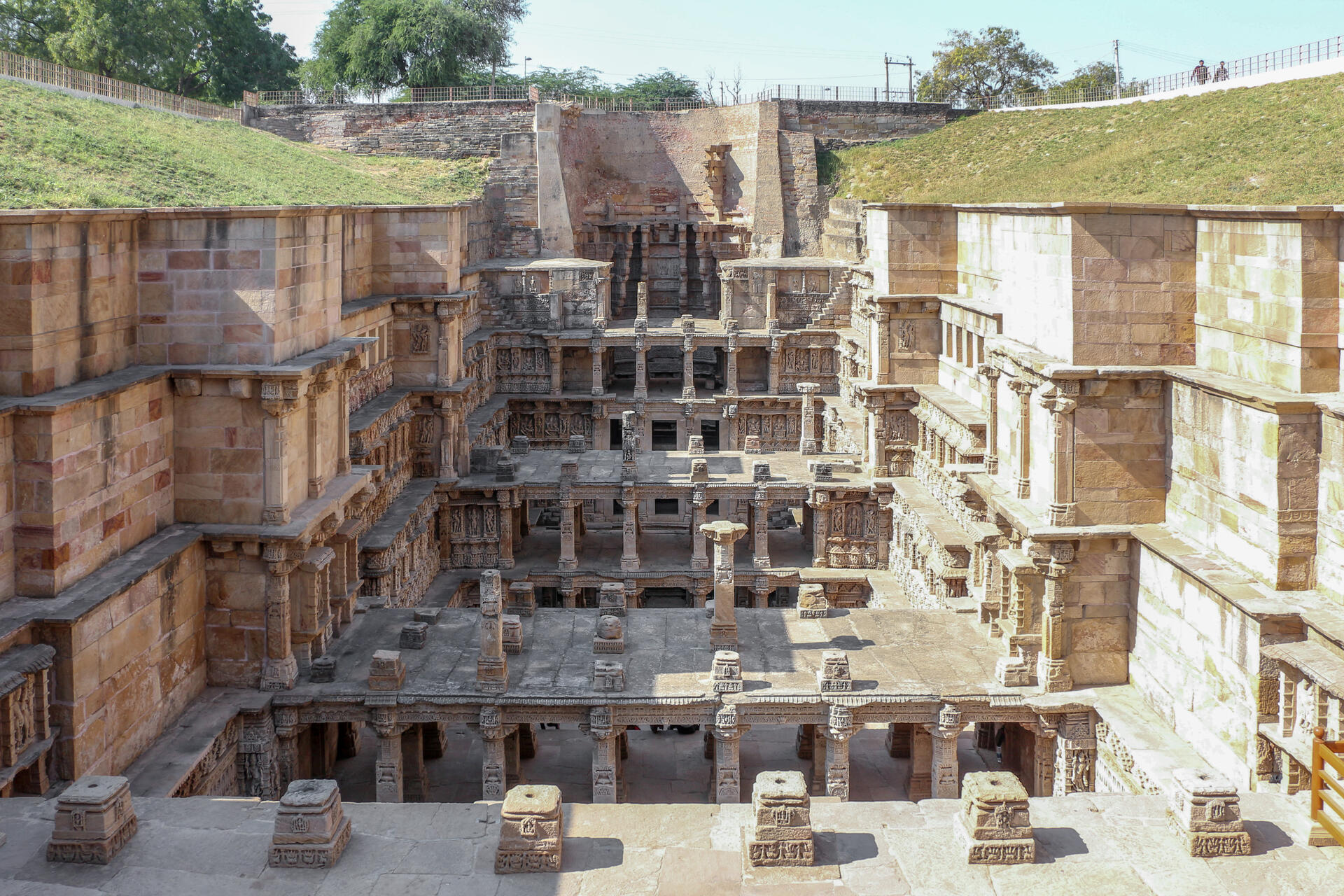
© Bernard Gagnon, CC BY-SA 3.0 Resized from original. (This derivative is under the same CC BY-SA license.)
World Heritage Research
Discover scientific research and academic studies that deepen our understanding of Rani-ki-Vav (the Queen’s Stepwell) at Patan, Gujarat from its history and significance to its conservation, management, and contemporary challenges.
-
Mapping of "Rani-ki-Vav" a UNESCO World Heritage Site through Information Design
A designed print and digital interpretive brochure for Rani-ki-Vav significantly enhances visitor engagement with the stepwell's sculptures. The brochure employs a numbered mapping system linking sculptures to precise locations, walking distances, cardinal orientations, and viewing sides, supported by iconographic explanations and QR codes for additional information. This approach fosters longer stops, more focused questions, and improved interpretive confidence among visitors. The study identifies gaps in pre-visit information, site signage, and narrative consistency while offering a scalable model that integrates traditional knowledge with contemporary graphic communication, aligning with UNESCO's guidelines for heritage information design.
Harshil Bhandari, Anupam Rana. (2026). Mapping of "Rani-ki-Vav" a UNESCO World Heritage Site through Information Design. Zenodo. https://doi.org/10.5281/ZENODO.18230356
View Publication Record | Read Publication -
Vav ni Dharohar: An Interactive Mobile App with AR Experience of UNESCO World Heritage Site "Rani-ki-Vav"
A mobile application integrating Augmented Reality (AR) enhances on-site interpretation of the UNESCO World Heritage Site Rani-ki-Vav, offering visitors detailed insights into its iconography, construction techniques, and cultural symbolism. This portable solution, adapted from a kiosk-based system, enables personalized engagement through smartphone use while maintaining research rigor and stakeholder inclusivity. Human-centered design principles and extensive stakeholder collaboration ensured the app's accessibility and cultural relevance, demonstrating AR technology's potential to improve heritage interpretation and visitor satisfaction.
Bhandari, H. (2026). Vav ni Dharohar: An Interactive Mobile App with AR Experience of UNESCO World Heritage Site “Rani-ki-Vav”. International Journal of Arts Architecture & Design, 4(1), 33–42. https://doi.org/10.62030/2026janpaper3
View Publication Record | Read Publication -
India's Water Wisdom: 5 Ancient Engineering Systems That Still Inspire the World
Ancient Indian water engineering systems, including the UNESCO-listed Rani ki Vav stepwell and the Kallanai tank irrigation cascade, continue to inspire modern solutions for India's severe water crisis. These systems, which include stepwells (Baoli), earthen check dams (Johad), underground rainwater tanks (Kund), and bamboo drip irrigation, demonstrate sustainable groundwater management strategies that have been successfully revived in regions like Rajasthan and Meghalaya. The study highlights their engineering brilliance, civilizational significance, and potential to address contemporary water challenges, such as the annual 200,000 deaths from inadequate safe drinking water access and declining per capita water availability. By analyzing these systems through historical data, groundwater assessments, and modern revival efforts, the research underscores their relevance in mitigating India's water scarcity.
Rout, N. (2026). India's Water Wisdom: 5 Ancient Engineering Systems That Still Inspire the World. Https://Thequestsage.com. https://doi.org/10.5281/ZENODO.20640408
View Publication Record | Read Publication -
Bacterial degradation of sandstone at the UNESCO World Heritage Site Rani-ki-Vav, India: A multi-analytical diagnostic study
A multi-analytical study at Rani-ki-Vav, a UNESCO World Heritage stepwell in India, reveals that bacterial biofilm and metabolic activity drive sandstone decay through complex microchemical processes. The research identifies key degradation pathways involving organic acid production, mineral dissolution, metal chelation, moisture retention, and salt crystallization, which collectively weaken the sandstone matrix. Using XRD, FTIR, LC-MS/MS, GC–MS/MS, and 16S rRNA profiling, the study detected a diverse microbiome dominated by Firmicutes, Bacteroidetes, and Proteobacteria, alongside specific metabolites like glycolic acid and cysteinyl-serine that contribute to mineral degradation. These findings provide a chemical basis for targeted conservation strategies to mitigate biodeterioration in sandstone heritage sites.
Priyadarshi, R., Priyadarshi, G., Patel, R., Bhandari, S., Majumdar, S., Bagatharia, S., & Patel, A. (2026). Bacterial degradation of sandstone at the UNESCO World Heritage Site Rani-ki-Vav, India: A multi-analytical diagnostic study. Journal of Cultural Heritage, 82, 96–101. https://doi.org/10.1016/j.culher.2026.09.003
View Publication Record | Read Publication -
Stepwell. Architetture per l'acqua nel nord Gujarat tra conservazione e recupero
Rani-ki-Vav, along with Adalaj ni vav and Asharwa Bai Harir vav, represents a unique underground architectural marvel in Ahmedabad, Gujarat, showcasing the intricate relationship between water infrastructure and design. These stepwells serve as both historical monuments and dynamic spaces for social integration or worship, reflecting their cultural significance. The study highlights the tension between conservation efforts to preserve these structures and the potential for their destruction, emphasizing the need for balanced approaches to safeguard their heritage value while exploring their relevance in contemporary contexts.
Setti, G. (2022). Stepwell. Architetture per l’acqua nel nord Gujarat tra conservazione e recupero. Territorio, (97), 150–161. https://doi.org/10.3280/tr2021-097019
View Publication Record | Read Publication -
A Study of Architecture in Gujarat from Past toPresent
Gujarat's architectural evolution reflects a dynamic interplay between tradition and modernity, with Rani-ki-Vav (the Queen’s Stepwell) at Patan serving as a key example of historical innovation. The study reveals how climate, materials, creativity, and culture shaped traditional structures—such as palaces, markets, and stepwells—while 20th-century developments introduced modern and contemporary designs, including the Sabarmati Riverfront and the Statue of Unity. Notably, Ahmedabad’s architecture, pioneered by B.V. Doshi, exemplifies this transition from classical to modern forms. The research combines historical analysis with material studies, highlighting how cultural continuity and technological adaptation have defined Gujarat’s architectural identity across eras.
Vyas, P., & PateL, D. G. (2021). A STUDY OF ARCHITECTURE IN GUJARAT FROM PAST TO PRESENT. Towards Excellence, 386–398. Internet Archive. https://doi.org/10.37867/te130135
View Publication Record | Read Publication -
Scotland's Heritage Investments in India: Acts of Cultural Diplomacy and Identity Building
Scotland's heritage investments in India, particularly its involvement in the conservation of Rani-ki-Vav (the Queen’s Stepwell) at Patan, Gujarat, represent a unique form of cultural diplomacy that avoids the pitfalls of cultural colonialism. Unlike traditional international heritage preservation efforts led by non-state actors like UNESCO, Scotland's state-led projects focus on celebrating shared histories and promoting positive narratives of Scottish contributions in India. These initiatives, including the documentation of Rani-ki-Vav as part of the 'Scottish 10' project, are framed as altruistic acts that strengthen bilateral relations while shaping a specific version of national identity. The study highlights how heritage can serve as a tool for diplomatic engagement and identity promotion at a state level.
Clarke, A. (2014). Scotland’s Heritage Investments in India: Acts of Cultural Diplomacy and Identity Building. Scottish Affairs, 23(2), 234–249. https://doi.org/10.3366/scot.2014.0019
View Publication Record | Read Publication