World Heritage Identification Number: 158
World Heritage since: 1981
Category: Cultural Heritage
WHE Type: Archaeological Sites
Transboundary Heritage: No
Endangered Heritage: No
Country: 🇨🇦 Canada
Continent: Americas
UNESCO World Region: Europe and North America
Map
Head-Smashed-In Buffalo Jump: A Testament to Ancient Hunting Practices and Blackfoot Culture
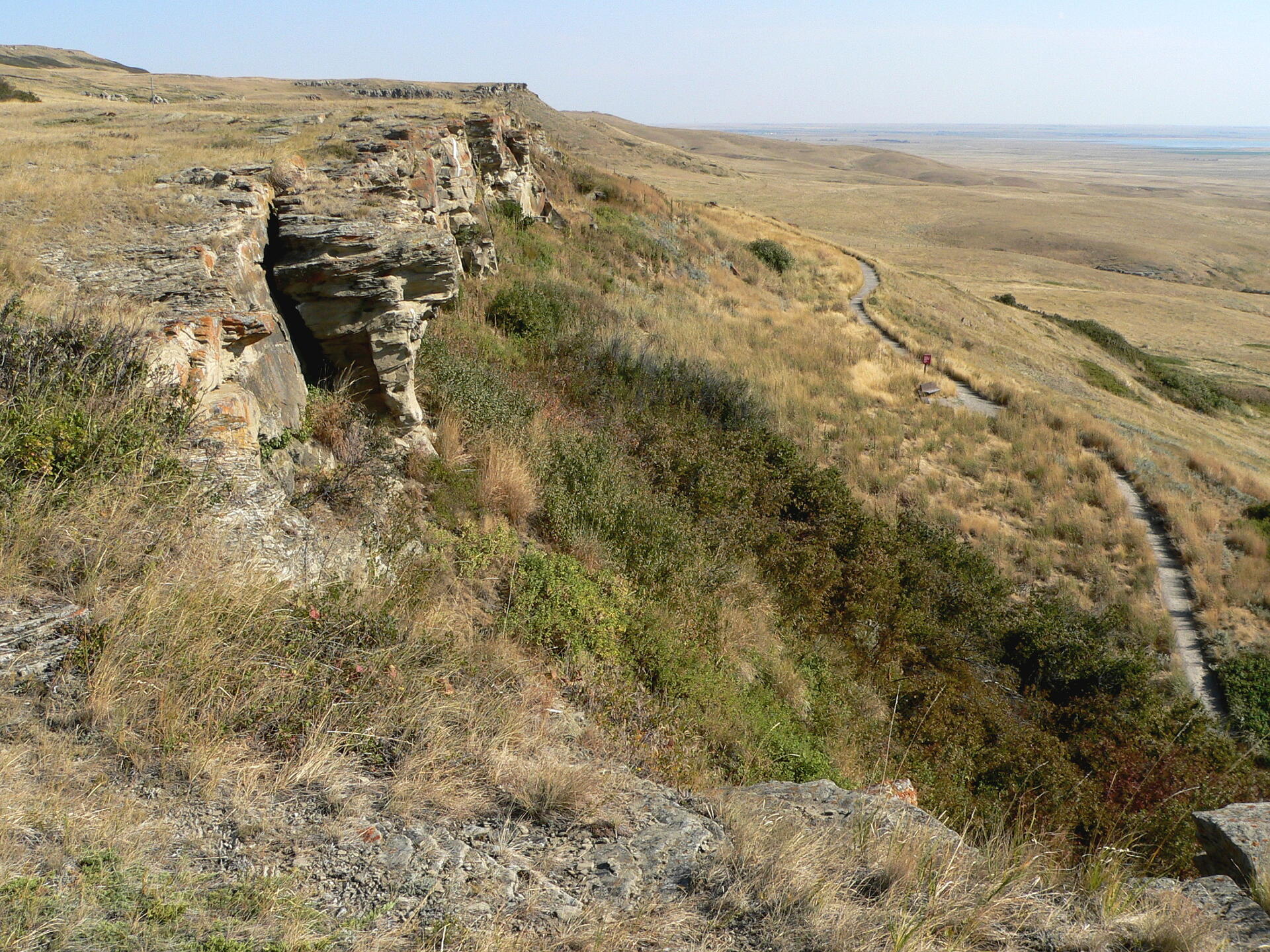
Head-Smashed-In Buffalo Jump, located 18 kilometers west of Fort Macleod in Alberta, Canada, stands as a testament to the ancient hunting practices of the Blackfoot people and their deep connection with the land. This significant archaeological site, inscribed as a UNESCO World Heritage Site in 1981, offers a unique glimpse into the lives of the Plains Indigenous peoples who inhabited the region for millennia.
The site derives its name from a poignant Blackfoot oral tradition. According to the legend, a young man wanted to witness the buffalo falling from the cliff and sought shelter in a small ledge behind the stampede of animals. However, the hunt was so successful that the bodies piled up against the cliff, pinning him against the rock and crushing his skull. When his people found him, they named the site Estipah-skikikini-kots, which translates to "where we got our heads smashed in."
The Blackfoot people developed a sophisticated communal hunting method, driving herds of American bison over the precipice, which caused them to fall to their deaths. This method was employed for nearly 6,000 years, demonstrating the exceptional knowledge of the Blackfoot people regarding the topography and behavior of the buffalo. The success of the buffalo jump depended on careful planning and cooperation. Hunters constructed drive lanes using stone cairns and natural features to funnel herds toward the cliff. Skilled runners, sometimes disguised in buffalo robes, guided the animals while others coordinated movement along the flanks.
Beyond its practical function, the buffalo jump held deep cultural and spiritual significance for the Blackfoot Confederacy. The bison was central to Blackfoot life, providing not only food but also materials for clothing, shelter, and tools. Hunts were accompanied by sacred ceremonies, guided by the belief that the survival of the people was a gift from the land, emphasizing respect for the animals and gratitude for what they provided. This relationship reflects a worldview in which humans and nature are closely interconnected.
Tangible evidence of this history remains in the vast processing camps and the massive accumulations of bones found below the cliff. At these camps, the carcasses were butchered and preserved to ensure the community’s survival through the harsh winter months. Some bone deposits reach depths of over ten meters, testifying to thousands of years of repeated use.
Today, Head-Smashed-In Buffalo Jump operates as an interpretive center and museum dedicated to preserving and showcasing Blackfoot culture. Visitors can explore exhibits that delve into the history, language, art, and spiritual beliefs of the Blackfoot people. The center also offers reconstructions, educational displays, and viewpoints overlooking the cliff, allowing visitors to better understand the scale and sophistication of the buffalo jump.
One of the most striking aspects of Head-Smashed-In Buffalo Jump is its location within the transition zone between the prairies and the foothills of the Rocky Mountains. The site’s breathtaking landscape provides a powerful reminder of the close relationship between the Blackfoot people and the natural environment.
However, this 6,000-year-old tradition came to a devastating end in the 19th century. The near-extinction of the American bison was not merely an accident of overhunting, but a calculated tool of colonization and genocide. Colonial authorities and commercial hunters systematically slaughtered the herds to ship hides to the East and, more pointedly, to remove the primary food source of the Plains Indigenous peoples. By destroying the "commissary" of the Blackfoot, colonial governments used starvation as a weapon to force tribes onto reserves and break their independence.
This period, known as the "Starving Time," led to a massive loss of life and a forced shift in the Blackfoot way of life. As bison populations collapsed, the Canadian government increasingly sought to control and assimilate Indigenous populations. Among the most consequential of these policies was the removal of Indigenous children from their families, which sought to erase Indigenous language and culture. The Residential School System aimed to "kill the Indian in the child," prohibiting their language and traditions.
Today, Head-Smashed-In Buffalo Jump continues to be interpreted in collaboration with Blackfoot communities, ensuring that their perspectives, knowledge, and traditions remain central to how the site is understood and shared. The site plays a crucial role in educating visitors about the Blackfoot people and their rich heritage. By fostering understanding and appreciation for this ancient culture, Estipah-skikikini-kots serves as a vital link between the past and the present, helping ensure that the stories and traditions of the Blackfoot people continue to be shared for generations to come.
To sum it up, Head-Smashed-In Buffalo Jump stands as a remarkable example of human ingenuity and adaptability. Its designation as a UNESCO World Heritage Site underscores the importance of preserving and celebrating our shared cultural heritage. As visitors explore the site and its exhibits, they are reminded not only of the Blackfoot people's remarkable past but also of the enduring connections between humans and the land.
UNESCO Description of the World Heritage Site
In south-west Alberta, the remains of marked trails and an aboriginal camp, and a tumulus where vast quantities of buffalo (American Bison) skeletons can still be found, are evidence of a custom practised by aboriginal peoples of the North American plains for nearly 6,000 years. Using their excellent knowledge of the topography and of buffalo behaviour, they killed their prey by chasing them over a precipice; the carcasses were later carved up in the camp below.
UNESCO Justification of the World Heritage Site
Criterion (vi): Head-Smashed-In Buffalo Jump is one of the oldest, most extensive and best preserved sites that illustrate communal hunting techniques and of the way of life of Plains people who, for more than five millennia, subsisted on the vast herds of bison that existed in North America.
Encyclopedia Record: Head-Smashed-In Buffalo Jump
Head-Smashed-In Buffalo Jump is a museum of Blackfoot culture 18 km (11 mi) west of Fort Macleod, Alberta, Canada. The now disused buffalo jump is a UNESCO world heritage site in an area where the foothills of the Rocky Mountains begin to rise from the prairie.Additional Site Details
Area: 3,626 hectares
Number of Components: 1
Coordinates: 49.7084055556 , -113.6520527778
World Heritage Research
Discover scientific research and academic studies that deepen our understanding of Head-Smashed-In Buffalo Jump from its history and significance to its conservation, management, and contemporary challenges.
-
Head-Smashed-In Buffalo Jump: The durative power of keystone institutions and embedded knowledge
Head-Smashed-In Buffalo Jump demonstrates remarkable cultural continuity over at least 6,000 years, with its use as a buffalo jump remaining consistent despite technological and environmental changes. The site's durative power is attributed to its role as a keystone institution, where embedded knowledge acted as a social surplus, reflecting the heterarchical social complexity of its users. This study applies theoretical models used elsewhere in North America to understand HSIBJ's long-term significance, highlighting its unique cultural resilience and the preservation of knowledge across generations.
Bubel, S., & Mcgeough, K. (2026). Head-Smashed-In Buffalo Jump: The durative power of keystone institutions and embedded knowledge. Plains Anthropologist, 1–17. https://doi.org/10.1080/00320447.2026.2678766
View Publication Record | Read Publication -
Ancient mitochondrial DNA extraction from Bison bison long bones from Head-Smashed-In Buffalo Jump, UNESCO World Heritage site
Researchers analyzing ancient mitochondrial DNA from bison long bones at Head-Smashed-In Buffalo Jump uncovered novel haplotypes that suggest significant genetic diversity loss among American bison prior to European contact. The study, which sequenced the control region of mitochondrial DNA from 21 bison remains, also identified shared haplotypes between ancient and modern populations, offering new insights into the complex history of living bison herds. This genetic bottleneck, likely caused by 19th-century population decline, provides a rare glimpse into pre-contact bison genetics and their resilience or vulnerability to historical pressures.
Asis, R., Ngo, S., Chan, M., Bubel, S., & Burg, T. M. (2024). Ancient mitochondrial DNA extraction from Bison bison long bones from Head-Smashed-In Buffalo Jump, UNESCO World Heritage site. Journal of Archaeological Science: Reports, 59, 104791. https://doi.org/10.1016/j.jasrep.2024.104791
View Publication Record | Read Publication -
Mooring subjects of heritage: proprioceptive emplacement at Head-Smashed-In Buffalo Jump
Head-Smashed-In Buffalo Jump (HSIBJ) employs proprioceptive emplacement to immerse visitors within a heritage landscape that intertwines Blackfoot and settler-colonial narratives. The Interpretive Centre uses motion-triggered projections to anchor visitors in official national heritage narratives, confirming their subjectivity through physiological awareness of body position and movement. This proprioceptive grounding places visitors within an 'ancient' narratology of nation, addressing settler anxieties about latecoming status while reinforcing broader archaeological and heritage frameworks.
Chew, M. (2016). Mooring subjects of heritage: proprioceptive emplacement at Head-Smashed-In Buffalo Jump. International Journal of Heritage Studies, 22(9), 679–689. https://doi.org/10.1080/13527258.2016.1184700
View Publication Record | Read Publication