World Heritage Identification Number: 409
World Heritage since: 1987
Category: Natural Heritage
WHE Type: Protected Areas & National Parks
Transboundary Heritage: No
Endangered Heritage: No
Country: 🇺🇸 United States of America
Continent: Americas
UNESCO World Region: Europe and North America
Map
Exploring Hawaiʻi Volcanoes National Park: Where Volcanoes Shape the Land
Hawaiʻi Volcanoes National Park, established in 1916, is a testament to the raw power and beauty of nature that lies within the heart of the Big Island of Hawaiʻi. Encompassing two of the world's most active volcanoes – Kīlauea and Mauna Loa – this UNESCO World Heritage Site, inscribed in 1987, offers a unique opportunity to witness the ever-changing landscape shaped by volcanic activity.
The park's centerpiece is Kīlauea, whose volcanic activity has continually reshaped the surrounding landscape. Its eruptions have sculpted a diverse and captivating terrain, from lava tubes and craters to steam vents and expansive lava fields. The Halemaʻumaʻu Crater, located within the summit caldera, is particularly noteworthy, offering a window into the volcanic activity of Kīlauea. Visitors can observe volcanic activity from designated viewpoints when conditions and park access permit, although specific eruption-viewing locations can change as volcanic activity and safety conditions evolve.
Mauna Loa, the world's largest shield volcano, towers above Kīlauea at an impressive height of 4,169 meters. Its enormous bulk dominates the island and represents one of Earth's most impressive examples of a shield volcano. Although less frequently active than Kīlauea, Mauna Loa has experienced numerous eruptions throughout recorded history, including a major eruption in 2022. Its broad slopes and enormous summit caldera demonstrate how repeated eruptions have gradually built the volcano over hundreds of thousands of years.
The park's geological features extend far beyond its two famous volcanoes. Visitors can encounter hardened lava flows, volcanic cones, pit craters, steam vents, lava tubes, and dramatic coastal cliffs formed as molten rock repeatedly reached the Pacific Ocean. Roads and trails provide access to some of these remarkable landscapes, including the Chain of Craters Road, which descends through a succession of volcanic features toward the coast. The Thurston Lava Tube offers another fascinating glimpse into the subterranean processes through which flowing lava once carved passages beneath the surface.
Beyond the volcanic wonders, Hawaiʻi Volcanoes National Park is home to a rich and diverse ecosystem teeming with unique flora and fauna. The park boasts several distinct habitats, ranging from rainforests of giant ferns to arid desert landscapes. These varied environments support a wide array of native species, many of which are endemic to the Hawaiian Islands. Among the notable residents are the ʻapapane, a bright red Hawaiian honeycreeper, and the nēnē, the state bird of Hawaiʻi and a species endemic to the Hawaiian Islands that was once brought close to extinction.
The park also plays a crucial role in preserving the cultural heritage of the Hawaiian people. Kīlauea and its surrounding landscape hold profound spiritual significance, particularly through the traditions associated with Pele, the powerful deity connected with volcanoes and fire. Native Hawaiians developed extensive knowledge of the volcanic environment and its plants, landscapes, and resources, while cultural practices and stories continue to shape the way the land is understood today. Sites throughout the park, including the Puʻuloa Petroglyphs, preserve evidence of this long relationship between people and the volcanic landscape.
The park's international significance extends beyond its UNESCO World Heritage designation. In 1980, the area was incorporated into the Hawaiian Islands Biosphere Reserve under UNESCO's Man and the Biosphere Programme, recognizing the importance of its active volcanic landscapes and exceptional ecosystems. Centered in part on Mauna Loa and Kīlauea, the reserve highlights the close relationship between geological processes, biodiversity, scientific research, and the conservation of Hawaiʻi's distinctive natural environments.
Today, Hawaiʻi Volcanoes National Park offers a breathtaking glimpse into the raw power and beauty of volcanic activity, while also providing valuable insights into the geology, ecology, and cultural heritage of the Hawaiian Islands. Its designation as a World Heritage Site reflects the global importance of its volcanic landscapes and the geological processes they reveal. Whether you're an avid hiker, a curious geologist, a nature enthusiast, or simply seeking a unique and unforgettable travel experience, Hawaiʻi Volcanoes National Park offers an extraordinary opportunity to witness a landscape that is still being created by the forces of nature.
UNESCO Description of the World Heritage Site
This site contains two of the most active volcanoes in the world, Mauna Loa (4,170 m high) and Kilauea (1,250 m high), both of which tower over the Pacific Ocean. Volcanic eruptions have created a constantly changing landscape, and the lava flows reveal surprising geological formations. Rare birds and endemic species can be found there, as well as forests of giant ferns.
UNESCO Justification of the World Heritage Site
Criterion (viii): This property is a unique example of significant island building through ongoing volcanic processes. It represents the most recent activity in the continuing process of the geologic origin and change of the Hawaiian Archipelago. The park contains significant parts of two of the world's most active and best understood volcanoes, Kilauea and Mauna Loa. The volcano Mauna Loa, measured from the ocean floor, is the greatest volcanic mass on earth.
Encyclopedia Record: Hawaiʻi Volcanoes National Park
Hawaiʻi Volcanoes National Park is a national park of the United States located in Hawaii on the island of Hawaii. The park encompasses two active volcanoes: Kīlauea, one of the world's most active volcanoes, and Mauna Loa, the world's largest shield volcano. The park provides scientists with insight into the development of the Hawaiian Islands and access for studies of volcanism. For visitors, the park offers dramatic volcanic landscapes, glimpses of rare flora and fauna, and a view into the traditional Hawaiian culture connected to these landscapes.Additional Site Details
Area: 87,940 hectares
Number of Components: 2
Coordinates: 19.40083333 , -155.1236111
IUCN World Heritage Outlook
The 2025 Conservation Outlook on Hawaii Volcanoes National Park reports the following assessment:
Source: International Union for Conservation of Nature (IUCN) · View assessment
Image
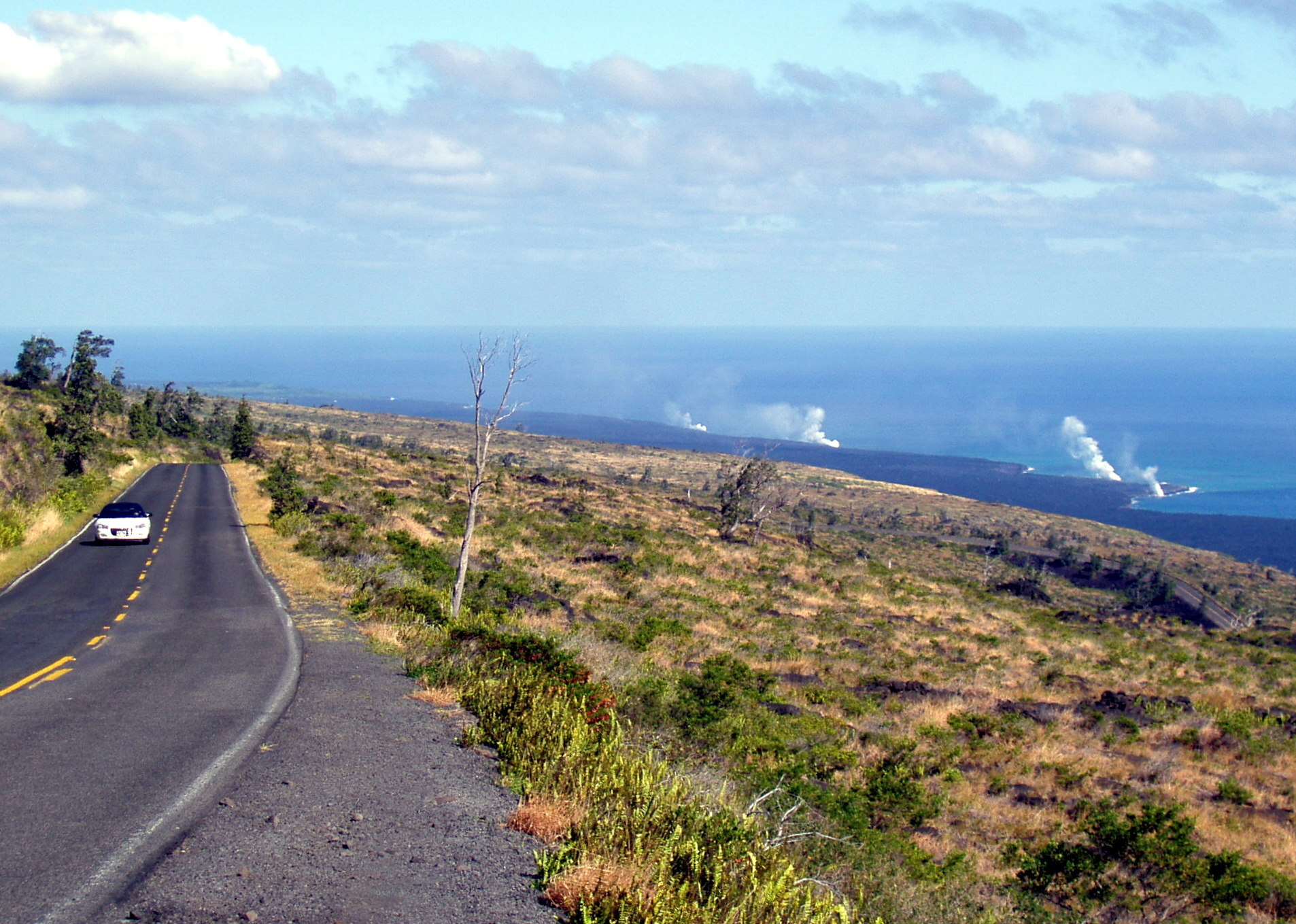
© Jos-uit-boston at Dutch Wikipedia, CC BY-SA 3.0 Resized from original. (This derivative is under the same CC BY-SA license.)
World Heritage Research
Discover scientific research and academic studies that deepen our understanding of Hawaii Volcanoes National Park from its history and significance to its conservation, management, and contemporary challenges.
-
Interactions of Fire and Nonnative Species Across an Elevation/Plant Community Gradient in Hawaii Volcanoes National Park
A study in Hawaii Volcanoes National Park revealed that invasive species, particularly nonnative ferns and grasses, can significantly hinder the recovery of native tropical forests following wildfires. The research, conducted over two years post-2003 fires, found that while Metrosideros polymorpha trees often survived via basal sprouting, their growth was stunted in areas where invasive understory species rapidly established. This suggests that fire and nonnative species interactions can maintain shrublands dominated by fire-resilient, nonnative plants, potentially threatening native biodiversity. The study documented stand-replacing fires across elevation gradients, highlighting the complex dynamics between fire regimes and invasive species in tropical ecosystems.
Ainsworth, A., & Kauffman, J. B. (2010). Interactions of Fire and Nonnative Species Across an Elevation/Plant Community Gradient in Hawaii Volcanoes National Park. Biotropica, 42(6), 647–655. Portico. https://doi.org/10.1111/j.1744-7429.2010.00636.x
View Publication Record | Read Publication