World Heritage Identification Number: 1648
World Heritage since: 2021
Category: Cultural Heritage
WHE Type: Religious Sites & Sacred Architecture
Transboundary Heritage: No
Endangered Heritage: No
Country: 🇨🇮 Côte d'Ivoire
Continent: Africa
UNESCO World Region: Africa
Map
Sudanese Style Mosques in Northern Côte d’Ivoire: A Fusion of Architectural Traditions
The Sudanese style mosques in northern Côte d’Ivoire represent a remarkable blend of architectural traditions that have endured for centuries. Inscribed as a UNESCO World Heritage Site in 2021, these eight mosques offer a unique insight into the history of Islamic architecture in West Africa.
More to come…UNESCO Description of the World Heritage Site
The eight Sudanese-style mosques located in Tengréla, Kouto, Sorobango, Samatiguila, Nambira, Kong, and Kaouara are characterized by earthen construction, projecting frameworks, vertical buttresses crowned with pottery or ostrich eggs, and high or low minarets in the form of a truncated pyramid. They present an interpretation of an architectural style that originated between the 12th and 14th centuries in the city of Djenné, which was then part of the Mali Empire and whose prosperity came from the trade of gold and salt across the Sahara to North Africa. It is especially from the 15th century that this style spread southwards, from the desert regions to the Sudanese savannah, adopting lower forms with stronger buttresses, to meet the requirements of a more humid climate. These mosques are the best preserved of the twenty that have survived in Côte d'Ivoire, out of several hundred that still existed at the beginning of the 20th century. The Sudanese style that characterizes these mosques, and which is unique to the savannah region of West Africa, developed between the eleventh and nineteenth centuries, when Islamic merchants and scholars spread southward from the Mali Empire, extending the trans-Saharan trade routes into the woodlands. The mosques are not only very important physical evidence of the trans-Saharan trade that fostered the expansion of Islam and Islamic culture, but are also a tangible expression of the fusion of two architectural forms that have endured over time: the Islamic form practiced by the Arab-Berbers and that of the indigenous animist communities.
UNESCO Justification of the World Heritage Site
Criterion (ii): The Sudanese-style mosques of northern Côte d'Ivoire are material evidence of an important exchange of influences in the Gur and Mandé cultural areas between the 14th and 18th centuries. Architectural developments conveyed by predominantly Muslim traders, particularly Arab-Berbers and Mandé people from the Niger Delta, merged with local building traditions to produce a style of mosque building that spread from East to West in the savannah areas of West Africa and which has persisted for many centuries.
Criterion (iv): The Sudanese-style mosques of northern Côte d'Ivoire are an outstanding example of a type of architecture that very specifically reflects a major period of migration, south of the Islamic Saharan states to the forest areas, which began in the 14th century and accelerated after the collapse of the Songhai Empire at the end of the 16th century. This led to the development of new trade centres, the introduction of Islam and its spread, of which the building of mosques is one of the major symbols. The style of these mosques reflects a fusion of Islamic and local architectural styles adapted to climatic conditions, and the mosques themselves can be seen as documents relating to an important stage in human history.
Encyclopedia Record: Sudanese style mosques in northern Côte d'Ivoire
The Sudanese style mosques in northern Côte d’Ivoire are a collection of eight mosques in northern Côte d'Ivoire that were built between the 17th and 19th centuries in a Sudanese style first brought to the Empire of Mali in the 14th century.Additional Site Details
Area: 0.1298 hectares
Number of Components: 8
(iv) — Outstanding example of a type of building or landscape
Coordinates: 10.4903166667 , -6.4101666667
Image
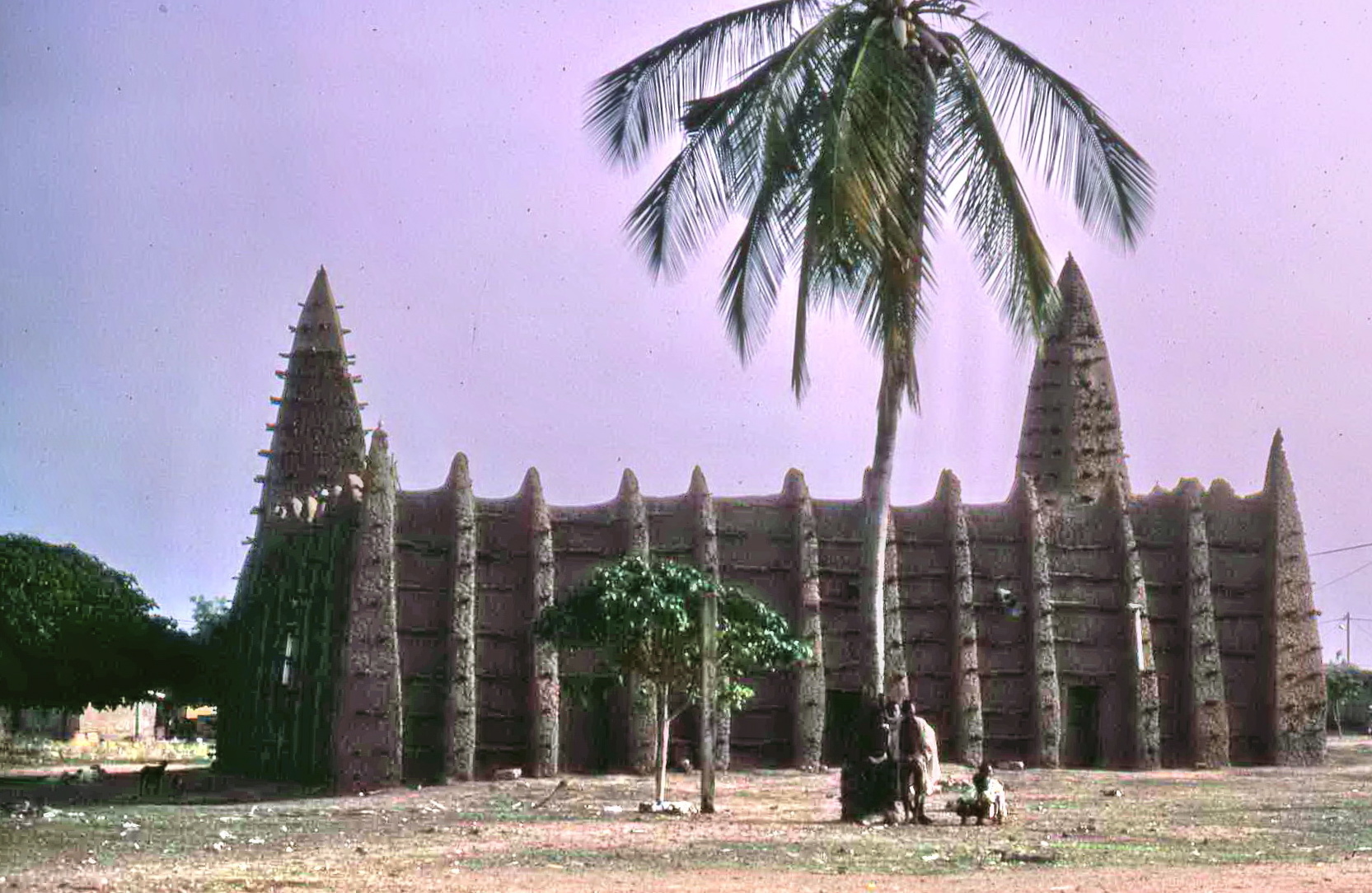
© Ivoire8, CC BY-SA 3.0 Resized from original. (This derivative is under the same CC BY-SA license.)