
World Heritage Identification Number: 155
World Heritage since: 1981
Category: Natural Heritage
WHE Type: Protected Areas & National Parks
Transboundary Heritage: Yes
Endangered Heritage: Yes
Country: Côte d'Ivoire, Guinea
Continent: Africa
UNESCO World Region: Africa
Map
Mount Nimba Strict Nature Reserve: A Biodiversity Hotspot in West Africa
Mount Nimba Strict Nature Reserve, a UNESCO World Heritage Site since 1981, is a testament to the extraordinary natural wealth hidden within the heart of West Africa. Situated along the borders of Guinea, Liberia, and Côte d'Ivoire, this protected area spans a total area of 175.4 square kilometers, with 125.4 square kilometers in Guinea and 50 square kilometers in Côte d'Ivoire. The reserve encompasses substantial sections of the Nimba Range, a geographically distinct region characterized by its rich and unusual flora and fauna.
More to come…UNESCO Description of the World Heritage Site
Located on the borders of Guinea, Liberia and Côte d’Ivoire, Mount Nimba rises above the surrounding savannah. Its slopes are covered by dense forest at the foot of grassy mountain pastures. They harbour an especially rich flora and fauna, with endemic species such as the viviparous toad and chimpanzees that use stones as tools.
UNESCO Justification of the World Heritage Site
Criterion (ix): Part of the rare mountainous chains of West Africa, Mount Nimba rises abruptly to an altitude of 1,752 m above a rolling panorama and giving way to forested plains at the lower altitudes. It is an isolated refuge covered with montane forests, making the landscape of the Gulf of Guinea an exceptional site from the ecological perspective. Its geomorphological characteristics and its sub-equatorial montane climate of strong seasonal and altitudinal contrasts produce a rich variety of microclimates. This latter factor has contributed to the individualization of an insolite plant and fauna population, as well as a dynamic and exceptionally varied ecosystem.
Criterion (x): Its unique geographical and climatic location combined with its biogeographical background provides the Nimba chain with one of the most remarkable diversities of the whole West African region. It is also one of the only sites of the Gulf of Guinea with a strong endemism potential. The wide range of habitats in the Reserve with its numerous niches enables the property to provide shelter to more than 317 vertebrate species, 107 of which are mammals, and, to more than 2,500 invertebrate species with a strong endemism level. The viviparous toad of Mount Nimba (Nimbaphrynoides occidentalis), critically threatened with extinction due to its very reduced breeding area, only lives in high altitude habitats. Another endemic species in danger of extinction is the micropotamogale of Mount Nimba (Micropotamogale lamottei), a small semi-aquatic insectivore. Several species of threatened primates are also present, including chimpanzees capable of using tools. The Reserve contains a very important plant population, with a dense forest covering the lower level of the massif up to 1,000 m altitude, replaced higher up by a montane forest rich in epiphytes. The massif of Nimba has summits that extend over 15 km in length and covered with montane savanna. More than 2,000 species of vascular plants, including several endemic or quasi-endemic plants have been recorded.
Encyclopedia Record: Mount Nimba Strict Nature Reserve
Mount Nimba Strict Nature Reserve is a protected area and UNESCO World Heritage Site located in both Guinea and Côte d'Ivoire, extending over a total of area of 175.4 km2, with 125.4 km2 in Guinea, and 50 km2 in Côte d'Ivoire. The reserve covers significant portions of the Nimba Range, a geographically unique area with unusually rich flora and fauna, including exceptional numbers of single-site endemic species, such as Nimbaphrynoides, the Nimba otter shrew, and multiple species of horseshoe bats. Its highest peak is Mount Richard-Molard at 1,752 m (5,750 ft), which is the highest peak of both countries.Additional Site Details
Area: 17,540 hectares
Number of Components: 1
(x) — Contains most important habitats for biodiversity
Coordinates: 7.60318 , -8.39097
IUCN World Heritage Outlook
The 2025 Conservation Outlook on Mount Nimba Strict Nature Reserve reports the following assessment:
Source: International Union for Conservation of Nature (IUCN) · View assessment
Image
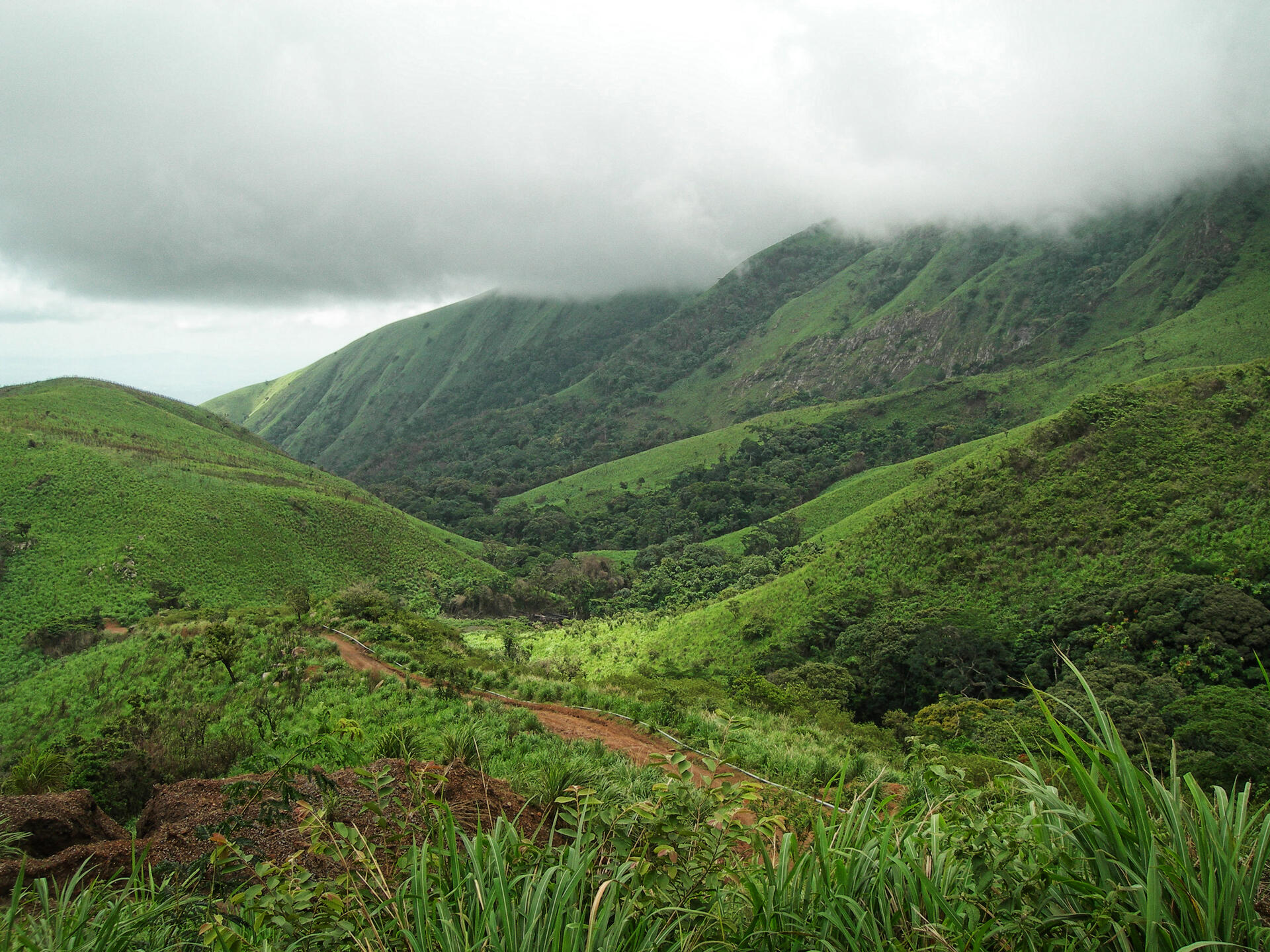
© Guy Debonnet, CC BY-SA 3.0 igo Resized from original. (This derivative is under the same CC BY-SA license.)
World Heritage Research
Discover scientific research and academic studies that deepen our understanding of Mount Nimba Strict Nature Reserve from its history and significance to its conservation, management, and contemporary challenges.
-
Abundance and Distribution of Carnivorous Mammals in a Protected Area : Preliminary Study in the Mount Nimba Integral Nature Reserve (West, Cote Divoire)
A preliminary study in the Mount Nimba Strict Nature Reserve, Côte d'Ivoire, identified five carnivore species—golden cat (Caracal aurata), African civet (Civettictis civetta), African genet (Genetta genetta), marsh mongoose (Atilax paludinosus), and brown mongoose (Crossarchus obscurus)—with the Viverridae family being the most abundant. The research, conducted from 2020 to 2024 using line transect counting and camera trapping, found carnivores distributed across four habitat types: dense lowland forests, dense montane forests, gallery, and secondary forests. Abundance was notably higher in the southern and northern regions of the reserve. The study highlights the need for further research on prey spectra and activity patterns to deepen understanding of ecosystem dynamics and support sustainable conservation efforts.
Kone, N., Bamba, K., Yao Kouakou, C., Ange Deda, A.,. (2025). ABUNDANCE AND DISTRIBUTION OF CARNIVOROUS MAMMALS IN A PROTECTED AREA : PRELIMINARY STUDY IN THE MOUNT NIMBA INTEGRAL NATURE RESERVE (WEST, COTE DIVOIRE). International Journal of Advanced Research, 13(09), 815–820. https://doi.org/10.21474/ijar01/21766
View Publication Record | Read Publication -
Ants response to mining prospection disturbances across vegetation zones in tropical mountain chains of Mount Nimba, Guinea, West Africa
Ant communities in tropical mountain chains, particularly those in Mount Nimba Strict Nature Reserve, show significant resilience to early mining disturbances but are more vulnerable in forest habitats. A study comparing ant richness and species composition across three vegetation zones—highland meadows, transition savannahs, and altitudinal forests—revealed that while meadows and savannahs remained relatively stable between mining prospecting sites and nearby undisturbed areas (World Heritage Sites), forest habitats exhibited notable differences. Despite variations in weather and soil variables, such as soil pH, vegetation structure emerged as the primary factor influencing ant assemblage composition. This finding underscores the critical role of native forest protection and rehabilitation in successful mine site restoration efforts.
Yeo, K., Kouakou, L. M. M., Touao, M. K., Gauze, E., Ouattara, K., & Soro, A. N. (2019). Ants response to mining prospection disturbances across vegetation zones in tropical mountain chains of Mount Nimba, Guinea, West Africa. International Journal of Biological and Chemical Sciences, 13(2), 899. https://doi.org/10.4314/ijbcs.v13i2.26
View Publication Record | Read Publication