World Heritage Identification Number: 195
World Heritage since: 1982
Category: Natural Heritage
WHE Type: Protected Areas & National Parks
Transboundary Heritage: No
Endangered Heritage: No
Country: 🇨🇮 Côte d'Ivoire
Continent: Africa
UNESCO World Region: Africa
Map
Taï National Park: A Biodiversity Haven in West Africa
Taï National Park, located in the southwestern region of Ivory Coast, is a significant conservation area that has been recognized by UNESCO as a World Heritage Site since 1982. The park serves as one of the last substantial remnants of the primary tropical rainforests in West Africa, making it a crucial habitat for numerous endemic and threatened species.
More to come…UNESCO Description of the World Heritage Site
This park is one of the last major remnants of the primary tropical forest of West Africa. Its rich natural flora, and threatened mammal species such as the pygmy hippopotamus and 11 species of monkeys, are of great scientific interest.
Encyclopedia Record: Taï National Park
Taï National Park is a national park in Ivory Coast that contains one of the last areas of primary rainforest in West Africa. It was inscribed as a World Heritage Site in 1982 due to the diversity of its flora and fauna. Five mammal species of the Taï National Park are on the Red List of Threatened Species: pygmy hippopotamus, olive colobus monkeys, leopards, chimpanzees, and Jentink's duiker.Additional Site Details
Area: 508,186 hectares
Number of Components: 1
(x) — Contains most important habitats for biodiversity
Coordinates: 5.6488888889 , -7.0952777778
IUCN World Heritage Outlook
The 2025 Conservation Outlook on Taï National Park reports the following assessment:
Source: International Union for Conservation of Nature (IUCN) · View assessment
Image
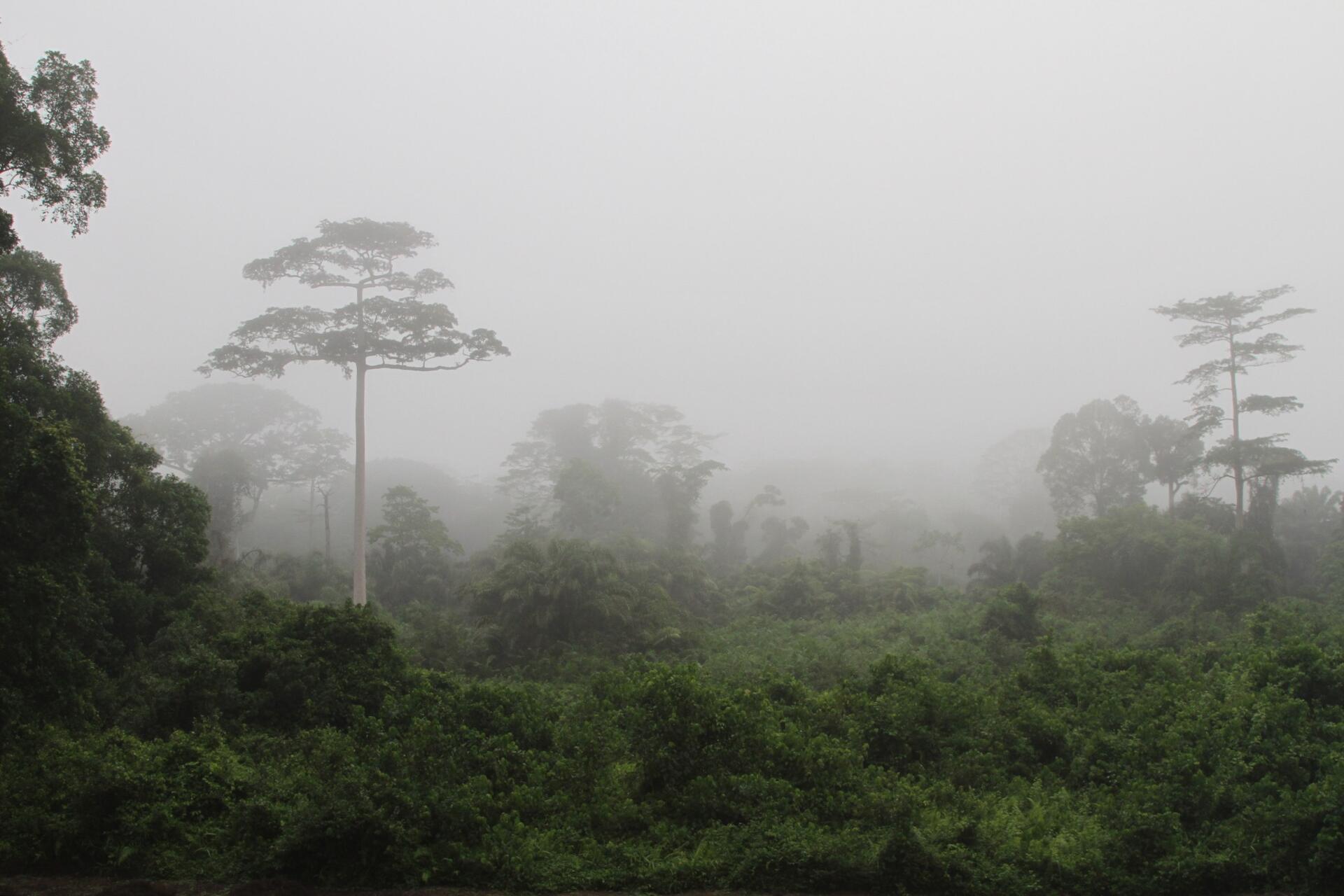
© yakovlev.alexey from Moscow, Russia, CC BY-SA 2.0 Resized from original. (This derivative is under the same CC BY-SA license.)
World Heritage Research
Discover scientific research and academic studies that deepen our understanding of Taï National Park from its history and significance to its conservation, management, and contemporary challenges.
-
Demography and life history of five chimpanzee communities in Taï National Park
A nearly four-decade study of wild chimpanzees in Taï National Park, Côte d'Ivoire, reveals critical insights into their demography and life-history strategies. By tracking five communities (North, South, Middle, East Groups), researchers uncovered key reproductive metrics such as age at first birth, interbirth intervals, and longevity, providing a rare long-term dataset for chimpanzee ecology. The study highlights adaptations in Taï chimpanzees' reproductive success and fitness, offering comparisons with other long-term sites to elucidate species-specific responses to environmental challenges.
Wittig, R., & Boesch, C. (2019). Demography and life history of five chimpanzee communities in Taï National Park. The Chimpanzees of the Taï Forest, 125–140. https://doi.org/10.1017/9781108674218.010
View Publication Record | Read Publication -
Factors influencing bacterial microbiome composition in a wild non-human primate community in Taï National Park, Côte d’Ivoire
A groundbreaking study reveals that the gut microbiomes of nine sympatric non-human primate species in Taï National Park, Côte d’Ivoire, are shaped by host species, social group dynamics, and parentage, rather than direct social relationships. Surprisingly, chimpanzees exhibited unique phylogenetic overdispersion patterns, contrasting with the expected clustering seen in other monkey species. This suggests distinct ecological or physiological factors influencing their microbiome composition. The research employed a comparative approach to analyze microbiome data across species, providing insights into the complex dispersal routes and evolutionary pressures shaping these microbial communities.
Gogarten, J. F., Davies, T. J., Benjamino, J., Gogarten, J. P., Graf, J., Mielke, A., Mundry, R., Nelson, M. C., Wittig, R. M., Leendertz, F. H., & Calvignac-Spencer, S. (2018). Factors influencing bacterial microbiome composition in a wild non-human primate community in Taï National Park, Côte d’Ivoire. The ISME Journal, 12(10), 2559–2574. https://doi.org/10.1038/s41396-018-0166-1
View Publication Record | Read Publication -
Bushmeat consumption and environmental awareness in rural households: a case study around Taï National Park, Côte d'Ivoire
A significant reduction in bushmeat consumption—exceeding 62% after four multimedia campaigns—was observed in rural households near Taï National Park, Côte d'Ivoire. The study highlights the effectiveness of recurring awareness campaigns, combining theatre and film screenings, in curbing bushmeat intake, particularly among poorer households with more dependent children. Bushmeat, primarily composed of rodents and bovids, accounted for 13% of animal protein consumed in these communities. Researchers conducted surveys in 144 households across 20 localities between July and December 2012 to assess the impact of poverty and awareness campaigns on bushmeat consumption patterns.
Kouassi, J. A. K., Normand, E., Koné, I., & Boesch, C. (2017). Bushmeat consumption and environmental awareness in rural households: a case study around Taï National Park, Côte d’Ivoire. Oryx, 53(2), 293–299. https://doi.org/10.1017/s0030605317000333
View Publication Record | Read Publication -
Diversity and prevalence of gastrointestinal parasites in seven non-human primates of the Taï National Park, Côte d’Ivoire
A comprehensive survey of gastrointestinal parasites in seven non-human primate species within Côte d'Ivoire's Taï National Park reveals high diversity and prevalence, with 23 parasite species identified. Species such as Cercopithecus diana, C. petaurista, Cercocebus atys, and C. campbelli exhibited greater parasite richness and more equitable distribution compared to others. The study, the first of its kind for these primate taxa in Taï National Park, employed microscopic examination techniques—direct wet mount, formalin-ethyl acetate concentration, and MIF (merthiolate, iodine, formalin) concentration—to analyze 3142 stool samples collected between 2009 and 2010. Findings underscore the complex parasitic dynamics in these primate populations, providing critical baseline data for future conservation and health monitoring efforts.
Kouassi, R. Y. W., McGraw, S. W., Yao, P. K., Abou-Bacar, A., Brunet, J., Pesson, B., Bonfoh, B., N’goran, E. K., & Candolfi, E. (2015). Diversity and prevalence of gastrointestinal parasites in seven non-human primates of the Taï National Park, Côte d’Ivoire. Parasite, 22, 1. https://doi.org/10.1051/parasite/2015001
View Publication Record | Read Publication -
How feeding competition determines female chimpanzee gregariousness and ranging in the Taï National Park, Côte d'Ivoire
In Taï National Park, Côte d'Ivoire, high-ranking female chimpanzees increase their gregariousness during periods of food scarcity, unlike low-ranking females who reduce their social interactions to minimize energy expenditure. This study challenges the assumption that high-ranking females always benefit from being more social, revealing instead a conditional response to ecological conditions. Researchers analyzed long-term data from two Taï chimpanzee communities using multivariate analysis to test whether dominance rank influenced gregariousness and travel costs. The findings suggest that female chimpanzees in Taï do not monopolize core areas, unlike other populations such as those in Gombe or Kibale, indicating significant variation in social behavior across chimpanzee populations.
Riedel, J., Franz, M., & Boesch, C. (2010). How feeding competition determines female chimpanzee gregariousness and ranging in the Taï National Park, Côte d’Ivoire. American Journal of Primatology, 73(4), 305–313. Portico. https://doi.org/10.1002/ajp.20897
View Publication Record | Read Publication