World Heritage Identification Number: 139
World Heritage since: 1980
Category: Cultural Heritage
WHE Type: Archaeological Sites
Transboundary Heritage: No
Endangered Heritage: No
Country: 🇵🇰 Pakistan
Continent: Asia
UNESCO World Region: Asia and the Pacific
Map
Taxila: An Ancient City of Learning and Cultural Exchange
Taxila, also known as Takshashila, is a historical city located in the Pothohar region of Punjab, Pakistan. Situated approximately 25 kilometers (16 miles) northwest of the Islamabad–Rawalpindi metropolitan area, Taxila is a significant archaeological site that offers insights into various stages of urban development in the Indus Valley Civilization. The city has been recognized as a UNESCO World Heritage Site since 1980 due to its rich history, cultural significance, and architectural importance.
More to come…UNESCO Description of the World Heritage Site
From the ancient Neolithic tumulus of Saraikala to the ramparts of Sirkap (2nd century B.C.) and the city of Sirsukh (1st century A.D.), Taxila illustrates the different stages in the development of a city on the Indus that was alternately influenced by Persia, Greece and Central Asia and which, from the 5th century B.C. to the 2nd century A.D., was an important Buddhist centre of learning.
UNESCO Justification of the World Heritage Site
Criterion (iii) : The ruins of four universally meaningful settlement sites at Taxila (Saraidala, Bhir, Sirkap, and Sirsukh) reveal the pattern of urban evolution on the Indian subcontinent through more than five centuries. Taxilia is the only site of this unique importance on the subcontinent.
Criterion (vi) : The Bihr mound is associated with the historic event of the triumphant entry of Alexander the Great into Taxila.
Encyclopedia Record: Taxila
Taxila or Takshashila is a city in the Pothohar region of Punjab, Pakistan. Located in the Taxila Tehsil of Rawalpindi District, it lies approximately 25 kilometres (16 mi) northwest of the Islamabad–Rawalpindi metropolitan area and is just south of the Haripur District of Khyber Pakhtunkhwa.Additional Site Details
Area: Not available
Number of Components: 17
(vi) — Directly associated with events or living traditions
Coordinates: 33.77916667 , 72.8875
Image
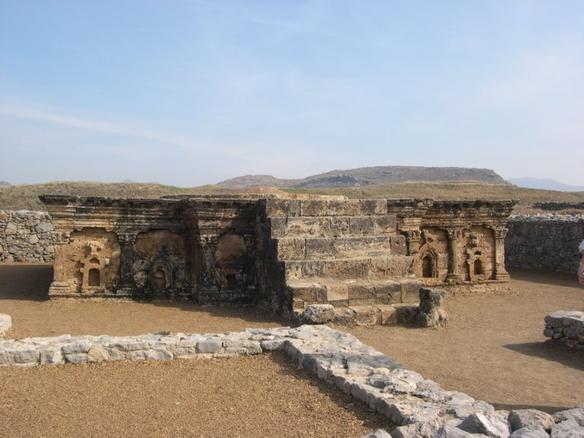
© not stated, CC BY-SA 1.0 Resized from original. (This derivative is under the same CC BY-SA license.)
World Heritage Research
Discover scientific research and academic studies that deepen our understanding of Taxila from its history and significance to its conservation, management, and contemporary challenges.
-
Evaluation of a Sustainable Urban Transportation System in Terms of Traffic Congestion—A Case Study in Taxila, Pakistan
A parking area emerges as the most sustainable solution to reduce traffic congestion at Taxila's intersection, according to a multi-method study combining fuzzy AHP-TOPSIS, fuzzy AHP-VIKOR, and traffic simulation software. Despite initial survey-based preferences favoring flyovers, on-site observations and literature reviews confirmed that expanding parking capacity would better address congestion while aligning with sustainable urban transportation principles. The research leveraged stakeholder input and advanced decision-making techniques to evaluate alternatives, offering actionable insights for Taxila's proximity to Pakistan’s economic hubs—Islamabad and Rawalpindi—while balancing infrastructure efficiency and environmental impact.
Raza, A., Ali, M. U., Ullah, U., Fayaz, M., Alvi, M. J., Kallu, K. D., Zafar, A., & Nengroo, S. H. (2022). Evaluation of a Sustainable Urban Transportation System in Terms of Traffic Congestion—A Case Study in Taxila, Pakistan. Sustainability, 14(19), 12325. https://doi.org/10.3390/su141912325
View Publication Record | Read Publication -
Traffic Flow Analysis and Solutions to Ease Traffic Flow at Unsignalized Taxila Intersection
A study at Taxila, Pakistan, identifies critical traffic congestion issues at unsignalized intersections along the N-5 highway, where complex roadway geometries exacerbate problems like accidents and high operational costs. The research quantifies these challenges through traffic flow analysis, aiming to assess system performance and its interaction with land use activities. By deriving actionable insights from traffic data, the study proposes solutions to improve efficiency, offering recommendations for policy changes and infrastructure adjustments—such as banning heavy vehicles during peak hours or expanding road capacity—to mitigate congestion and enhance safety.
Farooq, D., & Akram, T. (2018). Traffic Flow Analysis and Solutions to Ease Traffic Flow at Unsignalized Taxila Intersection. Periodica Polytechnica Transportation Engineering. https://doi.org/10.3311/pptr.10415
View Publication Record | Read Publication -
Effect of dust deposition on the performance of photovoltaic modules in Taxila, Pakistan
Dust deposition significantly reduces the performance of photovoltaic (PV) modules, with monocrystalline silicon modules experiencing greater losses compared to polycrystalline ones. A three-month study in Taxila, Pakistan, found that dust accumulation at 0.9867 mg/cm² led to a 20% decrease in average output power for monocrystalline modules and 16% for polycrystalline modules, alongside efficiency drops of 3.55% and 3.01%, respectively. The research systematically measured the impact of dust on PV performance by comparing clean and dirty modules under natural atmospheric conditions, highlighting the critical need to address dust-related losses in renewable energy systems.
Ali, H., Zafar, M., Bashir, M., Nasir, M., Ali, M., & Siddiqui, A. (2017). Effect of dust deposition on the performance of photovoltaic modules in Taxila, Pakistan. Thermal Science, 21(2), 915–923. https://doi.org/10.2298/tsci140515046a
View Publication Record | Read Publication -
Mycobial Deterioration of Stone Monuments of Dharmarajika, Taxila
A study on the mycobial deterioration of stone monuments at Dharmarajika, Taxila, revealed that 19 fungal species, including Alternaria alternata, Aspergillus spp., and Cladosporium herbarum, contribute to biodeterioration through biofilm formation and organic acid production. These fungi secrete corrosive acids such as oxalic, citric, and acetic acids, which accelerate stone decay—a significant threat to the preservation of tropical heritage sites. The research highlights the role of microbial metabolism in monument degradation, emphasizing the need for targeted conservation strategies.
Farooq, M. (2015). Mycobial Deterioration of Stone Monuments of Dharmarajika, Taxila. Journal of Microbiology & Experimentation, 2(1). https://doi.org/10.15406/jmen.2015.02.00036
View Publication Record | Read Publication -
Outdoor testing of photovoltaic modules during summer in Taxila, Pakistan
A comparative analysis of photovoltaic (PV) module performance in Taxila, Pakistan, during summer revealed that monocrystalline silicon (c-Si) modules exhibited the highest average efficiency, while amorphous silicon (a-Si) modules outperformed others in terms of performance ratio. The study found a significant decrease in both efficiency and performance ratio with rising module temperatures, which were approximately 20°C higher in summer compared to winter months. This decline correlated with ambient temperature fluctuations ranging from 18.1°C to 38.6°C. The research utilized outdoor monitoring to assess actual operating conditions of c-Si, polycrystalline silicon (p-Si), and a-Si modules, offering critical insights into PV performance under Taxila's climate.
Ali, H., Mahmood, M., Bashir, M., Ali, M., & Siddiqui, A. (2016). Outdoor testing of photovoltaic modules during summer in Taxila, Pakistan. Thermal Science, 20(1), 165–173. https://doi.org/10.2298/tsci131216025a
View Publication Record | Read Publication -
A Guide to Taxila
A comprehensive guide to the ruins of Taxila, this work reveals significant insights into the historical and topographical significance of the site. Led by Sir John Marshall, a renowned British archaeologist, the book combines detailed excavation findings with illustrative figures, a glossary of technical terms, and an extensive bibliography. It provides a concise yet thorough exploration of Taxila's architectural groups and their contents, offering valuable context for anyone interested in archaeology or the history of this UNESCO World Heritage Site.
Marshall, J. (2013). A Guide to Taxila. https://doi.org/10.1017/cbo9781316529904
View Publication Record | Read Publication -
Solid Waste Management Issues in Small Towns of Developing World: A Case Study of Taxila City
Taxila City faces severe solid waste management challenges due to rapid urbanization and industrialization. The study reveals that open dumping of municipal solid waste is causing significant environmental degradation, including land and water pollution, infectious diseases, and biodiversity loss. Key factors contributing to these issues include insufficient funding, poor waste management practices, non-implementation of legislation, and irresponsible behavior by residents. The research highlights the urgent need for improved waste management systems in small towns of developing countries to mitigate negative environmental impacts.
Ejaz, N., & Janjua, N. S. (2012). Solid Waste Management Issues in Small Towns of Developing World: A Case Study of Taxila City. International Journal of Environmental Science and Development, 167–171. https://doi.org/10.7763/ijesd.2012.v3.209
View Publication Record | Read Publication