World Heritage Identification Number: 208
World Heritage since: 2003
Category: Cultural Heritage
WHE Type: Cultural Landscapes
Transboundary Heritage: No
Endangered Heritage: Yes
Country: 🇦🇫 Afghanistan
Continent: Asia
UNESCO World Region: Asia and the Pacific
Map
Exploring the Cultural Landscape and Archaeological Remains of the Bamiyan Valley
The Cultural Landscape and Archaeological Remains of the Bamiyan Valley, inscribed as a UNESCO World Heritage Site in 2003, offer a unique insight into the rich cultural history of ancient Bactria, spanning from the 1st to the 13th centuries. This valley, located approximately 130 kilometers (81 miles) northwest of Kabul at an elevation of 2,500 meters (8,200 feet), serves as a testament to the integration of various cultural influences within the Gandhara school of Buddhist art.
Before the rise of Buddhism, the Bamiyan Valley was a crossroads of Central Asian civilizations, influenced by the Achaemenids, Greeks, Kushans, and Hephthalites. This blend of cultures created a fertile environment for the development of the Gandhara school of art, where Hellenistic, Persian, and Indian styles merged to produce unique sculptural and architectural forms. The valley’s location along early Silk Road trade routes also facilitated the exchange of ideas, goods, and religious practices, contributing to its cultural richness.
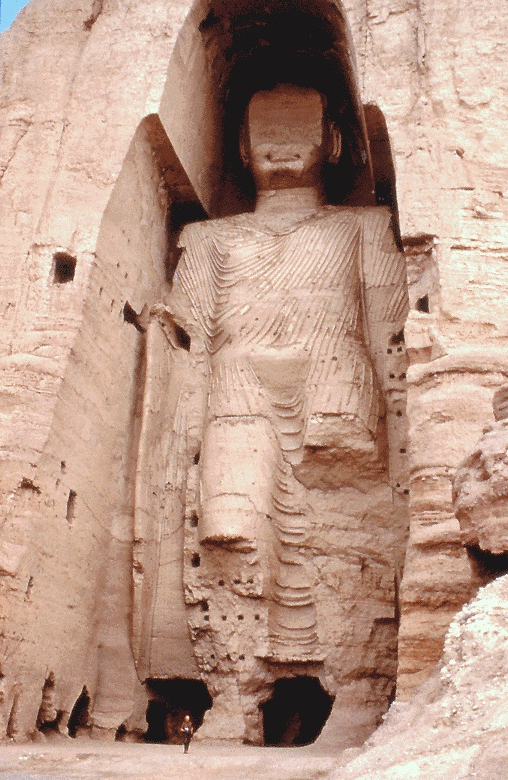
The Bamiyan Valley's most iconic landmarks were the Buddhas of Bamiyan, monumental Buddhist statues carved into the cliffs, likely around the 6th century. These monumental reliefs stood at 38 meters (125 feet) for the Eastern Buddha and 55 meters (180 feet) for the Western Buddha. Carbon dating of structural components suggests that the Eastern Buddha was constructed around 570 CE, while the Western Buddha was built around 618 CE, during a period influenced by the Hephthalites and local dynasties.
Unfortunately, these remarkable sculptures were destroyed by the Taliban in March 2001. Today, the niches, remains of plaster, and surrounding cave complexes are all that remain of these extraordinary works.
Beyond the monumental Buddhas, the Bamiyan cliffs are riddled with thousands of cave monasteries, some containing elaborate murals depicting Buddhist cosmology, devotional scenes, and daily monastic life. These murals not only highlight the spiritual practices of the region but also reveal influences from Hindu, Zoroastrian, and Central Asian artistic traditions, demonstrating the valley’s role as a melting pot of religious and cultural exchange.
Among these murals, some of the world’s oldest known oil-based paintings have been discovered, dating back to the 7th century CE. Artists combined mineral pigments with oil binders to create vibrant, long-lasting images that adorned the cave walls. These works demonstrate remarkable technical skill and highlight the valley’s role as a center of artistic innovation and cross-cultural exchange, long before similar techniques appeared in Europe.
In addition to Buddhist sites, the Bamiyan Valley also contains fortified structures from the Islamic period, illustrating the region’s transition from Buddhism to Islam. A notable example is the citadel of Shahr-e Zohak, located about 15 kilometers (9 miles) east of the Buddhas. Primarily expanded during the medieval Islamic era (Ghorid period), this "Red City" showcases the architectural achievements of the time and provides insight into the region’s later strategic importance.
The Cultural Landscape and Archaeological Remains of the Bamiyan Valley serve as a poignant reminder of the rich cultural heritage that once thrived in the region. Despite the tragic destruction of the Buddhas, the site continues to captivate visitors with its wealth of historical and artistic treasures. Efforts to preserve and protect these remnants underscore the valley’s enduring significance as a symbol of human creativity, resilience, and cultural continuity.
Despite its recognition as a UNESCO World Heritage Site, the Bamiyan Valley remains on the list of World Heritage Sites in Danger, reflecting ongoing threats from natural erosion, looting, limited conservation resources, and political instability. In response, international organizations and scholars have undertaken extensive efforts to document, preserve, and digitally reconstruct the valley’s heritage. Local initiatives complement these efforts, protecting niches, caves, and murals while raising awareness of the valley’s global significance.
Today, the Bamiyan Valley stands as a powerful symbol of resilience, intercultural dialogue, and the enduring value of human creativity. Even in the face of destruction and adversity, its cliffs and caves continue to captivate visitors, offering a vivid reminder of the region’s extraordinary historical, artistic, and spiritual legacy.
UNESCO Description of the World Heritage Site
The cultural landscape and archaeological remains of the Bamiyan Valley represent the artistic and religious developments which from the 1st to the 13th centuries characterized ancient Bakhtria, integrating various cultural influences into the Gandhara school of Buddhist art. The area contains numerous Buddhist monastic ensembles and sanctuaries, as well as fortified edifices from the Islamic period. The site is also testimony to the tragic destruction by the Taliban of the two standing Buddha statues, which shook the world in March 2001.
UNESCO Justification of the World Heritage Site
Criterion (i): The Buddha statues and the cave art in Bamiyan Valley are an outstanding representation of the Gandharan school in Buddhist art in the Central Asian region.
Criterion (ii): The artistic and architectural remains of Bamiyan Valley, an important Buddhist centre on the Silk Road, are an exceptional testimony to the interchange of Indian, Hellenistic, Roman and Sasanian influences as the basis for the development of a particular artistic expression in the Gandharan school. To this can be added the Islamic influence in a later period.
Criterion (iii): The Bamiyan Valley bears an exceptional testimony to a cultural tradition in the Central Asian region, which has disappeared.
Criterion (iv): The Bamiyan Valley is an outstanding example of a cultural landscape which illustrates a significant period in Buddhism.
Criterion (vi): The Bamiyan Valley is the most monumental expression of the western Buddhism. It was an important centre of pilgrimage over many centuries. Due to their symbolic values, the monuments have suffered at different times of their existence, including the deliberate destruction in 2001, which shook the whole world.
Encyclopedia Record: Buddhas of Bamiyan
The Buddhas of Bamiyan were two monumental Buddhist reliefs in the Bamiyan Valley of Afghanistan, carved possibly around the 6th-century. Located 130 kilometres (81 mi) to the northwest of Kabul, at an elevation of 2,500 metres (8,200 ft), carbon dating of the structural components of the Buddhas has determined the smaller 38 m (125 ft) "Eastern Buddha" was built around 570 CE, and the larger 55 m (180 ft) "Western Buddha" was built around 618 CE, which would date both to the time when the Hephthalites ruled the region.Additional Site Details
Area: 158.9265 hectares
Number of Components: 8
(ii) — Significant interchange of human values
(iii) — Unique or exceptional testimony to a cultural tradition
(iv) — Outstanding example of a type of building or landscape
(vi) — Directly associated with events or living traditions
Coordinates: 34.84694 , 67.82525
World Heritage Research
Discover scientific research and academic studies that deepen our understanding of Cultural Landscape and Archaeological Remains of the Bamiyan Valley from its history and significance to its conservation, management, and contemporary challenges.
-
Innovative Strategies and Use of UAVs to Survey and Monitor Archaeological Sites in Conflict/Post Conflict Zones. The Case Study of the Fortified Citadel of Shahr-i Zohak in Bamiyan (Afghanistan)
A groundbreaking study demonstrates that UAV-based photogrammetry can generate highly accurate 3D models of archaeological sites, even in conflict or post-conflict zones like Afghanistan. Using Skydio’s X10 and S2 drones with low ground-to-surface distances (1–5 meters) and high overlap (75%-95%), researchers achieved millimeter-level precision (1 mm per pixel) for a 120m x 30m section of the fortified citadel of Shahr-i Zohak, part of Afghanistan’s Bamiyan Valley UNESCO World Heritage Site. This method overcomes challenges such as UXO presence, limited accessibility, and lack of GPS connectivity by merging external (GPS-referenced) and internal (non-GPS) datasets. The findings highlight the potential for remote damage assessment in inaccessible regions, while also outlining practical guidelines and limitations for future applications in similarly challenging environments.
Bouledroua, D., & Cassar, B. (2025). Innovative Strategies and Use of UAVs to Survey and Monitor Archaeological Sites in Conflict/Post Conflict Zones. The Case Study of the Fortified Citadel of Shahr-i Zohak in Bamiyan (Afghanistan). The International Archives of the Photogrammetry, Remote Sensing and Spatial Information Sciences, XLVIII-M-9-2025, 171–178. https://doi.org/10.5194/isprs-archives-xlviii-m-9-2025-171-2025
View Publication Record | Read Publication -
Requirements for the Protection of the UNESCO World Heritage Cultural Landscape and Archaeological Remains of the Bamiyan Valley (Afghanistan)
International efforts to protect the Bamiyan Valley, a UNESCO World Heritage Site in Afghanistan, highlight the urgent need for integrated management strategies that balance heritage conservation with community development. The study introduces a Cultural Master Plan leveraging remote sensing to inventory archaeological zones, traditional settlements, and historical monuments while monitoring landscape changes due to urban development and limited conservation resources. Key findings emphasize that effective protection requires careful planning of development activities, community participation, and the revitalization of local identities—critical for achieving Sustainable Development Goals (SDG). The case of Bamiyan underscores global challenges posed by conflict, iconoclasm, and looting, offering lessons for heritage management in crisis areas.
Toubekis, G. (2024). Requirements for the Protection of the UNESCO World Heritage Cultural Landscape and Archaeological Remains of the Bamiyan Valley (Afghanistan). Cultural Heritage and Development in Fragile Contexts, 71–87. https://doi.org/10.1007/978-3-031-54816-1_5
View Publication Record | Read Publication -
The Future of the Bamiyan Buddha Statues
A critical precedent for heritage conservation ethics, this study establishes guidelines for the reconstruction of cultural properties destroyed by violence, using the Bamiyan Buddha statues as a case. It addresses fundamental questions about authenticity, decision-making, and the use of non-original materials in World Heritage reconstruction, while advocating for holistic strategies that integrate human rights and peacebuilding. The research synthesizes academic insights, practical experiences, and theoretical frameworks to inform global conservation policies, serving as a reference point for post-conflict heritage protection.
Nagaoka, M. (Ed.). (2020). The Future of the Bamiyan Buddha Statues. Springer International Publishing. https://doi.org/10.1007/978-3-030-51316-0
View Publication Record | Read Publication -
World Heritage and Reconstruction: An Overview and Lessons Learnt for the Bamiyan Valley
The intentional destruction of the Bamiyan Buddhas in Afghanistan spurred international action and legal reforms, leading to the inscription of the Bamiyan Valley on UNESCO's World Heritage List and the List of World Heritage in Danger in 2003. This study reviews the historical context, international doctrine, and debates surrounding the reconstruction of cultural heritage sites, particularly focusing on the Bamiyan Valley. It highlights the development of new legal instruments following the destruction and examines emerging debates around rehabilitation and reconstruction efforts. The research approach involves tracing the site's inscription history and analyzing the World Heritage Committee's actions post-destruction.
Rössler, M. (2020). World Heritage and Reconstruction: An Overview and Lessons Learnt for the Bamiyan Valley. The Future of the Bamiyan Buddha Statues, 99–111. https://doi.org/10.1007/978-3-030-51316-0_6
View Publication Record | Read Publication -
Our Heritage Is Already Broken: Meditations on a Regenerative Conservation for Cultural and Natural Heritage
The Bamiyan Buddhas, colossal 6th–7th century CE statues carved into Afghanistan’s Bamiyan Valley cliff faces, were destroyed by the Taliban regime in 2001 using mortar fire and dynamite. This act of cultural heritage destruction, which occurred just months before the September 11 attacks, sparked international outrage. In response, UNESCO designated the Bamiyan Valley as a World Heritage Site and added it to the 'World Heritage in Danger' list in 2003, recognizing its Outstanding Universal Value. The study reflects on this tragedy through a regenerative conservation lens, emphasizing the acceptance of imperfection and flaw as inherent to heritage preservation, drawing from philosophical meditations on waste and garbage. It underscores the urgent need for global recognition and protection of such invaluable historical treasures.
Kimball, M. (2016). Our Heritage Is Already Broken: Meditations on a Regenerative Conservation for Cultural and Natural Heritage. Human Ecology Review, 22(2). https://doi.org/10.22459/her.22.02.2016.03
View Publication Record | Read Publication