World Heritage Identification Number: 179
World Heritage since: 1982
Category: Mixed Cultural Heritage and Natural Heritage
WHE Type: Natural Landscapes & Geographic Features
Transboundary Heritage: No
Endangered Heritage: No
Country: 🇩🇿 Algeria
Continent: Africa
UNESCO World Region: Arab States
Map
The Rock Art of Tassili n'Ajjer: A Window into the Prehistoric Sahara
The Tassili n'Ajjer mountain plateau, situated in southeastern Algeria near the borders with Libya, Niger, and Mali, covers approximately 72,000 square kilometers (about 27,800 square miles). This extraordinary landscape was inscribed on the UNESCO World Heritage List in 1982 and is renowned for its spectacular geological formations and one of the world's most important concentrations of prehistoric rock art.
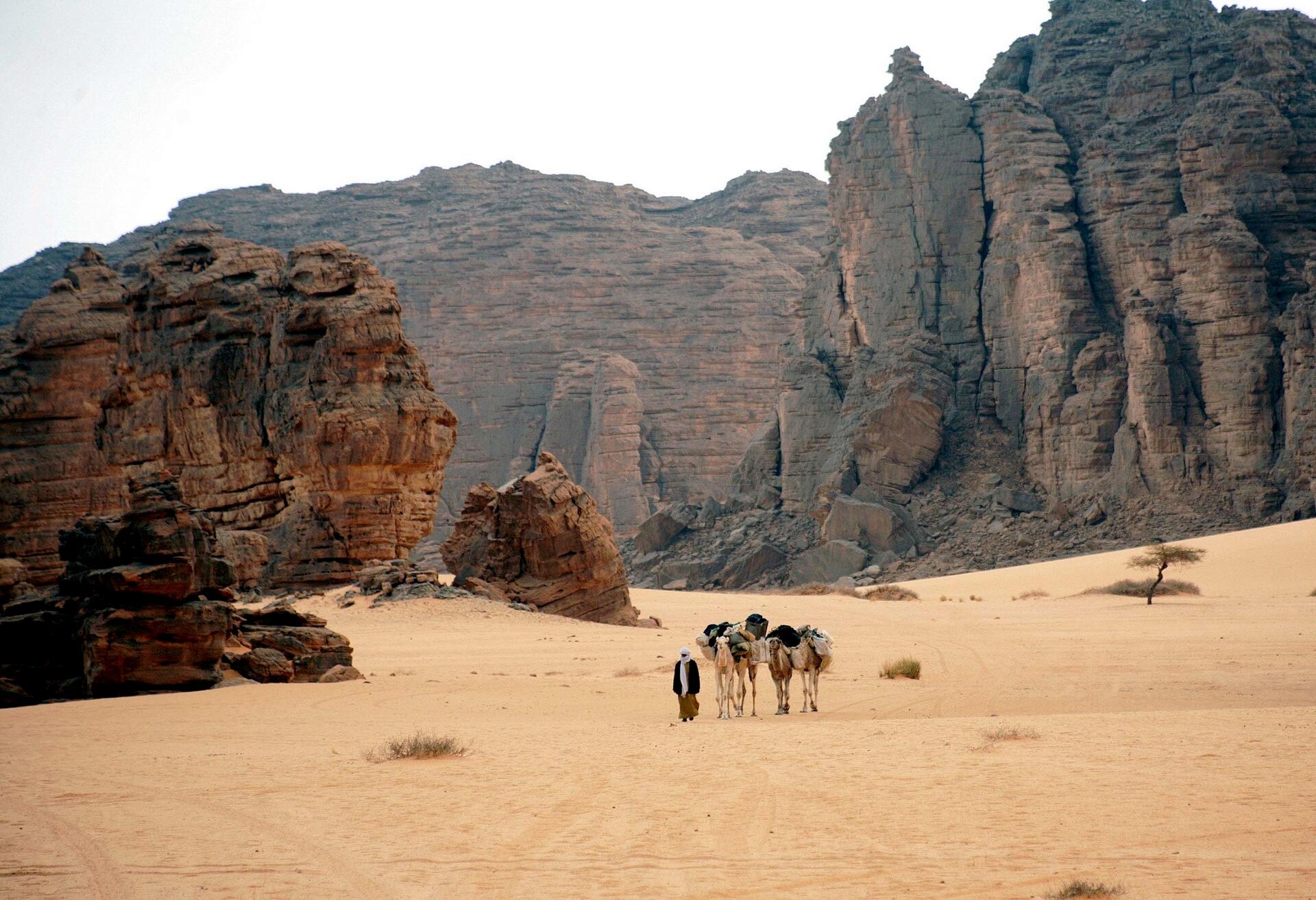
Geologically, Tassili n'Ajjer presents a remarkable landscape often described as lunar in appearance. Vast stretches of eroded sandstone form dramatic natural formations sometimes referred to as "forests of rock." The plateau incorporates ancient geological materials, including Precambrian rocks and extensive sedimentary formations, and its distinctive landscape has been shaped over immense periods by geological processes and erosion. Tassili n'Ajjer is the product of a complex geological history extending back hundreds of millions of years.
The primary draw of Tassili n'Ajjer, however, lies in its rich cultural heritage. More than 15,000 drawings and engravings have been documented across the plateau. These works, together with archaeological remains found throughout the region, preserve evidence of changing environments, animal populations, and human societies on the southern edge of the Sahara. The rock-art record spans roughly 10,000 years, with some of the earliest works dating back approximately 10,000 to 12,000 years, while archaeological evidence from the broader site extends to around 10,000 BCE.
The artworks provide an exceptional record of the Sahara's changing environment. During periods when the region was considerably wetter than it is today, particularly during the African Humid Period, the central Sahara supported a much richer range of vegetation and wildlife. Tassili's rock art includes representations of animals such as giraffes, rhinoceroses, antelopes, cattle, and other large fauna. Some of the animals depicted are no longer found in the region, offering important evidence of the environmental changes that transformed the Sahara over thousands of years.
Human figures are also prominent throughout the artwork. Scenes depict people engaged in activities associated with hunting, herding, dancing, and other aspects of daily and ceremonial life. The imagery belongs to several artistic traditions that developed over long periods. Archaeologists commonly distinguish traditions associated with early hunter-gatherers, cattle herding, horses, and, later, camels, although the chronology and regional development of Saharan rock art remain subjects of ongoing research.
Some of the most enigmatic images are the so-called "Round Head" figures and other unusual human or human-animal representations. Researchers have proposed various interpretations of these works, including ritual or religious meanings. UNESCO notes that the Round Head imagery may evoke possible magic-religious practices, suggesting the presence of complex spiritual beliefs among the earliest inhabitants of the region, but the precise significance of these figures remains uncertain.
The rock art reveals a succession of cultural traditions spanning several thousand years. Earlier imagery includes distinctive human figures associated with the Round Head tradition, while later periods increasingly feature cattle, reflecting the emergence of pastoral societies. Still later, representations of horses and chariots appear, followed by camels as desert societies adapted to increasingly arid conditions. Although the precise chronology and meaning of some images remain debated, this broad sequence provides an extraordinary visual record of changing ways of life in the Sahara.
Tassili n'Ajjer entered the modern scientific and public imagination particularly strongly during the twentieth century, when French archaeologist and researcher Henri Lhote and his collaborators documented many of its paintings and engravings. Their work brought international attention to the plateau and helped establish its importance in the study of prehistoric Saharan cultures. At the same time, some of Lhote's documentation and recording methods have since attracted serious criticism, including the practice of wetting paintings to make them more visible during copying and photography.
In addition to its rock art, Tassili n'Ajjer contains extensive archaeological evidence of past human occupation. Researchers have found habitation sites, burial mounds, enclosures, stone tools, and ceramic material, documenting the presence of successive communities over thousands of years. Together, these remains and the rock art provide complementary evidence for understanding how people lived and adapted to changing conditions in the prehistoric Sahara.
Visiting Tassili n'Ajjer today requires careful preparation because of its remote location and demanding desert environment. The plateau's vast sandstone landscapes, deep gorges, and isolated rock shelters make access challenging, but they also preserve an exceptional archaeological and natural environment. For visitors who make the journey, the combination of ancient artwork and dramatic geology offers a rare opportunity to encounter a landscape shaped by both natural forces and thousands of years of human activity.
Today, Tassili n'Ajjer stands as an important record of the environmental and cultural history of the Sahara. Its UNESCO World Heritage designation recognizes both its outstanding natural landscape and its exceptional archaeological and artistic heritage. Preserving the rock art, archaeological remains, and fragile desert environment is essential to ensuring that this remarkable record of the past survives for future generations.
UNESCO Description of the World Heritage Site
Located in a strange lunar landscape of great geological interest, this site has one of the most important groupings of prehistoric cave art in the world. More than 15,000 drawings and engravings record the climatic changes, the animal migrations and the evolution of human life on the edge of the Sahara from 6000 BC to the first centuries of the present era. The geological formations are of outstanding scenic interest, with eroded sandstones forming ‘forests of rock’.
UNESCO Justification of the World Heritage Site
Criterion (i): The impressive array of paintings and rock engravings of various periods gives world recognition to the property. The representations of the Round Heads Period evoke possible magic-religious practices some 10,000 years old, whereas the representations of the Cattle Period depicting daily and social life, and which are amongst the most famous prehistoric parietal art, have an aesthetic naturalistic realism. The last images represent the taming of horses and camels.
Criterion (iii): The rock art images cover a period of about 10,000 years. With the archaeological remains, they testify in a particularly lively manner to climate changes, changes in fauna and flora, and particularly to possibilities provided for farming and pastoral life linked to impregnable defensive sites during certain prehistoric periods.
Criterion (vii): With the eroded sandstone forming rock forests, the property is of remarkable scenic interest. The sandstone has kept intact the traces and marks of the major geological and climatic events. The corrosive effects of water, and then wind, have contributed to the formation of a particular morphology, that of a plateau carved by water and softened by the wind.
Criterion (viii): The geological conformation of Tassili n'Ajjer includes Precambrian crystalline elements and sedimentary sandstone successions of great paleo-geographical and paleo-ecological interest. Humans lived in this area by developing cultural and physiological behaviour adapted to the harsh climate; their vestiges date back to several hundreds of thousands of years. The rock art of Tassili n'Ajjer, is the most eloquent expression of relationships between humans and the environment, with more than 15,000 drawings and engravings testifying to climate changes, wildlife migrations, and the evolution of humankind on the edge of the Sahara. This art depicts water-dependent species like the hippopotamus, and species which have been extinct in the region for thousands of years. This combination of geological, ecological and cultural elements is a highly representative example of a testimony to life.
Encyclopedia Record: Tassili n'Ajjer
Tassili n'Ajjer is a mountain range in the Sahara desert, located in south-eastern Algeria. It holds one of the most important groupings of prehistoric cave art in the world and covers an area of more than 72,000 km2 (28,000 sq mi).Additional Site Details
Area: 7,200,000 hectares
Number of Components: 1
(iii) — Unique or exceptional testimony to a cultural tradition
(vii) — Contains superlative natural phenomena or beauty
(viii) — Outstanding example representing major earth stages
Coordinates: 25.5 , 9
IUCN World Heritage Outlook
The 2025 Conservation Outlook on Tassili n'Ajjer reports the following assessment:
Source: International Union for Conservation of Nature (IUCN) · View assessment
World Heritage Research
Discover scientific research and academic studies that deepen our understanding of Tassili n'Ajjer from its history and significance to its conservation, management, and contemporary challenges.
-
Solar Reflection Geometry of the Great Pyramid of Giza: A Proposed Optical Alignment with the Richat Structure, Mauritania
A novel analysis reveals that the Great Pyramid of Giza's western face, when illuminated at a specific solar elevation (13.6°), reflects sunlight horizontally toward the Richat Structure ('Eye of the Sahara') in Mauritania with remarkable precision—deviating only 2.84° from due west. This alignment, calculated using spherical geometry and solar optics, suggests intentional optical design. Two ancient sites, Siwa Oasis (Egypt) and Tassili n'Ajjer (Algeria), lie along the same bearing between Giza and Richat, further supporting this hypothesis. The study proposes that these geometric relationships warrant physical investigation of the Richat Structure and its potential cultural or astronomical significance.
Rios Jr, A. (2026). Solar Reflection Geometry of the Great Pyramid of Giza: A Proposed Optical Alignment with the Richat Structure, Mauritania. Zenodo. https://doi.org/10.5281/ZENODO.19262108
View Publication Record | Read Publication -
Geoheritage as a Tool for Environmental Education: Towards the Development of Sustainable Geotourism in Algeria – The Case of Tassili N’Ajjer
Tassili n'Ajjer, Algeria's spectacular geological plateau, holds significant potential for sustainable geotourism and environmental education when integrated into school curricula. A study involving 500 students and 80 faculty from two universities revealed high student interest in geo-heritage but low formal instruction. Faculty expressed enthusiasm for integrating geo-heritage teaching but noted institutional support gaps. Tassili n'Ajjer was identified as an ideal location for educational tours due to its geological and cultural importance, suggesting that enhanced visibility of Algeria's geosites could foster more informed and responsible tourism, aligning with sustainable development goals.
Saad Chinnoune, & Badreddine Rabhi. (2026). Geoheritage as a Tool for Environmental Education: Towards the Development of Sustainable Geotourism in Algeria – The Case of Tassili N’Ajjer. International Journal of Computational and Experimental Science and Engineering, 12(2). https://doi.org/10.22399/ijcesen.5122
View Publication Record | Read Publication -
Book 89-90 - BRm Ecological Rupture Model - Algeria Tell & Saharan Atlas - V90 Corrected and Reproducible
A revised and automated ecological assessment of Algeria's Tell and Saharan Atlas regions, including the UNESCO World Heritage Site Tassili n'Ajjer, reveals significant variations in ecological resilience under anthropic pressure. The corrected BRm Ecological Rupture Model (V90) recalculates and cross-checks 10 sites, identifying Tassili n'Ajjer as having a notably low vulnerability score of 0.21, indicating high resilience. This update addresses prior errors in the model (V89), ensuring reproducibility through automated verification. The study highlights the model's utility in quantifying ecological disruption across diverse landscapes, from the Djurdjura mountains to the Ahaggar Central region.
Mourad, A. H. M. I. M. (2026). Book 89-90 - BRm Ecological Rupture Model - Algeria Tell & Saharan Atlas - V90 Corrected and Reproducible. Zenodo. https://doi.org/10.5281/ZENODO.22063043
View Publication Record | Read Publication -
Discovery of New Fish Depictions in the Central Sahara (Tassili n'Ajjer Plateau – Algeria)
A new catalog of fish depictions from the Tassili n'Ajjer Plateau, Algeria, reveals the significance of fishing in Holocene Saharan subsistence. These images, re-examined using DStretch digital technology, provide clearer insights into the aquatic life and human activities of early inhabitants during a humid phase around 10,000 years ago. The study also revisits earlier depictions where species identification was unclear, contributing to a deeper understanding of this understudied topic.
Hassiba, S., & Nabilla, A. (2025). Discovery of New Fish Depictions in the Central Sahara (Tassili n’Ajjer Plateau – Algeria). Science, Education and Innovations in the Context of Modern Problems, 8(5), 693–705. https://doi.org/10.56334/sei/8.5.71
View Publication Record | Read Publication -
Ancient Neolithic cultures in the central Sahara
The central Sahara's Neolithic period was remarkably ancient, paralleling developments in the Near East with significant advancements in pottery, agriculture, and animal domestication. Unlike the Near East, where these innovations are often attributed to complex social structures, the Saharan region's early adoption of pottery predates that of the Near East. Rock art emerges as a defining feature of this era, offering profound insights into Neolithic cultures. The Hoggar region, alongside Tassili n'Ajjer and Acacus, stands out as a crucial center of civilization, preserving numerous significant sites that attest to the region's rich cultural heritage.
Benbouzid, L. (2022). Ancient Neolithic cultures in the central Sahara. Zenodo. https://doi.org/10.5281/ZENODO.21761967
View Publication Record | Read Publication -
On the presence of the African catfish Clarias anguillaris (Linnaeus, 1758) Siluriformes Clariidae) in south-eastern Algeria (Ifni-Illizi)
A significant discovery of the African catfish Clarias anguillaris (Linnaeus, 1758) in Guelta Ifni, Tassili n'Ajjer National Park, southeastern Algeria, was documented through experimental fisheries in August 2019. This finding expands the known distribution of the species on the African continent and updates the inventory of freshwater fish in southern Algeria. The study analyzed 16 morphometric variables and three meristic traits from two male specimens to confirm the identification, reinforcing its status as a Least Concern (LC) taxon on the IUCN Red List. This research contributes to broader biodiversity mapping efforts by providing new locality data for this widespread but understudied species.
Elkhalil, B. I., Benabdallah, B. B., & Mohamed, D. (2020). On the presence of the African catfish Clarias anguillaris (Linnaeus, 1758) Siluriformes Clariidae) in south-eastern Algeria (Ifni-Illizi). Biodiversity Journal, 11(2), 363–368. https://doi.org/10.31396/biodiv.jour.2020.11.2.363.368
View Publication Record | Read Publication -
Floral Ontogenesis and Embryogenesis Features of the Relic Wild Laperrine's Olive (Olea Europaea SSP Laperrinei) in Arid Central Sahara
A unique adaptation in the relic wild Laperrine's olive (Olea europaea subsp. laperrinei), endemic to Tassili n'Ajjer and Ahaggar, has been identified through detailed analysis of its floral ontogenesis and zygotic embryogenesis. This study reveals significant imperfections in the female gametophyte, often absent or lacking nuclei, suggesting an evolutionary response to extreme arid conditions. Unlike previous genetic and phylogenetic studies that focused on reproductive methods, this research delves into cytological and histological changes during early embryogenesis, providing new insights into the species' resilience and its potential as a genetic resource for cultivated olives.
LAHMISSI, A., VERDEIL, J. L., & BOUGUEDOURA, N. (2020). FLORAL ONTOGENESIS AND EMBRYOGENESIS FEATURES OF THE RELIC WILD LAPERRINE’S OLIVE (OLEA EUROPAEA SSP LAPERRINEI) IN ARID CENTRAL SAHARA. Applied Ecology and Environmental Research, 18(2), 3455–3469. https://doi.org/10.15666/aeer/1802_34553469
View Publication Record | Read Publication