World Heritage Identification Number: 188
World Heritage since: 1982
Category: Cultural Heritage
WHE Type: Archaeological Sites
Transboundary Heritage: No
Endangered Heritage: No
Country: 🇩🇿 Algeria
Continent: Africa
UNESCO World Region: Arab States
Map
The M'Zab Valley: A Timeless Oasis in the Sahara Desert
The M'Zab Valley, situated in the heart of the Sahara Desert, is a remarkable testament to human resilience and adaptability. Inscribed as a UNESCO World Heritage Site in 1982, this ancient oasis has remained largely unchanged since its establishment in the 10th century.
More to come…UNESCO Description of the World Heritage Site
A traditional human habitat, created in the 10th century by the Ibadites around their five ksour (fortified cities), has been preserved intact in the M’Zab valley. Simple, functional and perfectly adapted to the environment, the architecture of M’Zab was designed for community living, while respecting the structure of the family. It is a source of inspiration for today’s urban planners.
UNESCO Justification of the World Heritage Site
Criterion (ii): The anthropic ensembles of the M'Zab Valley bear witness, by their exceedingly original architecture dating from the beginning of the 11th century and by their rigour and organization, to an outstanding and original occupation model for human settlements of the cultural area of central Sahara. This model settlement has exercised considerable influence for nearly a millennium on Arab architecture and town-planning, including architects and town-planners of the 20th century, from Le Corbusier to Fernand Pouillon and André Raverau.
Criterion (iii): The three elements constituting the urban ensembles and settlements of the M'Zab Valley: ksar, cemetary, and palm grove with its summer citadel, are an exceptional testimony of the Ibadis culture at its height and the egalitarian principle that was meticulously applied by the Mozabite society.
Criterion (v): The elements constituting the M'Zab Valley are an outstanding example of a traditional human settlement, representative of the Ibadis culture that, through the ingenious system for the capture and distribution of water and the creation of palm groves, demonstrates the extremely efficient human interaction with a semi-desert environment.
Encyclopedia Record: M'zab
The M'zab, or Mzab, is a natural region of the northern Sahara Desert in Ghardaïa Province, Algeria. It is located 600 km (370 mi) south of Algiers and has approximately 360,000 inhabitants.Additional Site Details
Area: 665.03 hectares
Number of Components: 19
(iii) — Unique or exceptional testimony to a cultural tradition
(v) — Outstanding example of traditional human settlement
Coordinates: 32.48333 , 3.68333
Image
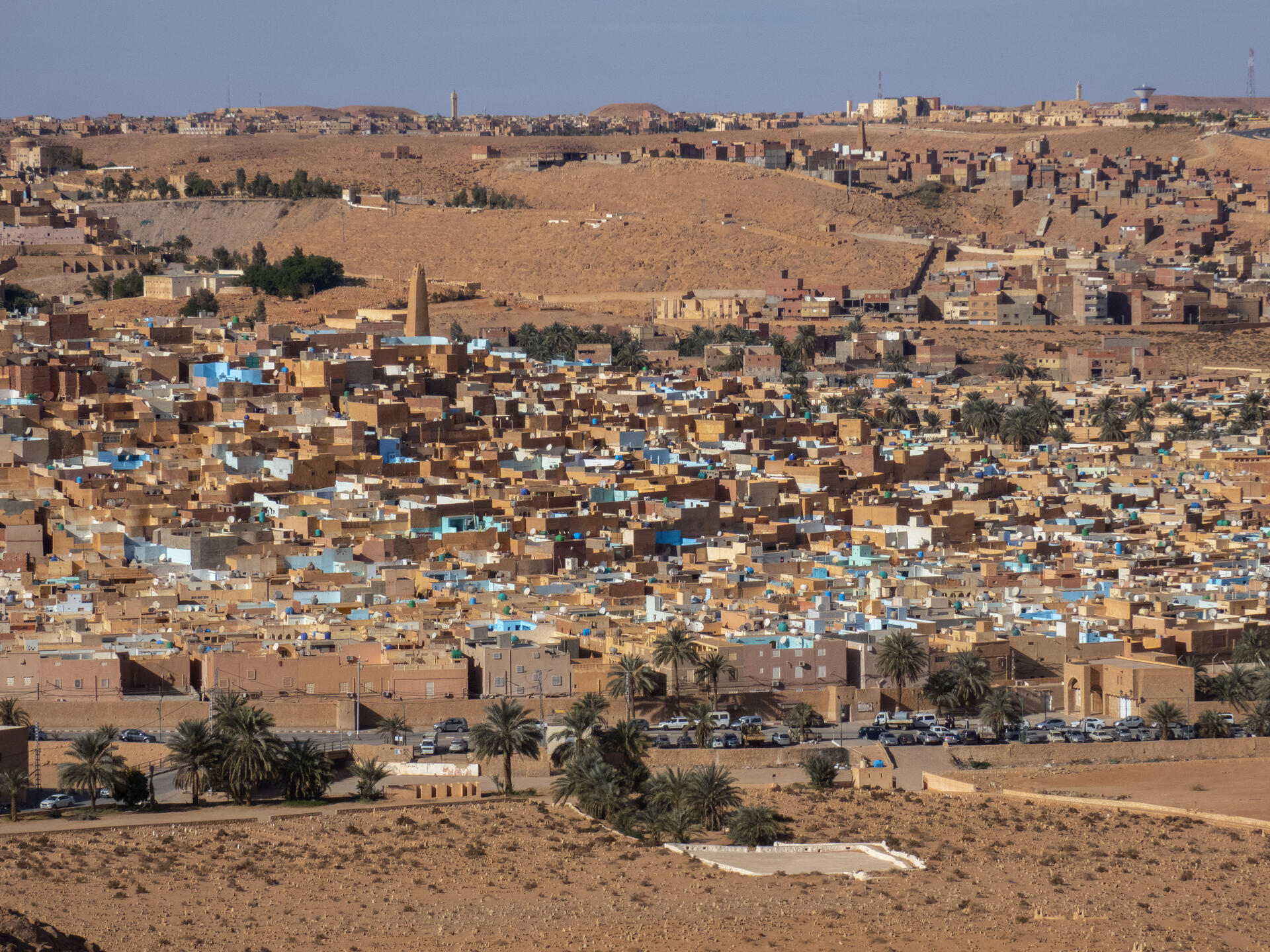
© Camille Gillet, CC BY-SA 4.0 Resized from original. (This derivative is under the same CC BY-SA license.)
World Heritage Research
Discover scientific research and academic studies that deepen our understanding of M'Zab Valley from its history and significance to its conservation, management, and contemporary challenges.
-
The Semiotic Construction of Meaning in Photographic Representations of Traditional Architecture in the Wilaya of Ghardaïa: A Semiological Analysis
Photographic representations of traditional architecture in the M'Zab Valley, Algeria, reveal layered cultural meanings tied to collective identity and social organization. Key visual elements—such as mosque minarets, narrow alleyways, earthen walls, and traditional doors—serve as signifiers evoking concepts like solidarity, religious-spatial order, privacy, climate adaptation, and deep-rooted belonging. The study applies semiological analysis, distinguishing denotative (literal) and connotative (cultural) meanings using Roland Barthes' framework. Nine archival images from Ghardaïa's heritage were analyzed alongside semi-structured interviews to contextualize findings. This approach demonstrates how architecture functions as both a physical structure and a symbolic carrier of cultural narratives.
Neceiba, F. (2026). The Semiotic Construction of Meaning in Photographic Representations of Traditional Architecture in the Wilaya of Ghardaïa: A Semiological Analysis. Science, Education and Innovations in the Context of Modern Problems, 9(3), 1–10. https://doi.org/10.56334/sei/9.3.28
View Publication Record | Read Publication -
Spatial assessment of groundwater recharge, agricultural pumping, and hydrodynamic stress in the complexe terminal aquifer (Ghardaïa, Algeria) using GIS and Remote Sensing
A severe localized groundwater crisis threatens historic oasis perimeters in the M'Zab Valley, Algeria, with agricultural pumping exceeding natural recharge by factors of 10 to 12.7, despite a macro-scale surplus balance. This paradox arises from distorted macro-balances due to vast uncultivated peripheral areas. The study employs an integrated GIS-ArcGIS, remote sensing (NDVI), and multi-criteria decision analysis (FAHP) framework to map optimal upstream green-engineering retention sites along Wadi M'zab and Wadi Metlili, aiming to maximize floodwater infiltration and stabilize vulnerable water tables. The validated FAHP model offers a targeted solution to mitigate local depletion, providing critical insights for sustainable groundwater management in hyper-arid regions.
Mokhtar, E., Merzouk, B., Ferhati, A., Benmouffok, H., Sahli, Y. S., & Berghout, A. B. (2026). Spatial assessment of groundwater recharge, agricultural pumping, and hydrodynamic stress in the complexe terminal aquifer (Ghardaïa, Algeria) using GIS and Remote Sensing. Journal of Advanced Applied Technology and Engineering, 1(02), 68–79. https://doi.org/10.67603/jaate.v1i02.10450
View Publication Record | Read Publication -
Comparative Study of Intimacy Between Millennial Vernacular Islamic Habitat of M’zab and Standardized Modern Habitat
A comparative analysis of the M'Zab Valley reveals significant differences in spatial and superficial intimacy between its millennial vernacular Islamic architecture and standardized modern habitats. The study quantifies these dynamics using ophthalmology calculations, Panero and Zelnik's spatial design principles, and interpersonal communication thresholds, while also considering gender-specific resonance frequencies. Findings suggest that the M'Zab's architectural design effectively protects privacy through sensory experiences, contrasting with modern approaches. This research highlights the cultural and functional depth of Islamic architecture, offering insights into its sustainability and intergenerational adaptability.
Krimo, D. (2025). Comparative Study of Intimacy Between Millennial Vernacular Islamic Habitat of M’zab and Standardized Modern Habitat. Journal of Islamic Architecture, 8(3), 780–794. https://doi.org/10.18860/jia.v8i3.25675
View Publication Record | Read Publication -
Transformations of Housing in the M'Zab Valley: Contemporary Urban Challenges and Threats to Identity
Recent urban development in the M’Zab Valley poses significant threats to its architectural identity and sustainable urban planning. While new housing projects outside the traditional ksour are necessary to meet growing demand, they disrupt the valley's historical landscape and Saharan aesthetic. A chronological analysis of these transformations reveals shifts in design elements, raising questions about the preservation of cultural heritage and the impact on built identity. The study highlights the tension between modernization and the maintenance of unique urban characteristics that have long defined the region.
Islam, S. M., & Dhaher, N. (2025). Transformations of Housing in the M’Zab Valley: Contemporary Urban Challenges and Threats to Identity. Proceedings of the International Conference of Contemporary Affairs in Architecture and Urbanism-ICCAUA, 8(1). https://doi.org/10.38027/iccaua2025en0056
View Publication Record | Read Publication -
Sheikh Abdelaziz bin Mohammed Al-Hashemi Al-Sharif and His Intellectual, Religious, and Political Influence in Southeastern Algeria: A Historical Study of His Role in Sufi Networks, Reformist Movements, and the Algerian National Struggle (1898–1938)
Sheikh Abdelaziz bin Mohammed Al-Hashemi Al-Sharif (1898–1938) emerges as a pivotal figure in southeastern Algeria, wielding profound influence across religious, economic, and political spheres during the early 20th century. As leader of the Qadiriyya Sufi order in the Oued Souf region, he became a cornerstone of local resistance against French colonial policies, bridging spiritual networks with reformist movements and national struggles. His strategic role extended across multiple regions, including Laghouat, M'zab Valley, Ouargla, Biskra, and Touggourt, cementing his significance in both intellectual and political landscapes. The study dissects his educational trajectory, alliances with reformist currents, and interactions with colonial authorities, while also analyzing the 1938 Colonial Education Decree and the 'Second Amiche Revolt,' offering a nuanced understanding of his multifaceted impact on Algerian history.
Abderrahman, G., & Boulachar, M. E. (2025). Sheikh Abdelaziz bin Mohammed Al-Hashemi Al-Sharif and His Intellectual, Religious, and Political Influence in Southeastern Algeria: A Historical Study of His Role in Sufi Networks, Reformist Movements, and the Algerian National Struggle (1898–1938). Science, Education and Innovations in the Context of Modern Problems, 8(12), 747–753. https://doi.org/10.56334/sei/8.12.62
View Publication Record | Read Publication -
The Importance of Social Sustainability for Conserving Cultural Heritage in Southern Algeria: A Case Study of the M'Zab Valley
A study on the M'Zab Valley, a UNESCO World Heritage Site in southern Algeria, reveals that social sustainability is critical for preserving its cultural heritage. The research found that residents highly value 'quality of housing,' with only 5-7% expressing a desire to relocate or change residences. Using a case study approach, the authors surveyed 200 households across two fortified villages (Ksour) in Al-Atteuf and Beni-Isguen, assessing indicators such as social networking, safety, sense of attachment, and quality of life. The findings highlight both the strengths and challenges faced by the Mozabite community, particularly in the context of rapid social and cultural changes. This work underscores the importance of integrating social sustainability into conservation strategies to safeguard intangible and tangible heritage.
NAIL, K., DAHMANI, K.,. (2024). THE IMPORTANCE OF SOCIAL SUSTAINABILITY FOR CONSERVING CULTURAL HERITAGE IN SOUTHERN ALGERIA: A CASE STUDY OF THE M’ZAB VALLEY. International Journal of Conservation Science, 15(1), 577–586. https://doi.org/10.36868/ijcs.2024.01.13
View Publication Record | Read Publication -
Customary Traditional Architecture in the M’zab Valley
The M'Zab Valley's traditional architecture stands out for its unique blend of unity and diversity, reflecting centuries-old customary systems deeply influenced by the Ibadi doctrine. This architectural landscape is characterized by interconnected elements that showcase equivalence across dwellings and facilities like mosques, while also exhibiting remarkable diversity in forms and patterns. Unlike rigid stylistic templates, this diversity emerges as a conscious response to local needs, incorporating social practices, intellectual pursuits, religious traditions, cultural expressions, historical influences, environmental considerations, and economic factors.
Omar, B. (2024). Customary Traditional Architecture in the M’zab Valley. Pakistan Journal of Life and Social Sciences (PJLSS), 22(2). https://doi.org/10.57239/pjlss-2024-22.2.00605
View Publication Record | Read Publication