
World Heritage Identification Number: 4
World Heritage since: 1978
Category: Cultural Heritage
WHE Type: Archaeological Sites
Transboundary Heritage: No
Endangered Heritage: No
Country: 🇨🇦 Canada
Continent: Americas
UNESCO World Region: Europe and North America
Map
Discovering the Past: A Journey to L’Anse aux Meadows National Historic Site
The L’Anse aux Meadows National Historic Site, situated on the northernmost tip of the island of Newfoundland, offers a unique glimpse into the past. This remarkable location, inscribed as a UNESCO World Heritage Site in 1978, holds significant historical importance as it represents the earliest known European presence in North America.
More to come…UNESCO Description of the World Heritage Site
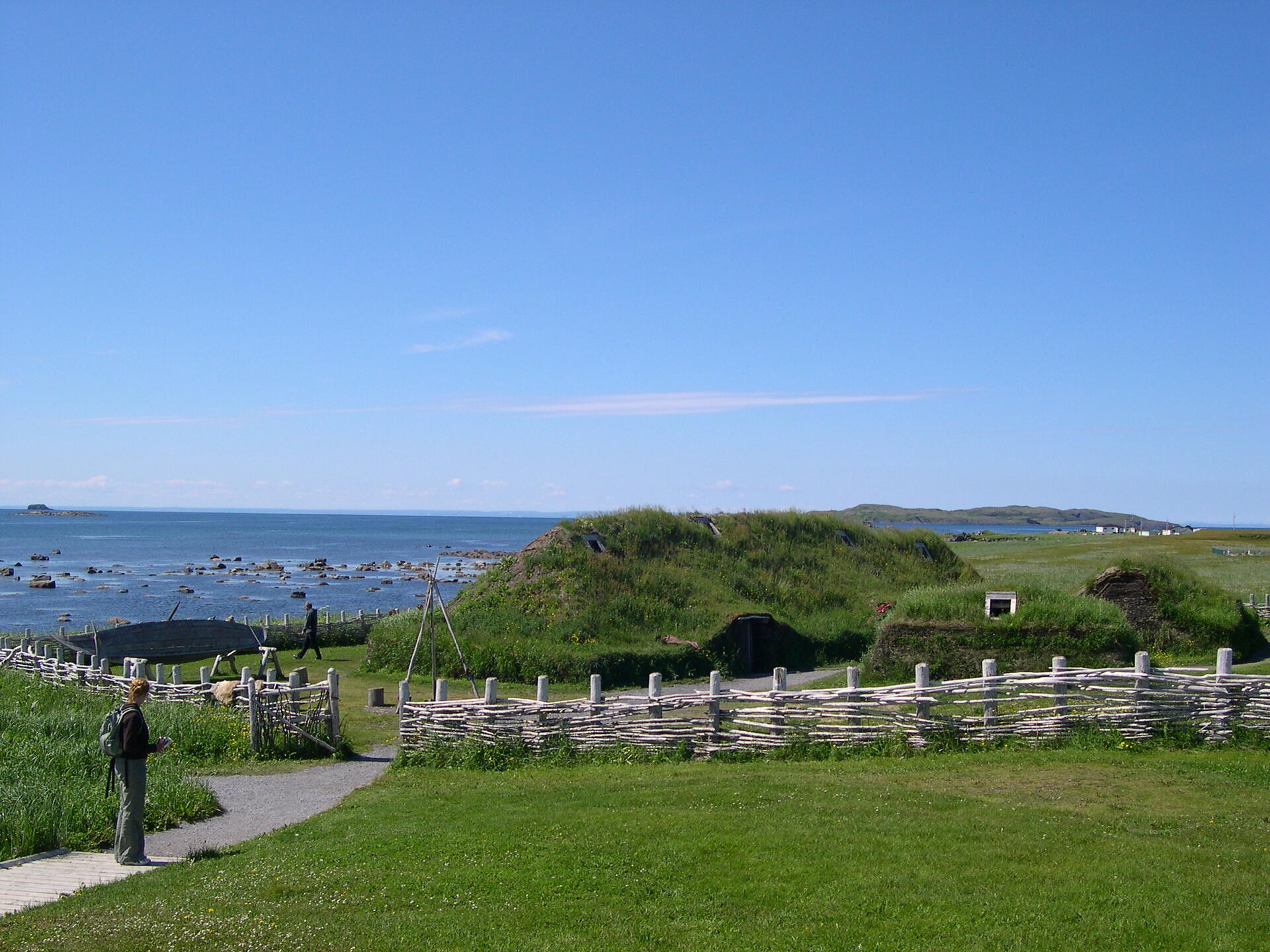
At the tip of the Great Northern Peninsula of the island of Newfoundland, the remains of an 11th-century Viking settlement are evidence of the first European presence in North America. The excavated remains of wood-framed peat-turf buildings are similar to those found in Norse Greenland and Iceland.
UNESCO Justification of the World Heritage Site
Criterion (vi): L’Anse aux Meadows is the first and only known site established by Vikings in North America and the earliest evidence of European settlement in the New World. As such, it is a unique milestone in the history of human migration and discovery.
Encyclopedia Record: L'Anse aux Meadows
L'Anse aux Meadows is an archaeological site, first excavated in the 1960s, of a Norse settlement dating to approximately 1,000 years ago. The site is located near St. Anthony on the northernmost tip of the island of Newfoundland in the Canadian province of Newfoundland and Labrador.Additional Site Details
Area: 7,991 hectares
Number of Components: 1
Coordinates: 51.5847222222 , -55.55
World Heritage Research
Discover scientific research and academic studies that deepen our understanding of L’Anse aux Meadows National Historic Site from its history and significance to its conservation, management, and contemporary challenges.
-
GRILLO, Paolo. Las puertas del mundo. Europa y la globalización medieval
A new perspective on medieval globalization reveals that European trade networks during the 13th and 14th centuries were far more interconnected than previously thought, extending across the Atlantic to L'Anse aux Meadows in Newfoundland and linking Europe with the kingdom of Mapungubwe in southern Africa. Paolo Grillo's study traces the global movement of ivory—sourced from both Arctic walruses and African elephants—as a key commodity that flowed between these distant regions, with European emporia serving as central consumption hubs. By analyzing archaeological evidence, including artifacts from L'Anse aux Meadows, Grillo demonstrates how shifts in trade routes and consumer preferences during the early 14th century—favoring elephant ivory over walrus ivory—reflect broader economic and environmental changes of the medieval period. This challenges traditional narratives of European isolationism, highlighting instead a complex web of transcontinental exchanges that predated modern globalization.
Gutiérrez Martín, C. (2026). GRILLO, Paolo. Las puertas del mundo. Europa y la globalización medieval. Edad Media. Revista de Historia, (27), 629–632. https://doi.org/10.24197/h4vq2p27
View Publication Record | Read Publication -
Historical-legal interpretation of the expeditions of Thorfinn Karlsefni and Leif Eriksson to Vinland
Norse expeditions to Vinland, led by Leif Eriksson and Thorfinn Karlsefni around 1000 A.D., were not limited by a lack of legal framework for colonization but faced challenges in cross-cultural interactions with indigenous populations. The study reveals that Norse society had a well-developed system of customary law (lǫg) and that land settlement (landnám) held significant legal and sacred importance. While Leif Eriksson's expedition was exploratory, Karlsefni's mission attempted full colonization, as evidenced by emerging property relations at L'Anse aux Meadows. The research combines historical-legal analysis with archaeological data from the site and scholarly works on medieval Scandinavian law to demonstrate that the short-term Norse presence in Vinland was due to external factors, particularly difficulties in regulating conflicts with indigenous peoples and logistical constraints.
Brazovskaya, Y. E., & Avdysh, D. M. (2025). Historical-legal interpretation of the expeditions of Thorfinn Karlsefni and Leif Eriksson to Vinland. Proceedings of Southwest State University. Series: History and Law, 15(5), 42–54. https://doi.org/10.21869/10.21869/2223-1501-2025-15-5-42-54
View Publication Record | Read Publication -
(Re)kindling kinship knowledges: a poetic remembering of place
This innovative research demonstrates the potential of poetic inquiry to bridge folklore, embodied knowledge, and environmental understanding. By integrating creative-practice methods with fieldwork at L'Anse aux Meadowsand other locations, the study reveals how personal, cultural, and environmental narratives shape worldviews. It challenges traditional academic frameworks by asserting the legitimacy of artistic research within folkloric studies, while also interrogating abstract heritage archives like Norse kennings and rock art. The findings underscore the significance of place-based knowledges in fostering deeper connections to both heritage and the natural environment.
Williams, N. M. (2025). (Re)kindling kinship knowledges: a poetic remembering of place. Memorial University of Newfoundland. https://doi.org/10.48336/325
View Publication Record | Read Publication -
Chasseurs et agriculteurs du Groenland et du Canada : un millénaire d'intéractions sociétés-environnements
A millennia-long study of human-environmental interactions in Arctic and subarctic regions reveals distinct ecological impacts of Norse settlers and Inuit communities. Using multiproxy analysis—including pollen, micro-charcoal, and parasite data—researchers reconstructed landscape changes near archaeological sites such as L’Anse aux Meadows (Canada) and two Greenlandic settlements. Findings indicate that Norse agricultural practices left visible environmental traces in Eastern Greenland, while Western Greenland showed moderate impact. At L’Anse aux Meadows, evidence suggests landscape opening around 1000 CE but no clear signs of livestock grazing. Inuit seasonal occupations in Labrador hint at wetland management and controlled fires, with caribou and dog presence. The study underscores the diversity of socio-ecological trajectories over a millennium, emphasizing the value of integrated paléoécological approaches to understanding past human-environmental dynamics.
Roulé, E. Chasseurs et agriculteurs du Groenland et du Canada : un millénaire d’intéractions sociétés-environnements. https://doi.org/10.70675/26fe54d9z7249z4ef1z964ez161412a19529
View Publication Record | Read Publication -
LIFE ON THE EDGE: The Archeologist, the Oil Rig, and the Newfoundlander
By 2101, L'Anse aux Meadows—a UNESCO-listed Viking archaeological site in Newfoundland—faces a transformed landscape where decommissioned offshore oil rigs, once symbols of resource extraction, now serve as monumental scrapyards and material salvage hubs. This speculative design project reimagines heritage in an era of climate-driven change, exploring how salvaged components can reshape terrain, community, and cultural identity while grappling with the complex legacies of extraction. Through critical drawings and maps, the research interrogates monumentality, counter-monumentality, and the future of heritage on the edge of environmental and historical upheaval.
Coughlan, Z. LIFE ON THE EDGE: The Archeologist, the Oil Rig, and the Newfoundlander. https://doi.org/10.22215/etd/2020-14055
View Publication Record | Read Publication -
New horizons at L’Anse aux Meadows
A new cultural horizon, distinct from the known Norse ruins at L'Anse aux Meadows (LAM), suggests that European presence in North America may have lasted significantly longer than previously thought. Fieldwork in 2018 revealed nonnative ecofacts in a peat bog adjacent to the site, hinting at prolonged Norse activity or interactions with Indigenous peoples. Bayesian analysis of radiocarbon data supports the possibility that Norse settlement endured for nearly a century, challenging earlier interpretations. This discovery reshapes our understanding of pre-1492 transatlantic contact and raises intriguing questions about cultural exchange in the region.
Ledger, P. M., Girdland-Flink, L., & Forbes, V. (2019). New horizons at L’Anse aux Meadows. Proceedings of the National Academy of Sciences, 116(31), 15341–15343. https://doi.org/10.1073/pnas.1907986116
View Publication Record | Read Publication -
Norse America
Archaeological evidence, including the discovery of L'Anse aux Meadows—a 1000-year-old European settlement on Newfoundland's coast—challenges the long-held belief that sporadic contact between the Old and New Worlds began only after Columbus. This site, linked to Norse sagas describing unknown lands, suggests the Norse ventured to North America around 1000 AD in search of habitable land rather than for exploration or economic gain. The study combines oral legends, archaeological findings, and interviews with historians to reconstruct Norse migrations from northern Europe to Iceland, Greenland, and beyond, debunking the myth of pre-Columbian isolation between cultures.
Graves, R. (2018). Norse America. Educational Media Reviews Online, 1(7). https://doi.org/10.59236/emro.v1i7a774
View Publication Record | Read Publication
