World Heritage Identification Number: 1497
World Heritage since: 2016
Category: Natural Heritage
WHE Type: Protected Areas & National Parks
Transboundary Heritage: No
Endangered Heritage: No
Country: 🇨🇦 Canada
Continent: Americas
UNESCO World Region: Europe and North America
Map
Mistaken Point: A Window into the Dawn of Complex Life
The Mistaken Point Ecological Reserve, situated at the southeastern tip of Newfoundland's Avalon Peninsula, is a unique and significant location that offers a glimpse into the early stages of life on Earth. Inscribed as a UNESCO World Heritage Site in 2016, this remote and rugged coastal region holds the oldest known assemblage of large fossils, providing valuable insights into the transition from simple microbial life to the emergence of complex organisms during the Ediacaran Period.
More to come…UNESCO Description of the World Heritage Site
This fossil site is located at the south-eastern tip of the island of Newfoundland, in eastern Canada. It consists of a narrow, 17 km-long strip of rugged coastal cliffs. Of deep marine origin, these cliffs date to the Ediacaran Period (580-560 million years ago), representing the oldest known assemblages of large fossils anywhere. These fossils illustrate a watershed in the history of life on earth: the appearance of large, biologically complex organisms, after almost three billion years of micro-dominated evolution.
UNESCO Justification of the World Heritage Site
Criterion (viii): Mistaken Point fossils constitute an outstanding record of a critical milestone in the history of life on Earth, “when life got big” after almost three billion years of microbe-dominated evolution. The fossils range in age from 580 to 560 million years, the longest continuous record of Ediacara-type megafossils anywhere, and predate by more than 40 million years the Cambrian explosion, being the oldest fossil evidence of ancestors of most modern animal groups. Mistaken Point contains the world’s oldest-known examples of large, architecturally complex organisms, including soft-bodied, ancestral animals. Ecologically, Mistaken Point contains the oldest and most diverse examples of Ediacaran deep-sea communities in the world thus preserving rare insights into the ecology of these ancestral animals and the early colonization of the deep-sea floor. Other attributes contributing to the property’s Outstanding Universal Value include the world’s first examples of metazoan locomotion, exceptional potential for radiometric dating of the assemblages, and evidence for the role of ancient oxygen levels in the regional and global appearance of complex multicellular life.
Encyclopedia Record: Mistaken Point Ecological Reserve
Mistaken Point Ecological Reserve is a wilderness area and a UNESCO World Heritage Site located at the southeastern tip of Newfoundland's Avalon Peninsula in the Canadian province of Newfoundland and Labrador. The reserve is home to the namesake Mistaken Point Formation, which contains one of the most diverse and well-preserved collections of Precambrian fossils in the world. Ediacaran fossils discovered at the site constitute the oldest known remnants of multicellular life on Earth.Additional Site Details
Area: 146 hectares
Number of Components: 1
Coordinates: 46.635 , -53.2111111111
IUCN World Heritage Outlook
The 2025 Conservation Outlook on Mistaken Point reports the following assessment:
Source: International Union for Conservation of Nature (IUCN) · View assessment
Image
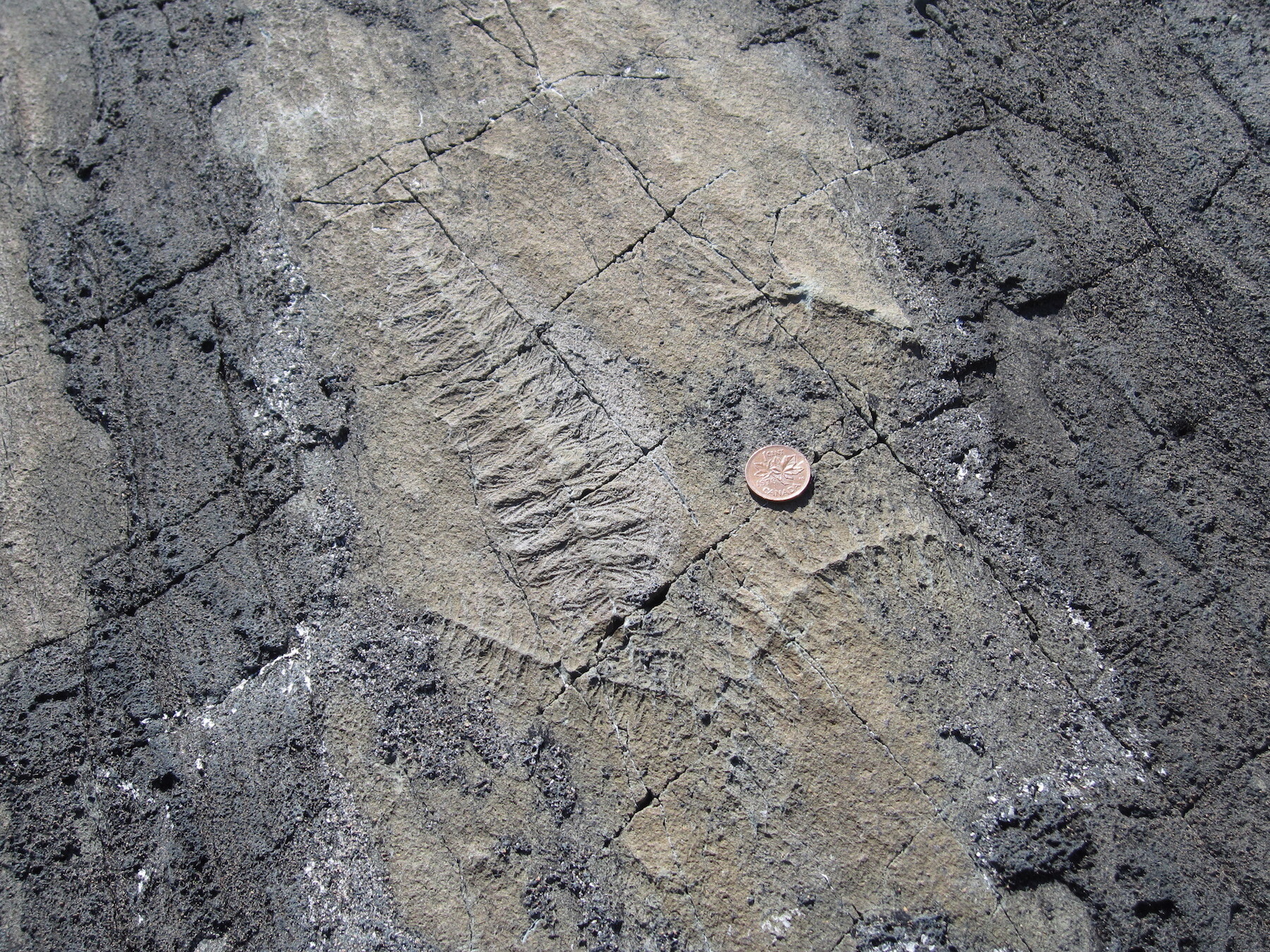
© Alicejmichel, CC BY-SA 4.0 Resized from original. (This derivative is under the same CC BY-SA license.)
World Heritage Research
Discover scientific research and academic studies that deepen our understanding of Mistaken Point from its history and significance to its conservation, management, and contemporary challenges.
-
Rheotropic Epifaunal Growth, Not Felling by Density Currents, Is Responsible for Many Ediacaran Fossil Orientations at Mistaken Point
A new study challenges the prevailing explanation for fossil orientations at Mistaken Point. Contrary to the long-held belief that density currents toppled these ancient organisms, researchers propose that rheotropic epifaunal growth—where creatures align with water flow—is responsible for many of the observed positions. This finding reshapes our understanding of Ediacaran life and its interaction with environmental conditions. The study employed a combination of field observations, sedimentological analysis, and computational modeling to test hypotheses about fossil orientations, ultimately providing a more nuanced interpretation of this significant paleoenvironment.
McIlroy, D., Pérez-Pinedo, D., Pasinetti, G., McKean, C., Taylor, R. S., & Hiscott, R. N. (2022). Rheotropic Epifaunal Growth, Not Felling by Density Currents, Is Responsible for Many Ediacaran Fossil Orientations at Mistaken Point. Frontiers in Earth Science, 10. https://doi.org/10.3389/feart.2022.849194
View Publication Record | Read Publication -
Orientations of Mistaken Point Fronds Indicate Morphology Impacted Ability to Survive Turbulence
Research on the Ediacaran fossils at Mistaken Point reveals that morphological variations among eight taxa significantly influenced their resilience to turbulent water conditions. The study found that Bradgatia and Thectardis exhibited bimodal felling directions, suggesting they were more susceptible to turbulence, while frondose rangeomorphs like Beothukis and Plumeropriscum, along with arboreomorphs, were felled in a single direction, indicating better resilience due to their upright stance. This implies that taxa with elongated habits or stems had improved survivability in turbulent environments compared to those lacking these features, which may have thrived in calmer waters.
Vixseboxse, P. B., Kenchington, C. G., Dunn, F. S., & Mitchell, E. G. (2021). Orientations of Mistaken Point Fronds Indicate Morphology Impacted Ability to Survive Turbulence. Frontiers in Earth Science, 9. https://doi.org/10.3389/feart.2021.762824
View Publication Record | Read Publication -
A Chronostratigraphic Framework for the Rise of the Ediacaran Macrobiota: New Constraints from Mistaken Point Ecological Reserve, Newfoundland
A new chronostratigraphic framework for the Mistaken Point Ecological Reserve (MPER) reveals critical insights into the rise and diversification of Ediacaran macrobiota. The study provides precise radio-isotopic ages from volcanic tuffites, dating key fossil horizons between 574.17 ± 0.66 Ma and 564.13 ± 0.65 Ma. This includes the oldest architecturally complex fossils (574.17 ± 0.66 Ma) and the famous 'E' Surface fossils (565.00 ± 0.64 Ma). The findings enable a time-calibrated record of evolutionary signals, showing peak taxonomic diversity in the Mistaken Point and Trepassey Formations and highlighting that uniterminal rangeomorphs preceded multiterminal forms by several million years. This holistic approach integrates stratigraphy, paleontology, and geochronology, offering a robust framework to study mid-late Ediacaran evolution.
Matthews, J. J., Liu, A. G., Yang, C., McIlroy, D., Levell, B., & Condon, D. (2020). A CHRONOSTRATIGRAPHIC FRAMEWORK FOR THE RISE OF THE EDIACARAN MACROBIOTA: NEW CONSTRAINTS FROM MISTAKEN POINT ECOLOGICAL RESERVE, NEWFOUNDLAND. Geological Society of America Abstracts with Programs. https://doi.org/10.1130/abs/2020am-352772
View Publication Record | Read Publication -
A Chronostratigraphic Framework for the Rise of the Ediacaran Macrobiota: New Constraints from Mistaken Point Ecological Reserve, Newfoundland
New radioisotopic dating of volcanic tuffites at the Mistaken Point Ecological Reserve, Newfoundland, provides precise age constraints for the rise and diversification of Ediacaran macrobiota, some of the earliest known animal fossils. The study reveals that architecturally complex fossils date back to 574.17 ± 0.66 million years ago (Ma), while rangeomorphs from the Fermeuse Formation are confirmed to be no younger than 564.13 ± 0.65 Ma. Exceptionally preserved specimens on the 'Brasier' Surface in the Briscal Formation are dated at 567.63 ± 0.66 Ma, and fossils from the famous 'E' Surface are confirmed to be 565.00 ± 0.64 Ma. This age-depth model enables the conversion of stratigraphic fossil ranges into a time-calibrated framework, facilitating the study of evolutionary signals during the mid-late Ediacaran Period. The research highlights peak taxonomic diversity within the Mistaken Point and Trepassey Formations and shows that uniterminal rangeomorphs with undisplayed branching architecture appeared several million years before multiterminal, displayed forms.
Matthews, J. J., Liu, A. G., Yang, C., McIlroy, D., Levell, B., & Condon, D. J. (2020). A Chronostratigraphic Framework for the Rise of the Ediacaran Macrobiota: New Constraints from Mistaken Point Ecological Reserve, Newfoundland. GSA Bulletin, 133(3-4), 612–624. https://doi.org/10.1130/b35646.1
View Publication Record | Read Publication -
Palaeobiology of the reclining rangeomorph Beothukis from the Ediacaran Mistaken Point Formation of southeastern Newfoundland
Research on the Ediacaran fossil Beothukis mistakensis from Mistaken Point, Newfoundland, reveals its complex fractal-like morphology, challenging previous interpretations. The study finds that B. mistakensis lacks independent three-dimensional branches, instead featuring tightly juxtaposed, chamber-like secondary-order units likely filled with mesoglea. Growth analysis indicates development from the tip toward the base, with tertiary-order units representing surface morphology on the secondary units. This quilted structure suggests a sessile, reclining lifestyle, adapted to increase surface area-to-volume ratio, supporting a phagocytotic or chemosymbiotic mode of life similar to other reclining rangeomorphs like Fractofusus.
McIlroy, D., Hawco, J., McKean, C., Nicholls, R., Pasinetti, G., & Taylor, R. (2020). Palaeobiology of the reclining rangeomorph Beothukis from the Ediacaran Mistaken Point Formation of southeastern Newfoundland. Geological Magazine, 159(7), 1160–1174. https://doi.org/10.1017/s0016756820000941
View Publication Record | Read Publication -
Spatial analyses of Ediacaran communities at Mistaken Point
Spatial analyses of Ediacaran fossil communities at Mistaken Point, Newfoundland, reveal complex ecological interactions among 10 taxa on one surface (E), while another (D) shows no such associations. Bayesian network inference identified a web of interactions on the E-surface, with all but one taxon (Thectardis) linked to others, suggesting distinct ecological roles. The study also detected habitat associations and weak competition for resources between certain taxa, such as Charniodiscus–Plumeropriscum and Plumeropriscum–Fractofusus. No instances of interspecific facilitation were found. The research used millimeter-accurate GPS mapping and spatial point-process analysis to study these ~565-million-year-old fossils, providing insights into the ecological dynamics of early multicellular life.
Mitchell, E. G., & Butterfield, N. J. (2018). Spatial analyses of Ediacaran communities at Mistaken Point. Paleobiology, 44(1), 40–57. https://doi.org/10.1017/pab.2017.35
View Publication Record | Read Publication -
Great Canadian Lagerstätten 6. Mistaken Point Ecological Reserve, Southeast Newfoundland
Mistaken Point Ecological Reserve (MPER) on Newfoundland's southeastern coast is a pivotal global site for Ediacaran fossil research, hosting some of the oldest known soft-bodied macrobiota assemblages. Since their discovery in 1967, MPER's fossils have significantly advanced understanding of Ediacaran paleobiology by preserving in situ benthic paleocommunities with thousands of specimens, enabling detailed studies on ecology, development, preservation processes, taxonomy, and morphology. These insights provide clues about the phylogenetic positions of Ediacaran taxa within the tree of life. A continuous geological record spanning at least 10 million years further contextualizes these fossils temporally and environmentally.
Liu, A. G., & Matthews, J. J. (2017). Great Canadian Lagerstätten 6. Mistaken Point Ecological Reserve, Southeast Newfoundland. Geoscience Canada, 63–76. https://doi.org/10.12789/geocanj.2017.44.117
View Publication Record | Read Publication -
Two new Ediacaran small fronds from Mistaken Point, Newfoundland
Research at Mistaken Point, Newfoundland, has uncovered two new Ediacaran small fronds, Plumeropriscum hofmanni and Broccoliforma alta, revealing greater diversity in the low epibenthic tier than previously recognized. These taxa, characterized by unique morphologies—one mop-like with a three-dimensional petalodium structure and the other flabellate with lobate features—challenge earlier assumptions about the simplicity of small-frond body plans during this period. The study taxonomically describes these fossils, which were informally referred to as 'dusters,' highlighting convergent evolution in stemmed fronds. This finding expands our understanding of Ediacaran biodiversity and ecological complexity.
Mason, S. J., & Narbonne, G. M. (2016). Two new Ediacaran small fronds from Mistaken Point, Newfoundland. Journal of Paleontology, 90(2), 183–194. https://doi.org/10.1017/jpa.2016.14
View Publication Record | Read Publication -
Confirming the Metazoan Character of a 565 Ma Trace-Fossil Assemblage from Mistaken Point, Newfoundland
A 565-million-year-old trace-fossil assemblage from Mistaken Point, Newfoundland, provides evidence of muscular metazoans in late Ediacaran deep-marine ecosystems. Analysis of the fossils, preserved within a turbidite succession, rules out abiogenic origins and links their formation to organisms capable of controlled locomotion, akin to modern mollusks and actinians. While not attributable to known ichnotaxa, the traces exhibit morphological characteristics consistent with muscular movement, suggesting the presence of complex organisms predating the Cambrian explosion.
LIU, A. G., MCILROY, D., MATTHEWS, J. J., & BRASIER, M. D. (2014). CONFIRMING THE METAZOAN CHARACTER OF A 565 MA TRACE-FOSSIL ASSEMBLAGE FROM MISTAKEN POINT, NEWFOUNDLAND. Palaios, 29(8), 420–430. https://doi.org/10.2110/palo.2014.011
View Publication Record | Read Publication -
Population structure of the oldest known macroscopic communities from Mistaken Point, Newfoundland
A groundbreaking analysis of the population structure of Ediacaran organisms from Mistaken Point, Newfoundland, reveals that these ancient communities likely reproduced continuously and aseasonally. By examining size-frequency distributions of four taxa across five fossil surfaces using Bayesian Information Criterion (BIC), researchers found single-cohort models with wide variance best explained the data. This suggests a 'continuous reproduction' model, where Ediacaran organisms lacked seasonal triggers for reproduction, possibly due to deepwater environmental conditions. The study provides critical insights into the life history and ecology of these oldest known macroscopic communities, challenging previous assumptions about their reproductive strategies.
Darroch, S. A. F., Laflamme, M., & Clapham, M. E. (2013). Population structure of the oldest known macroscopic communities from Mistaken Point, Newfoundland. Paleobiology, 39(4), 591–608. https://doi.org/10.1666/12051
View Publication Record | Read Publication -
First evidence for locomotion in the Ediacara biota from the 565 Ma Mistaken Point Formation, Newfoundland
Fossil evidence of locomotion from the Ediacara biota, dating back approximately 565 million years, has been discovered in deep-water environments at Mistaken Point, Newfoundland. This finding extends the record of complex trace fossils into the earliest stages of the Avalonian biota, suggesting that some of these early organisms were likely muscular and metazoan-grade. The study describes an assemblage of macroscopic locomotory traces, providing new insights into the behavior and biological affinities of Precambrian organisms. Researchers analyzed these trails to infer the presence of large motile organisms on the seafloor during this time, challenging previous assumptions about the simplicity of Ediacaran trace fossils.
Liu, A. G., Mcllroy, D., & Brasier, M. D. (2010). First evidence for locomotion in the Ediacara biota from the 565 Ma Mistaken Point Formation, Newfoundland. Geology, 38(2), 123–126. https://doi.org/10.1130/g30368.1
View Publication Record | Read Publication -
First evidence for locomotion in the Ediacara biota from the 565 Ma Mistaken Point Formation, Newfoundland: COMMENT
A critical reassessment of claims regarding the first evidence for locomotion in the Ediacara biota challenges the interpretation of putative locomotion traces from the 565 million-year-old Mistaken Point Formation in Newfoundland. The study argues that if these traces are to be considered the earliest geological evidence of animal movement, they must undergo rigorous re-evaluation against established criteria. By analyzing sedimentological and taphonomic contexts, the research aims to determine whether these features genuinely represent locomotion or could stem from other processes such as currents or bioturbation. This commentary underscores the need for cautious interpretation of fossilized traces in the absence of definitive proof, emphasizing the importance of contextual evidence in reconstructing ancient behaviors.
Retallack, G. J. (2010). First evidence for locomotion in the Ediacara biota from the 565 Ma Mistaken Point Formation, Newfoundland: COMMENT. Geology, 38(10), e223–e223. https://doi.org/10.1130/g31137c.1
View Publication Record | Read Publication -
First evidence for locomotion in the Ediacara biota from the 565 Ma Mistaken Point Formation, Newfoundland: REPLY
Researchers at Mistaken Point, Newfoundland, have provided definitive evidence that the ancient trace fossil assemblage from the 565-million-year-old Mistaken Point Formation represents locomotion behavior in Ediacara biota. Contrary to earlier shallow marine interpretations, sedimentological studies consistently support a deep-water turbidite or contourite depositional environment, reinforcing the significance of these findings. This conclusion challenges prior assumptions and solidifies Mistaken Point as a key site for understanding early complex biological activity.
Liu, A. G., McIlroy, D., & Brasier, M. D. (2010). First evidence for locomotion in the Ediacara biota from the 565 Ma Mistaken Point Formation, Newfoundland: REPLY. Geology, 38(10), e224–e224. https://doi.org/10.1130/g31448y.1
View Publication Record | Read Publication