World Heritage Identification Number: 171
World Heritage since: 1981
Category: Cultural Heritage
WHE Type: Buildings & Architectural Ensembles
Transboundary Heritage: No
Endangered Heritage: No
Country: 🇵🇰 Pakistan
Continent: Asia
UNESCO World Region: Asia and the Pacific
Map
A Glimpse into the Majestic Fort and Shalamar Gardens in Lahore, Pakistan
The Fort and Shalamar Gardens in Lahore, Pakistan, stand as testaments to the grandeur and artistic prowess of the Mughal civilization that flourished during the reign of Emperor Shah Jahan. Inscribed as a UNESCO World Heritage Site in 1981, these architectural marvels offer a captivating glimpse into the rich history and cultural heritage of South Asia.
More to come…UNESCO Description of the World Heritage Site
These are two masterpieces from the time of the brilliant Mughal civilization, which reached its height during the reign of the Emperor Shah Jahan. The fort contains marble palaces and mosques decorated with mosaics and gilt. The elegance of these splendid gardens, built near the city of Lahore on three terraces with lodges, waterfalls and large ornamental ponds, is unequalled.
UNESCO Justification of the World Heritage Site
Criterion (i): The 21 monuments preserved within the boundaries of Lahore Fort comprise an outstanding repertory of the forms of Mughal architecture at its artistic and aesthetic height, from the reign of Akbar (1542-1605) through the reign of Shah Jahan (1627-58). Equally the Shalimar Gardens, laid out by Shah Jahan in 1641-2 embodies Mughal garden design at the apogee of its development. Both complexes together may be understood to constitute a masterpiece of human creative genius.
Criterion (ii): The Mughal forms, motifs and designs developed at Lahore Fort and Shalimar Gardens have been influenced by design innovations in other royal Mughal enclaves but have also exerted great influence in subsequent centuries on the development of artistic and aesthetic expression throughout the Indian subcontinent.
Criterion (iii): The design of the monuments of Lahore Fort and the features of the Shalimar Gardens bears a unique and exceptional testimony to the Mughal civilisation at the height of its artistic and aesthetic accomplishments, in the 16th and 17th centuries.
Encyclopedia Record: Lahore Fort
The Lahore Fort is a citadel in the walled interior of Lahore in Punjab, Pakistan. The fortress is located at the northern end of the Walled City and is spread over an area greater than 20 hectares. It contains 21 notable monuments, some of which date to the era of Emperor Akbar. The Lahore Fort is notable for having been almost entirely rebuilt in the 17th century, when the Mughal Empire was at the height of its splendour and opulence.Additional Site Details
Area: Not available
Number of Components: 2
(ii) — Significant interchange of human values
(iii) — Unique or exceptional testimony to a cultural tradition
Coordinates: 31.59027778 , 74.30972222
Image
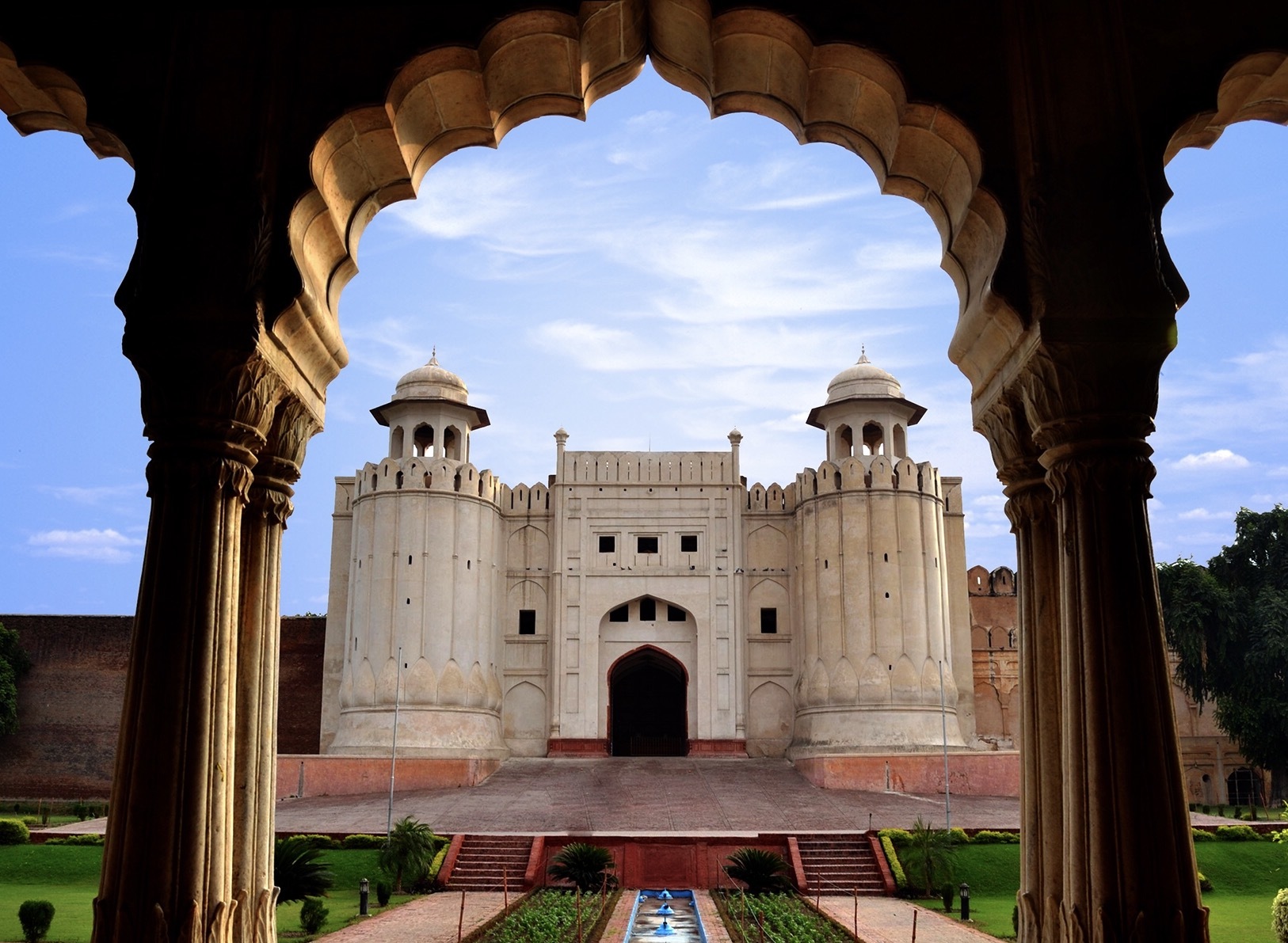
© Rohaan Bhatti, CC BY-SA 3.0 Resized from original. (This derivative is under the same CC BY-SA license.)
World Heritage Research
Discover scientific research and academic studies that deepen our understanding of Fort and Shalamar Gardens in Lahore from its history and significance to its conservation, management, and contemporary challenges.
-
Culturally Sustainable Ornamentation in Sikh Architecture: A Case Study of Sher Singh Baradari, Lahore
A comparative study of the Sher Singh Baradari in Lahore, Pakistan, reveals how Sikh architectural ornamentation evolved through the adoption and adaptation of Mughal artistic techniques. The research highlights that Sikh artisans, trained during the Mughal era, integrated elements like stylized vase arrangements, symmetrical floral borders, and geometric brick patterns into their own designs for havelis, forts, palaces, and gurdwaras. This synthesis of traditional influences with local creativity showcases a unique visual language in Sikh architecture. The study also underscores the urgent need for conservation to protect this historically significant site from further deterioration due to conflicts and mob violence.
Latif, A., & Rizvi, S. F. A. (2026). Culturally Sustainable Ornamentation in Sikh Architecture: A Case Study of Sher Singh Baradari, Lahore. Research Journal for Social Affairs, 4(1), 81–93. https://doi.org/10.71317/rjsa.004.01.0674
View Publication Record | Read Publication -
Lahore fort as a symbol of national identity and cultural heritage in Pakistan
Lahore Fort, a living chronicle of empires and cultures, stands as a powerful symbol of Pakistan's national identity and cultural heritage. Strategically built by Emperor Akbar in the late 1500s, this monument reflects the architectural evolution and historical layers of the Mughal era, Sikh Empire, and colonial period. The study reveals how selective preservation policies have shaped its representation, linking it to religious and historical identity. Using a descriptive, analytical, and qualitative approach, the research examines the impact of government ideologies on cultural heritage, highlighting Lahore Fort's enduring significance as an emblem of Pakistan's past.
Fatima, R., & Siddiqui, Dr. K. S. (2026). Lahore fort as a symbol of national identity and cultural heritage in Pakistan. Social Sciences Spectrum, 5(3), 1–14. https://doi.org/10.71085/sss.05.03.559
View Publication Record | Read Publication -
Deciphering Iconographic Symbolism and Spatial Significance: An Evaluation of the Hazuri Bagh Baradari (1818–1819), Lahore's Sikh Architectural Heritage
The Hazuri Bagh Baradari (1818–1819) in Lahore, built during Ranjit Singh’s Sikh rule, was strategically positioned between the Badshahi Mosque and Lahore Fort to symbolize Sikh sovereignty. Its iconographic elements reflect a hybrid architectural style, representing cross-cultural interactions beyond mere aesthetics. This study reveals that the Baradari's location and design were not coincidental but purposeful, reinforcing Ranjit Singh’s authority while maintaining cultural continuity from the Mughal era. The research employs qualitative methods, primarily literature review, to analyze its spatial significance and ornamental symbolism. Further comparative studies on Sikh architecture across South Asia are recommended.
(Ed.). (2026). Deciphering Iconographic Symbolism and Spatial Significance: An Evaluation of the Hazuri Bagh Baradari (1818–1819), Lahore’s Sikh Architectural Heritage. Pakistan Social Sciences Review, 10(II). https://doi.org/10.35484/pssr.2026(10-ii)14
View Publication Record | Read Publication -
The Pigeon Houses on the Picture Wall of Lahore Fort: A Living Sanctuary
The Picture Wall of Lahore Fort, the world's largest glazed tile mosaic spanning 1450 feet, harbors over two hundred miniature structures serving as pigeon houses, challenging historical interpretations that dismissed them as weaponry loopholes. A critical analysis of historical data and on-site observations revealed these avian micro-architectures as intentional living sanctuaries, reflecting ecological awareness in Mughal design. The study bridges architectural history and conservation by advocating for the retention of these structures to preserve a thriving local pigeon population, contributing to discussions on integrating ecological principles into traditional heritage practices.
Amer, K., Zulfiqar, Z., & Altaf, M. (2025). THE PIGEON HOUSES ON THE PICTURE WALL OF LAHORE FORT: A LIVING SANCTUARY. Journal of Research in Architecture & Planning, 35(1), 63–79. https://doi.org/10.53700/jrap3512025_5
View Publication Record | Read Publication -
Cultural Heritage and Contemporary Challenges in Historically Significant Marketplaces: A Case Study of Lahore
Historically significant marketplaces, such as Lahore's Baghbanpura Bazaar, are facing severe challenges that threaten their cultural heritage. This study identifies critical issues like congestion, pollution, and poor maintenance of infrastructure, which are eroding the traditional fabric of these bazaars. The research proposes solutions derived from existing case studies to conserve and revitalize such marketplaces, ensuring they retain their historical significance. By analyzing the unique context of Baghbanpura Bazaar—developed during the Mughal era for gardeners near the Shalamar Garden—the study highlights the urgent need for intervention to preserve cultural heritage in the face of modern urban pressures.
Mashhood, M., Nisar, H., & Amjad, R. (2025). Cultural Heritage and Contemporary Challenges in Historically Significant Marketplaces: A Case Study of Lahore. ACADEMIA International Journal for Social Sciences, 4(4), 669–681. https://doi.org/10.63056/acad.004.04.0926
View Publication Record | Read Publication -
Echoes of Devotion: Safeguarding Gurdwara Janam Asthan Sri Guru Ram Das Ji
Gurdwara Janam Asthan Sri Guru Ram Das Ji, a living heritage site in Lahore's Walled City, stands as a symbol of Sikhism's devotional essence and the region's multicultural architectural legacy. Despite recent conservation efforts, its authenticity and integrity remain compromised due to environmental degradation, urban encroachment, and material deterioration. Ethnographic research reveals the site's deep socio-cultural significance, while pictorial surveys and archival studies document its current state and historical context. Proximity to the Lahore Fort (a UNESCO World Heritage Site) underscores the need for sustainable development in the historic core, emphasizing community participation to preserve shared cultural heritage as a lasting symbol of peace, resilience, and collective identity.
Jabeen, A., & Munir, M. (2025). Echoes of Devotion: Safeguarding Gurdwara Janam Asthan Sri Guru Ram Das Ji. Journal of Architecture and Built Environment Research (JABER), 2(1). https://doi.org/10.51846/jaber.v2i1.4698
View Publication Record | Read Publication -
Lahore Fort
Climate change poses significant threats to the structural integrity of Lahore Fort. Research indicates that rising winter temperatures and increased summer rainfall, along with environmental pollution and smog, are likely to accelerate deterioration in materials such as burnt bricks, plaster coatings, marble, and sandstone. The study highlights the vulnerability of these historical structures to chemical and biological agents, emphasizing the need for adaptive conservation strategies to mitigate long-term damage.
Pranger, S. (2024). Lahore Fort. Old Materials, New Climate, 356–374. https://doi.org/10.4324/9781003160489-25
View Publication Record | Read Publication