World Heritage Identification Number: 524
World Heritage since: 1989
Category: Cultural Heritage
WHE Type: Religious Sites & Sacred Architecture
Transboundary Heritage: No
Endangered Heritage: No
Country: 🇮🇳 India
Continent: Asia
UNESCO World Region: Asia and the Pacific
Map
The Archaeological Wonders of the Buddhist Monuments at Sanchi
The Buddhist Monuments at Sanchi, situated on a hilltop in the town of Sanchi in Madhya Pradesh, India, stand as a testament to the rich cultural heritage and historical significance of Buddhism in the region. Inscribed as a UNESCO World Heritage Site in 1989, this ancient Buddhist sanctuary features structures dating back to the third century BCE through the first century CE, making it one of the oldest and most well-preserved Buddhist sites in existence.
The heart of the Sanchi complex lies in the Great Stupa, a magnificent structure that serves as the central monument of the site. Commissioned by Emperor Ashoka during the Mauryan Empire, the Great Stupa is believed to house the sacred relics of Buddha himself. The stupa's design follows the traditional Buddhist architectural style, featuring a hemispherical dome (anda) built upon a circular terrace (medhi). The Great Stupa underwent several renovations throughout history, with each phase adding unique elements to its overall structure, including the famous torana (gateways) and additional decorative features.
Around the Great Stupa, visitors can explore various other structures, including monasteries, temples, and additional stupas. Stupa 3 is particularly significant as it houses the relics of the Buddha’s chief disciples, Sariputra and Maudgalyayana. The monument's intricate carvings depict scenes from the Jataka tales, the life of Gautama Buddha, and various aspects of Buddhist philosophy. Notably, the Buddha is represented aniconically—through symbols like the Bodhi tree, footprints, or an empty throne—rather than in human form. One of the most notable examples of these carvings can be found on the Gateway of Torana 1, which features a series of sculptures illustrating the story of the Bodhisattva's journey towards enlightenment.
The Sanchi complex also includes the Ashoka Pillar, which originally stood approximately 13 meters (42 feet) high. Adorned with a highly polished finish characteristic of Mauryan craftsmanship, it was topped by an elegant capital featuring four lions. The pillar, which bears an edict against schism in the Buddhist community, stands as a symbol of Emperor Ashoka’s commitment to the unity of the Sangha and to the spread of Buddhism across his vast empire.
Despite facing various challenges over time, including centuries of neglect after the 12th century and later damage by treasure hunters, the site was rediscovered in 1818 and meticulously restored.he Buddhist Monuments at Sanchi continue to captivate visitors with their historical, artistic, and spiritual importance. Today, the site serves as a crucial reminder of the ancient origins of Buddhism and its enduring influence on Indian culture.
Taken together, the Buddhist Monuments at Sanchi offer a fascinating glimpse into the past, providing valuable insights into the evolution of Buddhism and its impact on Indian society. As a UNESCO World Heritage Site, this remarkable complex invites scholars, tourists, and spiritual seekers alike to immerse themselves in the rich tapestry of history, art, and philosophy that define the Buddhist Monuments at Sanchi.
UNESCO Description of the World Heritage Site
On a hill overlooking the plain and about 40 km from Bhopal, the site of Sanchi comprises a group of Buddhist monuments (monolithic pillars, palaces, temples and monasteries) all in different states of conservation most of which date back to the 2nd and 1st centuries B.C. It is the oldest Buddhist sanctuary in existence and was a major Buddhist centre in India until the 12th century A.D.
UNESCO Justification of the World Heritage Site
Criterion (i): The perfection of its proportions and the richness of the sculpted decorative work on its four gateways make Stupa 1 an incomparable artistic achievement. The group of Buddhist monuments at Sanchi – stupas, temples and monasteries – is unique in India because of its age and quality.
Criterion (ii): From the time that the oldest preserved monument on the site was erected, i.e., Aśoka’s column with its projecting capital of lions inspired by Achaemenid art, Sanchi’s role as intermediary for the spread of cultures and their peripheral arts throughout the Mauryan Empire, and later in India of the Sunga, Shatavahana, Kushan and Gupta dynasties, was confirmed.
Criterion (iii): Having remained a principal centre of Buddhism up to early medieval India following the spread of Hinduism, Sanchi bears unique witness as a major Buddhist sanctuary in the period from the 3rd century BCE to the 1st century CE.
Criterion (iv): The stupas at Sanchi, in particular Stupa 1 and Stupa 3, represent the most accomplished form of this type of monument. The hemispherical, egg-shaped dome (anda), topped with a cubical relic chamber (harmika), is built on a circular terrace (medhi); it has one or two ambulatories for the faithful to use (pradakshina patha). Representing a transition from wood structures to stone, the railings (vedika) and the gateways (torana) also bear witness to the continued use of the primitive forms of megalithic tumuli covered with an outer layer and surrounded by a palisade.
Criterion (vi): Sanchi is one of the oldest extant Buddhist sanctuaries. Although Buddha never visited the site during any of his former lives or during his earthly existence, the religious nature of this shrine is obvious. The chamber of relics of Stupa 3 contained the remains of Sariputra, a disciple of Shakyamuni who died six months before his master; he is especially venerated by the occupants of the “small vehicle” or Hinayana.
Encyclopedia Record: Sanchi Stupa
Sanchi Stupa is a Buddhist complex, famous for its Great Stupa, on a hilltop at Sanchi Town in Raisen District of the State of Madhya Pradesh, India. It is located, about 23 kilometers from Raisen town, district headquarter and 46 kilometres (29 mi) north-east of Bhopal, capital of Madhya Pradesh.Additional Site Details
Area: Not available
Number of Components: 1
(ii) — Significant interchange of human values
(iii) — Unique or exceptional testimony to a cultural tradition
(iv) — Outstanding example of a type of building or landscape
(vi) — Directly associated with events or living traditions
Coordinates: 23.47944 , 77.73972
Image
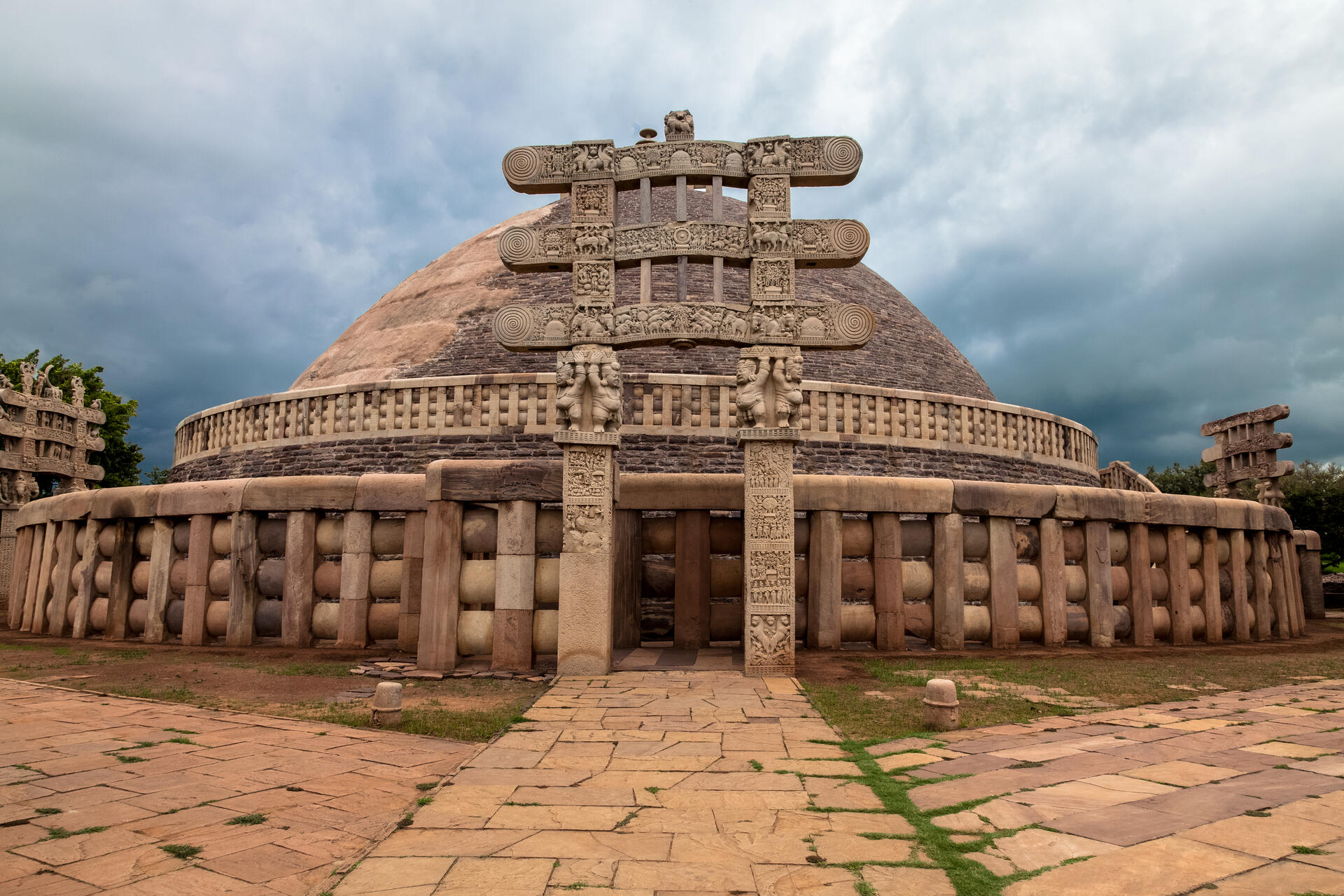
© Patrick J. Finn, CC BY-SA 4.0 Resized from original. (This derivative is under the same CC BY-SA license.)
World Heritage Research
Discover scientific research and academic studies that deepen our understanding of Buddhist Monuments at Sanchi from its history and significance to its conservation, management, and contemporary challenges.
-
Buddhist stups: a historical monument of Indian Tourism
Buddhist stupas, such as those at Sanchi, serve as profound architectural and spiritual symbols that transcend their original function as burial mounds. These structures have evolved over centuries to represent the path to spiritual awakening, blending religious significance with cultural heritage. The study highlights how stupas, initially discovered in colonial India by travelers and archaeologists, have become pivotal landmarks for tourism, pilgrimage, and cultural exchange. Employing interdisciplinary methods—including archaeological, art-historical, and historical analyses—the research examines the transformation of stupas from simple burial mounds to complex, dome-shaped shrines adorned with intricate details. The Great Stupa at Sanchi, in particular, exemplifies early Indian craftsmanship and the spread of Buddhist philosophy under royal patronage. This work underscores the stupa's enduring significance as a global symbol of religious and cultural heritage, offering insights into its historical value and architectural beauty.
Kondekar, R. S. (2026). Buddhist stups: a historical monument of Indian Tourism. Zenodo. https://doi.org/10.5281/ZENODO.18468244
View Publication Record | Read Publication -
Relic Worship in Buddhism and Its influence on Design, Symbolism and Spatial Organization of Buddhist Architecture
Relic worship, central to Buddhism since the Buddha's death around 483 BCE, was not merely a practice but a driving force behind the development of Buddhist architecture. Emperor Ashoka's dissemination of relics in the 3rd century BCE marked a pivotal moment, propagating Buddhism and shaping its architectural forms. This study reveals that relic worship influenced the design, symbolism, and spatial organization of Buddhist monuments across four key sites: Sanchi, Amaravati, Ajanta, and Borobudur. These sites represent distinct stages in Buddhist architectural evolution, from ritual circumambulation at Sanchi to the integration of relics into monastic routines at Ajanta and the symbolic elevation seen in Borobudur's multi-level structure. The research demonstrates that relics remained the religious focus, evolving to reflect local cultural and artistic preferences while maintaining a unifying role in devotion, symbolism, and spatial organization.
Dhar, V. (2026). Relic Worship in Buddhism and Its influence on Design, Symbolism and Spatial Organization of Buddhist Architecture. International Journal for Multidisciplinary Research, 8(1). https://doi.org/10.36948/ijfmr.2026.v08i01.69909
View Publication Record | Read Publication -
Important Buddhist places and Indian Buddhism
Archaeological evidence at UNESCO World Heritage Site Sanchi challenges traditional textual interpretations of Indian Buddhism, revealing that Buddhist monuments were part of a broader multi-religious context and reflecting diverse social practices. This study critiques the limitations of text-centered approaches, which often reflect later sectarian influences and preserve altered versions compiled centuries after the Buddha's lifetime. Unlike written sources, archaeological epigraphs provide more direct insights into actual religious practices across different groups. The research argues that integrating both textual and material evidence is crucial for accurately reconstructing Indian Buddhism's history.
Meena, P. L. (2026). Important Buddhist places and Indian Buddhism. RESEARCH REVIEW International Journal of Multidisciplinary, 11(5), 01–07. https://doi.org/10.31305/rrijm.2026.v11.n05.001
View Publication Record | Read Publication -
BHOJPUR STUPA NO. 7 Archaeological, Epigraphic, Relic-Deposit, Historical, Museum, and Evidence-Critical Research HIRR-2026-0029
A critical reassessment of the 19th-century excavation records for Bhojpur Stupa No. 7 reveals that the celebrated rock-crystal stupa reliquary, previously attributed to this monument, actually belongs to Bhojpur Stupa No. 2. This correction is based on a meticulous analysis of Alexander Cunningham's original chapter structure, page sequence, and descriptions, which clearly separate the two stupas. The study confirms that Stupa No. 7 contained a central shaft, a displaced relic chamber, signs of disturbance, and two inscribed earthenware vases with readings 'Patito' and 'Upahitakasa,' suggesting ancient relic-related deposits and commemorative associations. However, it does not support claims of an intact crystal reliquary or the presence of calcined bone fragments attributed to the historical Buddha. The research also reviews later treatments by F.C. Maisey, British Library records, and modern collection histories, distinguishing archaeological provenience from museum custody and legal title.
S.Dhammasami, B. I. S. (2026). BHOJPUR STUPA NO. 7 Archaeological, Epigraphic, Relic-Deposit, Historical, Museum, and Evidence-Critical Research HIRR-2026-0029. Office of Siridantamahapalaka. https://doi.org/10.5281/ZENODO.22007663
View Publication Record | Read Publication -
Women in the Sunga Age: Between Brahmanical Revival and Buddhist Influence
During the Sunga Age (c. 185–73 BCE), women navigated a complex social landscape shaped by competing Brahmanical and Buddhist influences, retaining visible roles despite patriarchal constraints. Archaeological evidence from Sanchi and Bharhut reveals women as active participants in religious life, depicted as donors, worshippers, and central figures in art, contrasting with Brahmanical texts that emphasized domestic subordination. This study highlights the tension between Brahmanical revival and Buddhist institutions, which offered greater spiritual mobility for women. By analyzing textual, legal, and archaeological sources, it illuminates how tradition and transition coexisted, defining women's status during this pivotal period in Indian civilization.
Bharti, P. K. (2025). Women in the Sunga Age: Between Brahmanical Revival and Buddhist Influence. International Journal of History, 7(11), 24–27. https://doi.org/10.22271/27069109.2025.v7.i11a.559
View Publication Record | Read Publication -
Are travellers' destination visit intentions influenced by social media An information adoption theory perspective
Social media significantly influences travelers' intentions to visit UNESCO World Heritage Sites, with information usefulness emerging as the strongest predictor. A study of 220 respondents found that argument quality, attitude, and tie strength—measures of how effectively social media presents information—positively impact perceived usefulness, which in turn drives destination visit intentions. The research applied the Information Adoption Model to analyze data from travelers visiting the Buddhist Monuments at Sanchi and the Rock Shelters of Bhimbetka (both in Madhya Pradesh, India) using structural equation modeling. Notably, source credibility did not significantly affect outcomes. This work highlights social media's role as a critical tool for pre-visit information gathering, offering insights into how digital platforms shape travel behavior.
Kumar, A., & Lata, S. (2024). Are travellers’ destination visit intentions influenced by social media An information adoption theory perspective. International Journal of Indian Culture and Business Management, 33(1), 103–120. https://doi.org/10.1504/ijicbm.2024.141582
View Publication Record | Read Publication -
Do Travellers' Destination Visit Intentions Influence by Social Media An Information Adoption Theory Perspective
A significant positive correlation was found between the usefulness of social media information and travellers' intentions to visit UNESCO World Heritage Sites, specifically Buddhist Monuments at Sanchi. The study, employing the Information Adoption Model with additional constructs like argument quality, attitude, and tie strength, revealed that these factors significantly influence perceived information usefulness. Source credibility, however, did not prove significant. Using structural equation modelling (SEM) with partial least squares (PLS) analysis on a sample of 220 respondents from Madhya Pradesh, the research highlights how social media adoption shapes destination visit intentions, offering insights for heritage site management and tourism marketing strategies.
Lata, S., & Kumar, A. (2023). Do Travellers’ Destination Visit Intentions Influence by Social Media An Information Adoption Theory Perspective. International Journal of Indian Culture and Business Management, 1(1). https://doi.org/10.1504/ijicbm.2023.10056839
View Publication Record | Read Publication