World Heritage Identification Number: 240
World Heritage since: 1986
Category: Cultural Heritage
WHE Type: Buildings & Architectural Ensembles
Transboundary Heritage: No
Endangered Heritage: No
Country: 🇮🇳 India
Continent: Asia
UNESCO World Region: Asia and the Pacific
Map
Exploring the Epic Legacy: An In-depth Look at the Khajuraho Group of Monuments
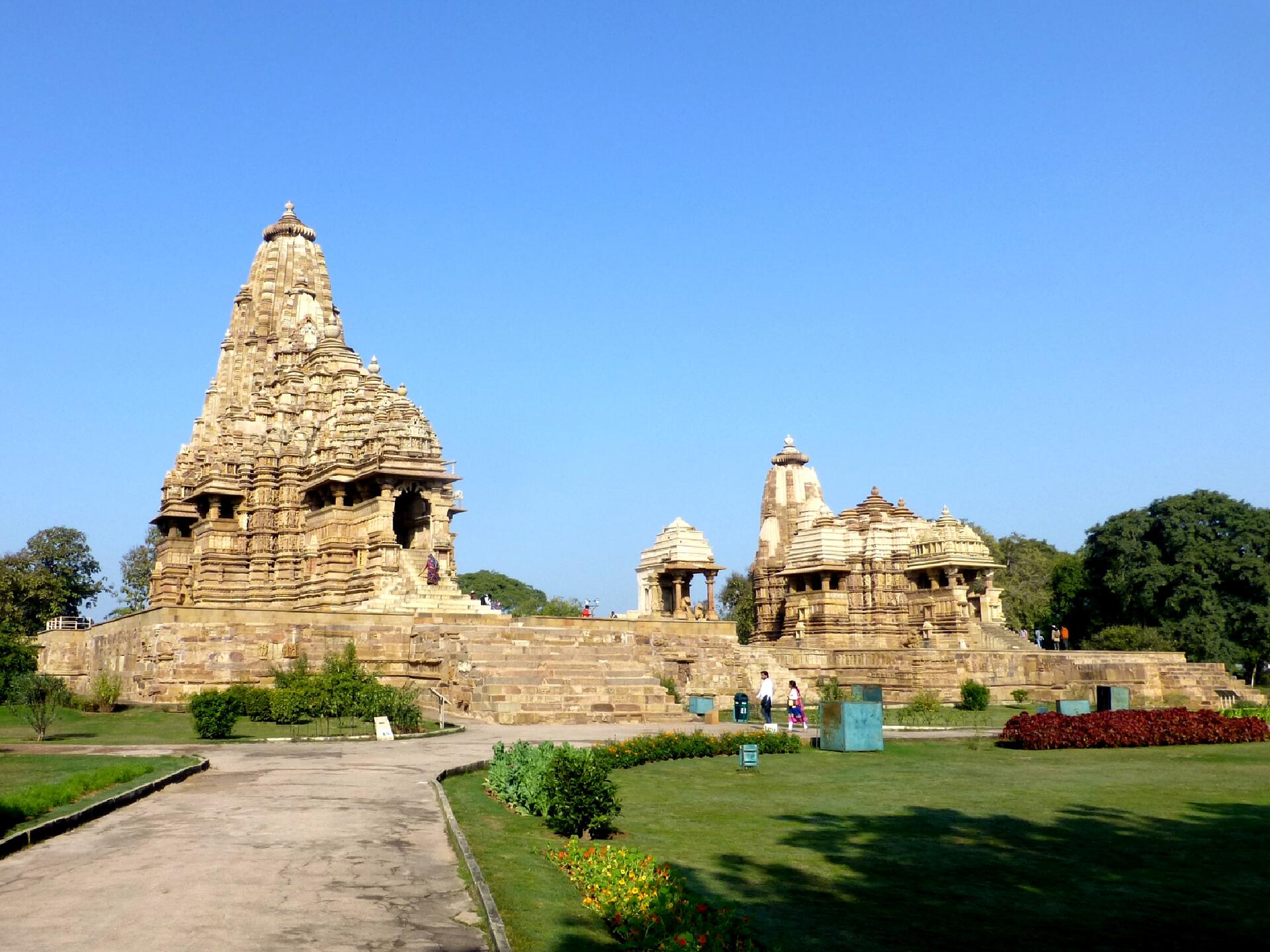
The Khajuraho Group of Monuments, nestled in the heart of Madhya Pradesh, India, stands as a testament to the rich cultural heritage and artistic prowess of the ancient Chandella dynasty. This collection of temples, dating back to the period between 950 and 1050 AD, has been recognized by UNESCO as a World Heritage Site since 1986.
More to come…UNESCO Description of the World Heritage Site
The temples at Khajuraho were built during the Chandella dynasty, which reached its apogee between 950 and 1050. Only about 20 temples remain; they fall into three distinct groups and belong to two different religions – Hinduism and Jainism. They strike a perfect balance between architecture and sculpture. The Temple of Kandariya is decorated with a profusion of sculptures that are among the greatest masterpieces of Indian art.
UNESCO Justification of the World Heritage Site
Criterion (i): The complex of Khajuraho represents a unique artistic creation, as much for its highly original architecture as for the high-quality sculpted décor made up of a mythological repertory of numerous scenes of amusements that includes scenes susceptible to various interpretations, sacred or profane.
Criterion (iii): The temples of Khajuraho bear an exceptional testimony to the Chandella culture, which flourished in central India before the establishment of the Delhi Sultanate at the beginning of the 13th century CE.
Encyclopedia Record: Khajuraho Group of Monuments
The Khajuraho Group of Monuments are a group of Hindu and Digambara Jain temples in Chhatarpur district, Madhya Pradesh, India. They are about 46 km (28.6mi) from Chhatarpur city, the district headquarter, 283 km (177mi) from Gwalior, 175 kilometres (109 mi) southeast of Jhansi, 10 kilometres (6.2 mi) from Khajwa and 9 kilometres (5.6 mi) from Rajnagar. The temples are famous for their Nagara-style architectural symbolism and a few erotic sculptures.Additional Site Details
Area: Not available
Number of Components: 15
(iii) — Unique or exceptional testimony to a cultural tradition
Coordinates: 24.85222 , 79.92222
World Heritage Research
Discover scientific research and academic studies that deepen our understanding of Khajuraho Group of Monuments from its history and significance to its conservation, management, and contemporary challenges.
-
Visitors Satisfaction Level with Sustainable Tourism Practices Exercised at World Heritage Sites of Madhya Pradesh
A significant difference in visitor satisfaction with sustainable tourism practices exists among different demographic profiles at UNESCO World Heritage Sites in Madhya Pradesh, including Khajuraho. The study also found that perception of sustainability directly impacts overall satisfaction levels. Researchers used structured questionnaires distributed via online platforms to collect data from a random sample in April and May 2024, employing regression analysis to validate these findings.
Taru Saxena. (2025). Visitors Satisfaction Level with Sustainable Tourism Practices Exercised at World Heritage Sites of Madhya Pradesh. Communications on Applied Nonlinear Analysis, 521–533. https://doi.org/10.52783/cana.v32.5080
View Publication Record | Read Publication -
Diversity of Micro Organisms and Lower Plants on the Monuments of Khajuraho, India
The Khajuraho Group of Monuments, renowned for their cultural and historical significance, faces significant biodeterioration due to microbial activity. A study identified 6 bacterial genera, 12 fungal species, 7 algal species, and 3 lichens on the temple surfaces, highlighting their role in the decay process. This deterioration is driven by a combination of physical and chemical reactions, exacerbated by environmental factors such as seasonal variations, rain, wind, and sunlight. The study, conducted at the western group of temples, underscores the urgent need for preservation efforts to mitigate biological degradation, which threatens these UNESCO World Heritage Sites.
Tiwari, J., Arjariya, A., Singh, R., Agrawal, P., & Khare, R. (2024). Diversity of Micro Organisms and Lower Plants on the Monuments of Khajuraho, India. Advances in Zoology and Botany, 12(2), 87–100. https://doi.org/10.13189/azb.2024.120201
View Publication Record | Read Publication -
Non-western rendition of ambient rhetoric of Khajuraho monuments.
Khajuraho Group of Monuments, renowned for their architectural and artistic grandeur, possess a unique persuasive power rooted in their material bases and environmental integration. Unlike traditional studies focusing on symbology or iconography, this research introduces an 'ambient rhetoric,' highlighting the monuments' ability to affect visitors through their sandstone construction, fractal design, strategic artifact placement, and interaction with the surrounding environment. This approach moves beyond conventional rhetorical models, emphasizing a holistic perspective that accounts for intra-action with digital tools and the dynamic socio-politico-cultural landscape. The study argues that Khajuraho's persuadability lies in its enduring materiality and environmental attunement, offering a novel framework to understand non-western rhetorical practices.
Mainaly, S. Non-western rendition of ambient rhetoric of Khajuraho monuments. https://doi.org/10.18297/etd/4166
View Publication Record | Read Publication -
Simpson’s Diversity index of Macroflora at Khajuraho Group of Monuments
A study assessing the Simpson’s Diversity Index of macroflora at the Khajuraho Group of Monuments reveals significant biodiversity on monumental surfaces, with plant species contributing to the deterioration and damage of these heritage structures. The research highlights climate as a pivotal factor influencing the growth of macro organisms, which in turn accelerates the degradation process. This finding underscores the urgent need for long-term preservation strategies that account for both cultural and ecological factors. The study employed a quantitative approach to analyze floral diversity, providing insights into the biological pressures affecting these UNESCO World Heritage Sites.
Tiwari, J., Ahirwar, N. K., Singh, R., Arjariya, A., & Pachaya, J. S. (2023). Simpson’s Diversity index of Macroflora at Khajuraho Group of Monuments. Haya: The Saudi Journal of Life Sciences, 8(07), 95–99. https://doi.org/10.36348/sjls.2023.v08i07.001
View Publication Record | Read Publication