World Heritage Identification Number: 1165
World Heritage since: 2006
Category: Cultural Heritage
WHE Type: Buildings & Architectural Ensembles
Transboundary Heritage: No
Endangered Heritage: No
Country: 🇵🇱 Poland
Continent: Europe
UNESCO World Region: Europe and North America
Map
A Pioneering Masterpiece: The Centennial Hall in Wrocław
The Centennial Hall, officially known as the Jahrhunderthalle, stands as a testament to the ingenuity and vision of its architect, Max Berg. Situated in the heart of Wrocław, Poland, this iconic structure has been a significant part of the city's landscape since its completion in 1913. Inscribed as a UNESCO World Heritage Site in 2006, the Centennial Hall is a remarkable example of early 20th-century modern engineering and architecture.
More to come…UNESCO Description of the World Heritage Site
The Centennial Hall, a landmark in the history of reinforced concrete architecture, was erected in 1911-1913 by the architect Max Berg as a multi-purpose recreational building, situated in the Exhibition Grounds. In form it is a symmetrical quatrefoil with a vast circular central space that can seat some 6,000 persons. The 23m-high dome is topped with a lantern in steel and glass. The Centennial Hall is a pioneering work of modern engineering and architecture, which exhibits an important interchange of influences in the early 20th century, becoming a key reference in the later development of reinforced concrete structures.
UNESCO Justification of the World Heritage Site
Criterion (i): The Centennial Hall in Wrocław is a creative and innovative example in the development of construction technology in large reinforced concrete structures. The Centennial Hall occupies a key position in the evolution of methods of reinforcement used in architecture, and represents one of the climactic points in the history of the use of metal in structural consolidation.
Criterion (ii): The Centennial Hall is a pioneering work of Modern engineering and architecture, which exhibits an important interchange of influences in the early 20th century, becoming a key reference in the later development of reinforced concrete structures.
Criterion (iv): As part of the Exhibition Grounds of Wrocław, the Centennial Hall is an outstanding example of Modern recreational architecture that served a variety of purposes, ranging from hosting conferences and exhibitions to concerts, theatre and opera.
Encyclopedia Record: Centennial Hall (Wrocław)
The Centennial Hall ; German: Jahrhunderthalle), formerly named People's Hall, is a historic building in Wrocław, Poland. It was constructed according to the plans of architect Max Berg in 1911–1913. Max Berg designed Centennial Hall to serve as a multifunctional structure to host "exhibitions, concerts, theatrical and opera performances, and sporting events". The hall continues to be used for sporting events, business summits, and concerts.Additional Site Details
Area: 36.69 hectares
Number of Components: 1
(ii) — Significant interchange of human values
(iv) — Outstanding example of a type of building or landscape
Coordinates: 51.1069472222 , 17.0770138888
Image
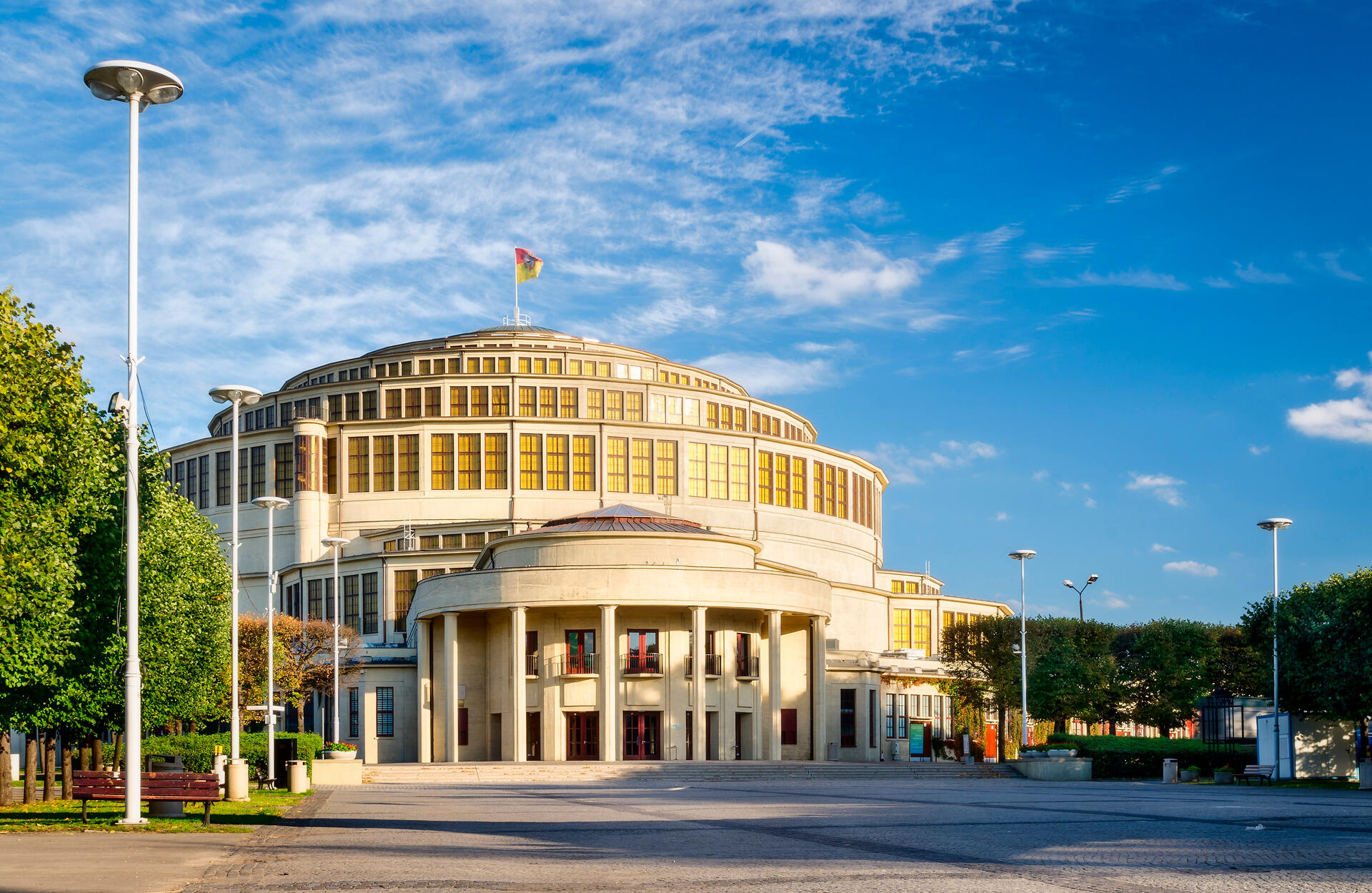
© Jar.ciurus, CC BY-SA 3.0 pl Resized from original. (This derivative is under the same CC BY-SA license.)
World Heritage Research
Discover scientific research and academic studies that deepen our understanding of Centennial Hall in Wrocław from its history and significance to its conservation, management, and contemporary challenges.
-
New Form, New Material and Color Scheme, the Exposed Concrete Phenomenon—The Centennial Hall in Wrocław
Stratigraphic studies and archival research reveal that the Centennial Hall in Wrocław was originally intended to feature exposed concrete on its exterior while its interior would be adorned with painting, stained glass, and sculpture. Contrary to its current appearance, the external walls were initially covered with a translucent yellowish coating, presenting a distinct face of reinforced concrete architecture. This finding challenges the perceived aesthetic of the building and sheds new light on its design intent. The research was conducted as part of the CMP grant from The Getty Foundation's Keeping It Modern program, utilizing both stratigraphic tests and historical inquiries to uncover the building's original form and color scheme.
Ilkosz, J., Wójtowicz, R., & Urbanik, J. (2022). New Form, New Material and Color Scheme, the Exposed Concrete Phenomenon—The Centennial Hall in Wrocław. Arts, 11(1), 17. https://doi.org/10.3390/arts11010017
View Publication Record | Read Publication -
Comparative interpretation of results after application of different non-destructive and portable techniques on historic concrete in the Centennial Hall in Wrocław
A multi-technique approach using non-destructive and portable techniques (NDPT) has proven effective for assessing the conservation state of historic concrete structures, as demonstrated by a study on Wrocław’s Centennial Hall. The research found that methods like ultrasonic pulse velocity, rebound tests, sponge test, Evanescent Field Dielectrometry (EFD), and colorimetric measurements yielded repeatable results when applied by different teams under similar protocols. These techniques allowed for the evaluation of concrete hardness, compactness, surface permeability, water and salt content, and color changes without invasive inspections. The study highlights the potential of this approach to inform conservation decisions for historic concrete buildings, offering a robust framework for monitoring their condition amid climate change and urban impacts.
Riminesi, C., Cuzman, O. A., Moczko, M., & Raszczuk, K. (2022). Comparative interpretation of results after application of different non-destructive and portable techniques on historic concrete in the Centennial Hall in Wrocław. Case Studies in Construction Materials, 17, e01409. https://doi.org/10.1016/j.cscm.2022.e01409
View Publication Record | Read Publication -
The Centennial Hall of Wroclaw: history of a modern architecture in reinforced concrete classified World Heritage Site
The Centennial Hall in Wrocław stands as a groundbreaking example of early 20th-century modern architecture and engineering, particularly for its pioneering use of reinforced concrete. Its dome, the largest of its time, showcased advanced technological innovation and structural ingenuity, reflecting the material's potential to adapt to any architectural form. This masterpiece of human creativity was recognized by UNESCO as a World Heritage Site, marking a significant shift in the concept of cultural heritage to include previously underappreciated works. The study delves into the hall's architectural and technological uniqueness, its historical significance, and its role in representing a pivotal phase in global architectural history.
Licordari, M. (2021). The Centennial Hall of Wroclaw: history of a modern architecture in reinforced concrete classified World Heritage Site. Journal of Architectural Conservation, 27(1-2), 17–52. https://doi.org/10.1080/13556207.2020.1854508
View Publication Record | Read Publication -
The image of contemporary architecture of Wrocław depicted in recent tourist commercial and Internet media
Contemporary public architecture, often overshadowed by historic landmarks, plays a significant role in enhancing the tourist attractiveness of Wrocław. This study reveals that modern architectural structures, including the Centennial Hall, are increasingly featured in tourist commercial and internet media, contributing to the city's progressive brand and shaping visitor perceptions. The research analyzed advertising materials, statistical data, and iconographic sources to identify frequently depicted contemporary buildings and assess their impact on tourism. Findings indicate that modern architecture can be a powerful element in promoting local heritage and boosting cultural tourism, challenging the traditional focus on historic sites.
Bursiewicz, N. (2021). The image of contemporary architecture of Wrocław depicted in recent tourist commercial and Internet media. W Terfront Public Art Urban Design Civic Participation Urban Regeneration, 63(9), 28–48. https://doi.org/10.1344/waterfront2021.63.9.02
View Publication Record | Read Publication -
Strengthening the 100‐year‐old reinforced concrete dome of the Centennial Hall in Wrocław
A century after its construction, the reinforced concrete dome of Centennial Hall in Wrocław—once the world's largest—was successfully strengthened using external prestressing techniques. This innovative approach addressed structural weaknesses in the 65-meter-diameter dome, ensuring its longevity while preserving its modernist architectural significance. The study involved a detailed assessment of the hall's condition, numerical simulations to model stress distribution, and the implementation of prestressing cables along the lower tension ring. Recognized as a UNESCO World Heritage Site for its pioneering engineering, Centennial Hall's renovation serves as a case study in sustainable heritage conservation, balancing structural integrity with historical preservation.
Onysyk, J., Biliszczuk, J., Prabucki, P., Sadowski, K., & Toczkiewicz, R. (2014). Strengthening the 100‐year‐old reinforced concrete dome of the Centennial Hall in Wrocław. Structural Concrete, 15(1), 30–37. Portico. https://doi.org/10.1002/suco.201300007
View Publication Record | Read Publication