World Heritage Identification Number: 1243
World Heritage since: 2007
Category: Cultural Heritage
WHE Type: Agriculture Landscapes, Parks & Gardens
Transboundary Heritage: No
Endangered Heritage: No
Country: 🇨🇭 Switzerland
Continent: Europe
UNESCO World Region: Europe and North America
Map
The Lavaux Vineyard Terraces: A Testament to Human-Environment Interaction
The Lavaux Vineyard Terraces, a UNESCO World Heritage Site since 2007, offer a captivating glimpse into the harmonious relationship between humans and their environment, particularly in the realm of viticulture. Stretching for approximately 30 kilometers along the south-facing northern shores of Lake Geneva, these vineyard terraces span the lower slopes of the mountainside between the picturesque villages and the lake.
More to come…UNESCO Description of the World Heritage Site
The Lavaux Vineyard Terraces, stretching for about 30 km along the south-facing northern shores of Lake Geneva from the Chateau de Chillon to the eastern outskirts of Lausanne in the Vaud region, cover the lower slopes of the mountainside between the villages and the lake. Although there is some evidence that vines were grown in the area in Roman times, the present vine terraces can be traced back to the 11th century, when Benedictine and Cistercian monasteries controlled the area. It is an outstanding example of a centuries-long interaction between people and their environment, developed to optimize local resources so as to produce a highly valued wine that has always been important to the economy.
UNESCO Justification of the World Heritage Site
Criterion (iii): The Lavaux vineyard landscape demonstrates in a highly visible way its evolution and development over almost a millennium, through the well preserved landscape and buildings that demonstrate a continuation and evolution of longstanding cultural traditions, specific to its locality.
Criterion (iv): The evolution of the Lavaux vineyard landscape, as evidenced on the ground, illustrates very graphically the story of patronage, control and protection of this highly valued wine growing area, all of which contributed substantially to the development of Lausanne and its Region and played a significant role in the history of the geo-cultural region.
Criterion (v): The Lavaux vineyard landscape is an outstanding example that displays centuries of interaction between people and their environment in a very specific and productive way, optimising the local resources to produce a highly valued wine that was a significant part of the local economy. Its vulnerability in the face of fast-growing urban settlements has prompted protection measures strongly supported by local communities.
Encyclopedia Record: Lavaux
Lavaux is a region in the canton of Vaud in Switzerland, in the district of Lavaux-Oron. Lavaux consists of 830 hectares of terraced vineyards that stretch for about 30 km along the south-facing northern shores of Lake Geneva.Additional Site Details
Area: 898 hectares
Number of Components: 1
(iv) — Outstanding example of a type of building or landscape
(v) — Outstanding example of traditional human settlement
Coordinates: 46.4919444444 , 6.7461111111
Image
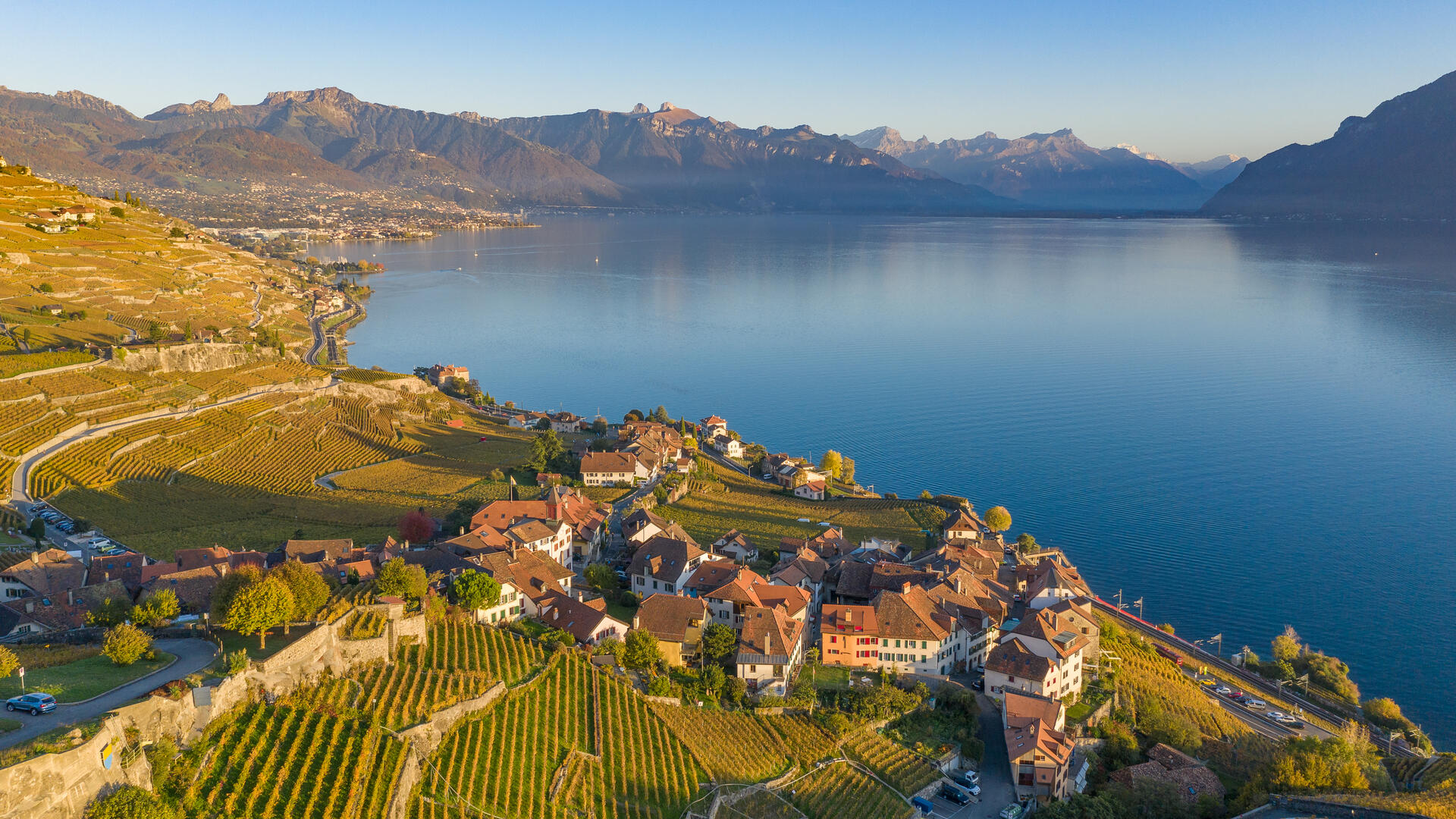
© Lorenz Poffet, CC BY-SA 4.0 Resized from original. (This derivative is under the same CC BY-SA license.)
World Heritage Research
Discover scientific research and academic studies that deepen our understanding of Lavaux, Vineyard Terraces from its history and significance to its conservation, management, and contemporary challenges.
-
A vine physiology-based terroir study in the AOC-Lavaux region in Switzerland
A vine physiology-based terroir study in the AOC-Lavaux region revealed that vintage effects significantly influence terroir zones, overshadowing soil groups. The research, conducted over three consecutive seasons across 22 plots with varying expositions, soil types, and altitudes, found spatial temperature variability to be twice as high as annual temporal variation, averaging 395 growing degree days (GDD) between the most extreme plots. Principal Component Analysis (PCA) and hierarchical clustering of vine and berry physiological parameters showed vintage-dependent grouping, highlighting that altitude was the main driver of precocity in all years, independent of vintage. This study underscores the importance of topography in viticultural terroirs and provides insights for optimizing mitigation strategies in the face of global warming.
Rienth, M., Lamy, F., Schoenenberger, P., Noll, D., Lorenzini, F., Viret, O., & Zufferey, V. (2020). A vine physiology-based terroir study in the AOC-Lavaux region in Switzerland. OENO One, 54(4), 699–716. https://doi.org/10.20870/oeno-one.2020.54.4.3756
View Publication Record | Read Publication -
An example of a vine-physiology based fine-scale terroir study in the AOC Lavaux-region in Switzerland
A vine-physiology based study on the Lavaux vineyard terraces, Switzerland, reveals significant small-scale terroir variations in Chasselas grape cultivation. The research found that altitude was a key driver of budburst and flowering timing, with higher-altitude plots showing earlier phenological development. Notably, while these plots exhibited lower sugar concentrations at maturity (70-84° Oechsle), they accumulated the highest sugar quantities per berry, up to 26% variation. Individual berry weight varied by 35%, highlighting substantial differences in ripening patterns across the 140-ha terraced landscape. This ongoing study demonstrates the potential of vine physiology measurements to characterize terroir at a fine scale, offering insights into grape quality and viticultural practices.
RIENTH, M., LAMY, F., NOLL, D., LORENZINI, F., VIRET, O., & ZUFFEREY, V. (2018). An example of a vine-physiology based fine-scale terroir study in the AOC Lavaux-region in Switzerland. E3S Web of Conferences, 50, 2011. https://doi.org/10.1051/e3sconf/20185002011
View Publication Record | Read Publication -
Q fever outbreak in the terraced vineyards of Lavaux, Switzerland
A Q fever outbreak linked to sheep in the terraced vineyards of Lavaux, Switzerland, was identified through epidemiological investigations and veterinary testing. The study found that 43% of sheep carried Coxiella burnetii, while 30% exhibited anti-Coxiella antibodies, highlighting a significant zoonotic risk. Mitigation measures, including flock vaccination and public health alerts, successfully limited the outbreak to 14 human cases, preventing a larger epidemic. The research underscores the importance of surveillance in low-endemicity regions, leading to the reintroduction of mandatory Q fever reporting in Switzerland.
Bellini, C., Magouras, I., Chapuis-Taillard, C., Clerc, O., Masserey, E., Peduto, G., Péter, O., Schaerrer, S., Schuepbach, G., & Greub, G. (2014). Q fever outbreak in the terraced vineyards of Lavaux, Switzerland. New Microbes and New Infections, n. https://doi.org/10.1002/2052-2975.37
View Publication Record | Read Publication -
The herbicide glyphosate and its metabolite AMPA in the Lavaux vineyard area, western Switzerland: Proof of widespread export to surface waters. Part II: The role of infiltration and surface runoff
A study on the Lavaux vineyard terraces in western Switzerland found that glyphosate and its metabolite AMPA are widely exported to surface waters, primarily through surface runoff (96%) rather than soil throughflows. The research, conducted over two growing seasons (2010–2011), revealed elevated concentrations of these chemicals at depths of 60–80 cm in parcel bottoms, indicating infiltration and preferential flows driven by rainfall patterns and soil characteristics. Slope steepness and the presence of impervious weathered marls at 100 cm depth influenced throughflows, contributing to lateral transport. The findings highlight that significant rainfall events (>10 mm/day) accelerate herbicide export from the topsoil, emphasizing the role of precipitation regime and soil structure in contaminant mobility.
Daouk, S., De Alencastro, L. F., & Pfeifer, H.-R. (2013). The herbicide glyphosate and its metabolite AMPA in the Lavaux vineyard area, western Switzerland: Proof of widespread export to surface waters. Part II: The role of infiltration and surface runoff. Journal of Environmental Science and Health, Part B, 48(9), 725–736. https://doi.org/10.1080/03601234.2013.780548
View Publication Record | Read Publication