World Heritage Identification Number: 1707
World Heritage since: 2024
Category: Mixed Cultural Heritage and Natural Heritage
WHE Type: Natural Landscapes & Geographic Features
Transboundary Heritage: No
Endangered Heritage: No
Country: 🇫🇷 France
Continent: Europe
UNESCO World Region: Europe and North America
Map
Unveiling the Rich History and Biodiversity of Te Henua Enata – The Marquesas Islands
The Marquesas Islands, officially known as Te Henua Enata, are a unique and captivating collection of volcanic islands located in the remote South Pacific Ocean. This remarkable archipelago, inscribed as a UNESCO World Heritage Site in 2024, offers a fascinating blend of cultural heritage, natural beauty, and extraordinary biodiversity.
More to come…UNESCO Description of the World Heritage Site
Located in the South Pacific Ocean, this mixed serial property bears an exceptional testimony to the territorial occupation of the Marquesas archipelago by a human civilisation that arrived by sea around the year 1000 CE and developed on these isolated islands between the 10th and the 19th centuries. It is also a hotspot of biodiversity that combines irreplaceable and exceptionally well conserved marine and terrestrial ecosystems. Marked by sharp ridges, impressive peaks and cliffs rising abruptly above the ocean, the landscapes of the archipelago are unparalleled in these tropical latitudes. The archipelago is a major centre of endemism, home to rare and diverse flora, a diversity of emblematic marine species, and one of the most diverse seabird assemblages in the South Pacific. Virtually free from human exploitation, Marquesan waters are among the world’s last marine wilderness areas. The property also includes archaeological sites ranging from monumental dry-stone structures to lithic sculptures and engravings.
UNESCO Justification of the World Heritage Site
Criterion (iii): Te Henua Enata – The Marquesas Islands provide an outstanding example of the Ènata's occupation from the 10th to the 19th century, offering insight into their adaptation to a challenging natural environment with limited building materials, their settlement patterns in deep, rugged valleys, and their complex social and spiritual organization into chiefdoms. The steep volcanic terrain and climatic constraints led the Ènata to construct two-storey dry-stone lithic platforms (paepae), some of which rise up to six metres in height, serving as both housing and ceremonial buildings, including tohua (gathering places) and me’ae (sacred spaces). The local people also developed a unique art form, incorporating sculpted tiki figures and intricate petroglyph engravings, illustrating the close relationship between human beings and their environment. The eight valleys within the property are considered the most remarkable for the density and size of their lithic remains.
Criterion (vi): Despite the near disappearance of the Ènata following the demographic collapse and cultural assimilation caused by European contact, many tales, myths, and legends referring to real and cosmological landscapes remain alive today, passed down in the Marquesan language. Combined with the knowledge handed down from generation to generation, the writings of the early explorers from the late 18th and 19th centuries, and the first ethnographic studies carried out in the late 19th century, they provide valuable insights into the life of the Ènata chiefdoms, including their belief systems surrounding the origins of the world. All these living traditions and knowledge highlight the enduring connection the modern Marquesan population have with their environment.
Criterion (vii): The Marquesas’ volcanic origins have created dramatic landscapes of razor-sharp ridges, towering peaks, and sheer cliffs rising over 1,000 metres above the ocean. The Marquesas are among the world's most vertical islands. Their lush vegetation, combined with dramatic topography and rugged coastlines, creates island scenery unparalleled in the tropics. The cliffs plunge directly into the ocean, providing natural vantage points for observing wildlife, including hundreds of dolphins gathering in massive pods, alongside two species of manta rays—the reef manta ray and the giant manta ray—whose rare microsympatry (shared habitat at the same dive site) is highly unusual and rarely observed elsewhere in the world. This creates a breathtaking panorama of raw, untamed nature.
Criterion (ix): The Marquesas, the only isolated archipelago in the middle of the equatorial Pacific, are an oasis of marine life in the vast Pacific Ocean. The counter-current surrounding the Marquesas isolates the property from the main oceanic currents. The archipelago has one of the world's highest fish biomasses, averaging 3.30 T/ha with peaks of 20 T/ha. Marquesan waters exhibit exceptional endemism relative to their size (3,400 km²), with 13.7% of coastal fish and 10% of mollusc species found nowhere else. Marquesan coastal communities are a major centre of Indo-Pacific and global endemism, along with Hawaii, Easter Island and the Red Sea. Recognized as one of the last remaining wild marine areas on the planet, the Marquesas' waters harbour some of the best-preserved coastal ecosystems worldwide. On land, the property protects two continuous vegetation corridors from summit to shore and includes four distinct tropical cloud forest ecosystems.
Criterion (x): The property harbours exceptionally well-preserved and irreplaceable marine and terrestrial ecosystems. The isolation of the young volcanic islands of the Marquesas archipelago has given rise to rare and diverse plant life, and more than half of the property's 305 plant species are irreplaceable. Endemism is particularly high in dry and semi-dry coastal forests, as well as in the mesic and ombrophilous forests of the highlands. The cloud forests that cover the ridges and peaks of the islands of Nuku Hiva, Ua Pou, Tahuata and Fatu Iva are home to over 70% of the endemic species of a peak, island or archipelago. The majority of land and freshwater molluscs are endemic to the islands. The archipelago supports one of the most diverse assemblages of seabirds in the tropical waters of the South Pacific. It is one of the world's few known nesting sites for 21 species of seabirds and 13 species and subspecies of land birds endemic to the archipelago. Fatu Iva and Tahuata are home to two endangered endemic species: respectively the òmaò keekee, with around 30 individuals, and the pahi, estimated at fewer than 300 individuals in 2017. The property is home to many endangered species such as the pītai, ùpe and kōtuè. The coastal marine ecosystem supports 40 notable species, many of which are globally endangered, including 16 marine mammals, 26 species of rays and sharks, and one endangered sea turtle, all concentrated around the 12 islands of the archipelago. Over 40% of fish species are endemic to the ecoregion, inhabiting a range of shoal areas, marine, brackish, and freshwater environments.
Encyclopedia Record: Marquesas Islands
The Marquesas Islands are a group of volcanic islands in French Polynesia, an overseas collectivity of France in the southern Pacific Ocean. Their highest point is the peak of Mount Oave on Ua Pou island, at 1,230 m (4,035 ft) above sea level.Additional Site Details
Area: 345,749 hectares
Number of Components: 7
(vi) — Directly associated with events or living traditions
(vii) — Contains superlative natural phenomena or beauty
(ix) — Outstanding example representing ecological and biological processes
(x) — Contains most important habitats for biodiversity
Coordinates: -7.9698944444 , -140.6460475
IUCN World Heritage Outlook
The 2025 Conservation Outlook on Te Henua Enata – The Marquesas Islands reports the following assessment:
Source: International Union for Conservation of Nature (IUCN) · View assessment
Image
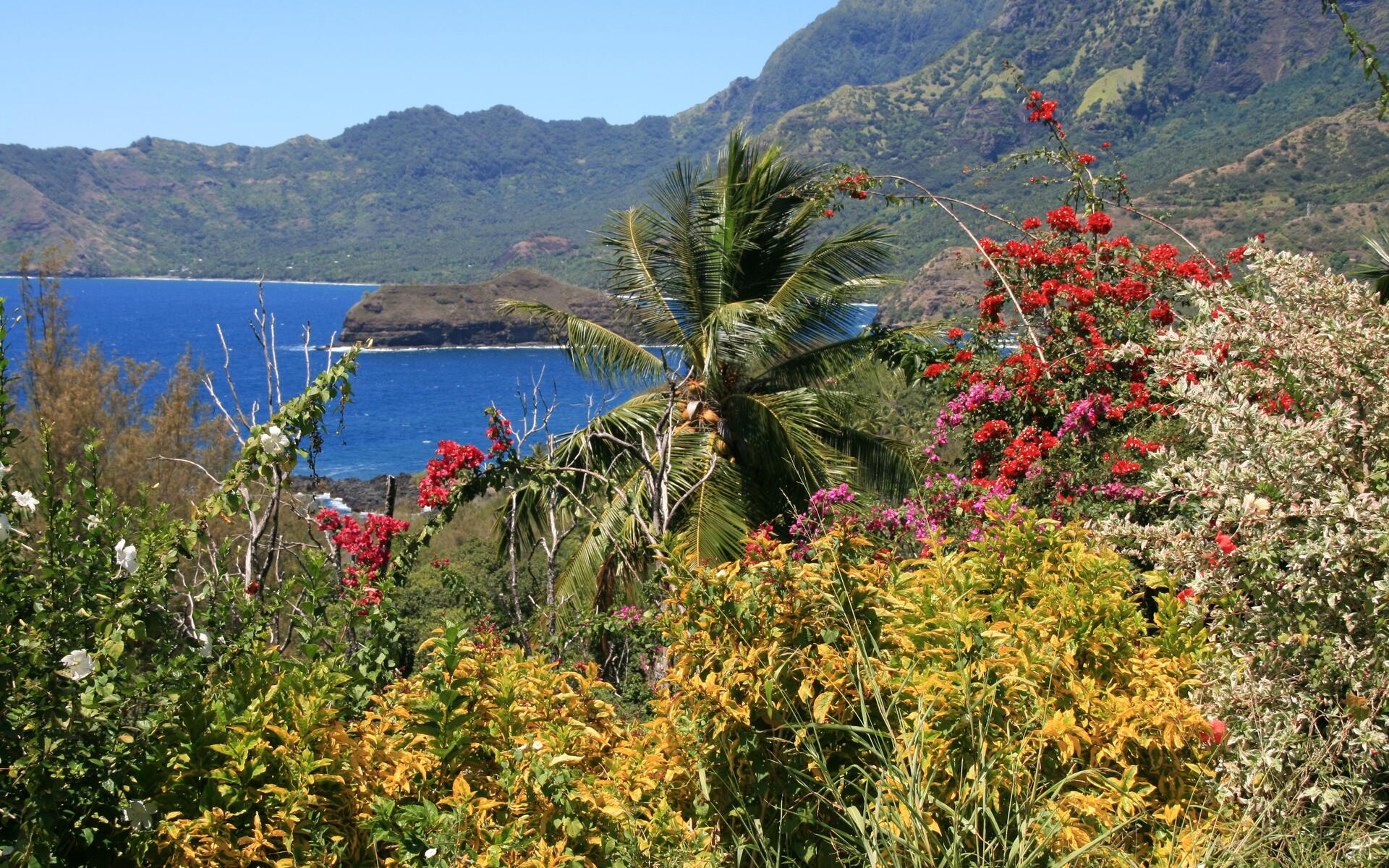
© Sémhur ·✉·✍·, CC BY-SA 3.0 Resized from original. (This derivative is under the same CC BY-SA license.)